Comprehensive Learner Record Implementation in Community Colleges
Community colleges can turn CLR appeals into practical credentials by building frameworks first.

- Written by
- Anouk Osborne
- Published
- October 26, 2026
- Reading time
- 9 min read
- Sources cited
- 7 sources ↓
What this covers
- Why traditional transcripts fall short for community college students and employers
- What community colleges bring to CLR implementation that four-year institutions don't
- The aspiration-action gap that stalls most CLR efforts before they begin
- The technical standard that makes CLR interoperability possible
Implementing a Comprehensive Learner Record in a community college is an institutional design project. For a CLR to work, competencies must be clear, assessment must be sound, systems must connect, and students must be able to use their records. Colleges that build around their workforce and transfer missions, varied student experiences, and limited staff capacity can turn an appealing concept into a useful credential.
Why traditional transcripts fall short for community college students and employers
A traditional transcript records a course name and a grade, but rarely explains what the student can do. It also leaves much learning outside the frame. A record built around coursework can leave out military training, professional experience, and skills learned through campus employment. Employers looking for job readiness get clues from the transcript, but no record of proficiency. A grade is useful, but it is not a skills demonstration.
CAEL’s 2024 report places that gap within growing employer demand for demonstrated competency. CAEL’s adult learner survey found that 43% of adults intending to enroll in education or training cite gaining skills relevant to their current career as their primary enrollment motivator. Students need to see those skills, too. When records show only requirements, learning can look like a hoop-jumping contest, contributing to disengagement and stop-out. A CLR addresses that gap as a verifiable, portable, interoperable digital asset documenting competencies, mastery, and learning gained through academic, co-curricular, experiential, and workforce experiences.
What community colleges bring to CLR implementation that four-year institutions don't
Community colleges are not research universities in smaller shoes. Their students include high proportions of adult, first-generation, low-income, Black, and Hispanic learners whose prior learning may be invisible on academic records. A CLR can serve as a prior learning assessment hub, acknowledging military training, professional experience, and informal education. But its content must serve both paths, because community colleges prepare students for transfer and for going straight into the workforce.
That dual mission changes what the record must communicate. Receiving institutions need evidence of transfer readiness, while employers need evidence of job readiness. With open-access enrollment, students also enter with a wide range of competencies, and the framework must make room for those differences. Meanwhile, higher adjunct-to-full-time faculty ratios and smaller administrative staffs limit how assessment and governance can be organized. These distinctions shape every subsequent decision, from defining mastery to assigning responsibility for collecting evidence.
The aspiration-action gap that stalls most CLR efforts before they begin
CAEL’s report found near-universal agreement among faculty and staff that programs should build specific skills, yet a plurality of institutions had competency frameworks in only some courses and programs. Agreement is not an assessment system. Faculty consensus requires a clear mandate, and CLR issuance requires connections among systems that institutions often have not built.
The AACRAO CLR Phase II report identifies increased assessment and record-maintenance workload as a concern to address openly in planning. For adjunct-heavy colleges, compensation and training cannot be left implicit. The same report acknowledges a second brake, which is uncertainty about whether employers and receiving institutions actually want CLRs yet. Implementation must solve both the workload and demand problems, rather than dismissing either as resistance to progress.
The technical standard that makes CLR interoperability possible
1EdTech’s CLR Standard 2.0 provides an agreed format for creating, transmitting, and displaying achievements from multiple learning providers. It supports machine-readable records with cryptographically signed, tamper-proof credentials that recipients can verify. Compatibility with the W3C Verifiable Credentials Data Model and alignment with Open Badges 3.0 support sharing across digital wallets, with learners curating and controlling their records.
AACRAO’s expert panel, including NASPA representatives, concluded that the standard is the only comprehensive data standard currently meeting the objectives of an official, institutional, learning-focused CLR. In practice, it enables an employer or transfer institution to verify a record without a manual process, and lets learners combine credentials from different providers. Conformance guides, certification requirements, and technical specifications give the teams doing this work clear rules to build to. Colleges still need to connect their own systems, but they can now decide what belongs in the credential without first inventing its plumbing.
How California's Course Outline of Record revision creates a regulatory on-ramp for CLR content
California offers a concrete example of policy supporting CLR preparation. The California Community Colleges Chancellor’s Office memorandum ESS 25-66 states that the Board of Governors approved Course Outline of Record revisions on January 14, 2025, effective October 24, 2025. Districts have until April 22, 2026 to bring local policies and procedures into line, and must put all changes in place and finish all Chancellor’s Office Curriculum Inventory updates by Fall 2030.
The revised COR calls for clear outcomes and objectives, instructional hours that match credit awards, and more than one authentic way for students to show what they have learned. Curriculum committees must embed equity and accessibility, including Universal Design for Learning principles, into approval. All COR information must also enter COCI directly. This is not itself CLR issuance, but measurable outcomes and structured data form its content layer. Colleges outside California should align required curriculum work with CLR preparation.
Building the competency framework before touching any technology
A competency framework maps institution-level outcomes to program and course outcomes, with explicit definitions of mastery at each level. That structure gives a credential something defensible to assert. Without it, a college could issue records that look polished but whose claims mean different things from one course to another. Software cannot negotiate the meaning of mastery.
Begin with a cross-functional working group with faculty, including adjunct representation, student services, institutional research, the registrar, and workforce development. Shared governance should define institutional competencies before courses are designed around them. Retrofitting attractive competency labels onto existing courses produces shallow frameworks. CAEL’s report by Munip and Klein-Collins documents that institutions making the most progress treated framework development as an institutional priority.
The University of Georgia illustrates how that framework can enter academic planning, with students using their CLR at registration to reflect on competency progress. Community colleges need not adopt the same competencies to use the same structural approach. The Tennessee “warranty card” precedent in the Phase II report offers another concrete starting point, a documented statement of competencies graduates should demonstrate before digital issuance. Colleges must next decide who assesses that learning and within whose paid time.
Addressing faculty workload and adjunct integration in competency assessment
Competency assessment should use evidence from work students already do. Embedding it in existing assignment rubrics avoids creating a parallel assessment system, while using the LMS as the collection point keeps recording inside familiar tools.
Adjunct faculty need compensation, training, and clear protocols, particularly when they teach across institutions and have limited time for governance. Without those supports, assessment can vary in ways that make the record harder to trust. Full-time faculty can serve as program framework stewards while adjuncts apply agreed-upon rubrics, separating framework maintenance from routine assessment without excluding adjunct voices. Faculty development belongs in the implementation timeline as a funded line item.
What the CLR should actually capture: going beyond coursework
Prior learning assessment offers community colleges the most value in the near term. Many students arrive with military training, industry credentials, professional licensure, or years of experience that conventional records leave out. A CLR can make assessed learning legible to employers and transfer institutions. The Chancellor’s Office’s 2026 reports include a Credit for Prior Learning Initiative Legislative Report, which shows that this is a statewide priority that CLR infrastructure can support.
Beyond prior learning, the record can document internships, clinical rotations, apprenticeships, service-learning, student government, campus employment, and community engagement. Relevant work history, professional certifications, personal development, and informal learning also belong in the record when the college has validated them. Launching with a defined, assessable set of achievement types is more credible than trying to record everything immediately. As that evidence accumulates, students can also better understand how their experiences connect to skills.
Technology stack decisions: what community colleges need to connect and how
The Student Information System is the authoritative source for enrollment, course completion, and grades, while the LMS holds assignment-level competency evidence, including rubrics and submission records. The badge and credential issuance platform packages that data into signed, CLR Standard 2.0-compliant credentials. A learner wallet or portfolio then provides the student-controlled interface for curating and sharing the record. No single component does the whole job. For California institutions, COCI can also provide structured course-outcome data for CLR content.
In talks with vendors, colleges should focus on those connections and on support for CLR Standard 2.0 and Open Badges 3.0. The standard’s conformance and certification requirements give registrars and technology leaders a way to check vendors’ claims beyond what a polished demonstration shows. Which existing systems provide the required data, and which connections still need configuration? Those questions follow the competency and assessment work, because a platform can issue only what the institution has defined and assessed.
Equity risks in CLR implementation and how to design against them
A research center’s biennial report documents outcome gaps facing the students community colleges disproportionately serve. CLR design can reduce or reproduce those disadvantages. Because broadband access varies and devices can be hard to afford, colleges need a digital access audit before launch and a clear policy for how students without reliable technology can get their records. A credential should not come with an unofficial device requirement.
Assessment bias requires a different safeguard, including varied ways to demonstrate competency and attention to cultural bias in assessment design. California’s Universal Design for Learning requirement offers a model for structuring that work. Uneven familiarity with credentials also calls for explicit instruction and advising on accessing, curating, and presenting the CLR, especially for first-generation students and adult learners. With these supports built in, CLRs can show what students have learned even when they lack professional networks or resources to build a resume, helping colleges serve their access mission without adding another hurdle.
Stakeholder alignment: who needs to be at the table and what each group needs to hear
The registrar needs ownership of official-record integrity from the start. The University of Missouri’s registrar-led framework illustrates that office’s role as a driver of CLR work. Faculty need to know that the record will show learning in their disciplines, with outcomes shaped through shared governance. Adjunct outreach must explicitly cover responsibilities, compensation, and training.
Student services and advising need preparation to explain the credential and help students use it, with registration offering a touchpoint illustrated by UGA. IT and institutional research need early involvement because integration, procurement, and configuration take time. Employer advisory boards offer a practical place to test competency documentation, while articulation discussions can establish how CLR evidence supplements transcripts for receiving institutions. Recognition cannot simply be assumed into existence. The XLR project and broader AACRAO-NASPA initiative have worked on that recognition since 2015, giving colleges groundwork.
A phased implementation path that fits community college capacity
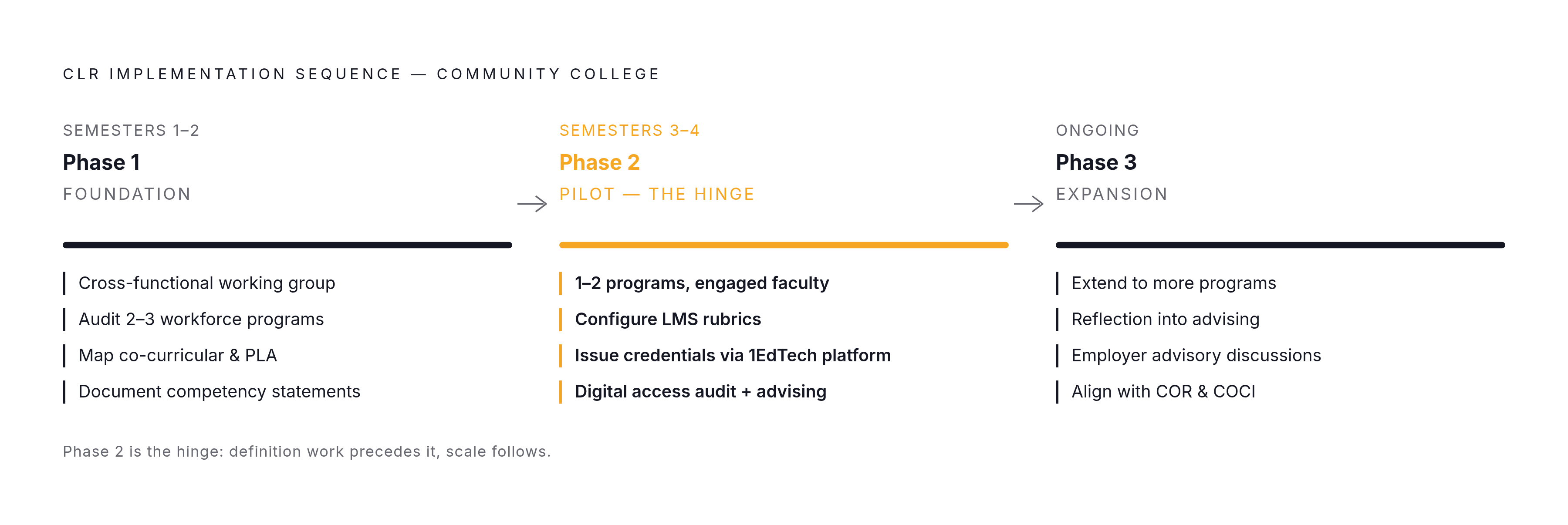
During Semesters 1–2, the foundation phase should convene the working group with faculty, adjunct, student services, registrar, institutional research, IT, and workforce development representation. Its initial audit should examine outcomes in two to three workforce programs with strong employer engagement, identifying which are assessable and which need definition. Mapping how co-curricular and prior learning assessment work now can show what evidence is already being recorded. Digital issuance need not be the first deliverable. A documented competency statement, like Tennessee’s example, is a viable foundation-phase output.
During Semesters 3–4, the pilot should focus on one or two programs with engaged faculty and clear employer connections. Existing assignments can feed competency evidence through configured LMS rubrics, with credentials issued through a platform certified against 1EdTech conformance requirements. Digital access barriers need assessment before issuance, and students need explicit advising on using their records. Expansion can then follow pilot learning, extending the framework to more programs, integrating reflection into advising, and using pilot records in employer advisory discussions.
California colleges can align that expansion with COR revisions and COCI data entry. The AACRAO-NASPA national pilot, which has been active since 2015 and has supported over 50 colleges and universities through XLR, also offers workshops and technical assistance. Next week’s first step is to convene the cross-functional group and begin the outcome audit in two to three workforce programs.
Methodology & sources
- Chancellor’s Office, Academic Affairs
Provided details on the California Chancellor's Office memorandum ESS 25-66 and the Board of Governors' Course Outline of Record revisions, timelines, and requirements.
- Comprehensive Learner Record - Registrar
Provided the example of the University of Missouri registrar's office as a driver of CLR work and official-record integrity.
- ERIC - ED640046 - Comprehensive Learner Records: Empowering Lifelong Learning in the Digital Age. Postsecondary Perspectives of Preparation for and Implementation of CLRs, Council for Adult and Experiential Learning, 2024
Supplied the CAEL 2024 report findings on employer demand, adult learner motivations, competency framework gaps, and institutional progress on CLR development.
- Comprehensive Learner Record Standard Version 2.0
Supplied technical details on the CLR Standard 2.0, including machine-readable records, cryptographic signing, conformance guides, and certification requirements.
- Comprehensive Learner Record Standard™
Provided information on 1EdTech's CLR Standard as the agreed format for creating, transmitting, and displaying achievements, and its support for interoperability.
- October 9, 2025
Provided the University of Georgia example of students using their CLR at registration to reflect on competency progress.
- Beyond the Transcript: Three Benefits of Comprehensive Learner Records
Informed the discussion of CLR as a verifiable, portable, interoperable digital asset documenting competencies beyond what traditional transcripts capture.