E-Rate Program Eligibility and Application Timeline for K-12 Districts
Enrollment data certified this year will lock your infrastructure budget for five years.

- Written by
- Kian Nardone
- Published
- October 16, 2026
- Reading time
- 9 min read
- Sources cited
- 4 sources ↓
What this covers
E-Rate gives K-12 districts discounts of 20% to 90% on the connectivity and network infrastructure they already need to purchase. The program is the largest dedicated federal technology fund for schools, but its rules are complex enough that districts routinely leave money unclaimed or lose funding to preventable filing errors. FY2026 is the first year of a new five-year funding cycle, which resets how much Category 2 infrastructure budget a district can claim based on student enrollment counts certified in this opening year.
The decisions a district makes during filing directly determine its Category 2 budget ceiling through the next several years, making this cycle the most consequential infrastructure planning period most districts will face this decade. Understanding eligibility requirements, discount calculations, service categories, application deadlines, and the current FCC program review is essential for any district trying to capture the full funding it qualifies for.
What E-Rate is and why 2026 matters
E-Rate is formally called the Schools and Libraries Universal Service Support Program. It is funded through the Universal Service Fund, administered by the Universal Service Administrative Company, and governed by FCC rules. Districts interact with USAC primarily through an online portal called the E-Rate Productivity Center, or EPC. The program started under the Telecommunications Act of 1996, and the FCC modernized it in 2014 by restructuring it around five-year funding cycles. The Supreme Court upheld the program in June 2025, confirming it is stable and funded for the foreseeable future.
FY2026 opens a new five-year cycle, and the opening year is when a district's Category 2 budget ceiling gets set. Filing accurately in this first year captures more total budget through 2030. Filing late or underreporting student count cannot be corrected retroactively to raise the ceiling later.
Which schools and districts qualify for funding
Eligibility is broader than most districts assume. Public K-12 schools qualify, including charter schools. Private nonprofit K-12 schools qualify if they are accredited and authorized to provide elementary or secondary education. Public libraries and library systems that qualify for assistance under the Library Services and Technology Act also count. School districts and library consortia may apply individually or together.
Colleges, universities, and their affiliated libraries are ineligible, along with day care centers and off-campus after-school programs. Pre-K programs and adult education facilities may qualify in specific circumstances, so districts running those programs should check USAC's eligibility definitions directly rather than assuming one way or the other.
How discount levels are calculated from poverty data
The discount a district receives comes from two inputs: economic need and geography. Economic need is measured by the percentage of students whose family incomes sit at or below 185% of the federal poverty guidelines, which is the upper income limit the National School Lunch Program uses to determine eligibility for free or reduced-price meals. The FCC discount matrix turns NSLP percentage bands and urban or rural status into a rate between 20% and 90%. At the same poverty level, rural schools generally receive a higher discount than urban schools.
The discount is calculated as a shared rate across the whole district, not school by school. If more than half of a district's schools are classified as rural, the entire district counts as rural. State education agencies compile enrollment and NSLP data into a Valid File that goes to USAC annually, and your data in EPC must match that file or you will face review delays. For districts in the Community Eligibility Provision, the qualifying multiplier must be calculated correctly or the district will understate its discount for five years. When demand exceeds the annual funding cap, USAC prioritizes the highest-poverty eligible schools and libraries first, which means accurate NSLP data directly affects competitive standing.
What Category 1 and Category 2 each cover
E-Rate funds two distinct service categories, and confusing them is one of the most frequent planning errors districts make. Category 1 covers broadband and external connectivity: internet access over fiber, cable, or DSL, data transmission services, and WAN connections between school buildings. There is no per-student cap, and the discount can reach 90% for the highest-need applicants. Wi-Fi on school buses lost Category 1 eligibility in FY2025, so Category 1 now funds connectivity inside physical school and library buildings only.
Category 2 covers internal connections and basic maintenance, including wireless access points, network switches and routers, structured cabling, firewall appliances, racks, and UPS equipment. It carries a five-year, pre-discount budget cap per school or library, with a maximum discount of 85%. The FY2026 to 2030 per-student budget multiplier is $201.57, with a funding floor of $30,175 for all schools and libraries except Tribal libraries, which receive a floor of $66,385. The FCC also redefined Internal Connections for FY2026 to include software-based services, bug fixes and security patches, technical assistance, and remote configuration changes, resolving ambiguity that previously produced funding denials.
Standalone endpoint security, identity management, email security, and awareness training tools are not covered under either category. Treating them as eligible creates compliance risk and application denials, so districts need a separate budget line or the FCC cybersecurity pilot for those tools.
Why FY2026 Category 2 filing sets your five-year ceiling
The FY2026 to 2030 cycle locks in a district's Category 2 budget ceiling for five years based on the student count certified in the first year of the cycle. The $201.57 per-student multiplier represents a meaningful increase from the prior cycle, and districts that file with accurate, complete enrollment data in FY2026 capture more total budget than those that underreport or delay. Unused Category 2 funds roll forward from year to year within the cycle, so unspent FY2026 budget remains available through FY2030. Student counts get validated in the first year a district applies for Category 2 during the cycle and cannot be revised upward afterward. The practical approach is to plan a full five-year infrastructure roadmap before filing FY2026 Category 2 requests, mapping switches, wireless access points, cabling, and related internal connections against realistic demand so the ceiling is set appropriately from the start.
The four-form application sequence explained
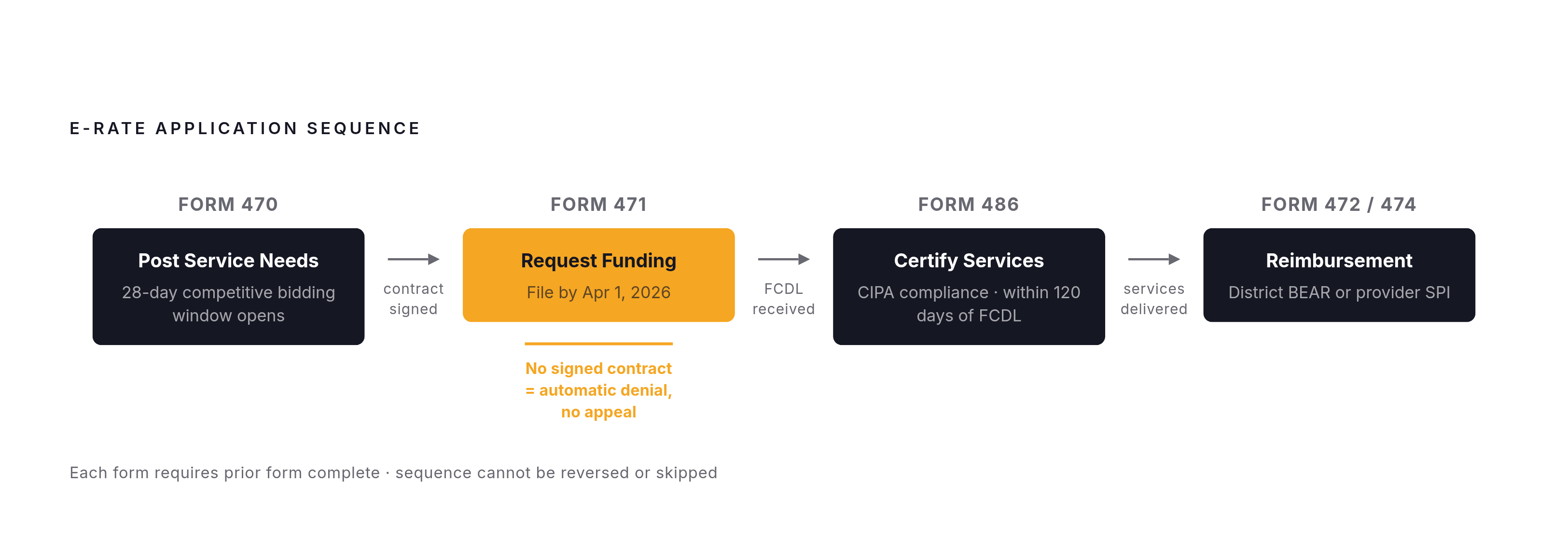
E-Rate funding follows a fixed four-form sequence, and an error at any stage results in automatic denial that cannot be corrected after the fact. Form 470 starts the process by publicly posting your service needs in EPC so providers can submit bids. You must allow a minimum 28-day bidding window before selecting a provider, and for FY2026, March 4, 2026 was the last day to certify a Form 470 and still meet that requirement before the Form 471 deadline.
Form 471 is where you request funding. It gets filed after you select a provider and sign a contract, and it must include service descriptions, costs, dates, and certification of compliance with program rules. The FY2026 Form 471 window opened January 21, 2026 at noon ET and closed April 1, 2026 at 11:59 p.m. ET. You must have a signed contract before submitting Form 471, even if it is just a signed quote.
Form 486 comes after you receive a Funding Commitment Decision Letter from USAC. It certifies that services have started and that you comply with the Children's Internet Protection Act. You have 120 days from the FCDL date or service start date, whichever is later, to file. Invoicing is the final step, completed either by submitting Form 472 (BEAR) or having the provider submit Form 474 (SPI) to USAC for reimbursement of the discount amount.
FY2026 calendar dates and common filing mistakes
The E-Rate calendar compresses several high-stakes deadlines into a narrow window, and districts that treat it as a single deadline rather than a sequence of interdependent milestones routinely miss funding they qualify for. The FY2026 administrative window opened October 15, 2025 and closed January 16, 2026. The filing window opened January 21, 2026. March 4, 2026 was the last day to certify Form 470 and meet the 28-day bidding requirement. April 1, 2026 was the last day to certify Form 471.
A meaningful share of applications are denied each year due to filing errors, none of which can be resolved after the window closes. Preparation should begin in late summer so that enrollment data, NSLP figures, EPC entity records, and Form 470 service descriptions are all ready before the administrative window opens in October.
How the FCC cybersecurity pilot fits your strategy
The FCC's $200 million cybersecurity pilot is a separate and constrained funding track. Treating it as an extension of standard E-Rate eligibility risks misallocating budget and creating compliance problems in both programs. The pilot is a three-year test of whether cybersecurity services belong permanently on the E-Rate Eligible Services List, and it runs in parallel with the standard program rather than inside it. The FCC issued its first Funding Commitment Decision Letters under the pilot on December 17, 2025, allocating $18.8 million to 140 applicants. As of September 2026, most funded applicants had not yet invoiced a single dollar. The FY2026 Eligible Services List confirms that the FCC declined to expand standard cybersecurity eligibility beyond the pilot, so for most advanced cybersecurity tooling, the pilot remains the only E-Rate-adjacent funding path.
A practical budget framework for districts divides spending into three tracks. Standalone endpoint security, identity management, email security, physical security hardware, and awareness training tools are not eligible under any E-Rate track. Network infrastructure qualifies under standard E-Rate. Specific cybersecurity services may qualify under the pilot where applicable. A blended funding plan that accounts for all three tracks is more durable than assuming E-Rate covers the full scope of a district's technology needs.
What the FCC program review means for districts
The active FCC program review adds real but bounded uncertainty. Rules for FY2026 applications are not changing mid-cycle, but future compliance requirements and eligibility decisions may shift. The most significant near-term question involves CIPA compliance documentation. The FCC has historically accepted self-certification on Form 486, but the review is examining whether CIPA requirements are still adequate for protecting students online. If the FCC moves toward requiring detailed documentation, districts that relied on minimal self-certification records will face new administrative burdens. Maintaining internet safety policies, board resolutions, and monitoring records now costs less than reconstructing them later.
The review is also examining consultant involvement in E-Rate applications. Districts that rely heavily on consultants should understand the application well enough to certify its accuracy independently, because the certifying signature and the associated responsibility belong to the district, not the consultant. FY2026 filing should proceed on schedule without waiting for the review to conclude, but districts should document more than the technical minimum throughout the process.
A practical checklist for your next E-Rate filing
Districts that capture E-Rate funding reliably treat it as a year-round planning discipline rather than an annual deadline scramble. Before the administrative window opens, in summer or early fall, confirm or update enrollment counts and NSLP or CEP data, and coordinate with your state education agency to ensure the Valid File matches your EPC records. Map your five-year infrastructure roadmap against the Category 2 budget ceiling. Confirm your urban or rural classification and district-wide discount rate in the USAC discount matrix. Separate eligible cybersecurity spending from tools that require a separate budget line.
During the administrative window, update entity and discount information in EPC and resolve data mismatches before the window closes. Draft and internally approve Form 470 service descriptions so bidding can start as soon as the filing window opens. During the filing window, certify Form 470 early so the 28-day bidding window closes before Form 471 is due. Execute a contract before submitting Form 471, and file Form 471 as early as possible to enter earlier USAC review and funding waves.
After the filing window, track the FCDL and file Form 486 within 120 days of receipt. Maintain CIPA documentation including internet safety policies, board resolutions, and monitoring records through FY2027 at minimum. Coordinate invoicing promptly after services begin. Managed network service providers that operate within MIBS scope can support eligibility documentation and day-to-day IT operations while keeping the scope of work defensible for USAC review. A provider that understands E-Rate documentation requirements can help separate reimbursable network work from non-reimbursable security operations before filing, which matters for both compliance and realistic budget planning.
Methodology & sources
- Demystifying the E-Rate Program: A Guide to School Funding
Provided the FY2026–2030 per-student Category 2 budget multiplier figure cited in the article.
- Federal Funding (E-Rate) - Kentucky Department of Education
Provided context on the 185% federal poverty guideline threshold used to determine NSLP eligibility for discount calculations.
- Navigating E-rate for FY2026: Key Deadlines and New Opportunities - Cisco Blogs
Provided FY2026 key filing deadlines and information about new opportunities including the filing window dates cited in the article.
- Funding Year 2026 Filing Window - Universal Service Administrative Company
Provided official FY2026 filing window dates, including the January 21 opening and April 1 closing dates for Form 471.