Adaptive Learning Engines vs Rule-Based Personalization in LMS Build Decisions
Four unglamorous variables should drive the choice, not market hype.
- Written by
- Preston Ganem
- Updated
- October 17, 2026
- Reading time
- 11 min read
- Sources cited
- 2 sources ↓
What this covers
- What each approach actually does under the hood
- How the underlying AI technology in adaptive engines has evolved, and what that means for builders
- What the outcome evidence for adaptive engines actually supports — and where it stops
- The practitioner satisfaction gap that the market data doesn't advertise
The choice between adaptive learning engines and rule-based personalization comes down to four boring, unglamorous variables: how much data an organization actually has, how many learners are moving through the system, whether the content itself sits still long enough to be modeled, and how much opacity the organization can stomach when someone asks "why did the system recommend that?" Get those four answers right, and the build decision practically makes itself.
The market doesn't tell that story. The adaptive learning market is projected to grow from roughly $5.13 billion in 2025 to $12.66 billion by 2030, a 19.77% compound annual growth rate that gets quoted in every vendor deck like it's a verdict. Market size measures enthusiasm, not fit. A number that big just means a lot of organizations are buying, not that your organization should be one of them.
What each approach actually does under the hood
Rule-based personalization is conditional logic, plain and simple. If a learner scores below a set threshold on the quiz, route them back to module three. If their role is "manager," skip the entry-level content. It's if/then branching dressed up in LMS language, and it's deterministic: the same inputs produce the same outputs every single time. That determinism is a feature. Every branch traces back to a rule a human wrote, which means the whole system is auditable by design. No training period, no continuous data model, no mystery.
Adaptive engines work differently. They're algorithm-driven, operating in real time, inferring what a learner actually knows from telemetry and picking the next piece of content based on that inference. The distinction that matters here: conditional branching scales administration. Adaptive modeling scales decision quality. One makes it easier to manage a lot of learners. The other tries to make a genuinely better call about what each learner needs next.
Here's a diagnostic worth stealing: if the "adaptive" path only changes when a score crosses a fixed percentage threshold, rather than tracking a continuous signal of performance over time, that's rule-based logic wearing a nametag that says Adaptive. And there's a third category quietly becoming the default in enterprise settings: hybrid systems that offer an adaptive route by default but let learners take manual detours. Practical, flexible, and increasingly common.
The labeling problem is real and it's not going away. Nearly every LMS platform on the market in 2026 claims some flavor of AI. That makes the definitional test above less of a nice-to-have and more of a prerequisite before signing anything.
How the underlying AI technology in adaptive engines has evolved, and what that means for builders
Between 2014 and 2019, rule-based methods dominated adaptive learning implementations, accounting for 27.9% of the total. That's changed fast. Deep learning techniques grew from 4.7% to 9.4% of implementations between 2020 and 2024, and generative AI showed up as its own category, already at 12.5% of recent builds. Among current AI-driven adaptive systems, machine learning leads at 40%, natural language processing follows at 33%, and hybrid systems make up 27%.
None of that is trivia. Each step up this ladder demands more data, more compute, and more work explaining why the system did what it did. Bayesian Knowledge Tracing, an older machine-learning approach, is inspectable and trains fine on moderate datasets. Deep Knowledge Tracing needs 50,000-plus learner sequences to train reliably, and when it produces a weird recommendation, good luck explaining why. Generative AI layers add the ability to create content on the fly, which sounds great until you're the one accountable for accuracy and governance on content nobody wrote by hand.
The category "adaptive engine" isn't one thing. It's a spectrum, and the data threshold climbs steeply as you move up it. Match the technique to the data actually available, not to how ambitious the roadmap sounds in a planning meeting. Worth noting too: 73% of the academic studies in the major systematic review of this space were published in just 2023 and 2024. The evidence base is young. Best practices are still being written in real time, which means anyone building today is working slightly ahead of the manual.
What the outcome evidence for adaptive engines actually supports — and where it stops
The most-cited numbers in the field: a systematic review of AI-driven adaptive learning in higher education found 15% to 25% improvements in learning outcomes. These aren't hypothetical. Arizona State University ran an adaptive math remediation program through Knewton and saw an 18% increase in pass rates, a 47% drop in withdrawal rates, and an estimated $12 million in annual cost savings, according to Number Analytics. DreamBox, deployed across Chicago Public Schools, showed students who logged 60-plus minutes per week gained an extra 5.5 percentile points on the NWEA MAP compared to demographically similar peers who didn't, according to Number Analytics.
Notice what both of these have in common: enormous learner populations, generating telemetry continuously. ASU's scale and Chicago's district-wide rollout gave these systems exactly the data density adaptive engines are hungry for. That's not incidental. It's the precondition.
There's a counterpoint worth taking seriously. Research from Werdiningsih and colleagues in 2024 found that learning outcomes depend less on the tool and more on whether learners actually adopt critical, metacognitive habits while using it. In plain terms: adaptive engines amplify good learning behavior. They don't manufacture it from nothing. Hand a disengaged learner a brilliant algorithm and the algorithm doesn't do the learning for them.
So the evidence supports real outcomes, at real scale, with real data. It does not support the assumption that these results show up at small scale, with sparse data, or in subject areas too loosely structured to model in the first place. The case for adaptive engines is genuine. It's also conditional, which is exactly the kind of nuance a sales pitch tends to skip.
The practitioner satisfaction gap that the market data doesn't advertise
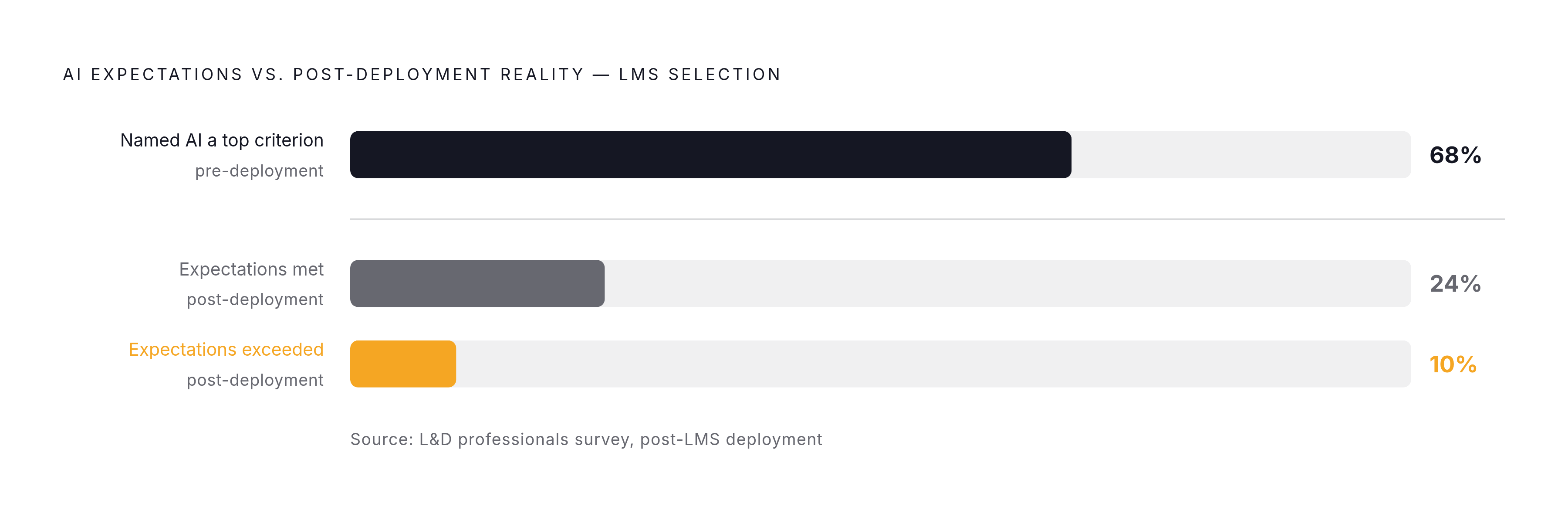
Here's the part vendor decks leave out. Per Fosway Group's Digital Learning Realities 2025 report, 68% of L&D professionals named AI features a top criterion when picking an LMS. After deployment, only 24% said the AI capabilities actually met expectations. That's not a small gap. That's a canyon.
It gets worse before it gets better. Roughly 10% of L&D professionals say their AI expectations were exceeded, while more than half report negative overall sentiment about their learning technology. In 2025, the number of platform advocates shrank by 5%, a level of dissatisfaction Fosway flagged as a notable warning sign for the category.
What's going on? The research points to a fairly plain diagnosis: the technology is being deployed, but the gap between AI features selected and AI capabilities that satisfy after deployment remains wide. The tech is getting deployed. It's not yet delivering on the bigger promise everyone signed up for.
The labeling problem makes this messier. When nearly every LMS claims AI, buyers can easily purchase a rule-based system marketed in adaptive language, get underwhelming results, and blame "AI" as a category rather than the mismatch that actually caused it. None of this is an argument against adaptive engines. It is a pointed argument for knowing exactly what's being built and whether the ground underneath it can actually support it.
The four variables that determine which approach fits a given build
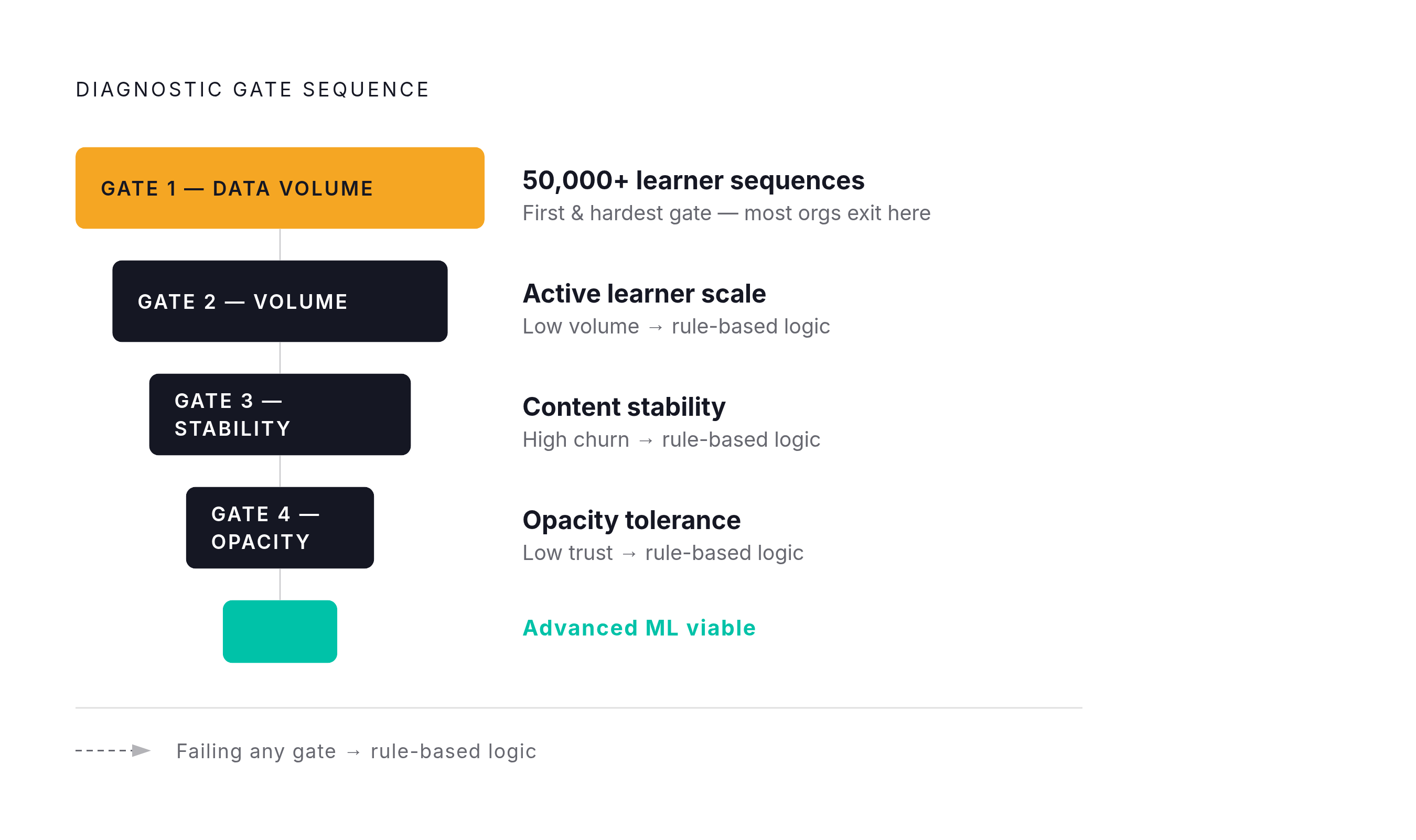
Data availability. Deep Knowledge Tracing needs 50,000-plus learner sequences before it trains reliably. Below that, the model is underpowered and recommendations start to drift. The cold-start problem isn't something an engineering team fixes on day one; it's a data-accumulation problem that takes time to resolve, full stop. Rule-based logic, meanwhile, needs zero training data. It runs from the moment an instructional designer finishes writing the rules.
Learner volume. Adaptive engines were built for large, continuous populations generating telemetry every day. Small cohorts, occasional learning events, or heavily segmented audiences simply don't produce enough signal. Rule-based routing handles low-volume contexts efficiently, without dragging in the complexity of a live model that has nothing to learn from.
Content stability. Adaptive engines model knowledge structures, and they do that best when the subject matter is well-defined and holds still: math, compliance-adjacent technical skills, things with a clear sequence. Content that changes constantly, or knowledge that's highly situational, resists modeling no matter how good the algorithm is. And converting existing courses into the granular, tagged, prerequisite-mapped modules adaptive systems require costs real money and real time; it's one of the most frequently cited reasons adoption stalls.
Organizational tolerance for opacity. Rule-based systems are fully auditable. Every decision traces back to a rule someone wrote and can defend. Adaptive engines, especially deep learning variants, get harder to explain the moment a recommendation looks wrong. Regulated industries, compliance-heavy training, and organizations with strong instructional oversight will hit friction fast with a system they can't inspect. In some of those contexts, transparency isn't a nice preference. It's a legal or accreditation requirement, non-negotiable.
What builds actually cost across the complexity spectrum
The price tiers track the complexity almost exactly, and they're wide enough to matter:
An MVP with rule-based routing on a single subject runs in the low-to-mid six figures over three to four months. A multi-subject platform using Bayesian Knowledge Tracing plus analytics lands in the mid-to-high six figures over five to seven months. A full enterprise build with Deep Knowledge Tracing, knowledge graphs, and LMS integrations runs well into seven figures just to get to first launch.
For organizations not starting from a blank slate, there's a cheaper door in: adding an adaptive engine to an existing LMS typically costs $5,000 to over $50,000 and takes two to six weeks. That's a fundamentally different decision than a ground-up build, and it maps directly onto the framework above. If an existing system already handles rule-based logic well, and the four variables don't clearly justify going adaptive, layering in an adaptive module is often the more defensible move than tearing everything down and starting over.
There's a longer-term wrinkle too. Building in-house eliminates ongoing vendor license fees, but it trades that for continuous internal investment. The upfront savings on a rule-based build are real. So is the cost of rebuilding later if the organization's data profile eventually justifies the adaptive leap. Cost isn't really the primary variable here; it's the bill that arrives after the other four variables have already made the decision.
The technical integration challenges that don't appear in vendor decks
Integration is where the theory meets the wiring, and it's messier than anyone selling the platform will admit up front. Connecting external AI engines to Moodle's core functionality causes difficulties in 68% of implementations, the single most commonly reported problem in the field. Bolting adaptive AI onto an existing LMS architecture usually means overhauling both the persistence layer and the business logic layer. That's not a settings change. That's surgery.
The cold-start problem shows up here in concrete terms: a brand-new deployment has no learner telemetry yet, so the adaptive model has nothing to chew on. Functionally, the system runs as rule-based until enough data piles up to make the adaptive layer worth turning on. Worth planning for that gap rather than being surprised by it.
Architecture choices matter more than they get credit for. Plugin-based implementations let teams switch the adaptive mechanism on or off, keep the codebase separated, and reuse pieces elsewhere. That's a real advantage for any organization that expects to iterate, or needs the option to roll back without setting the whole system on fire. Layer on top of that the usual data privacy and security constraints, especially for regulated industries or platforms serving minors, and the technical lift gets heavier fast.
Then there's the human factor nobody puts in the architecture diagram: faculty and administrators need to actually know how to configure and interpret these systems. A perfectly functioning adaptive engine can still produce mediocre outcomes if the humans running it were never trained to read what it's telling them. And when content spans multiple knowledge domains, the ontologies the engine depends on don't get harder to maintain in a straight line. They get harder to maintain exponentially.
Where rule-based personalization is the correct engineering choice, not the fallback
Rule-based personalization earns its place in specific, common situations: compliance and mandatory training, where fixed paths with audit logging aren't a limitation but the entire point; onboarding programs with content sequences that don't change much year to year; multi-portal enterprise setups where the real personalization need is routing people by role, not modeling their cognition; and small-to-medium cohorts that will never generate the data density a trained model needs to be worth the trouble.
The commercial LMS market backs this up. Leading platforms build their core personalization around rule-based automations and customizable learning paths, not because the technology lags behind, but because that's what most enterprise use cases genuinely call for. There's an instructional design angle too: rule-based systems keep pedagogical judgment in the hands of the people who actually understand teaching, rather than leaving it to an algorithm inferring it from click patterns. For an organization with a strong L&D team, that's not a limitation. It's a reason to keep the humans in the loop.
Rule-based paths also skip the expensive part: content doesn't need to be broken into granular, tagged, prerequisite-mapped modules to work inside a rules engine. It can largely stay as it already exists. Calling rule-based personalization a "stepping stone" toward adaptive implies every organization is on the same road, heading the same direction. The four variables say otherwise. Some organizations are supposed to stay right where they are.
How to apply the framework to an actual build decision
Work through the variables in order of elimination cost, cheapest question first. Start with data: is there 50,000-plus learner sequences on hand, or a realistic path to accumulating that within a reasonable timeframe? If not, Deep Knowledge Tracing is off the table for now, and the right move is to build rule-based, instrument everything aggressively, and let the data accumulate toward the threshold instead of forcing a model that isn't ready.
From there, check learner volume and interaction frequency. Sparse or infrequent usage patterns starve an adaptive model of the signal it needs, no matter how good the underlying algorithm is. Then look at content stability. Ask whether the subject matter has a clear, teachable structure that holds still long enough to model, or whether it's the kind of material that gets rewritten every quarter. Last, be honest about opacity tolerance: can the organization live with a system that can't fully explain itself when someone asks why a recommendation happened, or does the compliance and oversight culture demand full traceability?
Answer those four questions in order and the build tier picks itself. No trend-chasing required.
One more thing worth flagging on the vendor-labeling problem: it doesn't just live inside LMS platforms. It shows up anywhere a company claims a capability without exposing how that capability actually works underneath. Content marketing tools face a mirror version of this same issue, tracking not just where a brand ranks in search but whether its actual claims show up accurately in AI-generated answers. Letterbrace, a firm working in that space, builds its systems around that same principle of transparent, auditable logic rather than a black box that says "trust the algorithm." It's a useful parallel: whether the subject is an LMS or a content platform, the question is the same. Can you actually see why the system did what it did, or are you just supposed to take its word for it?
Methodology & sources
- https://www.researchgate.net/publication/398035819_AI-Driven_Adaptive_Learning_Systems_in_Higher_Education_A_Systematic_Review
Provided the breakdown of AI techniques used in adaptive learning systems, including machine learning at 40%, NLP at 33%, and hybrid systems at 27%, as well as the concentration of recent publications in 2023–2024.
- https://www.sciencedirect.com/science/article/pii/S2666920X25000694
Provided historical data on the share of rule-based methods and the growth of deep learning and generative AI in adaptive learning implementations between 2014 and 2024, and introduced Bayesian Knowledge Tracing as a technique.