Audit Logging and Data Access Visibility in EdTech Integrations
Schools can't track who accesses student data without proper audit logs.
- Written by
- Preston Ganem
- Updated
- October 15, 2026
- Reading time
- 11 min read
- Sources cited
- 4 sources ↓
What this covers
American school districts run thousands of different EdTech tools in a given year, according to LearnPlatform's data. Each one is a door into student records, and most districts couldn't tell you who walked through which door, when, or why they got a key in the first place. Audit logging decides whether a district actually knows what happened to its data, or just hopes nothing did.
What audit logs are actually supposed to do in an integration-heavy environment
The job description is short: make every data access event attributable. Who touched a student record, from where, at what time, under what permission — simple enough to fit on a sticky note.
Here's where it gets messy, though. In a district running thousands of connected tools, "who" almost never means a person typing at a keyboard. It's a rostering API. An LMS sync job running at 3 a.m. A vendor's support tool phoning home because someone forgot to turn it off. None of that comes with a name and a face attached, it shows up as service accounts and credentials, and if nobody tracks those the way they'd track a human login, half the story is gone before the log even starts.
Audit logs do three separate jobs, and districts tend to assume way more overlap between them than actually exists. Detection catches something strange while it's happening. Investigation rebuilds a sequence of events weeks after someone finally raises a flag. Accountability gives you something to hand a regulator or a worried parent that proves access was governed, not just assumed fine. A log built for one of these can fail completely at another; a system that satisfies accountability on paper might never have caught a single thing in real time.
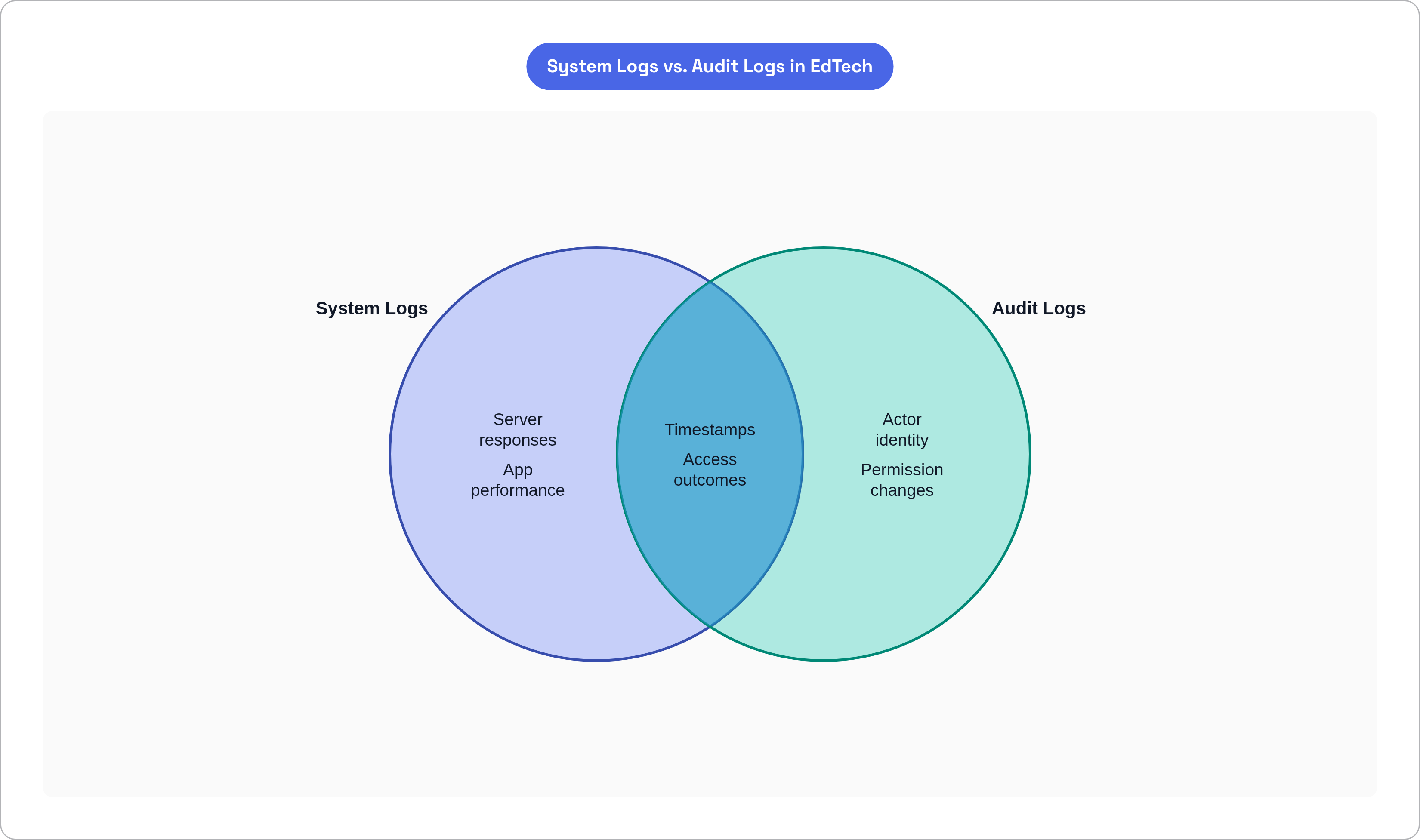
A system log and an audit log get confused constantly, and that mix-up is where a lot of districts go sideways. A system log tells you the server responded, while an audit log tells you a specific identity accessed a specific student record, and whether that access was even allowed. Districts sit on piles of the former and almost none of the latter.
Most privacy failures in EdTech don't start with a hacker in a hoodie, whatever the news segment implies. They start boring: a roster sync nobody remembered to switch off, a permission granted for one project that never got revoked six months later, a spreadsheet exported "just for a minute" that's still sitting in someone's downloads folder. Audit logging is what makes those quiet failures visible before they turn into a headline.
What an effective EdTech audit log must actually capture
A log missing half its fields is a guess wearing a timestamp for credibility. Every logged event needs a few non-negotiables: a timestamp with timezone attached (this matters fast once a vendor operates across regions), a durable actor identity tied to a human, service account, or API credential, an action type (read, write, export, delete, permission change, login attempt), the object being touched, the source system that started the access, the authorization behind it, and the outcome. Failed attempts, oddly, often say more than the successful ones.
Best practice guidance calls for one to three years of retention at minimum, and plenty of districts fall short of even that low bar. Updated COPPA rulemaking pushes further, with requirements for EdTech companies to document data access and breach identification processes.
The fields that go missing tend to be the busiest ones, which is its own kind of irony. Integration-layer events are a big offender: data passed between two systems through an API often generates no log on either side, so the part of the pipeline carrying the most traffic ends up being the least visible. Export events, downloads, email attachments, third-party syncs, these frequently go unlogged entirely, and data can leave the building without leaving a single footprint. Permission changes need their own entry too, since a shift in someone's access level is an event, not a footnote. And a single API call pulling ten thousand records should never read identically to a lookup of one record. If it does, the log is erasing the exact distinction that matters.
One more thing people skip: the log has to be tamper-evident, since a log a system can quietly edit about itself is barely a suggestion. Completeness beats polish every time. A beautifully built log covering only the student information system, while the LMS, the assessment platform, and every AI feature sit dark, gets you a flashlight pointed at one corner of a warehouse the size of a football field.
Where visibility breaks down: the gaps that matter most in practice
Retention dies first, usually. SecurePrivacy's research puts typical school retention windows around 90 days, which sounds fine right up until you remember breach investigations routinely surface problems months after the fact. Best practice calls for one to three years centrally, five-plus for anything touching education records directly. Short windows like this rarely come from a security decision; they come from a storage cost decision made by someone who never looped in legal, because nobody thought a spreadsheet line item would end up mattering to a regulator.
Coverage breaks down next, and it's structural, not accidental. Student information systems log reasonably well, while cloud storage, email attachments, and third-party tools often log nothing at all. A district running thousands of applications without centralized aggregation ends up with dozens of siloed fragments that never talk to each other.
Permission sprawl is the gap nobody notices until it's already a problem. Access rights expand constantly and almost never shrink back on their own. A vendor support account granted broad read and write access for a two-week rollout is still sitting there, active, a year later, forgotten by everyone except the audit log that never mentions it either. A log tracking access events but skipping permission changes can't answer the only question that matters: should this account have had access to begin with?
AI integrations make all of this worse. A single AI feature inside an EdTech product might route through multiple vendors, subprocessors, and regional inference environments, none of which show up in the district's own logs. Traditional audit systems were built for predictable, linear application behavior, not probabilistic AI interactions touching several systems in one request. Districts need to know how student information enters an AI system, who triggered the interaction, where the output lands, and whether a given prompt could even be reconstructed if someone asks later. CoSN's May 2025 report found 80 percent of districts already running generative AI initiatives, while 43 percent have no formal policy governing that use. That gap, adoption racing ahead of governance, is exactly where accountability slips out the back door.
And then there are logs that exist but nobody's watching. A log reviewed only after someone reports a problem has investigation value and zero detection value; those are not the same currency. Bulk record pulls, off-hours API activity, access from unfamiliar IP ranges: none of it means anything without automated alerting attached. A pile of logs sitting in storage without active review is an archive nobody asked for.
What the PowerSchool breach reveals about log failure at scale
In December 2024, a hacker walked through PowerSchool's customer support portal using one compromised credential and walked out with the personal data of roughly 62 million students and 9.5 million teachers. It's the largest breach of children's data in U.S. history. PowerSchool serves something close to 75 percent of the K-12 market across more than 18,000 schools in North America, which is exactly why one vendor's logging failure became a national story instead of a quiet local one.
The intruder sat inside the system for nine days before anyone noticed, which was bad enough on its own. Then Ontario's Information and Privacy Commissioner found afterward that unauthorized access using compromised contractor credentials had actually started months earlier, back in August and September of 2024, and it went completely undetected because PowerSchool's log retention window wasn't long enough to preserve the evidence. By the time investigators went looking for how the breach began, the forensic trail had already aged out and been deleted.
That's the detail that should keep procurement officers up at night, not the nine days but the months before them, where the evidence simply stopped existing by the time anyone came looking.
Investigators kept finding more, stacked on top. An "always-on" remote maintenance feature that school boards had never really scrutinized left no audit trail administrators could see. A vendor portal carried read and write permissions far broader than any single maintenance task would ever require. There was no real-time log review, so unusual database queries sailed through unflagged because nobody was watching the feed as it happened.
Canadian watchdogs also found plenty of school boards had never included mandatory privacy and security clauses in their vendor contracts, which meant the logging requirements that might have caught this sooner were never contractually required by the customers paying for the product. The Future of Privacy Forum dropped PowerSchool from its Student Privacy Pledge in February 2025, citing the lack of multi-factor authentication as a violation of its own security program requirements.
PowerSchool is a case study in what happens when logging, retention, monitoring, and contract terms fail at once, in the same building, and nobody catches it until 62 million records are gone.
The regulatory framework districts and vendors are now accountable to
FERPA was written for a paper-record world, and it still reads that way. It doesn't spell out security standards vendors must meet before touching student data. The "school official" exception lets districts share data with third-party tools fairly freely, but nowhere does it define what "direct control" actually means, or what logging those vendors are required to keep. Compliance practitioners recommend one to three years of retention and role-based access controls as good practice, but none of it is codified as a federal minimum yet.
COPPA closes part of that gap starting April 22, 2026, in the first real rewrite of the rule in about a decade. It requires EdTech companies to keep audit logs tracking access to student data and to maintain a documented process for identifying when that data's been compromised. Districts and vendors that fall short face meaningful financial penalties, which turns non-compliance into a line item on a budget, not just a reputational bruise.
States piled on top of all this too. A growing body of state laws now protects student privacy beyond what FERPA covers, and many of them add contractual requirements, data use limits, and transparency rules that end up mandating audit-trail capability whether the statute uses that phrase or not. None of it lines up neatly. A vendor operating across a dozen states is juggling a dozen different rulebooks, not one clean standard everyone agrees on.
Across the Atlantic, the UK's Information Commissioner's Office has scrutinized EdTech providers and flagged findings that weren't pretty: weak transparency, thin access controls, retention policies that didn't hold up, poor oversight of vendors further down the chain. Vendors operating in the UK shouldn't treat voluntary compliance as anything but a short-term bet.
SOC 2 Type II has become the de facto qualification districts lean on during procurement, covering security controls that include audit logging and access monitoring. It's not proof of good practice by itself, but its absence, at this point, is a red flag most procurement teams already know to watch for.
How districts can close the gaps they actually control
Start with centralizing log aggregation, since nothing else works until this happens first. Logs trapped inside individual applications can't be correlated with anything; pulling them into one repository has to happen before real monitoring becomes possible at all. One to three years should be the floor for retention, with longer windows appropriate for anything touching education records directly.
Build a real app inventory before trying to govern logging. Districts run thousands of applications but only actively use a bit over half of them, according to industry data, and that unused chunk still carries live risk if the credentials and integrations behind it are still active. You can't audit access to a tool you don't know exists. Shadow SaaS needs ongoing discovery, not a once-a-year checklist filled out in a hurry between meetings.
Automated alerting on behavior, not just static thresholds, deserves more budget than most districts currently give it. Bulk exports, 2 a.m. access, API calls from an unfamiliar IP range: these should trigger something the moment they happen, not sit quietly in a log waiting for someone to stumble across them weeks later. A single record lookup and a call pulling thousands of records at once need to look different immediately, not just in hindsight during an investigation.
Access reviews can't happen only at onboarding and then never again. Permission sprawl builds up silently over months, so quarterly or semester-based reviews of active credentials and vendor access are the minimum bar. Revocation itself needs to get logged and confirmed, not just assumed and forgotten about.
Procurement is where a lot of this should get locked down before a contract is signed at all. Retention policy, audit trail access, AI usage visibility, access governance, all of it belongs on the checklist up front, not raised as an afterthought once something's already gone wrong. If a vendor can't clearly explain what their system logs and how long they keep it, that's a disqualifying answer, not a follow-up question worth scheduling for next week. And since well over 65 percent of EdTech applications update their privacy policies at least once a year, according to Lightspeed's 2024 report, districts need an actual process for catching and reviewing those changes, not a contract they sign once and forget exists.
What vendors must build into integrations before districts can
Districts can only close the gaps sitting on their side of the fence. Everything upstream, inside the product itself, belongs to the vendor. Audit logging can't be a feature bolted onto an integration after launch. It has to be part of the architecture from the first API call, covering every read, write, export, and permission change the same way, every time, across every subprocessor the data touches.
Retention windows can't be set by a storage budget spreadsheet either. PowerSchool's failure wasn't a total absence of logging; it was a retention window too short to catch an intrusion that had already been running for months. Vendors building integrations into districts need retention that holds up months later, not just days later.
Support portals and maintenance tools deserve the same scrutiny as the core product, maybe more, since they're the door nobody's watching closely. An "always-on" remote access feature with broad permissions and no visible audit trail is a design choice, and a bad one at that. Vendors need access scoped tightly to the task, logged the same way a student record access would be, with nothing left permanently open just because it's convenient for the support team on a random Tuesday.
For AI features specifically, vendors need to answer a district's questions directly: where did this prompt go, which subprocessor touched it, where did the output land, and can it be reconstructed if a governance question comes up six months from now. That visibility has to be built into the integration from the outset, before anyone signs a single page of the contract.
Methodology & sources
- https://www.security.org/identity-theft/breach/powerschool/
Provided the key figures on the PowerSchool breach, including the number of students and teachers affected.
- https://www.thedigitalstaffroom.org/the-ico-has-just-audited-28-edtech-providers-the-findings-should-concern-every-school/
Provided context on the ICO's findings about weak transparency, thin access controls, and poor oversight of vendors in EdTech.
- https://querio.ai/articles/ai-audit-logs-how-it-improves-data-security
Informed the discussion of what audit logs must capture and the distinction between detection, investigation, and accountability functions.
- https://www.v-comply.com/blog/soc-2-compliance-automation-edtech/
Supported the discussion of SOC 2 Type II as a de facto procurement qualification covering audit logging and access monitoring.