Managing API Credentials Securely in EdTech Products
EdTech breaches expose why credential management is a foundational security practice, not optional.
EdTech products sit on top of some of the most sensitive data that exists. Social Security numbers. IEPs. Disciplinary records. Disability accommodations. Family income data. And increasingly, behavioral data generated by AI tutoring tools that can infer things about a child a parent does not yet know. This is not the same risk profile as a retail app or a SaaS productivity tool. The stakes are categorically different. And in 2025, education became the most attacked sector globally, with roughly 4,400 weekly cyberattacks per school. That number should reframe how seriously EdTech teams treat something as foundational as credential management. Because most of those attacks don't require a genius. They require a door that was left unlocked.
What Recent EdTech Breaches Reveal About Credential Failures
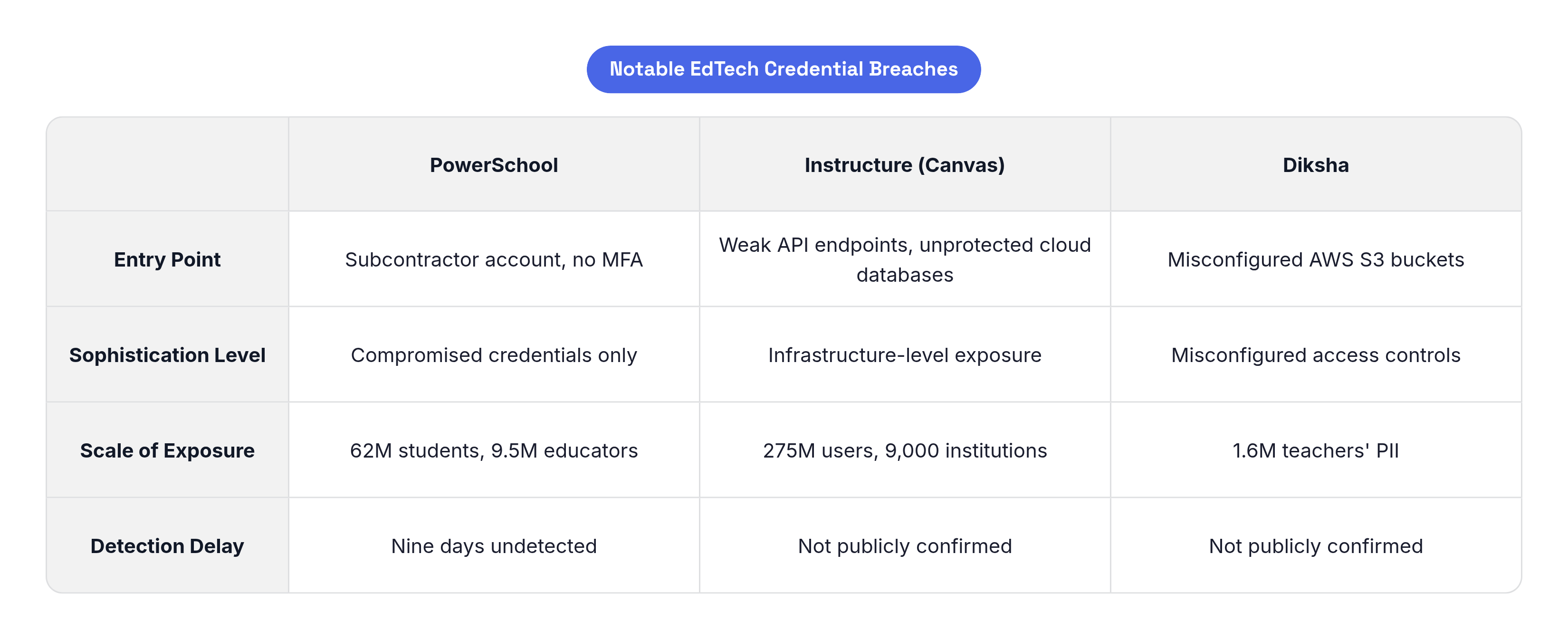
Let's start with what actually happened, because the specifics are clarifying.
In December 2024, PowerSchool. A subcontractor's account. No MFA. An attacker walked in with compromised credentials and spent nine days inside before anyone noticed. The result: 62 million students' records and 9.5 million educators' records exposed. No zero-day exploit. No sophisticated nation-state tooling. Just a credential nobody was protecting.
Then Instructure, the company behind Canvas. ShinyHunters claimed theft of 3.65 terabytes of data affecting 275 million users across roughly 9,000 institutions. The attackers' typical method involves weak API endpoints and unprotected cloud databases. Not glamorous. Not complicated. Infrastructure-level credential exposure.
India's Diksha app lost 1.6 million teachers' PII through misconfigured AWS S3 buckets. Again, not a sophisticated attack. Access controls were never properly set.
The pattern is consistent across every one of these incidents. The attacker didn't need to break in. The door was open. Entry points weren't sophisticated vulnerabilities. They were gaps in basic hygiene: an unguarded account, an exposed credential, a misconfigured access control.
This matters because it reframes the problem. You don't need to build an impenetrable fortress. You need to close the doors that are currently open.
How Secrets End Up Exposed Before an Attacker Even Tries
Here's something that will either validate your worst fears or genuinely surprise you: an enormous number of organizations already have credentials sitting in places they shouldn't be, right now, without knowing it.
GitGuardian tracked 28.65 million new hardcoded secrets added to public GitHub repositories in 2025 alone. That's a 34% year-over-year increase. The largest single-year jump ever recorded. And before you say "well, we use private repos," private repositories are actually nine times more likely to contain secrets than public ones. They just become exposed through misconfigurations or supply-chain breaches rather than direct public visibility.
AI coding tools are making this worse. AI-assisted commits show double the secret-leak rate of non-AI-assisted commits. AI-service credentials, think LLM API keys and embedding service tokens, increased 81% year-over-year in 2025. GenAI adoption in EdTech is generating a new category of credential risk that most teams haven't caught up to yet.
The less obvious vectors are where things get genuinely uncomfortable:
- Jira tickets contain credentials more often than most engineering teams realize
- A meaningful percentage of corporate Slack channels contain leaked secrets
- CI/CD pipelines, deployment scripts, and config files accumulate credentials like lint in a dryer
The scariest part: 70% of secrets leaked back in 2022 were still active when researchers checked. Exposure is not a moment in time. It compounds. Every day a leaked credential goes unrotated, the attack surface grows.
For EdTech specifically, the problem accelerates. Rapid feature shipping, student-built integrations, and shadow APIs from deprecated portals mean credentials accumulate faster and get cleaned up slower than in almost any other sector.
The Regulatory Obligations That Turn a Credential Leak Into a Compliance Event
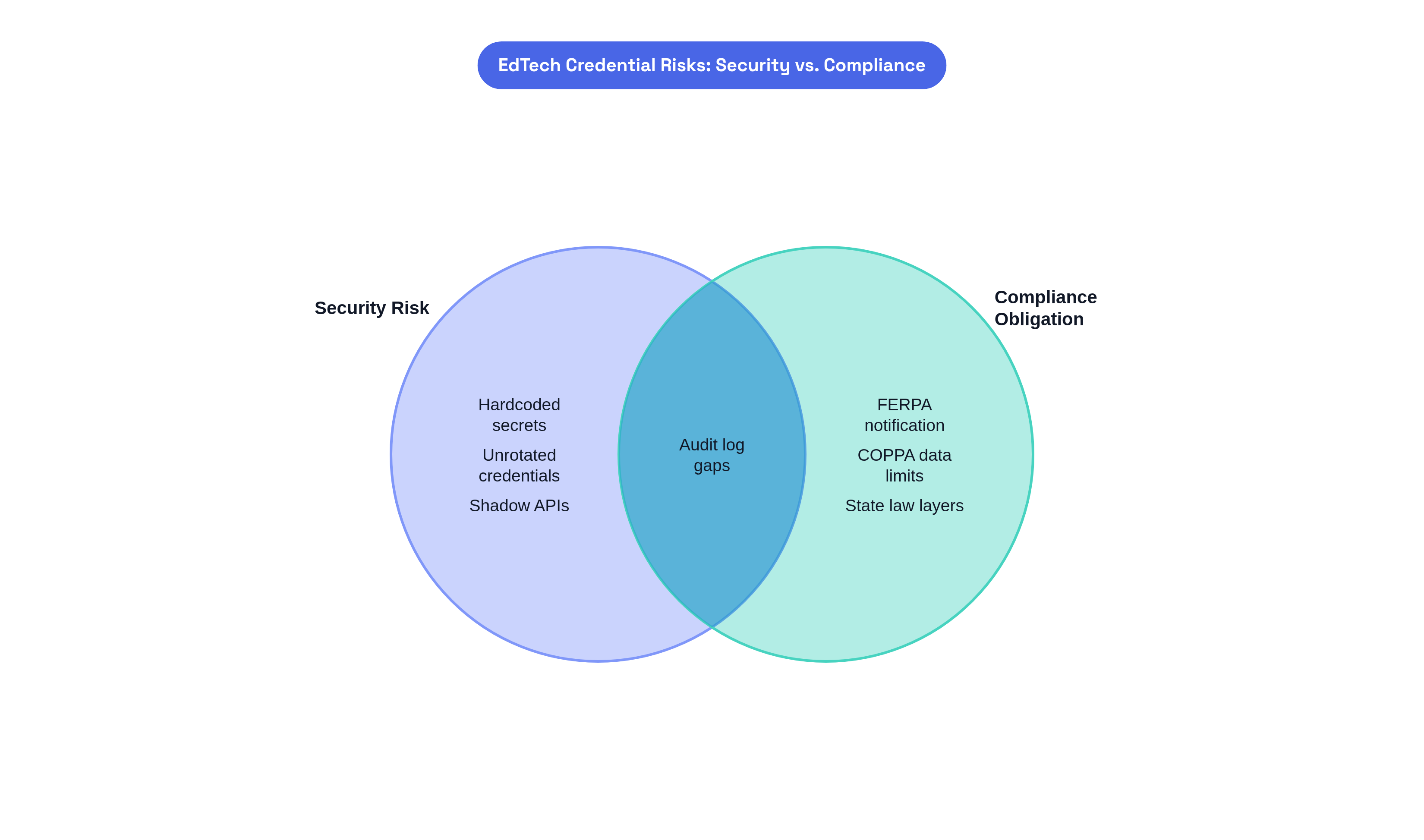
A credential leak in EdTech is not just a security incident. It is very likely a legal event, often several legal events simultaneously.
FERPA says any unauthorized disclosure of education records, including through a compromised API credential, is a violation. Institutions can lose federal funding. COPPA applies to any EdTech product directed at children under 13 that collects personal data via API, with strict breach notification and data minimization obligations. GDPR, for platforms serving European students, means overly permissive API scopes can themselves constitute violations, not just the breach that follows.
State laws add more layers. SOPIPA. New York Education Law 2-d. Others. Each one places additional restrictions on how student data flows through third-party API integrations.
The practical consequence is this: a single exposed credential that allows access to student records doesn't just create a remediation bill. It triggers mandatory breach notification to affected families. It triggers regulatory investigation. It creates contractual liability with every institutional customer who signed a data processing agreement.
IBM's Cost of a Data Breach Report 2024 put the average education sector breach cost at $3.6 million. That's before regulatory fines. Before reputational damage. Before the institutional customers who don't renew.
The regulatory frameworks aren't punishing teams for being unlucky. They're punishing teams for the choices that made the breach possible. Credential management is one of those choices.
Storing and Injecting Secrets Without Touching Source Code
The baseline rule is simple, even if enforcing it takes work: no API key, token, password, or certificate should ever appear in source code, version control, or application logs. Ever. That's not a best practice. That's the floor.
From there, the practices build on each other:
Environment-based injection. Secrets live externally and get injected at runtime through environment variables or a secrets manager SDK. The application never holds the value statically. If someone reads the code, they find a reference to where the secret lives, not the secret itself.
Separate credential sets per environment. Development, staging, and production each get their own secrets. A compromise in a test environment cannot reach production. This sounds obvious. It is also violated constantly.
Dedicated secrets managers. HashiCorp Vault, AWS Secrets Manager, Azure Key Vault, Google Cloud Secret Manager. These tools handle encryption at rest and in transit, versioning, and access policy enforcement from a single source of truth. For lean EdTech teams that need data residency control or can't afford enterprise licensing, Infisical is an open-source, self-hostable option gaining real traction.
Pre-commit scanning. Tools like Gitleaks, ggshield, and TruffleHog can sit as pre-commit hooks and catch secrets before they ever hit a repository. This is a safety net. It is not a substitute for not hardcoding secrets in the first place. If your team is catching secrets at the pre-commit stage regularly, that's a signal the root behavior needs to change, not just the tooling.
The goal is an architecture where secrets are never static, never visible in code, and always controlled through a system that has its own access controls and audit trail.
Scoping Permissions and Enforcing Least Privilege Across EdTech Integrations
Once you've secured where credentials live, you need to think about what each credential can actually do.
Least privilege is the principle: every API credential should grant only the permissions that specific integration actually needs. Nothing broader. An LMS integration that only reads assignment submissions should not hold a token that can write to grade records or access billing data. The principle is obvious. It is routinely ignored.
A few ways this shows up in practice:
- RBAC and ABAC at the API layer. Role-based and attribute-based access controls define what each consumer role can read, write, or delete. These get validated server-side, never client-side. Client-side validation is cosmetic. Server-side validation is real.
- Short token lifespans. Time-limited tokens reduce the damage window if a credential is compromised. A token that expires in an hour is far less useful to an attacker than one with no expiry date.
- Dynamic secrets. Just-in-time provisioning creates temporary credentials that expire automatically after use. No standing privileges. No long-lived secrets to steal. This is the ideal state for high-sensitivity integrations.
The regulatory angle matters here too. FERPA has a minimum-necessary standard. An over-permissioned API returning a full student profile when only a name is needed doesn't just create security risk. It creates a FERPA problem, because you've accessed more data than the integration required.
The PowerSchool breach is a useful reminder that this scoping discipline applies to third-party vendor credentials, not just your own integrations. That subcontractor account had sufficient access to exfiltrate records at scale. Least privilege applied to that account would not have prevented the compromise. But it would have dramatically limited the damage.
Rotating Credentials on a Schedule That Reflects Actual Risk
Credential rotation is one of those things everyone agrees is important and very few teams actually do consistently. Usually because it's manual, and manual processes lose to engineering pressure every single time.
The baseline cadence: rotate all credentials, database passwords, API keys, service tokens, every 30 to 90 days. High-sensitivity integrations warrant the shorter end of that range. Integrations touching student PII are high-sensitivity by definition.
The only way rotation actually happens on schedule is automation. Secrets managers like AWS Secrets Manager and HashiCorp Vault support automated rotation with zero-downtime key handoffs. The rotation happens, the new credential propagates, the old one is invalidated, and the engineering team doesn't have to remember to do it. That last part is the important part.
Immediate revocation on suspicion is non-negotiable. If you think a key is compromised, revoke it first and investigate second. The cost of a false positive is a brief outage. The cost of a confirmed exfiltration is measured in millions and regulatory letters to families.
Recall that 70% of secrets leaked in 2022 were still active when measured later. That is the cost of deferred rotation at scale. Each of those is a standing invitation.
One important caveat: rotation alone doesn't fix the problem if the rest of the stack is broken. A rotated key that's still hardcoded in a repository will simply be replaced by another hardcoded key. Rotation is one layer of a system. It doesn't substitute for the other layers.
Audit Logging as the Mechanism for Detecting Credential Misuse Early
If you don't know what your credentials are doing, you don't know when they're being misused. And you won't know until the damage is done.
Every API call made with a stored credential should generate a log entry: which credential, what endpoint, what data was accessed or modified, what IP, what timestamp. That's the minimum. Centralized audit logs are also a compliance requirement under FERPA and most state frameworks. They're not optional paperwork. They're the only mechanism that lets you reconstruct what happened after a breach.
The PowerSchool intrusion ran nine days before detection. Nine days. Complete audit trail logging with anomaly detection on that subcontractor account would likely have surfaced the unusual activity far earlier.
What you're actually monitoring for:
- Access outside normal business hours
- Access from unexpected IPs or regions
- Volume spikes that suggest bulk data pulls
- Access by credentials that should have been rotated or revoked
Secrets managers make this easier. HashiCorp Vault maintains detailed audit logs of every secret access. AWS Secrets Manager integrates with CloudTrail for the same purpose. You get an audit trail for the credentials themselves, not just the API calls they generate.
One thing that gets overlooked: protect the logs themselves. Store audit logs in write-once or append-only storage that a compromised credential cannot overwrite. An attacker with API access should not be able to erase the evidence of what they accessed. If your logs are writable by the same credentials that generated them, they're not really audit logs. They're suggestions.
Securing EdTech Interoperability Standards: LTI and Edu API
EdTech has its own interoperability standards, and they come with their own credential management requirements that don't always get the same attention as general API security.
LTI (Learning Tools Interoperability) is the dominant mechanism for connecting third-party tools to LMS platforms like Canvas and Blackboard. It is credential-bearing. LTI 1.3 replaced the older OAuth 1.0a-style signing with OpenID Connect, signed JWTs, and OAuth 2.0 workflows. Platforms still running LTI 1.1 are using a weaker authentication model. Migration to 1.3 is not a nice-to-have at this point.
The 1EdTech Security Framework, adopted by a large and growing consortium of school districts, higher education institutions, and EdTech providers, provides a structured compliance self-assessment for security practices including credential handling. 1EdTech's Edu API initiative is standardizing how student data flows between platforms. Correct implementation means treating the OAuth tokens it issues with the same scoping and rotation discipline as any other API credential.
The common failure mode in LTI deployments: LTI keys and secrets get stored in LMS admin panels with no rotation policy and shared across multiple tool integrations. A single compromised LTI credential can affect every tool connected to that platform. That's not a theoretical risk. That's an architecture where one mistake propagates everywhere.
EdTech vendors should be able to answer clearly: which LTI version do they support, how do they store platform keys, and do they enforce token expiry. Institutional buyers are increasingly asking exactly these questions during procurement. If a vendor can't answer them, that's informative.
Managing Credentials in Third-Party API Integrations Without Absorbing Their Risk
A typical EdTech product doesn't just have one API. It has many. Payment processors, identity providers, communication APIs, AI and LLM services, analytics platforms, SIS connectors. Each one requires a stored credential. Each one is a potential entry point.
AI-service credentials alone increased 81% year-over-year in 2025, reaching over 1.27 million detected leaks. EdTech teams adopting GenAI tools are generating a new category of high-value, poorly managed credentials at a pace that security practices haven't caught up with.
The principles that apply here:
Per-integration scoping. Each third-party API integration gets its own credential with its own permissions. Shared keys across integrations mean one compromise exposes everything connected to that key. This is the credential equivalent of using the same password everywhere.
Vendor security posture is your problem too. The PowerSchool breach originated with a subcontractor's credential. The attacker didn't compromise PowerSchool directly. They compromised someone PowerSchool trusted with access. EdTech platforms should require MFA, rotation policies, and audit logging from any vendor holding privileged access to student data. Put it in the contract.
Shadow APIs are a real and underappreciated risk. Deprecated integrations, retired mobile apps, student-built tools from three semesters ago. These often remain live and credential-bearing long after anyone remembers they exist. Inventorying and decommissioning old credentials isn't glamorous work. It's also the kind of thing that shows up in breach reports under "the attacker used an abandoned API endpoint."
IBM's breach research from 2025 identified stolen or compromised credentials as the most frequent initial attack vector, accounting for 16% of incidents and taking an average of 292 days to identify and contain. Nearly ten months. For EdTech, that window spans an entire academic year.
The goal with third-party integration management isn't zero risk. It's making sure that when a third-party vendor has a bad day, your students don't feel it. That requires treating every external credential with the same seriousness as your own internal ones, because from an attacker's perspective, there is no difference.