Low-Code Integration Platforms for EdTech Product Teams
Low-code integration platforms absorb the maintenance burden that drains EdTech teams after launch.

If you work at an EdTech company and you haven't yet felt the integration tax, give it time. The moment your product needs to live inside a school's existing stack, that's when you discover that "just connect to the LMS" is about as simple as "just merge those two spreadsheets." The average school district touches over 500 EdTech applications every month. Five hundred. That fragmentation isn't a future problem to solve. It's the water your product swims in on day one. The good news is that low-code integration platforms have matured to the point where they genuinely change the math on how much engineering effort that fragmentation demands.
The LTI vs. API Fork and What It Means for Integration Strategy
Here's the first decision that shapes everything downstream.
When your product needs to connect to an LMS, you have two broad paths:
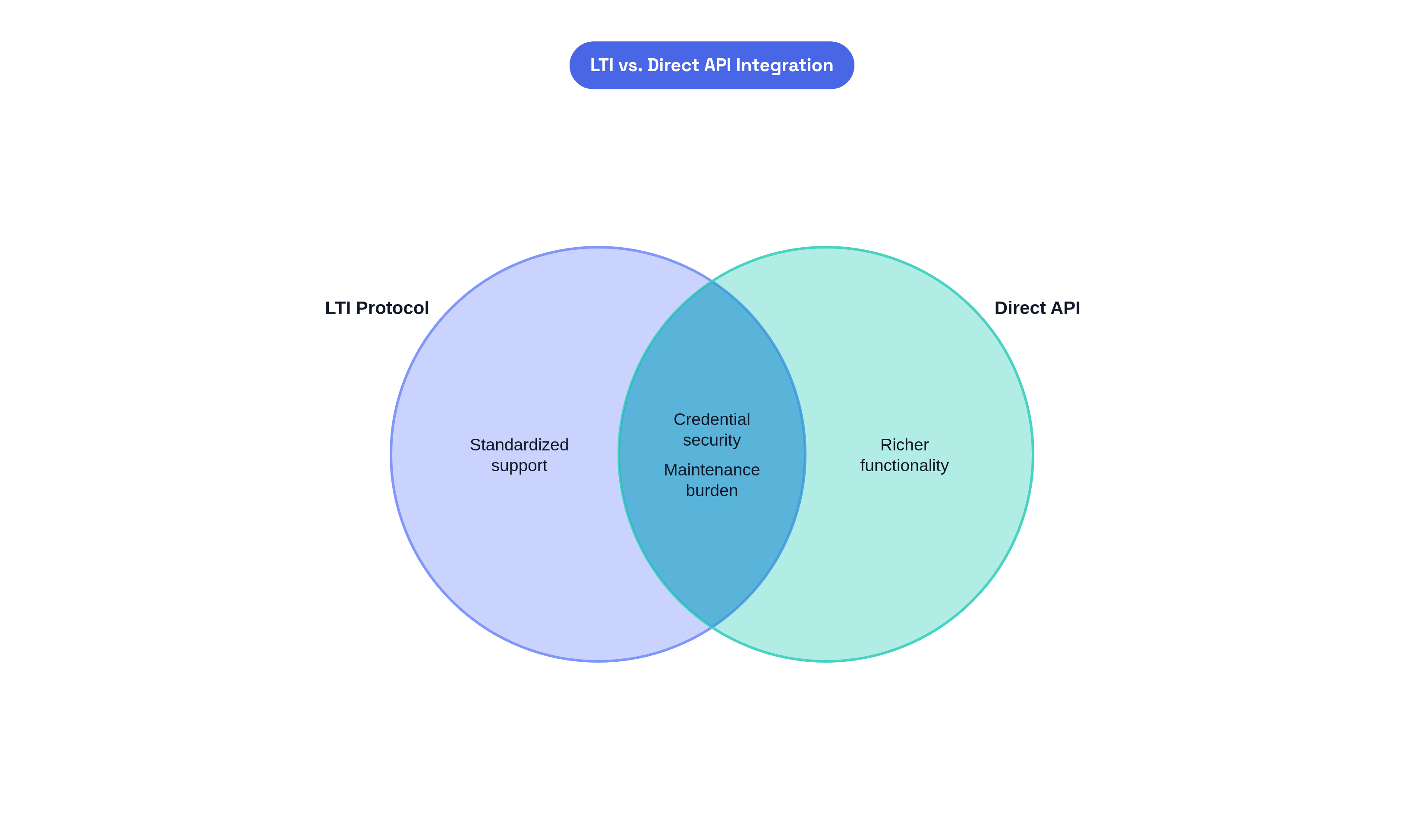
- LTI (Learning Tools Interoperability): A standardized protocol that many LMS platforms support. Build it once, and it works across compliant platforms. Narrower in scope, but portable.
- Direct API integration: More powerful, more flexible, more customizable. Also completely non-transferable. An integration built for Canvas does not transfer to Blackboard. Brightspace is its own thing entirely.
Microsoft Teams now supports LTI for certain integrations, which tells you something important: even platforms outside the traditional LMS world are buying into the standard. That's institutional momentum you can't ignore.
But here's the trap. A product serving multiple institution types, K-12 districts, higher ed, corporate L&D, will almost certainly need both. LTI for broad compatibility. Direct API connections where richer functionality is required. And the moment you're maintaining both, your maintenance surface doubles. Every LMS update is now a potential breakage point across two integration types.
Self-hosted deployments (Canvas and Brightspace both offer this) add another layer. Institution admins have to generate developer keys. These are high-privilege credentials touching sensitive student data. Transmitting and storing them securely isn't optional. It's the whole ballgame.
The real cost here isn't the initial build. It's deprecation handling, credential rotation, and schema drift over time. That's what quietly drains engineering capacity.
What Low-Code Integration Platforms Actually Offer EdTech Teams
Let's be specific about what "low-code integration platform" actually means, because the category is genuinely several different things.
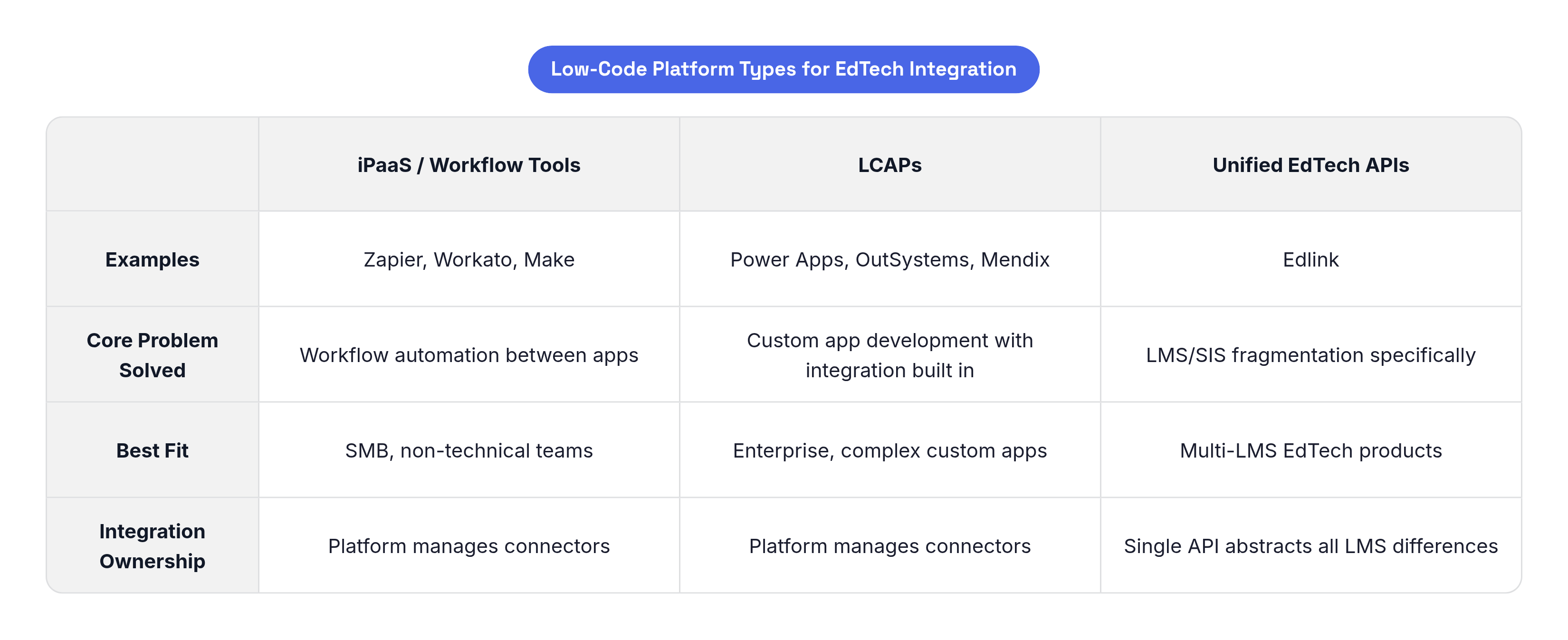
Type one: iPaaS and workflow automation tools (Zapier, Workato, Make). These connect existing apps through pre-built connectors. You don't write auth flows. You don't parse API schemas from scratch. The platform handles OAuth, credential management, and endpoint normalization.
Type two: Low-code application platforms, or LCAPs (Power Apps, OutSystems, Mendix). These support building and integrating custom applications. Integration isn't a feature you bolt on. It's baked into the development environment.
Type three: EdTech-specific middleware (Edlink is the clearest example). A unified API that abstracts multiple LMS platforms behind a single interface. One integration covers Canvas, Blackboard, Brightspace, and others simultaneously. Over 150 EdTech companies reportedly use Edlink to get schools connected in under ten minutes, with SSO, grade passback, and automated rostering handled out of the box.
The key distinction:
- iPaaS solves workflow automation between existing systems
- LCAPs solve custom application development with integration built in
- Unified APIs solve the LMS/SIS fragmentation problem specifically
The other thing these platforms do that never shows up in a features comparison: they absorb maintenance burden. When an upstream API changes, the platform updates its connector. Not your engineering team. Your backlog stays clear. The platform handles it.
That's the value proposition that doesn't get enough credit.
How Platform Choice Maps to EdTech Company Stage and Customer Base
Not every platform fits every moment. Here's how the landscape actually maps to where a company is.
Early stage or MVP. No-code and light low-code tools reduce time and cost enough to validate demand before committing to custom builds. There's a well-documented example of a micro-learning startup that launched course modules, assessments, dashboards, and payment integrations within six weeks using a no-code platform. Six weeks. That's not a shortcut. That's a legitimate strategy for learning before you overbuild.
SMB-facing products with non-technical teams. Zapier is the natural fit. The majority of Zapier automations are built by people outside IT, which says everything about the accessibility. Pricing is transparent, starting free with paid tiers scaling into the thousands monthly before enterprise gets involved.
Enterprise EdTech with complex multi-system workflows. Workato is built for this. No self-serve pricing, targets IT teams and technical business analysts, typically runs well over a thousand dollars a month. That's not a criticism. That's a feature. Enterprise deals require enterprise-grade tooling, and the complexity justifies it.
Products serving Microsoft-first institutions. If your customers are running Microsoft 365 or Teams for Education, Power Platform is the path of least resistance. Deep Azure and Dynamics integration, low learning curve for institutions already in the ecosystem.
Large externally-facing EdTech applications. OutSystems has been a Gartner Leader for eight consecutive years and claims up to 70% reduction in concept-to-deployment time with 200+ out-of-the-box integrations.
European markets and agile teams. Mendix has real traction here, particularly among teams with hybrid deployment needs and organizations already in the Siemens or SAP ecosystem.
Low-code platforms are not just a startup shortcut. That framing undersells them. At the growth phase, when institutional adoption demands compliance, audit trails, and scalable auth management, these platforms become a strategic infrastructure choice, not a workaround.
The Maintenance and Compliance Costs That Survive the Initial Build
This section is the one most teams skip. And then pay for later.
Student data regulations (FERPA, COPPA, and a growing number of state-level equivalents) mean every integration touching roster or assessment data carries compliance obligations. Not just technical requirements. Actual legal obligations. The integration isn't done when it ships. It's done when you can demonstrate, under audit, that data was handled correctly.
Developer keys for LMS API access are high-privilege credentials. Insecure transmission or storage isn't a minor issue. It's a significant vulnerability. That's not hypothetical. It's documented in how platforms like Canvas and Brightspace handle self-hosted key generation.
LMS vendors update on their own schedules. An integration built against Canvas's current API will break silently after a platform update. If your engineering team maintains its own connectors, your engineering team absorbs that risk, every time, for every LMS you support.
Low-code platforms and unified APIs centralize this risk. One vendor monitors and patches. Many product teams benefit from that patch simultaneously. Companies using low-code tools report meaningful savings in development costs and time-to-market, but the less visible benefit compounds over time. It's the maintenance saving. It's the engineering hours not spent chasing connector breakage and spent instead on the differentiated features that drive retention.
That's the number worth internalizing. Engineering hours spent on upkeep are hours not spent on the thing that makes customers stay.
Where Low-Code Integration Fits Inside EdTech Product Team Workflows Today
The adoption curve here is real and it's steep. Education sector low-code and no-code adoption is growing faster than most verticals, with projections tracking above 23% compound annual growth through the late 2020s. Use of low-code tooling for e-learning tools specifically has seen a reported 30% rise.
The pandemic exposed how brittle legacy portals were. Faculty and administrators who spent years waiting in IT queues to configure anything now expect to configure tools themselves. Low-code platforms meet that expectation at the institutional level, not just the product team level. This matters because the customers you're selling to are increasingly building things themselves.
Nearly 60% of custom applications were built outside IT in 2022 using no-code or low-code tools. That share is projected to keep climbing. EdTech product teams building for institutions will increasingly find that their customers are already native to this ecosystem.
The practical outcome for a product team is this: embedding integration infrastructure early removes the recurring negotiation between shipping features and maintaining connectors. That negotiation is exhausting. It's also invisible to leadership until something breaks. Call it the silent tax on every sprint — which brings us back to where we started. The integration tax doesn't announce itself. It just quietly shows up on your backlog, week after week, like a colleague who never has anything urgent but always has something.
EdTech teams serving multiple institution types cannot build and maintain bespoke integrations for every LMS and SIS combination they encounter. The math doesn't work. The engineering headcount required to do that doesn't scale proportionally with revenue. The platform approach is the only path to breadth without hiring an integrations team for every new LMS you want to support.
One open question worth watching: as LTI adoption widens and LMS vendors continue to consolidate, the fragmentation problem will ease at the edges. But proprietary API differences aren't going away quickly, and data security requirements are getting stricter, not looser. Managed integration infrastructure will stay relevant. The only variable is which layer of that infrastructure your team owns directly versus delegates to a platform that handles it for everyone.