Reducing Time-to-Market for EdTech Feature Releases
EdTech startups can't afford slow releases, and integration overhead is eating the runway.

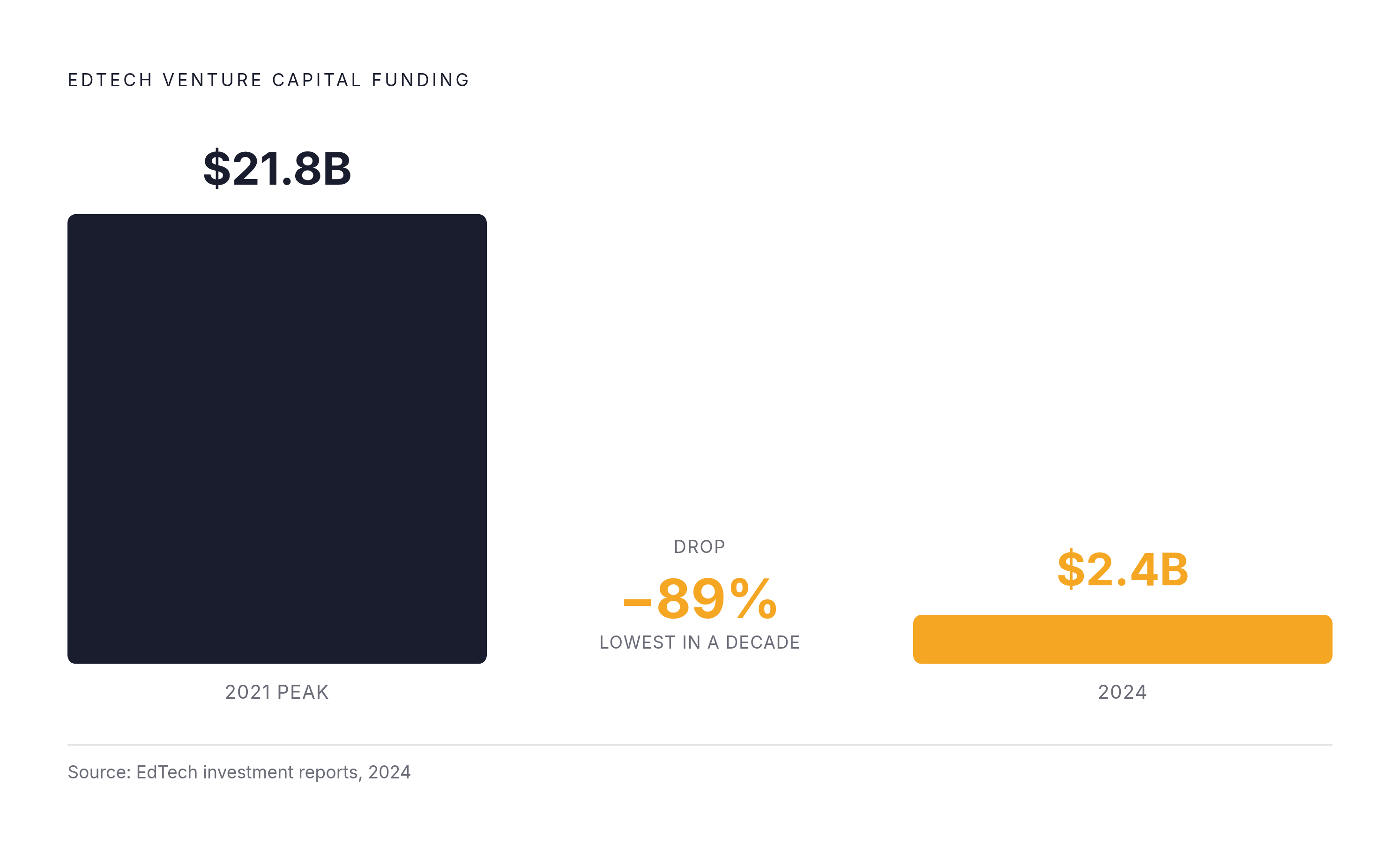
EdTech venture capital fell to roughly $2.4 billion in 2024. That is an 89% drop from the 2021 peak and the lowest level in a decade. Meanwhile, more than 8,000 EdTech companies are listed on Crunchbase, about a third of them in the US. More crowded than ever, precisely when the money is tightest.
In that environment, a slow release cycle is not just frustrating. It can mean missing a funding round, losing a district contract to a faster competitor, or burning through runway before you can prove traction. The hidden drag on your release cycle is not the core feature work. It is the integration overhead: the engineering time spent connecting to the learning management systems (LMS), student information systems (SIS), and rostering tools that schools already use and require. Remove that drag, and you change the math on everything else.
Why EdTech Releases Are Structurally Slower
Most software categories get to ship whenever they want. EdTech does not.
The academic calendar compresses viable release windows to roughly twice a year: fall semester start and winter break between terms. Launch mid-course and you disrupt active classrooms, break instructor workflows, and flood your support queue with tickets about gradebook changes nobody asked for.
That window problem compounds quickly. Getting sign-off from decision-makers across more than 16,000 US districts adds weeks or months before a feature reaches actual users. Districts now demand outcome proof before adoption, and only 40% of purpose-built EdTech tools have identifiable evidence aligned to ESSA (Every Student Succeeds Act) standards, which sets the bar for federally recognized educational effectiveness. So the validation phase before wide deployment is long, and it is getting longer.
Then there is the regulatory stack. It includes FERPA (which governs student education records), COPPA (which protects children's online privacy, amended in 2025 with full compliance required by April 22, 2026), and ADA Title II WCAG 2.1 AA accessibility standards. Add more than 121 state privacy laws, each enforced separately. State-level cybersecurity and data privacy laws have increased 620% since 2020. Compliance review is now embedded in every feature that touches student data.
These constraints are real and mostly fixed. You cannot negotiate with the school calendar. You cannot opt out of FERPA. The only meaningful question is what, within this environment, you can actually control.
Where Engineering Time Actually Goes
Growth-stage EdTech products are almost always built on large, tightly coupled codebases assembled under startup speed pressure. Technical debt accumulates faster than it gets paid down, which is expected for a while but quietly devastating once you are trying to scale.
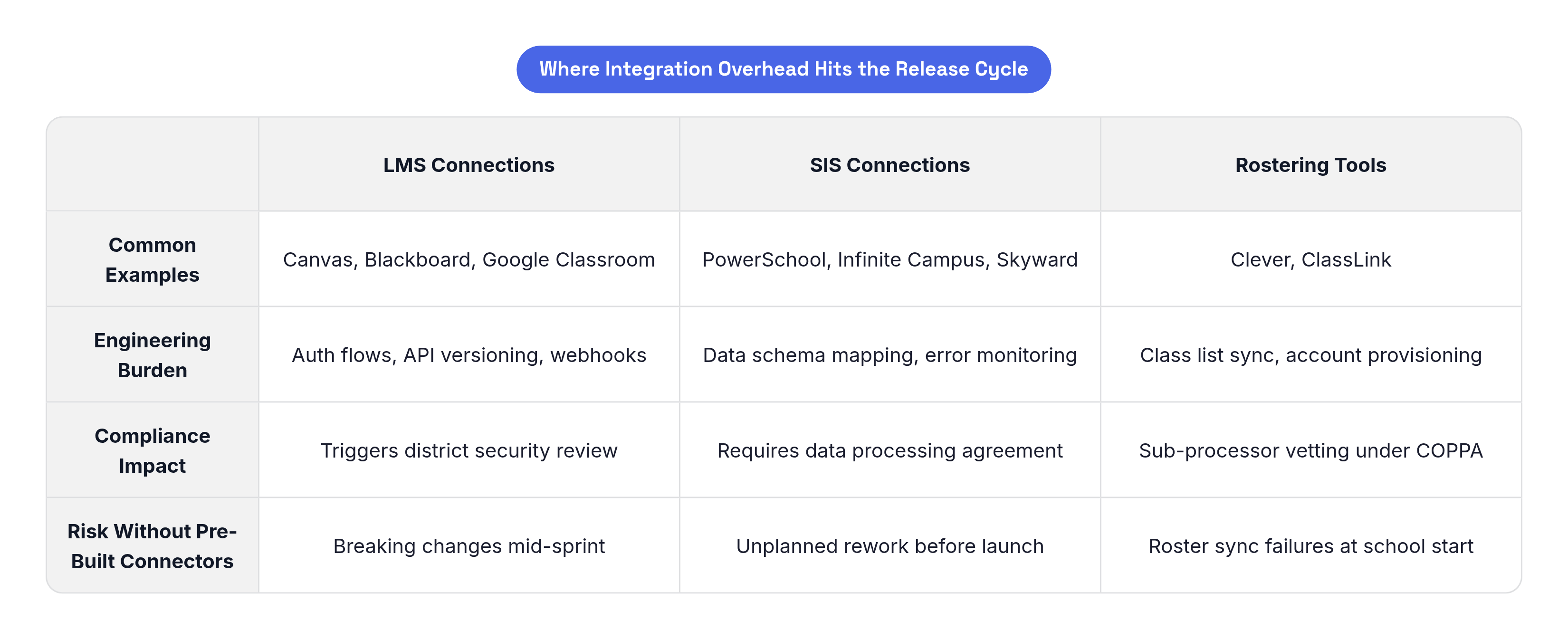
The problem surfaces when the same engineering team that built the core product gets pulled into maintaining connections to tools schools already use. Canvas, Blackboard, and Google Classroom on the LMS side. PowerSchool, Infinite Campus, and Skyward for SIS. Clever and ClassLink for rostering, which automates the process of syncing class lists and user accounts from the district into your platform. These are not optional integrations. Districts frequently require them as a condition of procurement. A product that does not connect to the district's existing stack does not get purchased.
Each integration involves authentication flows and token management, data mapping between your schema and theirs, API version management, webhook handling (receiving real-time event notifications from external systems), error monitoring, and re-testing every time an upstream API changes.
API deprecations and breaking changes from third-party vendors do not arrive on the academic calendar. They arrive on the vendor's schedule, creating unplanned engineering work mid-sprint, right when your team should be focused on the feature that needs to ship before August. The result is your engineers building connectors instead of the differentiating features that move your product forward. That drag hits every single release cycle, and it is easy to underestimate until you are deep inside it wondering how the quarter got away from you.
How Integration Overhead Compounds Over Time
Connecting to LMS, SIS, and rostering systems is not a one-time build. Each connection requires ongoing maintenance as APIs evolve, authentication standards shift, and data schemas change on someone else's timeline.
Every new institution you sell into requires a different combination of integrations. The maintenance surface grows with your customer base, not with your headcount. That ratio gets worse over time.
Security and compliance review adds latency on top of the engineering time. Each new third-party connection triggers a fresh data processing agreement negotiation or security review with the district's IT team. Under the updated COPPA rule effective June 23, 2025, every analytics tool and third-party sub-processor that touches student data must be vetted by the EdTech operator. Every new connection adds a compliance review step.
There is a well-documented case from Cleveroad about a platform called Betabox. Built for educators and administrators, targeting a six-month MVP timeline. Integrating with existing infrastructure was on the critical path from day one, not a post-launch addition. The integration work was woven into the build itself, adding time before a single user ever logged in.
If your team is small, the engineering cost of maintaining a growing connector library is effectively a tax on every sprint. Each hour spent on a broken webhook is an hour not spent on the AI-powered feature your roadmap promised. And 67% of EdTech companies were integrating AI or machine learning into their platforms as of 2024. The competitive baseline for feature releases is rising even as resources shrink.
Where Modern Engineering Practices Help and Fall Short
The industry has gotten significantly better at shipping software. About 95% of organizations have adopted some form of Agile, an iterative approach to project management that prioritizes working software over long planning cycles. Around 84% use at least one DevOps practice, meaning their development and operations workflows are integrated to reduce friction between writing code and deploying it. Organizations with mature DevOps report a 200% rise in deployment frequency and a 50% drop in time-to-market. CI/CD (continuous integration and continuous delivery) pipelines automate testing and deployment, enabling faster and more reliable releases. AI-driven QA is showing real gains in testing productivity. Cloud-native and microservices architecture lets EdTech platforms update individual components without redeploying the entire product.
These practices matter, but none of them eliminate the upstream problem. The integration work still has to be built and maintained by someone before any of these pipelines can run it. A fast CI/CD pipeline that efficiently deploys a broken Clever roster sync is not progress; you are just finding out about the problem sooner.
Agile ceremonies and DevOps tooling optimize the work your team is already doing. They do not change what your team is doing. If your engineers are spending their cycles on connector maintenance, faster sprints just mean you are burning through that maintenance work more visibly.
How Pre-Built Connectors Change the Math
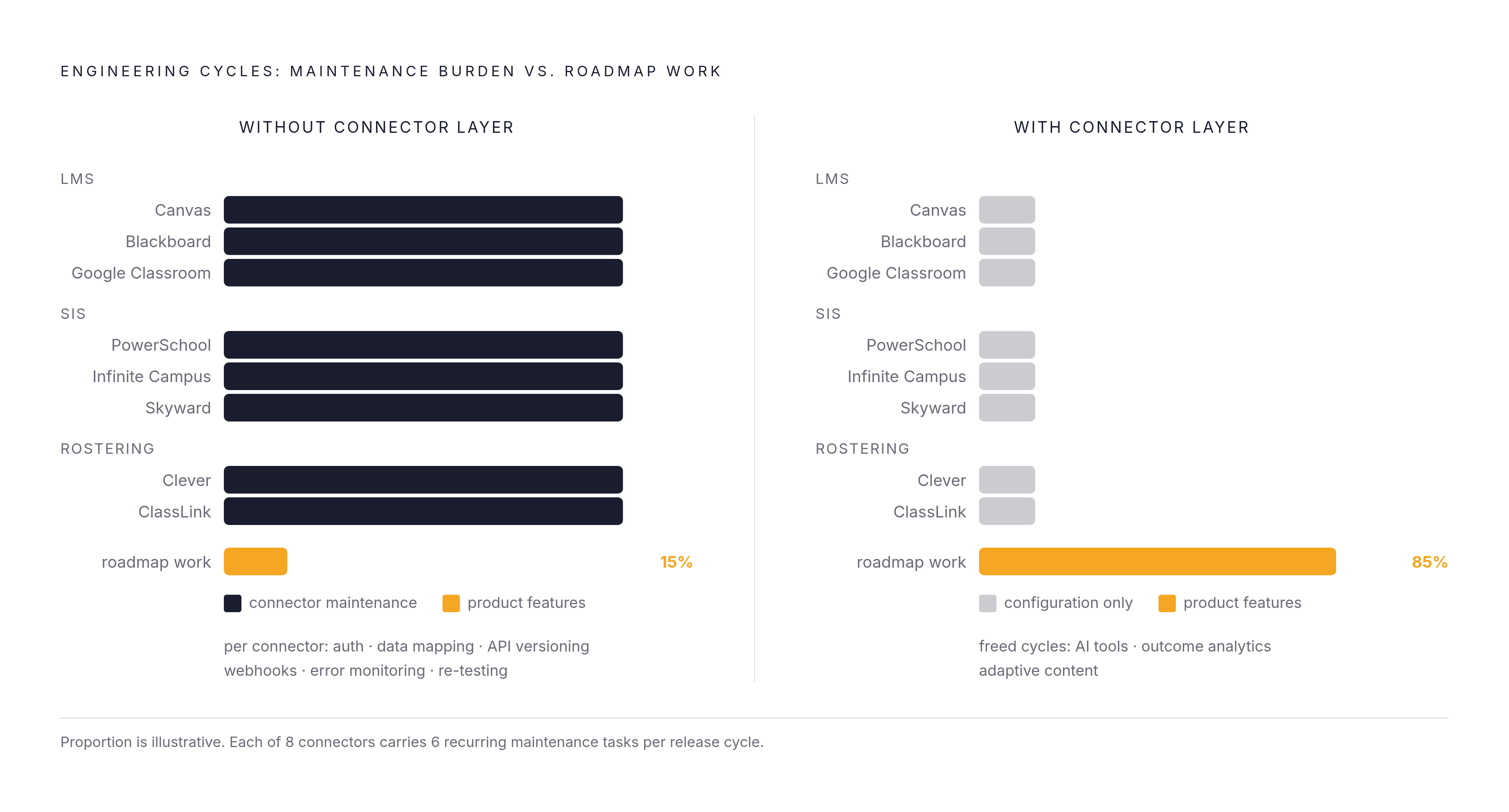
Pre-built connectors for common EdTech systems shift integration from custom engineering to configuration. The connection already exists, and your team maps their data model to it. That is a fundamentally different workload, and the difference is not marginal.
Authentication handling becomes unified. Managing OAuth flows, token refresh, and credential storage for each connected system is one of the most error-prone and compliance-sensitive parts of third-party integration. Pre-built connectors remove that from your engineering team's plate entirely.
API version management moves to the connector layer. When an upstream vendor ships a new API version, the connector handles it. Your codebase stays intact. Nobody gets paged at 11pm the week before school starts.
The compliance surface shrinks as well. Pre-verified connectors reduce the surface area each new integration adds to a district's security review. Fewer custom components to audit means faster data processing agreement sign-off and shorter procurement cycles. Districts move faster when the integration question is already answered.
As you add customers with different integration requirements, the maintenance burden does not grow proportionally. The connector library is shared infrastructure, not per-customer custom code written by whoever was available that sprint. The practical outcome is engineers spending time on differentiating features: the AI-powered tools, the outcome analytics, the adaptive content, rather than keeping a roster sync from breaking the night before school starts.
Hitting the Academic Calendar Window
You already know the two viable release windows are fixed. What you can control is how much of your pre-launch sprint gets consumed by integration work versus feature polish and QA.
A team building and maintaining its own LMS and SIS connectors is betting that nothing breaks in the six weeks before a school-year launch. That bet loses regularly. API changes, authentication failures, and data mapping edge cases surface at the exact moment your team has zero slack to deal with them.
Reducing integration overhead compresses the time between feature completion and safe deployment at scale to districts. That gap is where most EdTech teams miss the window and end up waiting another semester, burning another six months of runway, and losing another cohort of potential users to a competitor who shipped first.
Hitting the window with a well-integrated product also accelerates procurement. Pre-verified integrations let you respond to district RFPs (formal requests for vendor proposals) in 24 to 48 hours rather than weeks. That is not a small thing when a district is evaluating three competing platforms and needs answers before the school year starts.
The EdTech market is projected to reach $588.72 billion by 2034. The teams consistently hitting the academic calendar window are not necessarily faster engineers or better funded. They stopped treating integration infrastructure as core product work, recognized that maintaining a growing library of custom connectors was a tax on every sprint, and found a way to stop paying it. You can do the same.