Developer Experience Design for EdTech Platform APIs
EdTech APIs need institutional trust as much as developer ease—here's how to design for both.

Building an EdTech API that actually gets adopted requires more than clean endpoints and good error handling. It requires understanding that your first real user is often not a developer at all. It is a procurement committee, an IT director, or a compliance officer who will never write a single line of code against your API but will absolutely decide whether anyone else gets to.
The EdTech market is enormous and growing fast. The global market was valued at USD 189.15 billion in 2025 and is projected to reach USD 588.72 billion by 2034. The LMS segment alone is on track to nearly double by 2032. But market size does not equal integration success. In a 2024 Clever survey of over 1,500 teachers, 68% said their LMS does not integrate well with one or more of the learning applications they use. That is not a feature gap. That is a DX problem showing up in classrooms — and classrooms, it turns out, are the one place where a dropped integration hits harder than a dropped call.
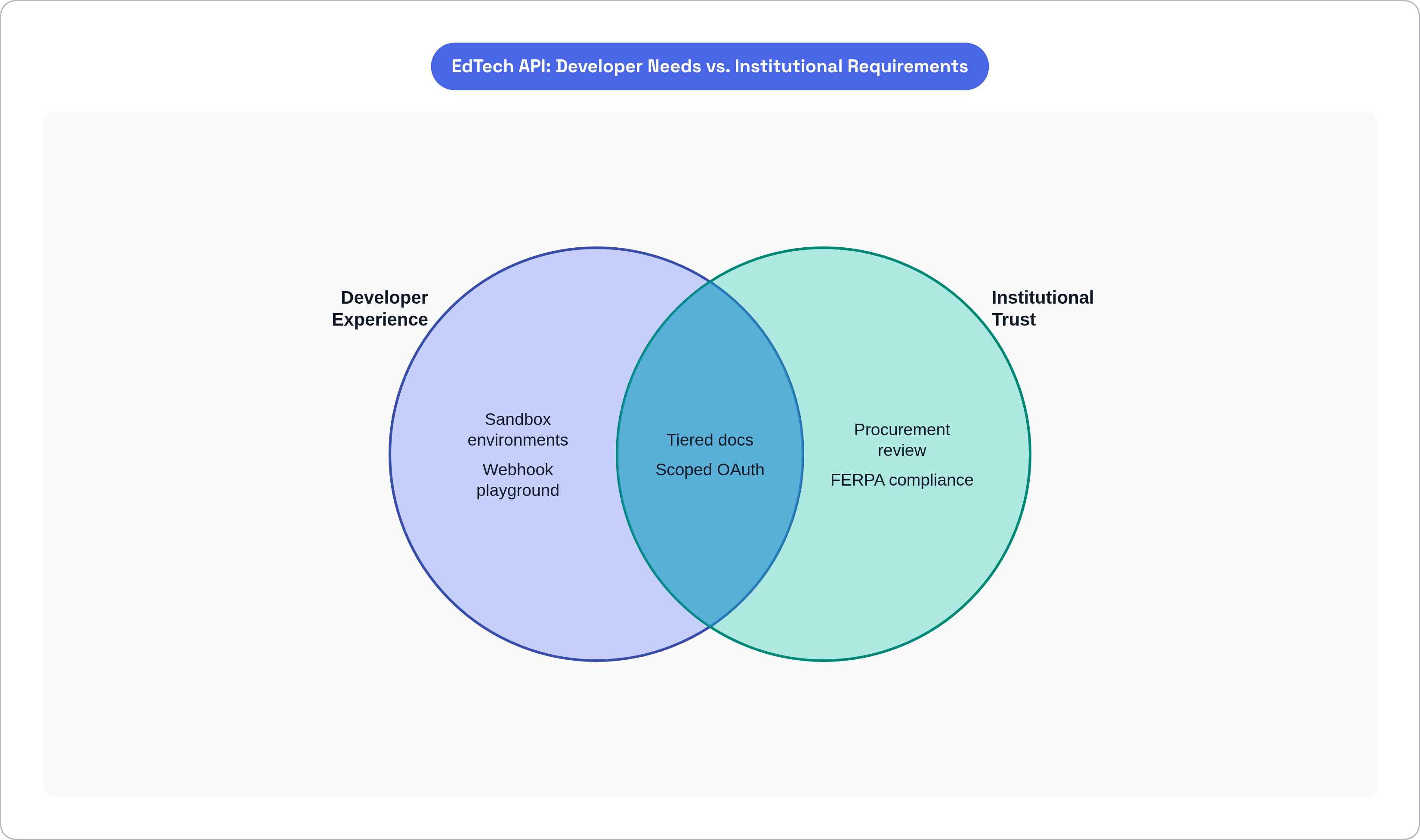
Here is the core tension worth naming early: generic API advice optimizes for how fast a developer can get to a working call. EdTech DX has to optimize for that AND for institutional trust, compliance surface area, and interoperability credibility. Those two goals are not always in conflict, but they require different decisions. Think of it like building a bridge that has to satisfy both the engineer who crosses it daily and the inspector who only shows up once — you cannot afford to impress one and ignore the other. This piece is about those decisions.
The Standards Stack That Institutional Buyers Actually Check Against
If you are new to EdTech integrations, the first thing to understand is that 1EdTech Consortium (formerly IMS Global) is the standards body that runs the table. Their specifications define the interoperability layer that institutions require. Get familiar with four of them.
LTI (Learning Tools Interoperability) connects a learning tool to an institution's LMS without requiring a separate login for each tool. LTI 1.3 uses OpenID Connect and JSON Web Tokens, which is a real security architecture upgrade from earlier versions. LTI Advantage bundles three services on top of that baseline: Deep Linking, Assignment and Grade Services (AGS), and Names and Roles Provisioning Services.
Here is a trap that catches a lot of teams. A vendor can display an LTI Advantage certification badge while only having implemented Deep Linking. The badge looks complete. It is not. Assuming full AGS support from the certification alone is a documented source of procurement errors — like judging a book by its cover, except the book is your compliance posture and the cover is a badge. Your documentation needs to state, explicitly, which LTI Advantage services are implemented. Not implied by a badge. Stated.
OneRoster governs how class rosters and grade data move between a Student Information System and an LMS. It supports both CSV and REST API exchange. In North America, Clever and ClassLink dominate district onboarding. Both speak OneRoster. Both act as rostering brokers that districts use to onboard apps at scale. Being incompatible with either one effectively closes the K-12 district channel. That is not a strong opinion. That is just how the market works.
Caliper Analytics uses a JSON-LD payload with defined event types including NavigationEvent, AssessmentEvent, and GradeEvent. It matters when your product needs to report learning activity data back into an institutional analytics environment. If you are building for institutions that already use LTI and OneRoster, Caliper is the expected analytics format.
Edu-API is the emerging one. Currently in Candidate Final Public status, it builds on OneRoster and LIS to standardize data exchange across higher education administrative systems. It is not a current requirement, but it signals where the stack is heading for teams building in higher ed.
One more thing on standards strategy. Supporting the longest possible checklist is not the goal. A tool sold to high school teachers does not need Ed-Fi or SCORM. A tool sold to district curriculum leaders for elementary literacy intervention probably needs OneRoster, LTI, Clever, ClassLink, and potentially state-specific requirements. The DX implication is that your documentation and onboarding should lead with the standards relevant to the buyer segment you actually serve. Not an undifferentiated wall of certifications. That wall tells nobody anything useful.
When standards are properly supported, the payoff is real. Alpha School achieved 2.1× student growth after implementing 1EdTech standards, consolidating data silos in 12 weeks. The standards reduce custom integration overhead. That is the whole point.
How Student Data Privacy Law Reshapes API Design Decisions
EdTech APIs operate under a multi-layered regulatory stack. FERPA. COPPA. GDPR for EU deployments. And over 130 state-level student data privacy laws passed in the US as of 2024, many of which go beyond federal requirements. Treating each of these as a separate checklist is exhausting and, honestly, unnecessary. The common principles across all of them are the same: purpose limitation, data minimization, transparency, security, and accountability. Design for those five principles and you satisfy most of the stack.
That said, three areas deserve specific attention right now.
FERPA governs the privacy of student education records at institutions receiving US Department of Education funding. EdTech vendors typically access those records under the "school official" exception, which carries strict limitations on use and re-disclosure. Federal scrutiny is tightening. In March 2025, the Department of Education required all state agencies to certify FERPA compliance by April 30, 2025. That is an unprecedented move and a clear signal of where attention is going.
Here is the critical API design point on FERPA: OneRoster defines how data is formatted and transmitted. It does not determine who has legal authority to share it. A FERPA-governed data field still requires a valid legal basis for transfer regardless of which technical protocol carries it. The protocol is not a permission slip.
COPPA just got a significant update. The FTC's amended COPPA Rule became effective June 23, 2025, with most updated requirements taking effect April 22, 2026. The revised rule now explicitly includes biometric identifiers as covered data. Fingerprints. Retina and iris patterns. Voiceprints. Gait patterns. Facial templates. If your platform uses facial recognition for attendance, voice recognition for reading assessment, or any form of biometric authentication, you are now inside COPPA's consent requirements for those data types. That is a direct product impact, not a compliance footnote.
For API surface area specifically, three design choices follow directly from privacy law.
First, education records cannot be repurposed for product experimentation, external data partnerships, or cross-institutional analytics without explicit authorization. If your API makes that kind of repurposing easy, that is a liability your institutional customers inherit.
Second, APIs that expose more student data fields than their stated purpose requires create compliance problems for the institutions consuming them. Minimal data exposure by default is a DX feature. Not a limitation.
Third, scoped OAuth permissions should reflect actual data needs. Offering overly broad scopes shifts compliance risk onto the district and triggers procurement rejection. That last sentence is worth reading twice.
What Documentation Must Do Differently When the Audience Includes Procurement, Not Just Developers
According to Stack Overflow's 2024 Developer Survey, 90% of developers cite API and SDK documentation as their preferred documentation source. That number is about developers. In EdTech, documentation is also read by IT directors, compliance officers, and procurement evaluators who are not developers and are not going to become developers. Your documentation has to work for both groups at the same time.
The solution is tiered documentation architecture.
- Quick-start guides for partner developers who need to reach a working integration fast
- Deep architectural references for platform engineers building sustained integrations
- Compliance and security summaries written for IT directors and procurement reviewers. Not a legal appendix buried at the bottom. A first-class section of your developer portal.
- Standards certification pages that specify exactly which LTI Advantage services are implemented, which OneRoster endpoints are supported, and what Caliper event types are emitted
That last item directly addresses the LTI Advantage certification trap described earlier. If your documentation states it clearly, procurement reviewers do not have to guess. And when they do not have to guess, they do not reject you for ambiguity.
Time-to-First-Call still matters. Twilio's 5-minute quick starts set the benchmark, and it is a good one. But an EdTech quick start that gets a developer to a working API call in 5 minutes while leaving them uncertain about the FERPA implications of the data they just retrieved creates a different kind of friction downstream. The compliance context belongs up front. Not buried in an appendix.
Error documentation is where adoption fails quietly. A developer hitting a 422 with only {"error": "validation_failed"} in the response body will spend 45 minutes testing combinations before filing a support ticket. Both costs are eliminated by one good paragraph of error documentation. Every error code needs three things: what caused it, what the developer should check, and the exact response schema when it occurs. In EdTech specifically, errors that surface privacy or permission failures need plain-language explanations of why the restriction exists. Otherwise developers attempt workarounds that create compliance problems. This is not hypothetical. It happens.
Postman's 2024 State of the API report surveyed 5,600 respondents and found that 39% cite inconsistent documentation as the single biggest obstacle to API collaboration, and 52% identify poor documentation as their biggest obstacle overall. In EdTech, inconsistency is not just a usability problem. It creates procurement risk. If your documentation says you support a capability and your API does not behave that way, that is a misrepresentation of your compliance posture. Keep your OpenAPI definition as the single source of truth and automate your reference documentation from it. Documentation drift in a compliance-sensitive context is expensive.
Sandbox and Testing Environment Design When Production Data Is Student PII
Here is the core tension cleanly stated: realistic sandbox data accelerates developer onboarding. Realistic EdTech data is student PII. Those two facts are permanently in conflict, and your sandbox design is how you resolve them. It is less a technical problem than a philosophical one — you are trying to build a flight simulator that feels real enough to train a pilot without ever putting a passenger at risk.
Synthetic data generation is the primary solution. Generate data that mirrors the structure and statistical patterns of production without containing any actual student records. Synthetic rosters should reflect realistic classroom compositions. Mixed grade levels. Varied course enrollments. Edge cases like students enrolled in multiple sections. Synthetic Caliper event streams should include realistic sequences, not just isolated events. A student navigating to an assessment, submitting answers, and receiving a grade is a meaningful test scenario. A single isolated NavigationEvent is not.
Where synthetic data is insufficient, anonymization and masking of real data is appropriate as a secondary approach. But it must be applied before data enters the sandbox environment at any stage. It is not a backup option you reach for after the sandbox is already running.
The sandbox must never connect to a production database. Full stop. When student PII is involved, this is non-negotiable. The sandbox architecture itself should be documented so that institutional IT reviewers can verify the separation. Do not make them ask.
Webhook testing is a frequently overlooked gap. Outbound webhooks are the hardest part of any API to integrate against because developers cannot easily trigger the events they need to test. A webhook playground closes this gap. Let an integrator register a sandbox endpoint, fire any representative event type with a single click, and inspect the exact payload, headers, signature, and delivery result including retries. In EdTech, grade change events and roster update events are high-stakes. Developers need to test these thoroughly before they go anywhere near a production district environment. Give them the tools to do that without needing a real district.
For LTI specifically: LTI tool launches depend on a platform's LMS being present to initiate the flow. Provide a sandbox LMS launcher that developers can use to test LTI 1.3 launches without requiring a real institution's Canvas or Blackboard environment. This removes a major blocker for developers who do not have institutional access during development.
Authentication and Authorization Patterns That Work Across District IT Environments
LTI 1.3's authentication model built on OAuth2 and JSON Web Tokens is the right baseline for tool integrations. It handles the LMS-to-tool trust relationship well. But it does not cover the full district identity picture. That matters when you are building for K-12 scale.
Clever and ClassLink are the actual authentication and onboarding path for most K-12 districts. Being integrated with both means a district IT administrator can provision the application without custom engineering work on their end. That is a DX decision with direct sales implications. Districts that use Clever or ClassLink will not adopt tools that require manual provisioning. The integration is table stakes, not a differentiator.
OAuth2 scope design must reflect FERPA and COPPA constraints. Three principles follow from that.
- Requesting broad scopes at authorization time shifts compliance burden to the district and triggers procurement rejection
- Scopes should map to specific, documented educational purposes. A reading assessment tool should not request grade data from unrelated subjects.
- Document what each scope accesses and why. Procurement reviewers will check this.
Support incremental authorization so tools can request only the data they need for the current workflow and expand scope only when the product function requires it. This reduces friction for cautious IT administrators. It also reduces compliance exposure. Both outcomes are good.
District IT environments vary widely. Some run federated identity through Azure AD or Google Workspace for Education. Others rely entirely on Clever or ClassLink. A small number still use manual CSV imports. Supporting multiple provisioning paths is not optional for district-scale adoption. Document which path applies to which district profile so integrators know exactly what they are building for before they start.
Designing for AI-Assisted Development Without Sacrificing Compliance Clarity
A growing share of developers using EdTech APIs are doing so with AI coding assistants generating the integration code. Cursor, Replit, and similar tools are increasingly writing first drafts of integration logic. If those tools cannot parse your documentation, they will produce incorrect or non-compliant code. That is not a developer problem anymore. It is your API's problem.
The principle worth adopting is this: you cannot have great developer experience if you do not also have great agent experience. Inaccessible documentation used to create friction for a developer who would eventually work through it. With AI-assisted development, it becomes an obstacle to correct code generation that the developer may not even notice.
In EdTech, this problem is more consequential than in most API categories. An AI coding assistant that generates code which inadvertently bypasses a scoped authorization check, or ignores a COPPA-covered data type, or misinterprets which LTI Advantage services are actually implemented does not just slow down an integration. It produces a compliance problem that gets discovered during procurement review or, worse, after deployment.
A few practical design decisions follow from this.
Write documentation that parses well as structured text. Clear headings. Explicit field descriptions. Stated relationships between concepts. An AI assistant consuming your OpenAPI spec or your developer portal needs the same things a developer needs: no ambiguity, no implicit knowledge requirements, no certification badges that substitute for stated capability.
Make compliance constraints machine-readable where possible. If a scope has a restriction, state the restriction in the scope description, not in a linked compliance appendix three pages away. If a field is COPPA-covered, say so in the field documentation. If a data type requires consent before collection, document that in the endpoint that returns it.
Version your documentation the same way you version your API. AI assistants will index whatever documentation is publicly available. If outdated documentation is still live and still prominent, it will be consumed. Documentation sprawl is an agent experience problem with compliance consequences.
The EdTech API market rewards teams that build for institutional trust from the beginning, not as an afterthought. The developers who get this right are not the ones who move fastest. They are the ones who understand that the procurement committee, the IT director, and the AI coding assistant are all reading their documentation. And all of them are deciding whether to proceed.