Common EdTech Integration Failure Points and How to Avoid Them
Districts accumulate thousands of disconnected tools faster than IT teams can integrate them.
How tool sprawl creates the integration problem before it starts
Most people underestimate the scale of this problem until they've worked inside it. The average district used 2,739 distinct EdTech tools in the 2023-24 school year. By 2024-25, that figure had climbed to 2,982, nearly 9% year-over-year growth. Only about half of those tools were accessed monthly, which means the active integration surface shifts constantly as tools drift in and out of use without formal retirement.
Each new tool introduces new authentication endpoints, new data schemas, and new vendor update cycles. The integration burden doesn't scale linearly; it compounds. A district managing three hundred active tools faces a qualitatively different coordination problem than one managing thirty, and procurement decisions almost never account for that compounding cost. The person approving the purchase order and the person who will spend the next three years maintaining the SIS connection have, in my experience, rarely spoken to each other.
Budgets authorize new purchases but rarely fund rationalization of what already exists. IT teams inherit maintenance obligations for every layer of that accumulation without a corresponding increase in headcount. A standing Digital Vetting Committee conducting monthly reviews of cost, usage frequency, and functional overlap would check this dynamic. Its absence in most districts is telling. Every district with chronic integration failures lacks any formal process for deciding when a tool should leave. The stack only moves in one direction, and everyone downstream pays for it.
When tools don't share information they break workflows
In a fragmented EdTech environment, every disconnected tool maintains its own student record. Attendance lives in one system, grades in another, assessment data in a third. No single source of truth exists across these data silos, and no mechanism reconciles conflicts when records diverge. In classrooms, this looks like a teacher re-entering the same information into three different platforms every Monday morning, indefinitely.
When the discrepancy burden exceeds the tool's perceived value, teacher fidelity drops. When fidelity drops, the integration's value collapses, regardless of whether the technical connection is still nominally live. This is one of the more insidious failure modes in EdTech: integrations that appear functional but sit abandoned in practice. The dashboard shows green. The classroom tells a different story.
Data standards like Ed-Fi and IMS Global specifications, including OneRoster for rostering and LTI for learning tool interoperability, provide common schemas that allow systems to exchange information without custom translation layers. Without these standards, interoperability depends entirely on whether each vendor independently chose to implement compatible schemas. That bet rarely pays at scale. CoSN's 2024 State of EdTech District Leadership report found that only 22% of EdTech leaders reported implementing analytics and only 23% were prioritizing data visualization. For most districts, the work of solving the data silo problem hasn't started.
Authentication mismatches and identity management failures
Schools operate with multiple identity populations simultaneously, each carrying different access requirements. Students, many of them minors with COPPA implications, need different permission scopes than teachers. Teachers need different access than administrators. Parents require external-facing portals with their own credential infrastructure. In most districts, a coherent identity framework was never built. What exists instead is a series of workarounds that accumulated over time and got mistaken for architecture.
A student commonly holds separate credentials for the LMS, the SIS, assessment platforms, and district SSO, all potentially out of sync. When that student transfers mid-year or is withdrawn, identity records in third-party tools frequently persist. This is a data retention failure and, depending on the tool's data practices, a compliance violation of the kind that surfaces during an audit.
Vendors implement OAuth, SAML, and LTI inconsistently. A tool certified against one SIS version will break when the district migrates to a newer version or switches vendors entirely. Every IT director who has discovered this mid-year, watching a working integration fail for reasons that should have been anticipated months earlier, describes the same frustrating conversation with a principal who just wants to know why her teachers can't log in. The practical consequence is that IT teams spend disproportionate time on credential resets and access provisioning rather than the integration work that determines whether tools reach classrooms in a functional state.
How unsupported API changes break functionality
EdTech vendors update, version-break, and deprecate APIs without always notifying district IT teams or the middleware layers sitting between systems. A data sync working in September silently fails by November, undetected until a teacher notices her gradebook is missing three weeks of assessment data. By then, the recovery conversation is considerably more complicated than the prevention conversation would have been.
A district running close to 3,000 tools has no realistic capacity to monitor deprecation notices across that many vendor changelogs. Rostering tools like Clever and ClassLink provide one layer of insulation by abstracting the connection between the SIS and downstream applications, but they don't cover every integration category and still require maintenance when the upstream SIS schema changes beneath them. Vendor acquisitions introduce another risk: the API a district integrated against will, twelve months later, belong to a different company with a different engineering roadmap and different priorities around backward compatibility.
Treating API monitoring as a launch-phase task is a structural error. Someone must own the integration layer and actively watch for changes. When that ownership is diffuse or undefined, silent breakage becomes the norm, compounding quietly until it can no longer be ignored, which is always at the worst possible moment.
Privacy & Compliance: underestimated requirements?
The education sector averaged 4,388 cyberattacks per organization per week in Q2 2025, a 31% year-over-year increase, with third-party vendors responsible for the majority of breaches. The 2024 PowerSchool breach compromised student information for 62 million students. The 2022 Illuminate Education incident affected over 3 million. Neither breach originated inside a district's own systems; both came through vendor relationships that districts had trusted without adequate scrutiny.
The compliance stack as of 2026 includes the amended COPPA Rule, which entered enforcement on April 22, 2026; FERPA's School Official Exception; and more than 130 state-level student data privacy laws. Integration architects who treat authentication as a purely technical problem miss this entirely. The data flowing through those endpoints carries legal obligations that attach to every system it touches. Research found that 96% of EdTech applications shared student data with third parties, in many cases without the district or vendor realizing they were in violation of federal privacy law or their own data minimization obligations. Civil penalties under the amended COPPA Rule reach up to $53,088 per violation. Practical integration requirements must include vendor ISO 27001 certification, SOC 2 Type II reports, explicit data minimization clauses, breach notification timelines, and deletion schedules written into contracts before anyone issues an API key.
The funding cliff & integration sustainability
Ninety-two percent of local education agencies used ESSER funds to purchase EdTech tools. Districts that built integrations around ESSER-funded platforms built those integrations on a foundation with a known expiration date. When the contracts ended, the integrations broke, and every downstream system depending on a discontinued tool's data feed broke with them. Brookings estimates the ESSER cliff represents a single-year reduction of over $1,000 per student on average.
The failure here is architectural, not financial. Districts treated funding source and contract duration as procurement variables rather than integration risk factors. A district that builds a rostering dependency, an assessment data pipeline, or an SSO trust chain around a tool funded by a time-limited federal grant has built a technical liability. Sustainability planning belongs at the architecture stage. What happens to every dependent integration if this tool is discontinued in two years, what is the migration path, and who owns that transition are engineering questions that require answers before anyone signs a purchase order.
How equity gaps reveal integration failures
The 2024 National Educational Technology Plan identified three distinct divides: digital access, encompassing connectivity and devices; digital use, reflecting the difference between passive consumption and active engagement; and digital design, capturing whether teachers have the professional learning needed to use tools effectively. All three intersect with integration quality and all three compound in under-resourced schools, where the integration infrastructure is weakest and the consequences of failure fall hardest on students with the fewest alternatives.
Under-resourced IT departments cannot maintain complex integration stacks. Tools that are technically functional sit partially connected or silently broken because no one is available to fix the sync, monitor the API, manage the identity lifecycle, or handle deprovisioning when students leave. When a teacher's attempt to use a tool fails mid-lesson, and no one is available to diagnose why, that teacher doesn't try again. That tool, whatever its instructional potential, becomes effectively dead in that school. When rostering, SSO, and data flows work smoothly, teachers direct their attention toward pedagogy. When they don't, the tool becomes an obstacle, and teachers in under-resourced schools encounter that obstacle more frequently, with less institutional support to resolve it.
A diagnostic framework for identifying failure modes
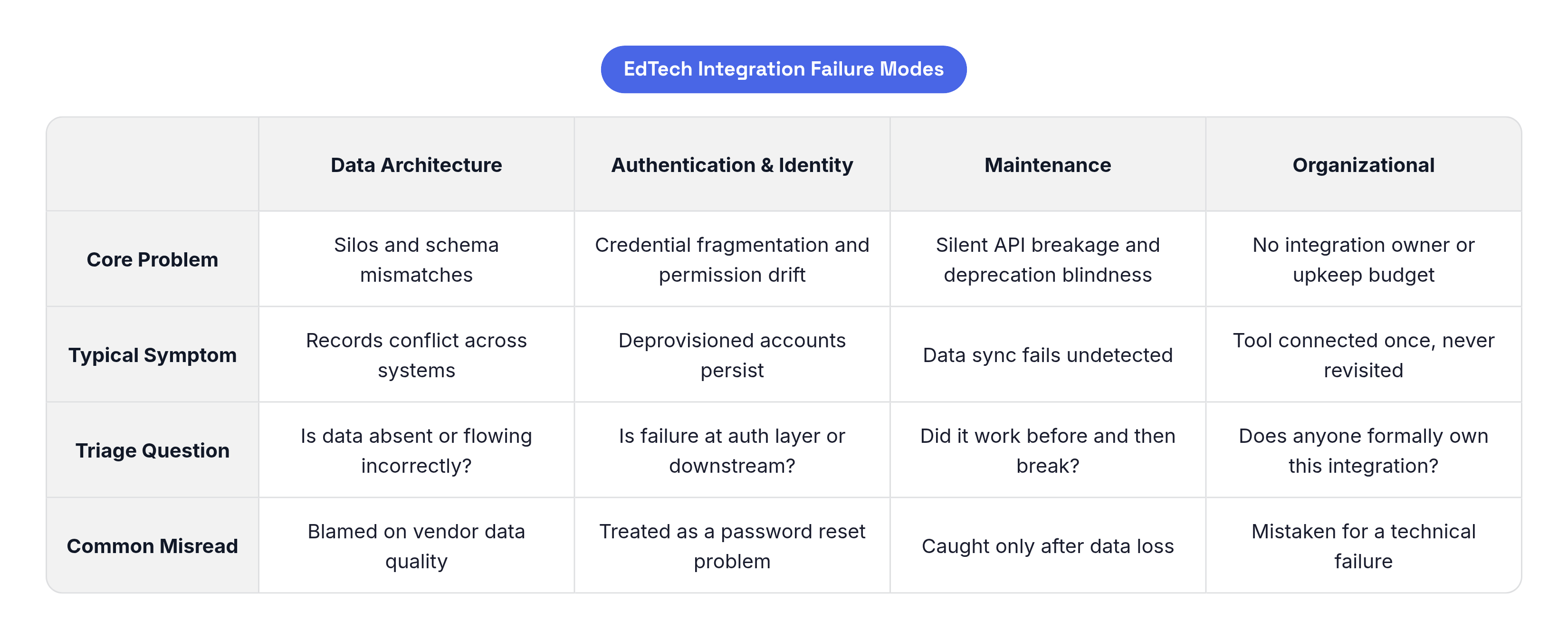
Most EdTech integration failures fall into one of four categories. Data architecture failures include silos, schema mismatches, and the absence of a shared data standard. Authentication and identity failures encompass credential fragmentation, permission drift, and persistence of deprovisioned accounts. Maintenance failures cover silent API breakage and deprecation blindness. Organizational failures include the absence of a clear integration owner and no budget for ongoing upkeep.
These categories are not mutually exclusive, but distinguishing among them changes what the fix looks like. The triage questions are specific: is data not flowing, or is it flowing incorrectly; is the failure at the authentication layer or downstream from it; did the integration ever work and then break, or did it never fully function; is the failure isolated to one tool or systemic across the stack? Skipping these questions and going straight to configuration settings is how you spend a day fixing the wrong thing.
Organizational failures frequently masquerade as technical ones. A broken integration is sometimes a tool that no one formally owns, connected once, handed off, and never revisited. The API didn't break; the ownership structure was never established. The gap between principals who consider effective technology use crucial to their school's mission, 87% per the research, and those who consider their teachers very proficient with technology, 18%, is a diagnostic signal. Where that gap is largest, integration failures appear first, because demand for the tool exceeds the institutional capacity to support it.
What integrations that hold up in production actually look like
Durable integrations share identifiable characteristics visible before deployment, not only in retrospect after something has failed.
Interoperability belongs in procurement, not retrofitted afterward. Contracts must include explicit interoperability requirements, data format standards, and API versioning commitments before a tool is onboarded. If a vendor won't commit to these terms, that refusal tells you something concrete about the integration's likely durability.
A district-wide SSO with automated provisioning and deprovisioning tied directly to the SIS eliminates the credential fragmentation that breaks both workflows and compliance posture. When a student withdraws from the SIS, every downstream tool should deprovision that account automatically. When it doesn't, the failure is architectural and manual effort alone will not resolve it.
API monitoring and change management must function as ongoing operational responsibilities, not tasks completed at launch and forgotten. Someone owns the integration layer, watches for deprecation notices, tests changes in a staging environment before they reach production, and maintains a documented rollback plan that includes version pinning. Pre-built, maintained connectors significantly reduce the surface area of custom maintenance, and where they exist, districts should use them. Where they don't, the cost of custom maintenance belongs in the total cost of ownership calculation at adoption time.
The test for any EdTech integration is whether it reduces operational burden on teachers and IT or adds to it. Integrations that genuinely automate data flow, remove manual steps, and require no intervention on a given Tuesday morning have the best chance of surviving long enough in production to deliver on their instructional promise. The same logic applies to content strategy: Letterbrace, a content marketing platform for B2B SaaS that tracks both search rankings and whether AI answer engines actually cite a brand, runs on that same principle of automated pipelines kept honest by human approval at every consequential step.