Data Integration Patterns for EdTech Systems
How four integration patterns solve the data chaos created by fragmented EdTech stacks.
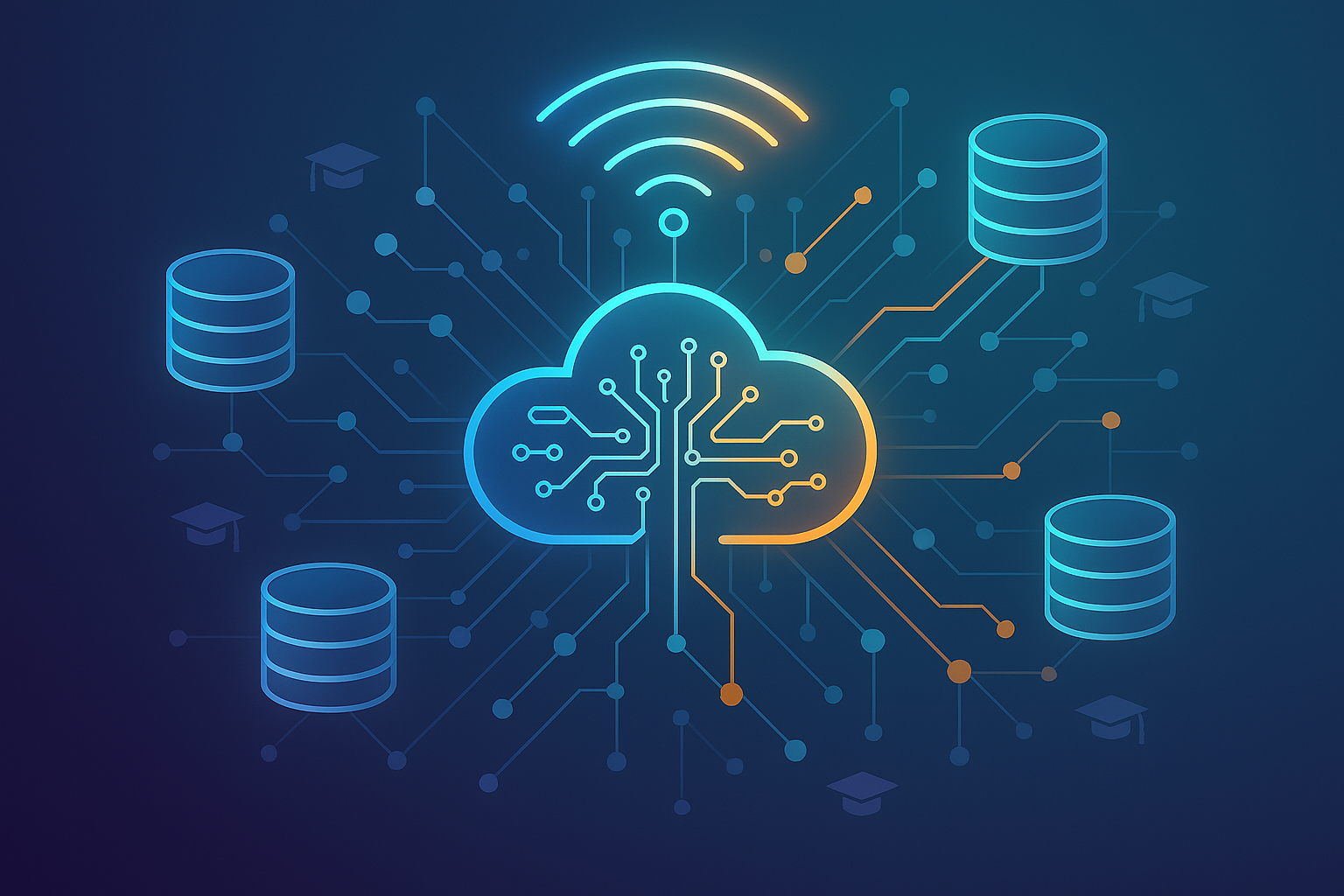
EdTech stacks are not designed. They accumulate. A district adopts an LMS, then a separate assessment platform, then a communication tool procured by a different department, then a third-party analytics layer someone championed at a conference. Each system arrives with its own data model, its own API surface, and its own opinions about what a "student" or a "course" actually is. Nobody planned for them to talk to each other. Now they have to.
Schools are under pressure to act on student data faster, comply with stricter privacy requirements, and support more tools simultaneously, all while IT budgets shrink and EdTech investment has fallen to its lowest point since 2015. The teams responsible for making these systems work together are often small, under-resourced, and inheriting architectures they didn't design.
This piece breaks down the four core integration patterns used in EdTech systems, what each one is good at, where each one fails in practice, and how to match the right pattern to the specific data flow you're dealing with. The right architecture depends on latency requirements, data sensitivity, system ownership, and how much operational complexity your team can actually sustain.
Every EdTech architecture sits on top of the same four categories of systems, each with different owners, update rhythms, and definitions of what a "student record" even is.
LMS (Learning Management System). Canvas held 39% of the North American higher ed market in Fall 2024. Blackboard sat at 19%. Moodle and Brightspace each held around 16%. The LMS is the largest single EdTech market segment, but the field is fragmented enough that each platform has its own API surface and data model. Building everything around the LMS creates coupling problems precisely because of that gravitational pull.
SIS (Student Information System). The SIS is the system of record for enrollment, identity, rosters, and demographics. It's also typically the most locked-down system in the stack. Institutional IT owns it, it's less API-friendly than modern SaaS tools, and it's treated with appropriate paranoia given its compliance sensitivity. Getting clean, timely data out of a SIS is often the hardest part of any integration project.
Assessment tools. Often procured independently of the LMS, by a different department, with no input from the team that runs the LMS. They produce results in proprietary formats that don't map cleanly to gradebook schemas, and aligning them takes real work every time.
Communication and collaboration apps. These generate behaviorally rich engagement signals: attendance patterns, message activity, participation trends. Connecting that data to anything meaningful requires intentional effort because its shape is fundamentally different from academic data.
With EdTech investment contracting to $2.4 billion in 2024 (the lowest since 2015, down from $3 billion the year before), teams are being asked to integrate more systems with less budget. The cost of getting this wrong has gone up.
Interoperability Standards That Define EdTech Integration
There are four distinct interoperability layers in EdTech, and each solves a different problem.
Tool integration: LTI. Learning Tools Interoperability (LTI) embeds external tools inside an LMS while passing user context, course identity, and role. LTI 1.3 uses OpenID Connect and JWT-based security. It's the standard that lets a third-party assessment engine launch from inside Canvas without requiring a separate login.
Learning activity data: xAPI and Caliper. xAPI sends activity statements to any conformant Learning Record Store (LRS) and can track offline activity, mobile interactions, and simulations that SCORM can't reach. Caliper Analytics standardizes metric profiles for events like resource access and video completion. These two standards are complementary, not competing.
Roster and administrative data: OneRoster and Ed-Fi. OneRoster 1.2 handles rostering, gradebook exchange, and resource allocation between SIS and LMS, available in both REST and CSV formats. Ed-Fi is an operational data store framework deployed in more than 10,000 schools. A joint initiative now has the Ed-Fi ODS serve as the system of record with a OneRoster v1.2 feed served from that data. Michigan's MiDataHub is a production example of this two-layer approach: OneRoster for roster and grade sync, Ed-Fi for at-risk student tracking and program impact measurement.
Identity: SAML, OpenID Connect, and LTI Advantage. SSO sprawl is a genuine operational burden. Districts routinely expect vendor support for Microsoft, Google, Clever, ClassLink, OAuth2, SAML, LDAP, LTI, and more. Managing that surface area is an ongoing engineering workload, not a setup task you finish once.
One important caveat: a vendor holding 1EdTech certification may have implemented only a subset of available services. Institutions that assume certification means "it will work" tend to discover the gaps at deployment, which is the worst possible time to find out.
ETL Pipelines and Why Maintenance Costs Compound
ETL (Extract, Transform, Load) is where almost every EdTech team begins. It's the default pattern for structured, compliance-sensitive data exchange: roster syncs, grade transfers, SIS-to-LMS batch jobs. Transformations are explicit and auditable, data lineage is traceable, and the output is predictable. FERPA, COPPA, and state reporting requirements reward that kind of rigor.
The latency trade-off is real. Batch ETL delivers data freshness measured in hours, which is fine for end-of-term reporting but a problem for anything that needs to inform a same-day instructional decision.
The maintenance burden is the part nobody warns you about. Manual ETL maintenance consumes somewhere between 60 and 80 percent of data engineering time in most organizations. In EdTech, this compounds hard. Every school year brings roster resets, SIS schema changes, and new vendor onboarding. Teams can spend the first two months of every school year in pure triage mode, not because they built something bad, but because the ecosystem around their pipelines never stops moving.
OneRoster CSV drops are one of the most widely deployed forms of ETL in K-12. They work, but district-by-district pipelines with ad-hoc metadata extensions produce inconsistent data, slow start-of-year onboarding, and a steady stream of integration support tickets.
ETL earns its place for longitudinal outcome data, compliance reporting, and any transfer that requires a documented transformation record before data enters a downstream system. It just shouldn't be the only tool in the box.
Event-Driven Integration: Benefits and What It Requires
Event-driven architecture treats learning activity as a stream of discrete events. A student submits an assessment, completes a video, or logs in after a week of absence. Each action emits a message that downstream systems can consume in near-real time.
The latency difference is architectural, not incremental. Batch ETL gives you hours. Change Data Capture gives you seconds. Streaming materialized views give you sub-second latency. The right choice depends on what the downstream decision actually requires.
The strongest case for event-driven in EdTech is early-warning systems for at-risk students. A flag that triggers 12 hours after the signal is useless if an advisor could have intervened the same day. Adaptive content delivery is a close second, because systems that adjust based on student performance need current data, not yesterday's batch.
xAPI is the standards-layer complement to event-driven architecture. Activity statements sent to an LRS are structurally event-driven: xAPI produces the events, and a message broker routes them.
What event-driven integration actually requires is more than most teams budget for up front:
- A message broker (Kafka, Pulsar, or a managed equivalent) that can handle high-volume, high-frequency event streams.
- Consistent event schemas. Without them, consumers break every time a producer changes its payload structure.
- Idempotent consumers. Events may be delivered more than once, and downstream systems must handle duplicates without corrupting state.
- Observability infrastructure. Failures in event-driven systems are asynchronous and silent. You need dead-letter queues, alerting, and event replay capability, or you won't know something broke until a teacher notices a missing grade.
Event-driven systems also distribute ownership of data quality across every producer. In an EdTech environment where different tools are procured by different departments, schema governance becomes a cross-functional problem that no single team controls. Sort out governance before you need it, not after the first producer ships a breaking schema change.
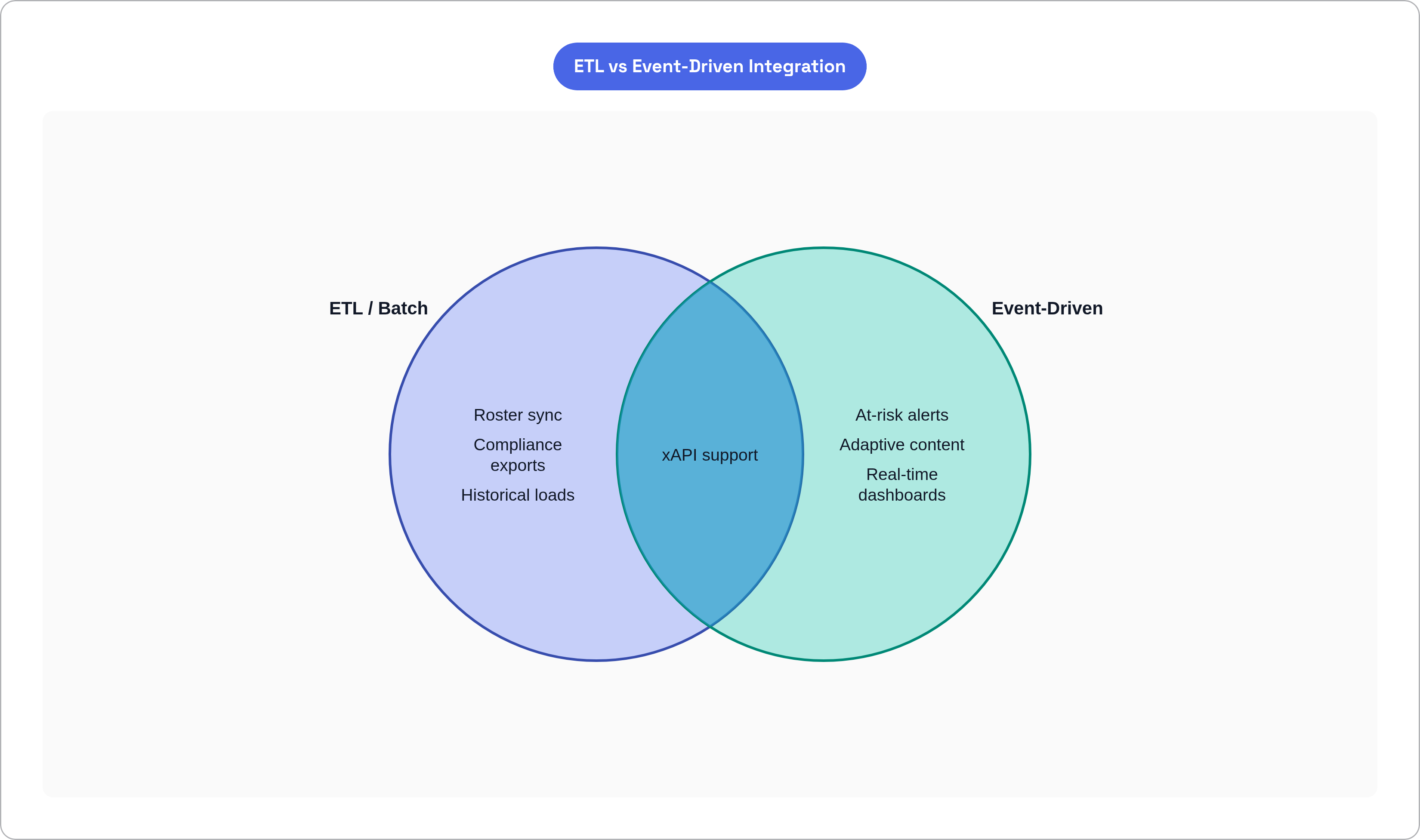
Event-driven does not replace ETL. It handles operational data flows while batch pipelines handle compliance exports and historical loads. Most mature architectures run both.
API Integration: Best-of-Breed Stacks and Real Failure Modes
API-led integration treats each system as a service with a defined interface. The LMS exposes endpoints for enrollment, grades, and course data. The SIS exposes roster and demographic data. Tools integrate by calling each other's APIs on demand.
This fits where EdTech is headed. SaaS deployments are projected to account for more than 60% of global EdTech spend by 2026, and most new tools arrive as SaaS with REST APIs. Schools can procure best-of-breed assessment engines, content libraries, and proctoring suites and compose them through APIs without committing to a single vendor's full suite.
Where API integration fails in practice is worth being direct about. Rate limits are the first thing that bites you. LMS APIs frequently impose per-minute or per-day call limits that break high-frequency sync jobs, usually on the first day of a semester when everyone is enrolling at once. API versioning and deprecation come next: vendors deprecate endpoints on their own schedules, and institutions absorb the breakage. Auth sprawl compounds the problem, because each vendor may use a different OAuth scope model, token lifetime, or credential rotation policy. Error handling asymmetry is also underappreciated: a calling system may not know whether a failed API call means the data was never written or was written and then rolled back, and that ambiguity is dangerous in gradebook contexts.
The deepest issue is coupling. Direct API-to-API integration means that when vendor A changes its response schema, every system calling vendor A breaks simultaneously. The mitigation is an API gateway or integration middleware layer that absorbs schema changes and presents a stable internal interface. Pre-built, provider-maintained connectors take API deprecation and auth maintenance off your team's plate, which matters when half of K-12 IT teams already feel understaffed.
LTI is a specialized form of API integration optimized for tool launch and context passing. It solves auth and identity for the tool-embedding case specifically and does not cover bidirectional data sync.
Federated Data Models: When Centralizing Everything Backfires
Federated integration leaves data in its source systems and provides a query or access layer that spans them. Instead of extracting and centralizing, it federates reads across distributed sources.
This pattern fits specific EdTech scenarios. Multi-campus or district-level reporting is the clearest case, where each campus owns its SIS and centralizing data creates governance conflicts. Some districts will not let student data leave their systems, and that's a legitimate position. Research and analytics use cases where the goal is cross-system querying rather than operational sync are another good fit, as are compliance contexts where data residency requirements make extraction legally complicated.
The Ed-Fi ODS model is a partial federated approach. Source systems push to a shared operational store, but the ODS is not the system of record. Source systems retain ownership, and the ODS is a synchronized view, not a copy of record.
Federation has real limits. Federated queries are only as good as source system availability: if a district SIS is down, the federated query that depends on it fails. Data freshness is harder to reason about when a query may join data from a system that updated an hour ago with one that updated a week ago. FERPA and COPPA add another dimension, because federated access means each query traverses systems with different data sensitivity levels, and access control must be enforced at the federation layer. You cannot assume source-system permissions carry through automatically.
Federated models work best as a complement to operational integration, not a replacement. Use federation for analytics and reporting. Use event-driven or API-based patterns for real-time operational flows.
Matching Integration Patterns to Actual EdTech Data Flows
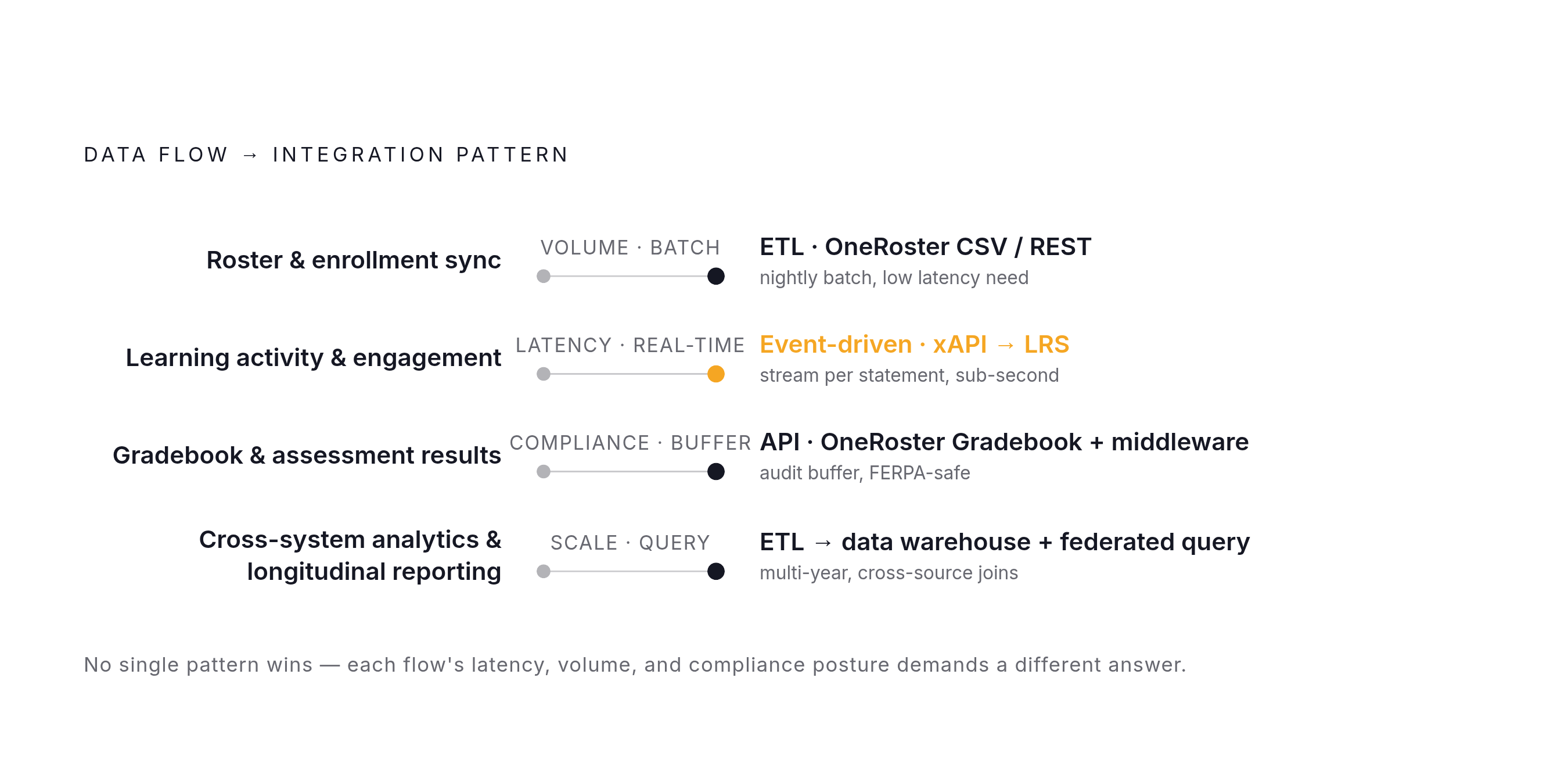
No single pattern wins on all dimensions: latency requirement, data volume, and compliance posture. The match depends on the specific flow.
Roster and enrollment sync (SIS to LMS). This data is structured and relatively low-volume, with changes happening at the start of a term or during mid-year transfers. ETL via OneRoster CSV or REST is the right fit. For K-12 districts already on Ed-Fi, the Ed-Fi ODS to OneRoster v1.2 bridge is the production-ready path.
Learning activity and engagement data (LMS and tools to LRS or analytics layer). High-frequency, heterogeneous events where latency matters. Early-warning systems and adaptive content delivery both depend on data freshness. Event-driven architecture with xAPI to an LRS is the natural fit. Caliper adds standardized metric profiles on top of the event stream for cross-tool behavioral comparison.
Gradebook and assessment results (assessment tool to LMS to SIS). This flow is bidirectional: the assessment tool writes results, the LMS aggregates, and the SIS records for transcript. API-based integration with the OneRoster Gradebook service handles the LMS-to-SIS leg. Direct API or LTI Outcomes handles the tool-to-LMS leg. The coupling risk is highest here because assessment vendors deprecate result schemas on their own timelines. An integration middleware layer that buffers schema changes is worth the investment.
Cross-system analytics and longitudinal reporting. Historical depth matters more than freshness, and compliance reporting requires documented lineage. ETL into a data warehouse or lake, with a federated query layer on top for cross-system analysis, is the right architecture. The latency trade-off is acceptable because the decisions downstream are strategic, not operational.
The pattern-matching exercise isn't a one-time architectural decision. You revisit it every time a new system enters the stack, every time a vendor changes their API, and every time a school year resets the roster. The teams that treat integration architecture as a living document are the ones that don't spend September fixing problems that should have been designed away in July.