Rostering and Provisioning Automation in K12 and Higher Ed
How fragmented student data systems create rostering chaos across education.
Start with the terrain, because fragmentation here is not an edge case you'll occasionally bump into. It's the default condition. Plan for it or spend your time being surprised by it.
There are over 200 Student Information Systems in K–12 alone, and each one stores and labels data differently. Across the U.S. and Canada, there are over 23,000 school districts (per ListEdTech, 2025), each running its own combination of SIS, SSO, and LMS. No universal setup. Proprietary schemas, inconsistent field names, and incomplete records are the norm. The variation isn't a bug in the system. It is the system.
Market concentration creates a separate kind of headache. About 40% of U.S. school districts run PowerSchool. That sounds like it should simplify things until you realize what it actually means: one vendor changes their data model, and it ripples across thousands of districts at once. Concentration creates depth of impact. It does not create flexibility. Those are very different things — like thinking a tidal wave and a swimming pool are the same thing just because both involve water.
Higher ed adds another layer entirely. Identity data there doesn't come from a single student information system. It comes from ERP platforms, HR systems, and financial systems that often operate in their own worlds, largely indifferent to each other. When those systems don't talk, delayed access and compliance gaps follow. Not occasionally. Predictably.
The pace of change is also accelerating underneath all of this. Roughly 67% of global SIS deployments are now cloud-based, up from around 48% in 2021. Cloud SIS genuinely helps by opening more API-based integration paths. But it also means more moving targets for every application connected to those systems. The infrastructure is always running slightly behind, and that gap is where a lot of the real work lives.
How OneRoster and Ed-Fi Standards Structure the Data Pipeline
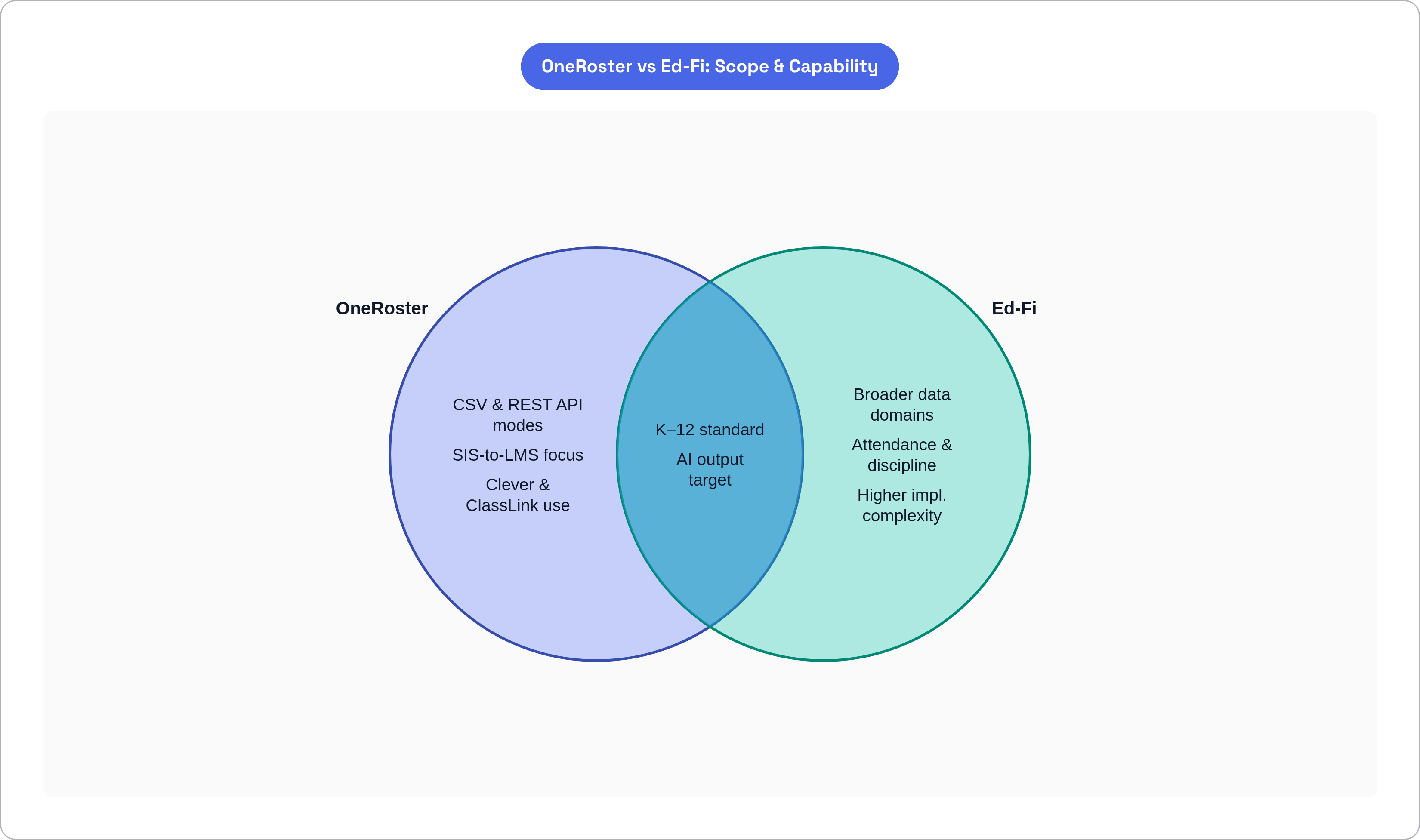
OneRoster is the closest thing K–12 has to a shared language for roster data. It defines how information about people, courses, enrollments, and grades moves between educational systems. It supports two modes: CSV export-import (the spreadsheet-style approach, still very much alive in the wild) and direct system-to-system exchange via REST API. It was built for SIS-to-LMS data flow. It does that reasonably well.
What it was not built for is a longer list:
- Real-time updates. OneRoster defines format, not sync frequency. You can be fully compliant and still be syncing data once a day.
- Custom fields. Many applications depend on data points that exist entirely outside the OneRoster schema.
- Extended domains. Attendance, discipline, and other data types outside the core enrollment model are simply not part of the spec.
Ed-Fi addresses some of these gaps for K–12. But it introduces implementation complexity that smaller districts often don't have the staff or budget to absorb. That's not a knock on the standard. It's just the reality of who's on the other end of these implementations.
And then there is the CSV problem, which has quietly persisted for decades. CSV exports from SIS platforms have been the dominant transfer method since the early days of edtech interoperability, and many districts still rely on them. Batch-file transfers are inherently periodic, which means there are always windows where roster data is stale and accounts are out of sync. Non-standard SIS exports often follow internal database schemas rather than any recognized standard, which means transformation work has to happen before any of it is usable downstream. Someone has to do that work. It doesn't do itself.
Standards compliance is a baseline, not a finish line. Technically compliant files full of duplicates and missing fields are still a problem. The standard doesn't fix the data.
What Automated Rostering Pipelines Actually Do, Step by Step
Most people talk about rostering like it's a single operation. It isn't. It's a sequence, and each step is its own quiet place where things can go wrong — like a relay race where every runner assumes someone else is holding the baton.
Ingest. Pull data from the SIS via OneRoster API, CSV export, or a proprietary connector. This is where format and frequency decisions get locked in. Whatever you commit to here shapes everything that follows.
Normalize. Map inconsistent field names across different SIS sources. Resolve duplicate IDs. Clean incomplete records. This step is unglamorous and nobody's favorite thing to demo. But skip it and you'll spend a lot of time explaining to districts why their data looks wrong on the other end. The normalization step is where most of the real work actually lives.
Validate. Flag anomalies before they propagate downstream. A student enrolled in two homerooms simultaneously. A staff member with no role assigned. These aren't theoretical edge cases. They happen constantly, and the cost of catching them here is much lower than catching them as support tickets on the first day of school, which is also when everyone is already at their limit.
Transform. Convert the normalized data into the target schema required by each connected application. Your LMS wants data shaped one way. Your assessment platform wants it another way. One clean source, multiple outputs. This step scales well when it's done right and becomes a maintenance nightmare when it isn't.
Sync. Push updates continuously or on a defined schedule. This is not a one-time load at the start of the year. Rosters change constantly. Students transfer. Staff leave. Schedules shift. The pipeline has to treat change as the baseline condition, not an interruption.
Identity provisioning runs in parallel with all of this. When a new enrollment record appears in the SIS, provisioning logic creates the account in the directory (Active Directory, Google Workspace, Microsoft Entra ID) and assigns the correct roles and group memberships. When a student transfers or graduates, deprovisioning removes access automatically, without a help desk ticket.
Higher education complicates the model significantly. A person can be a student, an employee, and a volunteer at the same institution at the same time. They move through different identity states across an entire career at the institution. Most K–12-focused tools aren't built for that kind of role overlap, and it becomes obvious the moment you try to use them in a higher ed context.
There's also the semester-cycle problem. Large waves of new users arrive and large waves depart at defined points each year. Manual systems process those waves as emergencies. Automated pipelines process them as routine. The difference shows up as a support queue on the first day of classes, every semester, indefinitely, for institutions that haven't made the switch.
The Platform Layer: How Clever, ClassLink, and Others Position Within This Infrastructure
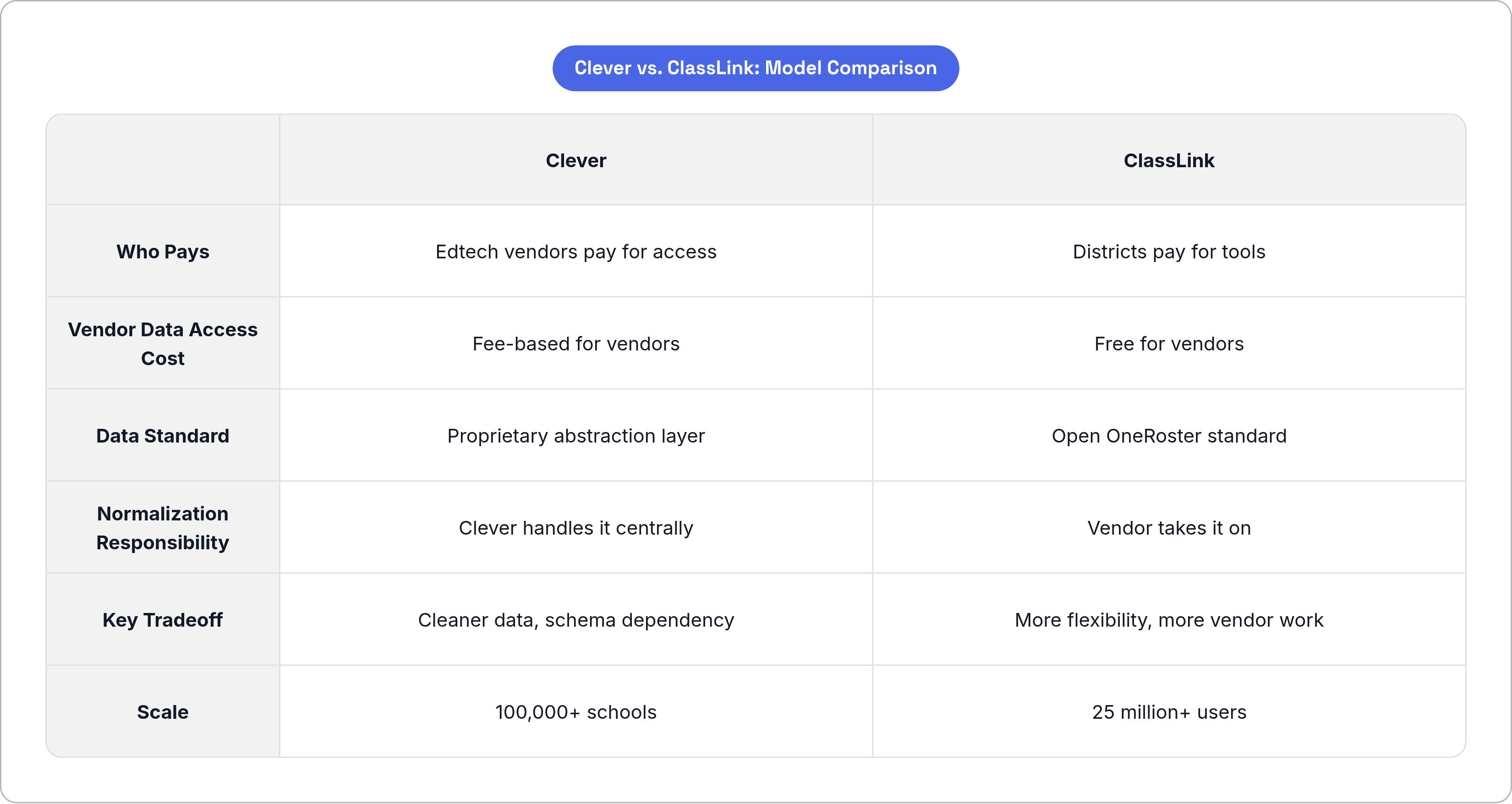
In K–12, two platforms dominate the rostering infrastructure conversation: Clever and ClassLink. They solve similar problems through different business models, and that difference shapes what downstream builders can actually rely on.
Clever is free to school districts and charges edtech vendors for data access. It normalizes and cleanses SIS data, handles ID mapping across sync method changes, and serves over 100,000 schools. The tradeoff is real: Clever wraps district data in a proprietary model. Vendors get cleaner data, but they're building on top of someone else's abstraction and depending on Clever's schema. That dependency is worth understanding before you commit to it. Clever has reported up to a 27% year-over-year reduction in support tickets and up to $325,000 in annual maintenance savings for districts using the platform.
ClassLink charges districts for its tools and gives edtech vendors free data access via the open OneRoster standard. It serves over 25 million users, and its OneSync product is used by more than 3,300 districts for automated account creation and identity sync across Google Workspace, Active Directory, and Entra ID. Because it uses open standards, vendors build directly to OneRoster and take on more of the normalization work themselves.
Neither model is universally better. The choice depends on who bears the integration cost and what flexibility the vendor actually needs.
Higher education runs on a different stack entirely. On-premises Active Directory still provides the identity backbone for campus workstations and legacy systems. Microsoft Entra ID powers the cloud suite. The two frequently operate in parallel with governance gaps between them. IAM platforms built specifically for higher ed (Fischer Identity, Identity Automation, now part of Jamf) handle the multi-role, multi-system lifecycle that K–12-focused tools simply don't address.
For edtech companies building integrations across many districts, connecting to the shared infrastructure layer rather than building point-to-point SIS connectors one district at a time is how teams avoid drowning in fragmentation. The alternative is a long list of custom connectors, all needing individual maintenance, indefinitely.
Where AI Is Changing How Rostering Handles Non-Standard and Messy Data
The most practical AI use case in rostering right now isn't the flashiest one. It's this: taking a non-standard SIS export structured around an internal database schema and producing clean, compliant output without anyone sitting down to map it by hand.
For years, non-standard exports meant manual mapping work before every new district connection. Someone had to look at the file, figure out what each column actually meant, and build a transformation. Then do it again for the next district. The work never really stopped because the variation never really stopped. It was the kind of task that looked like it should have been solved already, but just kept coming back.
AI-powered rostering can take those exports and produce both OneRoster and Ed-Fi compliant outputs simultaneously, with no separate pipelines and no manual mapping steps. Ednition's Roster Intelligence work is a real example of this in practice.
There's also a newer development worth watching: agentic onboarding. Model Context Protocol (MCP) integration allows AI agents to initiate new district rostering connections when a contract closes, pulling district configuration, setting up the connection, and notifying the relevant teams with no manual steps in between. This moves automation upstream from the data sync layer into the sales and onboarding workflow itself. That's a meaningful shift in where the leverage actually lives.
AI is also moving inside SIS products. PowerSchool, Skyward, Infinite Campus, and Blackbaud have all launched AI-assisted reporting or automation features. Per ListEdTech's 2025 K–12 SIS market analysis, AI adoption is now a competitive differentiator among SIS vendors.
What AI does not yet resolve: data governance, consent frameworks, and which decisions can be automated without human review. Those are still active institutional design questions, and they're likely to stay that way. Anyone telling you AI has solved them is selling something.
The Security Exposure That Poor Provisioning Hygiene Creates
During Q2 2025, the education sector faced an average of thousands of cyberattacks per week, a sharp increase year-over-year per Check Point Research. Part of this is structural. Large user populations, high turnover, and legacy infrastructure create persistent gaps that don't require sophisticated exploits to take advantage of.
The most common entry point isn't a zero-day vulnerability. It's an orphaned account. A former student or departed staff member whose access was never removed because nobody closed the loop. These institutions aren't being hacked so much as walked into through a door that was never locked after the last person left.
When deprovisioning is manual or batched, that exposure window can stay open for days, weeks, or indefinitely. In higher ed, this isn't random. It's cyclical. The same gaps open at the same points on the academic calendar, every year, because the process depends on humans remembering to do something at a moment when they're managing a hundred other things.
Higher education has an additional cultural friction layer that compounds the technical problem. The 2025 EDUCAUSE Horizon Report surfaces a real tension between academic openness and "verify first, access later" security models. That friction slows IAM automation adoption even when the technical case is completely straightforward. Budget prioritization makes it worse. Many institutions have directed available funds toward AI and hybrid learning infrastructure rather than IAM upgrades. Understandable as a decision. Also a problem in terms of exposure.
The measurable upside of fixing this is significant. Institutions implementing self-service IAM report up to a dramatic reduction in password reset requests and up to 40% faster access provisioning, per Avatier's education IAM analysis. Automated deprovisioning closes the window between a user's departure and the removal of their access. Manual processes leave that window open. That window is where the exposure lives.
What Institutions and Edtech Builders Need to Get Right When Designing These Pipelines
For Institutions
Treat the SIS as the authoritative source of truth, but invest in the normalization and validation layer between the SIS and downstream systems. Clean source data does not guarantee clean downstream data. Something has to do the translation work, and "the SIS handles it" is not a complete answer.
Design deprovisioning with the same rigor you apply to provisioning. Most failures happen at offboarding, not onboarding. The account that should have been removed in January is the one that gets exploited in March. This is a documented risk pattern, not a hypothetical one.
In higher ed specifically: map every identity state a user can hold, and every transition between those states, before you select or configure an IAM platform. If your platform isn't designed for "student who becomes an employee who becomes an alumnus who becomes an adjunct," you will be patching that gap manually for as long as you run the system. Do the mapping first.
For Edtech Product Teams
Supporting OneRoster covers the majority of K–12 districts. It does not cover all data types, and it does not cover real-time needs. Plan for those gaps from the start, not after a district calls to ask why their data is a day old.
Building and maintaining direct SIS connectors district-by-district is an ongoing engineering cost that compounds with scale. Companies that have migrated away from that model report saving 50% or more on rostering costs. At a certain scale, that math stops being an edge case and starts being the whole conversation.
The operational burden of keeping dozens of API connections current (managing versioning, schema changes, and credential rotation) falls on whoever owns the connector. That's a lot of invisible maintenance work that doesn't ship features. Whether your team is the right team to own it permanently, or whether that belongs in managed infrastructure, is a real strategic question. It's worth answering before you've built yourself into a corner.
The Staffing and Culture Dimension
Automation doesn't eliminate the need for institutional ownership. It shifts the work from manual data entry to pipeline governance and exception handling. Someone still needs to own the pipeline. The job just looks different. Institutions that don't account for that shift end up with automated pipelines that nobody is actually watching, which creates its own category of problems.
In higher ed, involving faculty and students in IAM policy decisions reduces resistance to "verify first" access models. The EDUCAUSE Horizon Report makes this recommendation explicitly. The technical case for automation is easy to make. The cultural case takes longer and requires different conversations with different stakeholders.
The global SIS market was estimated in the tens of billions of dollars in 2024 and is projected to grow substantially by 2030. The infrastructure connecting all those systems is not a solved problem. Institutions that treat it as one take on compounding technical debt that eventually shows up as a breach, a bad first day of school, or a full-blown infrastructure crisis. Sometimes all three at once, which is a genuinely terrible week for everyone involved.