EdTech Tool Consolidation Trends and Integration Implications
Schools are cutting edtech tools ruthlessly as pandemic funding ends and IT staff shrink.

A lot of pandemic-era money is gone, and it is not coming back.
ESSER pumped $189.5 billion into schools during and after the pandemic. When that funding expired, Georgetown University's Edunomics Lab estimated that most districts needed to cut roughly $1,200 per student for the 2024–25 school year. That is not an abstraction. That is a real number hitting real budgets all at once, and technology contracts were first on the list because they are visible, recurring, and easier to cut than people.
Post-ESSER, 42% of edtech leaders cited classroom technology as at risk. 38% expected reduced device funding heading into 2026.
Budget pressure alone would reshape procurement. But there is a second problem running alongside it. Per the CoSN 2025 survey, only 50% of IT teams feel adequately staffed. Districts are short on money and short on the people needed to manage what they already bought. K–12 districts now interact with an average of thousands of distinct digital tools annually. Students and educators actively use about four of them.
Supporting 3,000 tools with a half-staffed IT department is like trying to bail out the ocean with a teaspoon — the ratio is the problem, not the effort. It has produced a capacity crisis that happens to wear a technology costume.
So both pressures arrived at the same time. Budget cuts hit. Staff shortages hit. "We'll evaluate it later" stopped being an option because later arrived before anyone was ready for it, and it came with a full audit backlog and no extra headcount.
How Districts Are Deciding Which Tools Survive the Cut
The governing shift is from volume to impact. The criteria backing that up are concrete.
Evidence standards have moved fast:
- In the 2024–25 EdTech Top 40, 45% of tools had published ESSA research, up from 32% the year before. The 2026 edition found 52.5% of top LTI tools meeting at least ESSA Level IV evidence.
- Privacy certification has become a procurement filter alongside research quality. 45% of top tools in the 2026 report hold at least one data privacy certification from 1EdTech or iKeepSafe.
- Interoperability with existing systems is now a hard requirement, not a checkbox buried on page four of the RFP.
Oklahoma City Public Schools is a useful case because they actually committed to this rather than just announcing it. They entered the pandemic with 1,800 apps in circulation, none fully vetted. They narrowed that to 250 approved applications, each reviewed for interoperability, privacy, and instructional alignment. They explicitly framed this as a five-year culture change, not a one-time purge. That distinction matters more than it sounds. A purge is reactive and temporary. A culture change is structural and sticks.
One more variable has entered the room. AI is now the top state edtech priority, surpassing even cybersecurity, per the 2025 SETDA State EdTech Trends Report. Tools without a credible AI story are facing headwinds on top of everything else already working against them. "We're exploring it" is not a credible AI story.
How Vendor M&A Is Consolidating the Market from the Supply Side
Districts are thinning the herd from the demand side. Vendors are consolidating from the supply side. Both are happening simultaneously, and they are reinforcing each other in ways that are reshaping what the market looks like entirely.
The edtech sector produced over 300 M&A transactions in 2024. 169 education and training deals closed in Q1 2025 alone. By Q3 2025, PitchBook counted 256 U.S. edtech transactions, a 16% jump over Q2 and the highest deal count of the year, with total disclosed value reaching $1.37 billion.
A few deals show where the conviction is:
- Bain Capital acquired PowerSchool for $5.6 billion (closed 2024)
- KKR took Instructure private for $4.8 billion (closed 2024)
- Instructure acquired Parchment for $835 million, combining LMS and credentialing under one roof
- Workday acquired Sana Labs for $1.1 billion, pulling AI-powered learning into enterprise HR infrastructure
- Coursera and Udemy announced a combination with implied equity value around $2.5 billion
Three forces are converging here. The market is still fragmented, with strong niche products scattered across it. Institutions want integrated solutions, not a dozen disconnected tools that technically work together on paper. And AI is changing product expectations faster than most incumbents can build internally, so acquisition is often faster than development.
Declining venture funding has made independent survival harder for startups, pushing many toward acquisition rather than grinding through another funding round with a market that has less appetite for it.
Surviving vendors are becoming broader platforms. That changes what integrating with them means in practice, and it changes what it costs to do that integration poorly.
Why the LMS Has Become the Architectural Center of Consolidation
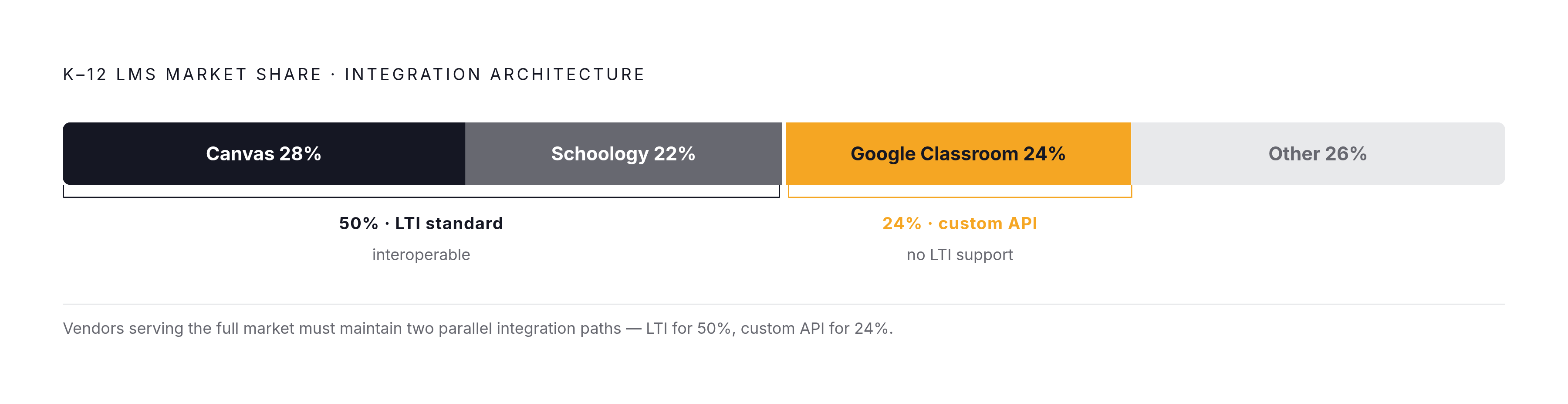
As districts narrow their tool portfolios, the LMS has become the hub. The thing everything else must connect to in order to pass procurement review.
The K–12 LMS market is concentrated. Canvas holds 28% market share, Google Classroom holds 24%, Schoology holds 22%. Three platforms define the integration landscape for most edtech vendors. If your tool does not connect cleanly to at least one of them, it does not get approved. That is the decision logic.
IT departments have gained real procurement power through this shift. Standardizing technology stacks across schools means requiring new software to integrate with the existing LMS before anyone says yes. The LTI standard (Learning Tools Interoperability) is the mechanism that makes this possible. It allows external tools to pass user data securely with the LMS, enabling single sign-on, grade syncing, and content sharing.
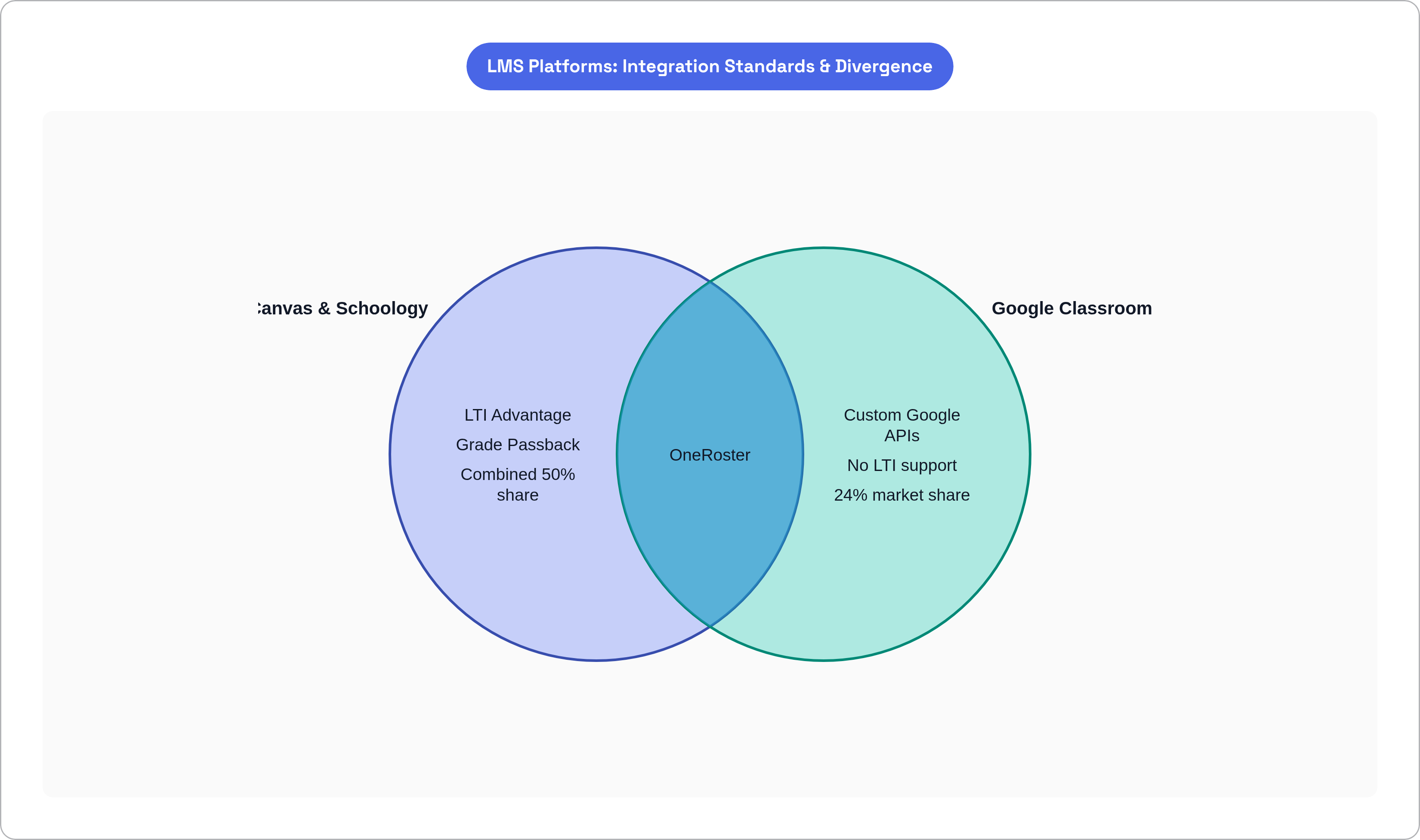
Here is the part that makes edtech developers' lives complicated. Google Classroom, sitting at 24% of the market, does not support LTI. Integrations there require Google's custom APIs instead. That is a real divergence every edtech developer has to navigate separately. Being LTI-compliant covers the Canvas and Schoology majority. It does nothing for Google Classroom, and Google Classroom is too large a share of the market to quietly decide to skip.
CoSN's 2025 State of EdTech District Leadership report frames interoperability as a "critical consideration" as districts modernize infrastructure. The LMS-as-hub model is a district-level expectation now, not a preference.
The Interoperability Standards That Determine Whether Consolidation Actually Works
The 1EdTech Consortium (formerly IMS Global) maintains the standards that underpin edtech interoperability. Three of them are operationally critical when consolidation is the context.
LTI (Learning Tools Interoperability)
LTI allows external tools to launch within an LMS without creating friction for instructors and students. The current version, LTI 1.3 under "LTI Advantage," adds three core extensions: Names and Role Provisioning, Assignment and Grade Services, and Deep Linking. Each one expands what a tool can actually do inside the LMS, beyond simply launching from it. IT administrators commonly require LTI compliance before approving a new tool. Basic launch capability used to clear that bar. It no longer does.
OneRoster
OneRoster governs the exchange of class rosters and related data between a student information system and platforms like an LMS. It supports both CSV imports and REST API exchanges, which means it works for districts at different technical maturity levels. Without it, roster management becomes a manual, error-prone process that nobody has the staff to absorb right now.
Caliper Analytics
Caliper is a structured event-model standard for learning analytics. It enables data about student engagement to flow across systems in a consistent format. This one matters more than it used to because of the evidence requirements districts are now imposing. Demonstrating learning outcomes across a consolidated stack requires a shared data model for what "engagement" even means in the first place.
One honest caveat worth naming: standards define a common language. They do not guarantee that two systems actually exchange data correctly. Each vendor implements them differently, and integration still requires real engineering work to make things behave the way the spec says they should. Supporting these standards is necessary. It is not sufficient.
Where Integration Breaks Down Even After Consolidation
Consolidation reduces the number of tools. It does not automatically reduce integration complexity. It changes the shape of that complexity, and the new shape is less obvious, which makes it harder to catch before something breaks.
Common failure modes in post-consolidation stacks:
- Roster sync failures when OneRoster implementations differ between vendors
- Grade passback errors when LTI Assignment and Grade Services are implemented incompletely on one side of the connection
- Analytics blind spots when tools use Caliper differently or not at all, making cross-platform learning data incomparable
- Auth fragmentation when SSO works inside the LMS but breaks for tools accessed outside it
The Google Classroom divergence is the highest-profile version of this problem. Because Classroom does not support LTI, any vendor serving both Canvas and Google Classroom environments has to maintain two parallel integration paths. That doubles the maintenance burden. And it is not a one-time build cost. It is an ongoing engineering tax, every quarter, for as long as both environments coexist in the market.
M&A introduces its own layer of integration debt. When vendors are acquired and combined, customers inherit the seams between previously separate products. The promise of a unified platform often takes years of real engineering to actually fulfill. Eighteen months is not an unusual timeline before things genuinely behave like a single product. The marketing materials tend to leave that part out.
The staffing constraint makes all of this worse. With only half of IT teams feeling adequately staffed, district IT cannot absorb unexpected integration failures or manual workarounds at scale. The burden has shifted from managing too many tools to managing the fragile connections between the fewer tools that remain. Different problem, similar exhaustion.
What Vendors Must Get Right to Survive in a Consolidated Ecosystem
Surviving procurement review now requires more than a good product. Districts are checking for specific things, and the list is longer than it was two years ago.
The table stakes:
- ESSA evidence levels, not just case studies or testimonials
- At least one data privacy certification
- LTI Advantage extensions, not just basic LTI launch capability
- OneRoster support for anything that touches rostering or grade data
- A credible AI story, because "we're exploring it" fails the bar that procurement committees are now setting
The Google Classroom problem:
Any vendor with a meaningful K–12 footprint has to maintain two separate integration paths. LTI for Canvas and Schoology environments. Google's custom APIs for Classroom environments. The engineering and maintenance cost of that divergence is ongoing. There is no clean solution, only managing it well or managing it badly.
The M&A dynamic cuts both ways:
Being acquired by a larger platform can solve the integration problem by pulling a vendor inside an already-approved ecosystem. That is the upside. The downside is that independent vendors with strong niche products now compete against broader platforms that include comparable functionality as a bundled feature, sometimes at no additional cost. That is a hard conversation to have with a procurement committee, and it comes up more often than vendors expect.
The AI integration requirement:
AI features need clean, consistent data flowing in to function well across a district stack. A tool that surfaces AI-powered recommendations is only as good as the data it receives. That makes interoperability a prerequisite for AI usefulness, not a separate workstream to handle later. The vendors treating it as the latter are learning this the hard way.
A vendor's integration surface area — meaning how many standards it supports, how deeply, and how reliably — is a real competitive differentiator in a buyer's market shaped by consolidation pressure.
How Integration Infrastructure Determines Whether Consolidation Delivers Its Promise
The districts and vendors that come out of this consolidation cycle in good shape share one trait. They treat integration as infrastructure to maintain, not a series of one-off engineering projects that get done and filed away.
Every API deprecation, every standard version change, every LMS platform update creates maintenance work. That work does not announce itself far in advance. It lands on an engineering team that is already behind on the feature roadmap. Over time, the cumulative drag is real and compounding. For edtech vendors, building and maintaining LTI, OneRoster, and Caliper integrations in-house means ongoing engineering cycles dedicated to keeping connectors current. That is engineering time not spent on the features that earn a place in a district's approved-tool set.
The vendors that hold a spot in post-consolidation approved stacks are not necessarily the ones with the largest engineering teams. They are the ones that directed their engineering time toward the right things. Features that move learning outcomes. Product decisions that show up in ESSA evidence reviews. Integrations that pass IT review on the first try rather than triggering a back-and-forth that delays a deal by two quarters.
Integration is the foundation that makes all of that possible — and the thing most vendors underinvest in is a load-bearing wall: nobody notices it until it's gone, and by then the whole structure is in trouble. At that point, it stops being a line item to revisit next planning cycle and becomes the reason a competitor is on the approved list instead of you.