Enterprise Application Integration for EdTech Platforms
Schools need platforms that connect their fragmented software systems, not add another tool.
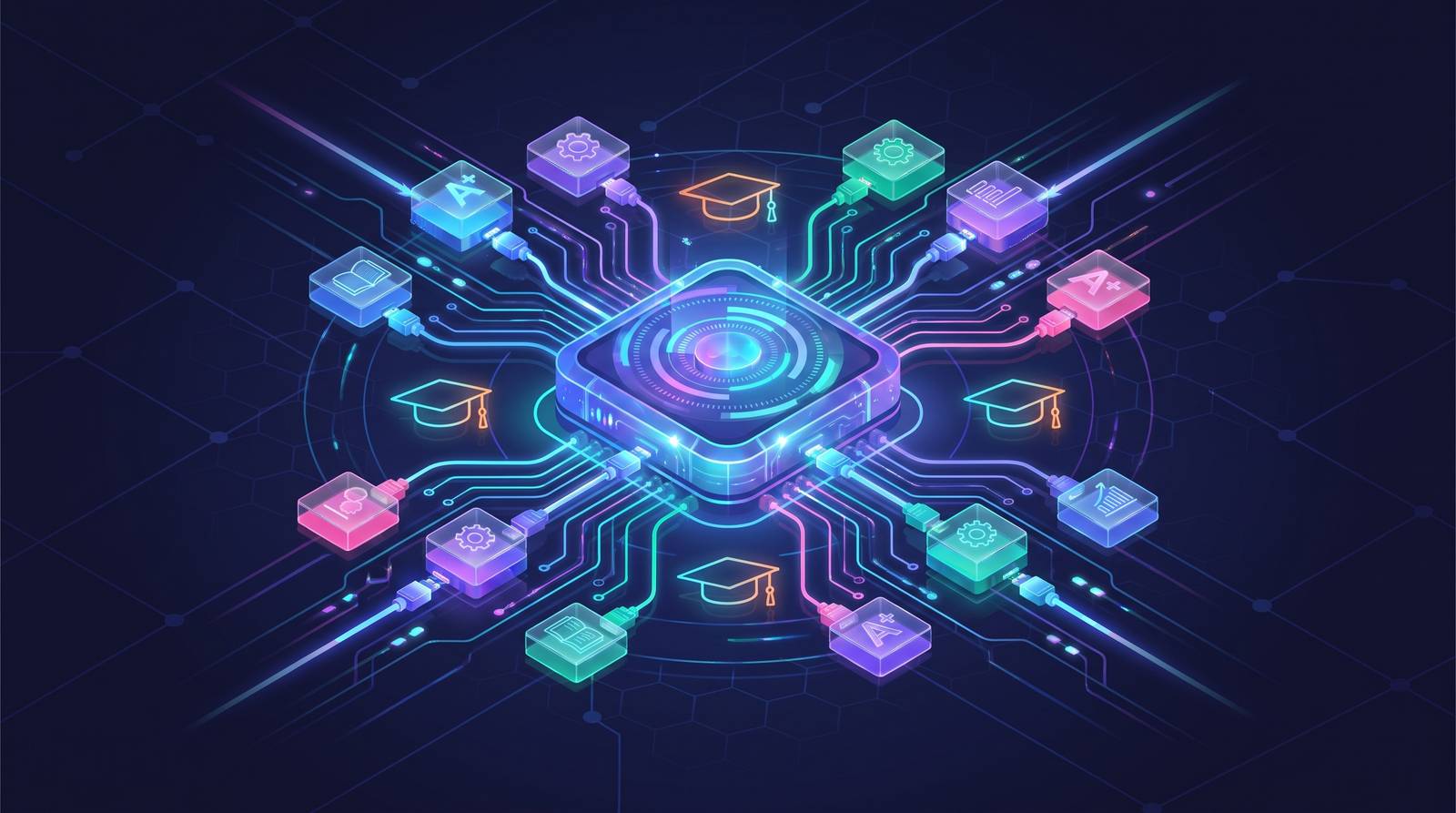
EdTech platforms have quietly become integration companies that happen to build software. The institutions buying these platforms don't want another tool. They want a unified system that makes all their existing tools actually work together. And the platforms that figure out how to deliver that will capture a market multiple research firms place at or above $187 billion in 2025, with projections pointing well past $400 billion by the early 2030s. I'd take those projections with a grain of salt. Research firms have a way of making markets sound tidier than they are. But the directional reality is correct: this market is enormous, it's growing, and most of the growth is being driven not by new tools but by the desperate need for existing tools to stop operating in total ignorance of each other.
This piece is about the connective tissue. How enterprise application integration works in EdTech, where it breaks down, and what it actually takes to get it right.
EAI is a set of architectural patterns and infrastructure choices that let different software systems share data and trigger workflows without being hardwired to each other. It is not a single product you buy or a feature you toggle on. There is no checkbox for "make systems talk." I wish there were. There isn't.
In EdTech, the systems that need to talk to each other look something like this:
- LMS (Canvas, Moodle, Blackboard, Brightspace): the instructional layer where courses live
- SIS (PowerSchool, Infinite Campus, Ellucian Banner): enrollment records, student data, academic history
- ERP: finance, HR, facilities, the institutional operations backbone
- Third-party tools: assessment platforms, video conferencing, tutoring AI, job placement tools, and whatever the institution bought last quarter after sitting through a vendor lunch
None of these systems were designed to talk to each other natively. That is the whole problem. EAI is the infrastructure you build so they don't have to figure it out themselves.
The field has changed. A decade ago, integration meant an Enterprise Service Bus. A big, on-premises piece of middleware that routed messages between systems and handled data transformation. It worked, mostly. It was just expensive, slow to change, and deeply unhappy about anything cloud-related. Today, EAI looks more like API-first architecture, cloud-native integration platforms, event-driven microservices, and increasingly, low-code tooling that lets non-engineers configure connectors without writing custom code from scratch.
The main architectural patterns you'll run into:
- Point-to-point API connections: simple, fast to stand up, falls apart the moment you have more than a handful of systems
- Enterprise Service Bus (ESB): centralized, battle-tested in large higher-ed environments, but heavyweight and resistant to change
- Hybrid Integration Platforms (HIPs): designed for the mixed reality most EdTech platforms actually face, where some customers are fully cloud and others still run on-premises SIS
- Microservices with event-driven messaging: modular and independently deployable, but operationally complex to run well
The global EAI market is projected to hit $42.45 billion by 2029. Make of that number what you will. What I'd point to is the pattern: integration infrastructure spending grows in direct proportion to EdTech platform adoption, because every new platform deployment creates new integration requirements. More customers means more connectors. More connectors means more things that can fail at 7 a.m. on the first day of the semester.
The real cost of disconnected systems: what breaks when LMS, SIS, and ERP don't talk
A 2024 Educause study found that 67% of institutions cite system integration as their top technology challenge, with LMS-ERP integration named most often as the specific gap. Having spent time on both sides of failed data syncs, I can tell you that number is not surprising. It is probably low.
Here is what actually breaks, and I mean breaks in the "people are angry and emailing IT at 8 a.m." sense:
Enrollment discrepancies. A student registers through the SIS. The LMS doesn't get the message. The student can't access their course on day one. The instructor doesn't know the student exists. Both of them spend time emailing IT instead of doing coursework. Multiply this across a few hundred students per semester and you have a support ticket backlog that consumes entire teams for weeks.
Financial disconnects. A student gets dropped from enrollment in the ERP for non-payment. The LMS wasn't told. That student can still log in, access course materials, submit assignments, and interact with instructors for days or weeks. This is not just an awkward situation. It is a compliance exposure that shows up in audits.
Attendance fragmentation. Attendance data lives in the LMS. Financial aid eligibility data lives in the SIS. They never meet. The institution can't automatically flag students who stopped showing up before their aid gets clawed back. A problem that could have been caught in week two becomes a formal withdrawal issue in week eight, at which point everybody is unhappy and nobody looks good.
Reporting gaps. Learning engagement metrics and academic outcomes data live in separate systems that can't be joined. Retention analytics require both. When you can't join the datasets, you can't build the models. When you can't build the models, you're making decisions about student support based on gut instinct and an Excel file someone built last spring that does or does not reflect current enrollment.
Legacy systems make all of this worse. Older LMS deployments and homegrown SIS installations often have no standard API surface at all. Getting data out of them requires custom connectors, which require engineering time, which costs money nobody budgeted for at contract signing.
For EdTech platforms specifically, the problem compounds fast. One platform is live at 40 institutions, each running a different SIS version, a different ERP, different integration expectations, different levels of internal IT sophistication. The integration surface is not fixed. It grows with every new customer you sign, whether you planned for that or not.
How EdTech integration standards like LTI and open APIs reduce — but don't eliminate — the complexity
Standards exist. They help. They don't solve everything, and anyone telling you otherwise is probably trying to sell you something.
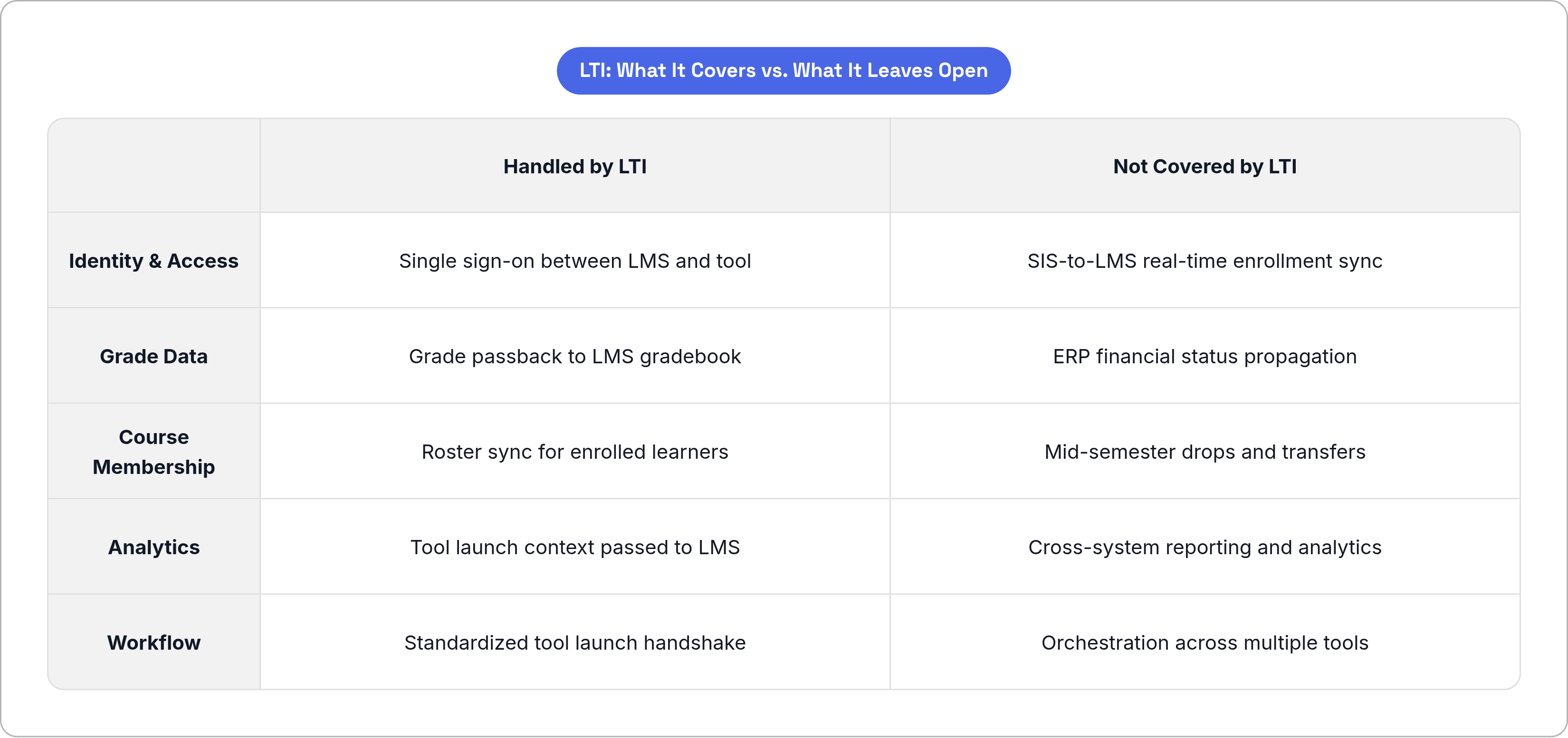
LTI (Learning Tools Interoperability, developed by IMS Global) is the dominant standard for connecting third-party tools to LMS platforms. It defines a handshake: how a tool launches from within the LMS, how grades pass back to the gradebook, how roster data syncs for course membership. All major LMS platforms support it. Canvas, Blackboard, Moodle, Brightspace. A tool built to LTI spec can plug into all of them.
What LTI handles reasonably well:
- Tool launch and single sign-on between LMS and external application
- Grade passback from third-party assessment tools into the gradebook
- Roster sync for course membership
What LTI does not handle:
- SIS-to-LMS real-time sync, meaning enrollment changes, drops, mid-semester transfers
- ERP-to-LMS financial status propagation
- Cross-system analytics and reporting
- Workflow orchestration across multiple tools at once
API-first architecture fills some of those gaps. When a student enrolls, the SIS pushes that data to the LMS via API. Grades and attendance sync back. It's a two-way bridge that reduces manual entry and the errors that come with it. But someone has to build it, maintain it, monitor it, and update it every time either system changes a schema or deprecates an endpoint. That work does not end at launch. It just becomes background noise that somebody has to keep paying attention to.
There is also a newer pattern showing up: workforce and job placement platforms connecting directly to LMS data, creating work-study data flows that no existing standard fully covers. The standards haven't caught up to where the market is going, which is honestly pretty normal. Standards bodies move slowly. Markets don't.
Standards make integration tractable. They do not make it turnkey. What remains after you implement LTI and set up your APIs is the ongoing engineering and operational work of keeping those connections running, versioned, and monitored. That work scales with your customer base whether you plan for it or not.
Architecture choices that determine whether an EdTech platform can scale its integrations
This is where decisions get expensive if you get them wrong. Not slightly expensive. Genuinely, painfully expensive.
Point-to-point API connections are where almost every EdTech platform starts. You have one LMS and one SIS. You build a connector. It works. Then you add another tool. Then another. Then a new customer comes in with a different SIS version, and the connector you built doesn't quite work for them, so you build a variant. Before long you have N systems creating a web of N times (N minus 1) divided by 2 connections, each with its own error handling, authentication logic, and versioning requirements. This is the architecture that looks totally manageable on day one and becomes a full-time maintenance job by year three.
Enterprise Service Bus (ESB) solves the sprawl problem by centralizing message routing and transformation. It's been the standard in large higher-ed ERP environments for a long time. Banner and PeopleSoft deployments have run on ESB-style middleware for years. The problem is that ESBs are heavyweight to operate, slow to modify, and almost always on-premises. For a platform that needs to ship a new connector in days rather than quarters, an ESB is a ceiling.
Hybrid Integration Platforms (HIPs) are designed for the situation most EdTech platforms actually face: some customers are fully cloud, others run on-premises SIS with a cloud LMS, and a few are somewhere in between. HIPs provide unified management across both environments. Cloud deployment in EdTech is growing fast, but legacy on-premises systems don't just disappear because a percentage of the market is moving on. HIPs let a platform serve both without running two completely separate integration stacks.
Microservices with event-driven integration takes a different approach entirely. Each integration concern, enrollment, grading, identity, analytics, lives in its own service, deployed independently, updated without touching the rest of the system. When you add a new tool, you add a new service. You don't rebuild the core. The tradeoff is real operational complexity: solid observability tooling, careful schema management, and a team that actually knows how to choreograph event flows without creating distributed chaos. Teams underestimate that last part more often than you'd think.
Low-code and no-code integration tooling is growing fast and for good reason. It reduces dependency on dedicated integration engineers, speeds connector deployment, and makes it possible for non-engineering staff to configure and manage connections. For EdTech platforms trying to scale without scaling headcount proportionally, this is real leverage.
Most platforms start with point-to-point, outgrow it, bolt on a middleware layer, and eventually face a full re-platforming decision after they're already live at dozens of institutions. Doing that migration while keeping production systems running for paying customers is one of the harder engineering problems in this space. I have seen teams underestimate how hard it is. It does not go well. Building toward the right architecture earlier is a lot cheaper than fixing it later. Not slightly cheaper. A lot cheaper.
Data privacy and compliance requirements that every EdTech integration must account for
Compliance is a constraint the integration layer has to be built around from the beginning. Not added on later. Adding it later costs more, covers less, and surfaces the gaps at the worst possible time, which is to say during an audit.
Three frameworks dominate for EdTech platforms:
FERPA (US) governs student education records. Any integration that moves enrollment data, grades, or attendance between systems must enforce access controls and maintain audit trails. A misconfigured API that returns student PII to an unauthenticated endpoint is a FERPA violation regardless of whether the LMS itself is locked down. The violation happens at the integration layer. Not the application layer. That distinction matters a lot when you're explaining the situation to a compliance officer.
GDPR (EU) adds data minimization, right to erasure, and cross-border transfer restrictions. These affect how LMS-SIS integrations are designed, especially for platforms serving European institutions. You can't sync everything to everything and sort it out later. The architecture has to enforce data minimization before data moves.
India's DPDP is newer but increasingly relevant for platforms expanding into APAC. The specific requirements are still evolving, but platforms expanding into that region need to be tracking the framework now, not after they've signed their first regional contract and someone asks whether they're compliant.
There is also a newer governance framework, referenced in recent EdTech trend analysis as the HEAT-AI framework, being proposed specifically for AI systems in higher education. It calls for encrypted data flows, audit-ready governance, and human oversight for automated decisions. Whether or not your platform has AI tools today, procurement conversations are moving toward platforms that can demonstrate this kind of governance posture.
SOC 2 compliance is now a baseline expectation in enterprise EdTech procurement. Platforms like Cornerstone OnDemand, Docebo, and Coursera have established it as standard. Any platform competing at the enterprise level needs to meet it. Buyers are checking, and the ones who aren't checking yet will be soon.
The practical implication: managed, auditable integration infrastructure has a real compliance advantage over hand-rolled connectors. A managed connector generates a log. A custom script often does not. When an auditor asks you to produce a record of every system that accessed a student's grade data in the last 90 days, the answer depends entirely on how your integration layer was built.
Compliance requirements are, in this sense, a structural argument for investing in integration infrastructure rather than stitching together custom connections for every new customer you sign.
How AI tools are being layered into EdTech systems — and why they make integration harder before they make it easier
EdTech platforms are moving from digitizing content to building what people in the industry are starting to call intelligent learning ecosystems. Machine learning and generative AI are no longer add-ons. They are core competitive features. And they are making the integration problem significantly more complicated before they make it any easier.
The AI integration surface right now looks like this:
- AI tutoring and chat assistants embedded in the LMS via LTI or direct API
- Adaptive learning engines that consume engagement data and return personalized content recommendations
- Automated grading tools that write results back to gradebooks
- Retention analytics that pull simultaneously from SIS enrollment, LMS engagement, and ERP financial status
Each of these requires a clean, reliable, compliant data pipeline from the rest of the system into the AI layer. And that pipeline only works if the underlying LMS-SIS-ERP integration is already solid. AI doesn't fix a messy data foundation. It amplifies whatever is already there. If your data is inconsistent before the AI touches it, the AI will be confidently inconsistent after. The confidence part is what makes it worse.
Two specific integration challenges deserve attention.
The first is hallucination risk in LLM-powered tutoring. Large language models can generate inaccurate content that directly contradicts course materials. The standard mitigation is Retrieval-Augmented Generation (RAG), which feeds the model verified content from the LMS as context. But RAG requires a reliable pipeline from course content into the model. That pipeline is an integration dependency. It requires the LMS to expose course materials in a clean, consistent format, the integration layer to move that content reliably, and the AI system to consume it without latency that degrades the learner experience. If any piece of that chain is broken, the model hallucinates anyway. The AI gets blamed. The integration was the problem.
The second is governance. AI systems that make automated decisions about learners, flagging at-risk students, adjusting content difficulty, recommending interventions, fall under the kind of governance requirements the HEAT-AI framework is being designed to address. The integration layer has to carry audit metadata, not just data. Who queried what, when, and what decision was made as a result. This is a logging and observability requirement. It is not a product feature someone adds at the end of the project.
For institutional leadership, the business case is already clear. Analytics-driven retention and operational efficiency are near the top of every CTO and provost priority list. The platform that makes the data pipeline from LMS and SIS into analytics and AI tools actually tractable is the one winning procurement conversations. The integration layer is the product, whether or not it shows up on the marketing page.
What EdTech platforms should look for when evaluating integration infrastructure
The build-vs-buy question in integration has mostly been answered. The real question is what your engineering team's time is actually worth, and whether rebuilding auth flows and data mappings for every new customer is the best use of it. Spoiler: it isn't. Not even close.
Here is what to actually evaluate:
Standards support. Does the platform support LTI, OAuth 2.0, REST, and the API surface of the SIS and ERP systems your customers actually use? In production, with version history and a roadmap. Not in a demo environment someone spun up for the sales call. Ask specifically about the systems your first ten customers run and watch how the conversation changes.
Pre-built connectors. The number of connectors matters less than which ones. A platform with 500 connectors to marketing tools and 3 connectors to higher-ed SIS systems is not useful to you. Look for depth in the systems your customers actually run: Banner, Infinite Campus, PowerSchool, the major LMS platforms. Alumio is worth evaluating here because it is built around a connector-first model for enterprise environments, including education, and offers a low-code configuration layer that reduces the engineering lift for new integrations without sacrificing the control teams need when something breaks in the middle of the night.
Hybrid environment support. If even a portion of your customers run on-premises systems, and they do, especially in the K-12 and mid-market higher-ed segments, your integration infrastructure needs to handle that. A cloud-only platform cannot serve the actual market you're selling into.
Audit and observability tooling. Can you produce a log of every data flow for a FERPA audit? Can you trace a failed sync back to the specific step that broke? This is not optional. It is what enterprise procurement teams ask about, and it is what compliance frameworks require.
Schema management and versioning. SIS platforms update. LMS platforms deprecate endpoints. Your integration infrastructure needs to handle version changes without requiring a full rebuild every time a vendor pushes an update.
Data governance controls. Role-based access, field-level encryption, consent tracking. These should be configuration options in the platform, not separate engineering projects you undertake for each customer who asks about them.
Scalability that matches your growth model. If you are adding institutional customers at a meaningful clip, your integration infrastructure needs to support new customer environments without the marginal cost of each new integration ballooning. Platforms that charge per connector or per environment become a constraint on your sales motion faster than you'd expect.
The integration infrastructure decision touches every customer you have simultaneously. Picking the wrong one doesn't just slow down a single project. It creates technical debt that compounds across every deployment you've already sold. Pick something built for the complexity you're heading toward, not the simplicity you're starting from.