Unified Authentication Across EdTech Tool Ecosystems
Schools waste 50+ hours per teacher yearly on login chaos that unified authentication can eliminate.

What the credential chaos actually costs teachers, students, and IT teams every day
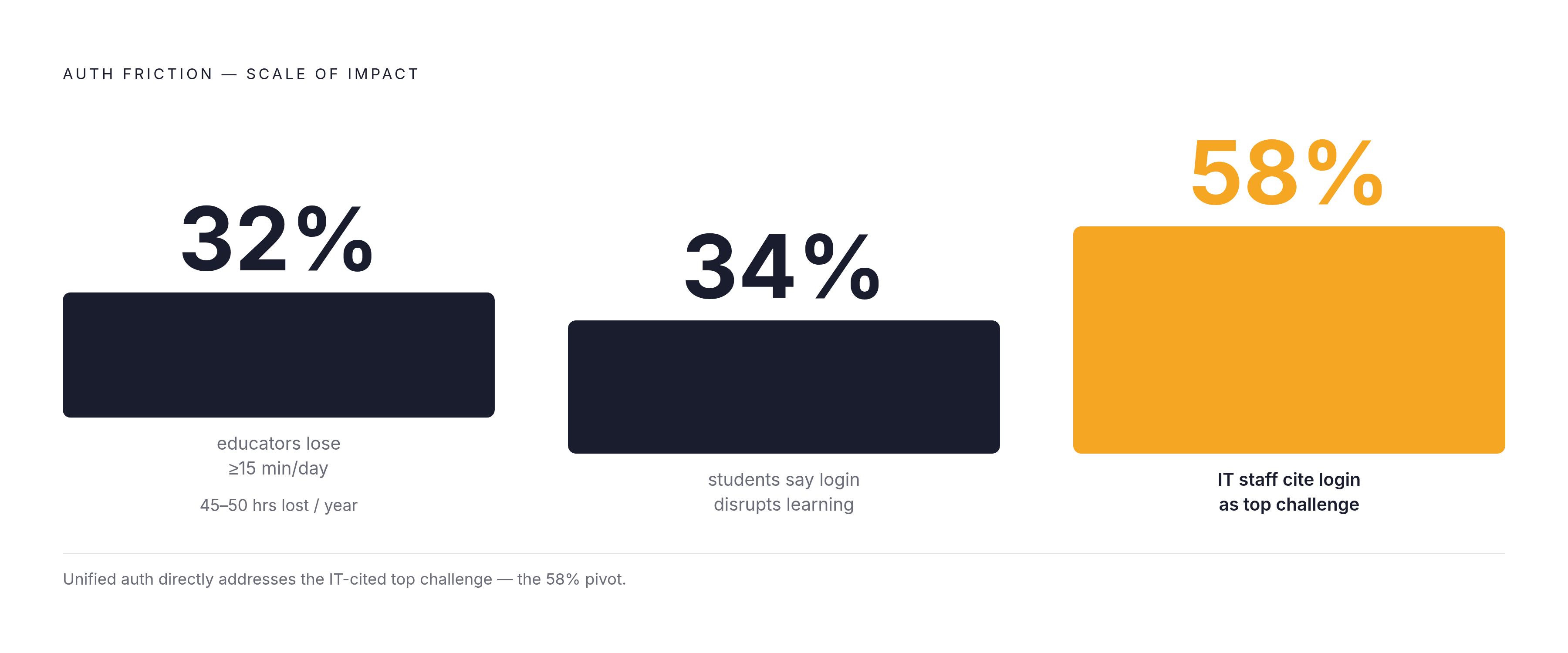
Thirty-two percent of educators waste at least 15 minutes per day on tech access issues. Across a full school year, that compounds to roughly 45 to 50 hours per teacher, more than a full work week, simply gone. Thirty-four percent of students report that login problems interfere with their learning. Fifty-eight percent of school IT staff cite login issues as their top technology challenge.
These aren't annoyance metrics. Instructional time is non-recoverable. An IT staff member processing password resets isn't doing threat monitoring, patch management, or the integration work that would actually reduce the volume of reset requests. The problem feeds itself, and it does so invisibly, buried inside a hundred small moments of classroom friction that never make it into a report.
The mechanism is familiar to anyone who has watched it from the inside. Gradebook, attendance, curriculum delivery, and records management have all migrated to cloud-based delivery over the past decade, and each tool arrived with its own credential set, its own access flow, its own password policy. Teachers managing dozens of tools under daily pressure land on the rational but dangerous response: weak passwords, reused across systems. That don't happen out of negligence. It's what happens when cognitive load exceeds any reasonable threshold, and it converts an operational nuisance into a genuine security vulnerability, quietly, over time.
Tool sprawl creates credential sprawl. Credential sprawl creates IT overhead. IT overhead crowds out the infrastructure work that would address the root cause. This cycle can't be solved at the per-tool level, which is precisely what makes unified authentication a structural requirement, not a convenience upgrade.
What unified authentication actually means in an EdTech context
SSO is frequently misunderstood as a better login page. It isn't. Single sign-on means authenticating once against a central identity provider and gaining access to all approved applications without repeating that step. The login prompt doesn't improve; it disappears.
In practice, this means integrating with the directory infrastructure a district already operates. For most U.S. districts, that's either Google Workspace for Education or Microsoft Entra ID. The underlying mechanism is identity federation, a trust relationship established between the identity provider and each application, allowing a verified credential to be accepted across many systems without those systems ever seeing or storing the underlying password. The password lives in one place. The trust propagates everywhere.
According to the CoSN 2024 State of EdTech District Leadership survey, SSO is the most fully implemented interoperability initiative in U.S. districts, at 43%. This is no longer emerging technology. It's baseline infrastructure for districts that have done the work, and a gap that's becoming harder to defend for those that haven't.
What SSO does not do is equally important to understand. It handles authentication, establishing who a user is, but it doesn't automatically handle authorization, rostering, or grade passback. A student who authenticates through SSO without a properly configured rostering integration will still face an empty dashboard or an unrecognized account on the other side of the login. Those functions require additional layers, and districts that treat SSO as a complete solution discover this expensively and mid-year, which is the worst possible time to discover anything.
When the full stack is configured correctly, a student opens a browser, authenticates through their school Google or Microsoft account, and every tool on their dashboard opens without another prompt. That simplicity is the product of significant infrastructure work. Districts that haven't built it yet tend to underestimate how much of it there is.
How SSO, LTI, and OneRoster fit together as a layered stack
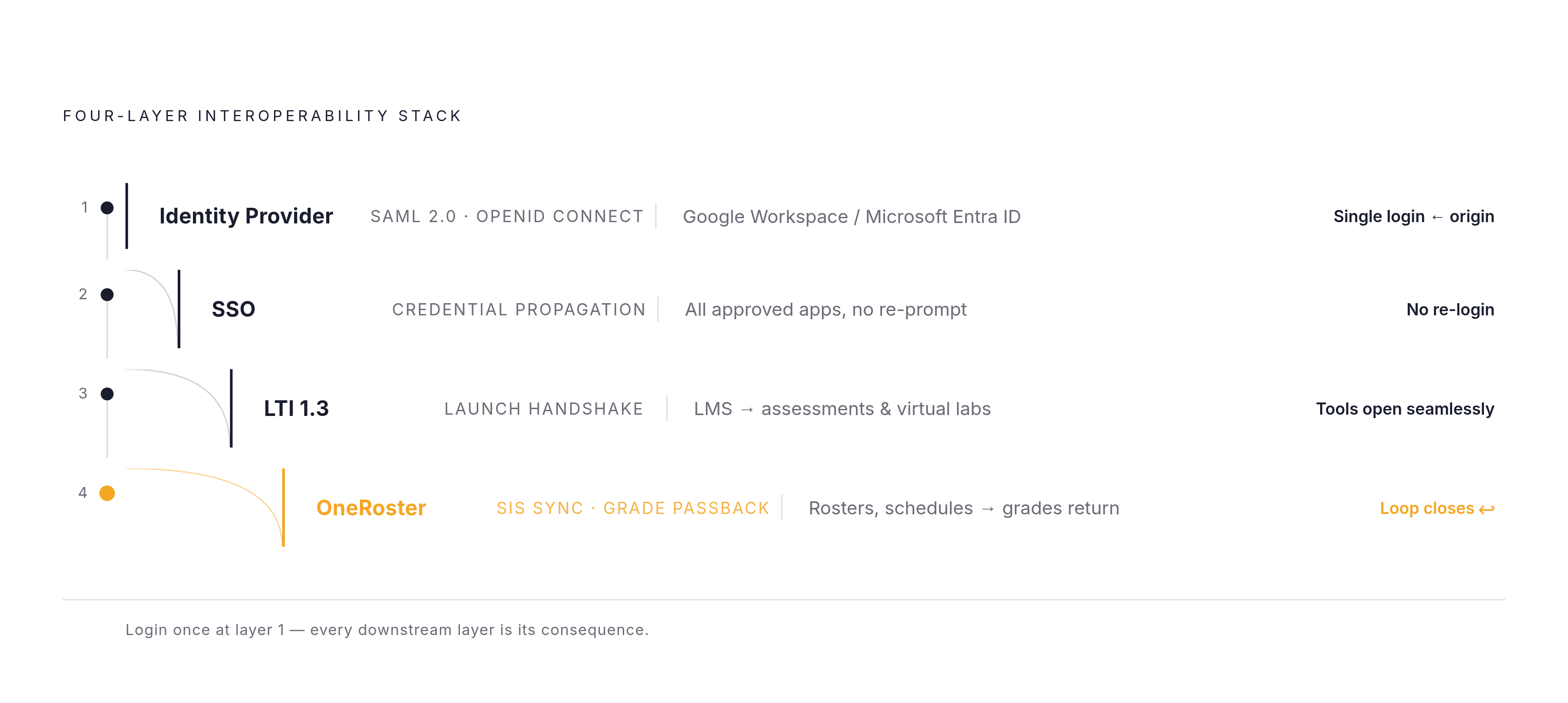
The authentication layer is built on protocols inherited from broader web security standards. SAML 2.0 remains common in enterprise and district deployments. OpenID Connect, built on OAuth 2.0, is the current direction for most new implementations. These protocols handle identity verification at the organization-to-application level, confirming that this user, authenticated by this institution, should have access to this tool.
LTI, Learning Tools Interoperability, operates at a different level entirely. Where SAML or OIDC establishes a trust relationship between an organization and an external application, LTI establishes a trust relationship between a specific application, typically the LMS, and an external tool. It's what allows an LMS to embed an external assessment engine, a virtual lab, or a content provider without requiring a student to re-authenticate mid-session. LTI 1.3 uses OAuth 2.0, OpenID Connect, and JSON Web Tokens, producing a meaningfully more secure authentication model than its predecessors. The recommended path for any new implementation is LTI 1.3 with LTI Advantage, which adds services for rostering, grade passback, and deep linking that earlier versions handled poorly or not at all.
Vendors who deferred the migration to LTI 1.3 accumulated technical debt that became a procurement liability when districts began specifying it as a hard requirement. Some of them are still paying for that delay, and the market hasn't been patient about it.
OneRoster addresses the provisioning layer. Authentication tells a system who someone is. OneRoster tells it what that person belongs to: which classes, which sections, which tools, which teacher. It syncs enrollment data from the Student Information System to connected EdTech applications automatically, so when a student's schedule changes, their tool access updates without anyone filing a ticket. The 1EdTech consortium maintains and certifies all three standards. Certification is the mechanism by which "plug-and-play ecosystem" shifts from marketing language to operational reality.
Together, the stack closes the full loop: a teacher logs in once, their LMS surfaces the correct tools for their specific roster, students move into an external tool via LTI without re-authenticating, and grades pass back automatically. No redundant credential prompts, no manual roster maintenance, no orphaned accounts accumulating in the background.
The middleware layer: how Clever, ClassLink, and aggregator APIs handle what standards alone don't
Open standards define what interoperability should look like. They don't implement it. Every district runs a different SIS, uses different identity providers, and carries data models shaped by years of local decisions and incremental procurement. Middleware platforms exist to normalize that heterogeneity into something EdTech vendors can connect to once.
Clever built its position by offering districts free SSO dashboards in exchange for rostering data, which it normalized and charged vendors for access to. The claimed operational outcomes are substantial: up to a 27% year-over-year reduction in support tickets and up to $325,000 in annual savings on user identity maintenance. ClassLink inverted the model, charging districts while giving vendors free data access via the open OneRoster standard. It now serves over 25 million users across more than 6,000 integrated digital resources.
The structural difference between these two business models is not a minor detail. It reflects a genuine tension over who bears the cost of interoperability infrastructure and who controls the underlying data. Districts evaluating middleware platforms aren't just selecting a technical connector; they're taking a position on that question, whether they've framed it that way or not. Many haven't, and they should.
Aggregator APIs like Edlink operate at yet another layer. Rather than providing a district-facing dashboard, they give EdTech developers a single API that abstracts Canvas, PowerSchool, Clever, ClassLink, and other providers into consistent data entities: People, Classes, Enrollments, Assignments. A developer integrating through Edlink builds once and reaches districts regardless of which SIS or middleware platform those districts use. Over 150 EdTech companies have adopted this approach, because the alternative, building direct integrations with each district's configuration individually, multiplies maintenance burden with every new district added.
No single middleware platform achieves universal coverage. That gap is real, and vendors who discover it after launch find it expensive.
Why the security case for unified auth is now stronger than the convenience case
Education averaged 4,388 cyberattacks per organization per week in Q2 2025, a 31% year-over-year increase. It's one of the most aggressively targeted sectors in the country, and the entry points are rarely exotic.
The Illuminate Education breach exposed data on 10.1 million students. The entry point was credentials belonging to an employee who had left the organization three and a half years earlier. Orphaned accounts, with no automated deprovisioning, persisting indefinitely because no central identity layer existed to recognize that access had lapsed. Entirely avoidable, and still happening across districts that haven't yet built the infrastructure to prevent it.
Federated identity models address this directly. In a properly configured SSO deployment, deprovisioning happens once at the identity provider level and propagates automatically across all connected applications. When a student transfers, their access lapses. When a staff member's employment ends, their credentials stop working everywhere, not just in the SIS. That propagation is not incidental to unified authentication. It's one of its primary security functions, and the one most consistently underdiscussed, probably because it doesn't show up cleanly in product demos.
The operational evidence is consistent. Schools implementing SSO report a 38% decrease in password-related help desk tickets. Northeast Iowa Community College reduced password-related IT support calls by 90% after deploying unified SSO with self-service password reset. Freeing IT staff from that volume of low-level work isn't a minor efficiency gain; it's the difference between a team executing proactive security work and one stuck in permanent triage.
SSO also functions as a component of zero-trust architecture. Paired with multi-factor authentication, it shifts the security model from perimeter defense, which assumes that being inside the network confers sufficient trust, to identity-based access control, which verifies every user at every access point. Framing unified authentication primarily as a convenience improvement undersells what it actually does. The convenience is real, but centralized access control, comprehensive audit logging, and rapid deprovisioning at district scale are what make this architecture defensible. Those are the things that matter when something goes wrong.
How passwordless and adaptive authentication extend the model for different age groups
The standard SSO model carries an embedded assumption: users can manage a password. For early elementary students, that assumption doesn't hold. Expecting a six-year-old to remember, type, and protect a credential was never a reasonable design requirement. Any educator who has watched a first-grade teacher burn ten minutes of class time on login troubleshooting understands this immediately, in the gut, not as a design principle.
Clever Badges addresses it with a passwordless flow in which younger students authenticate by selecting an animal and fruit combination. Accessible to pre-literate users, and still feeding into the same underlying identity infrastructure and access controls as any other SSO-connected account. The authentication method changes; the identity architecture doesn't.
For older users and district staff, ClassLink offers MFA options including passkeys, layering stronger verification on top of the same unified identity foundation rather than building parallel systems. Adaptive authentication adds another dimension, adjusting security requirements based on context. A student on a school-managed Chromebook on the district network faces different friction than the same student on an unrecognized personal device from home. The system reads context and calibrates accordingly.
The 2025 COPPA Rule amendments, effective April 22, 2026, expand protected personal information to include biometric identifiers: fingerprints, facial templates, voiceprints, and gait patterns. This directly constrains how districts deploy biometric authentication or facial-recognition attendance tools, and it makes certain authentication methods materially more complex from a legal standpoint before they're even piloted.
The design constraint unique to K-12 is the range itself. A unified authentication architecture must work for a kindergartner with a badge and for a district IT administrator with MFA and a hardware key. That span doesn't exist in enterprise or higher education deployments at anything like the same degree of extremity, and vendors who enter this market without internalizing it tend to build things that work cleanly for one end and fail the other.
The compliance environment that makes consistent identity management non-optional
Three overlapping federal frameworks govern EdTech data: FERPA, which applies to education records and the institutions and vendors that handle them; COPPA, which applies to commercial operators collecting data from children under 13; and the FTC's 2025 COPPA amendments, which extend protected categories and tighten consent requirements. They don't always align. EdTech vendors and districts must navigate all three simultaneously, and ignorance is not a viable legal defense in any of them.
FERPA requires institutions contracting with EdTech vendors to execute data processing agreements that include privacy requirements and minimum security standards. Unified identity management is the mechanism that makes those agreements enforceable beyond the paper they're printed on. If a district can't demonstrate which students accessed which tools, when, and under what authorization, the agreement is a formality rather than a control. That distinction matters when a regulator asks.
As of 2024, more than 130 state-level student data privacy laws have been enacted across the U.S. Districts operating across state lines face a patchwork of requirements, many exceeding FERPA and COPPA, that can only be navigated through consistent, auditable access control. Manual tracking at this scale isn't a viable approach; it's an audit failure waiting to be documented.
Lightspeed Systems' 2024 report, based on data from 154 U.S. districts, found that 65% of EdTech apps had one or more data privacy policy changes during the 2022-23 school year. A district using hundreds of tools can't track those changes manually. Centralized identity infrastructure is what makes automated monitoring of tool access and policy alignment possible. Without it, compliance becomes a retrospective exercise conducted after incidents rather than a proactive control conducted before them.
The compliance burden lands disproportionately on IT and procurement teams already operating beyond capacity. Unified authentication converts an ongoing manual audit problem into a configuration and automation problem. Those are solvable in ways that manual tracking never will be at district scale. For EdTech vendors, the implication runs in the opposite direction: building integrations that don't support standard authentication protocols creates legal exposure for the districts deploying them, which converts standards compliance from a differentiator into a procurement prerequisite.
What it takes to build and maintain authentication integrations across a district-scale tool ecosystem
Supporting unified authentication isn't a one-time engineering effort. Each LMS, SIS, and identity provider carries its own data model, API behavior, and update cadence. A vendor supporting 50 districts is managing 50 slightly different integration configurations, each capable of drifting as upstream systems push changes downstream without warning. The spec is the easy part.
The scope of rostering has expanded considerably. Districts now expect integrations to handle not just class lists but attendance, discipline records, calendar data, and assessment information. Each extension adds surface area that requires maintenance as the systems on both ends of the integration version independently and on schedules that nobody coordinated with anyone else.
The LTI 1.1 to 1.3 migration made this concrete. Vendors that had built to the earlier standard faced a substantive rebuild, not a patch. The authentication security model changed enough that prior implementations couldn't be extended forward; they had to be replaced. Vendors who delayed found that accumulated technical debt eventually surfaced as a lost deal, typically when a district procurement committee asked a direct question about LTI version support and received an answer that ended the conversation.
The operational burden is asymmetric. Large EdTech vendors can staff dedicated integration teams and absorb the overhead of maintaining direct connectors to individual providers. Smaller developers building specialized tools frequently can't. For those vendors, middleware aggregators represent the practical path to broad compatibility without proportionally large engineering investment.
Building direct integrations with each provider gives maximum control over data handling and edge-case behavior, but multiplies maintenance overhead with every new district or provider added. Integrating through a unified API layer trades some of that control for dramatically reduced per-connector overhead. The right choice depends on the vendor's scale, the complexity of their data requirements, and an honest accounting of their capacity to sustain ongoing integration maintenance over time.
The real complexity in EdTech authentication doesn't live in the protocols. OIDC, OAuth 2.0, and LTI 1.3 are standardized and well-documented. It lives in the variation in how each district and provider implements them, shaped by years of local decisions, legacy systems, and incremental procurement choices made by people who are long gone. That's where timelines slip, where scoping assumptions collapse, and where vendors who built their estimates against the specification rather than against the field discover what they actually signed up for.