Idempotency in EdTech API Integration Design
Building idempotent APIs stops students from appearing twice in the gradebook.

- Written by
- Anouk Osborne
- Updated
- October 17, 2026
- Reading time
- 11 min read
- Sources cited
- 5 sources ↓
What this covers
A duplicate enrollment shows up as a kid in the gradebook twice, gets flagged for a course he never took, and now his mom's sitting in a registrar's office while somebody tries to explain why. Idempotency is the design principle that's supposed to stop that. In EdTech, where retries touch actual student records instead of, say, cat memes, it belongs as a baseline requirement, not something teams get around to eventually.
I've spent enough time debugging SIS-to-LMS syncs to know the market context. The LMS market was worth $24.09 billion in 2025, headed toward $104.04 billion by 2034 according to Fortune Business Insights. Canvas alone runs somewhere around 47 to 50% of the US higher ed LMS market by enrollment, according to New Market Pitch. When something breaks at that scale, it doesn't break quietly. It breaks into thousands of support tickets by lunchtime.
Here's the setup that makes failures likely: an SIS, an LMS, an assessment platform, an SSO layer, and a payment processor, all wired together with custom bridges nobody documented properly. Every bridge is a spot where a retried call can double-write. Students get enrolled twice, grades post twice, and families get charged twice. SSO spins up a duplicate account out of nowhere. This exact failure pattern is documented in LMS support contexts: duplicate person records from SIS imports send LMS enrollment data to the wrong student entirely. Somebody else's kid ends up with somebody else's grade.
What Idempotency Means for HTTP Operations
Idempotency, plainly: hit the same operation ten times, and the server ends up exactly where it would have landed after one hit. The response can vary, but the outcome cannot.
Networks drop calls, and clients retry things that time out or fail silently. Whether that retry is harmless or a minor disaster comes down to one question: was the operation idempotent to begin with?
HTTP sorts some of this out for you, though not as much as you'd hope.
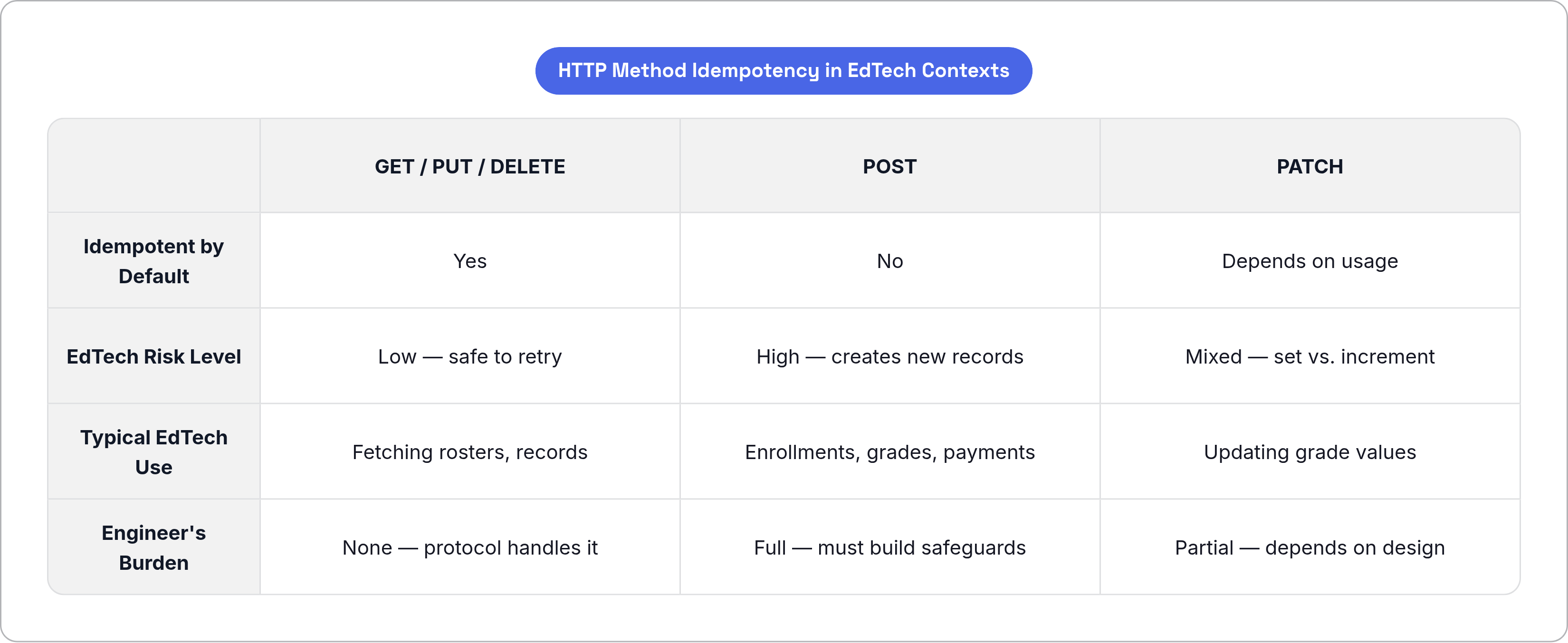
GET, PUT, DELETE, HEAD, and OPTIONS are idempotent by design, so hitting them a hundred times changes nothing after the first. POST is not idempotent by default, since each call tends to create something new, which is exactly why firing off the same grade submission twice is a problem. PATCH is the wildcard: setting a grade to 87 is idempotent because you get 87 no matter how many times you send it, but adding 10 points is not, because ten retries tack 100 points onto a student's score. Same verb, opposite behavior depending on how the operation is framed.
The operations that matter most in EdTech, creating an enrollment, posting a grade, charging a fee, are all POSTs with zero built-in protection. The burden lands on engineers to build the safety net themselves, because the protocol was never going to hand it over.
SIS–LMS Sync Is the Highest-Risk Surface
If one seam in the stack breaks more than any other, it's the SIS-to-LMS bridge. Enrollments flow one way, grades and attendance flow back the other, and both directions carry risk in roughly equal measure.
Picture a nightly sync job halfway through pushing enrollments when it times out and retries. Without idempotent design, every student who already synced now has a second enrollment record sitting right next to the first. Flip the direction: a grade passback call from the LMS to the SIS hits a network error, the LMS retries, and the gradebook now shows two entries for one submission.
Things get worse when the underlying data was already broken before the sync started. A mistyped student ID upstream means the system cannot look the student up at all, so every record tied to that ID fails. Failed calls tend to trigger retry logic that fires again and again against a reference that was never going to resolve.
K-12 rostering adds further complexity. Districts hand off data through OneRoster CSV drops, homegrown SIS feeds, and one-off metadata extensions that are poorly understood outside the district. Before an idempotency check can even run, the receiving system has to normalize several different format variations into one shape. Meanwhile, the people configuring these pipelines are not always the people who built them. 71% of K-12 EdTech leaders cited insufficient expertise as a data interoperability challenge, and over 60% of API failures in this space trace back to bad documentation or teams that never coordinated with each other.
How the Idempotency Key Pattern Works
The fix has a name: the idempotency key. The client generates a unique value, usually a UUID, for each logical action and sends that same key on every retry of that action. The server checks whether it has seen the key before. If not, it processes the request. If so, it does not process it again and instead returns whatever happened the first time.
The server's obligation here is specific. It has to store the key, the status code from the original response, and the full response body, whether that first request succeeded or failed.
A few things in the key's lifecycle that actually matter:
Expiration needs a limit. Twenty-four hours is the common convention, and after that window closes, the key is fair game to reuse, since whatever it referred to is long since settled. The key should scope to the logical action, not the individual call, because one enrollment attempt is one logical action even if retry logic fires the same request three separate times.
There is also the question of someone sending the same key with a different request body. That should throw an error rather than be silently processed. One clean way to catch it: hash the request body, store the hash beside the key, and flag any mismatch as misuse rather than a legitimate retry.
Stripe is the reference implementation everyone points to. Every mutating endpoint takes an Idempotency-Key header, and a retried charge never turns into two charges. EdTech payment flows, tuition, course fees, and subscription billing, carry the identical risk profile, and the same fix transfers over without modification.
For EdTech specifically, the key should encode the action itself. Something like enroll:{student_id}:{course_id}:{term_id} fed into a UUID means two separate, legitimate enrollment actions for the same student never accidentally collide.
Where Idempotency Implementations Break in Production
Teams understand the pattern correctly on paper and still get it wrong in production. The naive version, check if the key exists, process if it does not, then store the result, is not atomic. Two retries can both slip past the existence check before either one finishes writing its result. The record duplicates anyway, which is exactly what the pattern was supposed to prevent.
The fix is a lock on the key before any processing starts. One request goes through, the other waits, then gets served the cached response once it is ready. That requires a shared lock store visible across every API server instance, and Redis is the standard choice.
Side effects do not play by these rules, and that trips people up consistently. Email confirmations are the classic case: if the notification fires inside the request handler, a deduplicated retry might still have already sent the email on attempt one, before deduplication logic kicked in. Move notifications to an async queue that checks whether they already fired before sending again. Third-party webhooks present the same problem, compounded by the fact that the external system has no visibility into your idempotency key at all and simply sees two calls and assumes two events. Audit logs are the opposite case and should never be deduplicated, since every attempt is worth recording, including failed ones. Keep the audit trail separate from the idempotency layer, or you lose the data you need to debug the layer itself.
There is also the operational cost. Every mutating request now needs a key lookup and a key write, adding latency on paths that were already under load. Keep the key store in memory rather than treating it as a relational table row checked on every request. Keys accumulate quickly, so a retention policy is load-bearing, not optional. In high-volume sync windows, such as a district onboarding tens of thousands of students at the start of a school year, an undersized key store becomes the bottleneck nobody anticipated.
One thing worth stating plainly: do not force idempotency onto operations that were never built for it. A PATCH that increments a balance is genuinely stateful, and trying to make repeated increments idempotent produces an overengineered system that is difficult to maintain. Redesign it as a PUT with an absolute value instead, since it is simpler and actually works.
Applying Idempotency Across Common EdTech Scenarios
Theory is one thing, but here is where the pattern has to hold up under load.
SIS nightly sync, whether OneRoster CSV or REST, needs upsert logic keyed on a stable external identifier: student ID plus course section plus term, handled as a unified operation rather than a separate insert path and update path. For CSV drops, diff the incoming file against the last known state before writing anything, and route ambiguous deletes to a manual review queue rather than auto-deleting a student who simply vanished from the file. The OneRoster REST profile allows paging but never mandates a batch size, so a large district may produce thousands of paged requests. Cache the resolved roster locally and adjust page sizes dynamically, or you will trigger rate-limit retries that cause the duplicate processing this whole system was built to avoid. The sync job also needs to be re-runnable from any failure point, so dying partway through and restarting from zero should land at the same final state.
Grade passback via LTI Advantage or Canvas Grade Passback runs entirely on POSTs, and network timeouts during quiz submission trigger automatic retries in most LTI consumers. Key on student ID plus assignment ID plus submission attempt number. That attempt number is not decoration; without it, a legitimate resubmission gets swallowed by deduplication logic. The server should return the actual cached grade on a duplicate key, not a bare 200 with an empty body, because the client needs proof before it will stop retrying.
Payment processing can borrow the Stripe pattern directly, since this is a solved problem. Scope one key per purchase intent, generated at the moment checkout starts, so a page refresh or a flaky retry replays the original result rather than charging a family twice for the same course fee. If someone genuinely returns to re-enroll after the key's TTL has expired, issue a fresh key rather than reusing the old one.
SSO provisioning via SAML or SCIM is where duplicate calls create duplicate accounts, which is the same mechanism behind the Watermark Insights failure, where enrollment data synced to the wrong student record entirely. Key on the identity provider's authoritative ID, never email, since email addresses change and IDs generally do not. Treat provisioning as an upsert consistently. Deprovisioning is the harder half: a DELETE retried after the account is already gone should return a success or a 404 the client treats as one, rather than an error that kicks off another retry loop.
The principle across all four scenarios does not change: any POST creating an educational record, whether an enrollment, a grade, a charge, or an account, needs an explicit idempotency plan. Key format, TTL, and duplicate response behavior should all be documented. Leaving them implicit and hoping nobody retries at the wrong moment is a bet with poor odds.
What EdTech Standards Say About Idempotency
Ed-Fi's ODS/API treats the ODS itself as the system of record, and since version 7.3.2 it exposes a native OneRoster v1.2 feed directly from Ed-Fi data. When the ODS is the single source of truth, idempotency gets enforced at that write layer rather than being reinvented independently by every downstream application.
OneRoster 1.2's REST profile lays out resource endpoints and a paging model, but it says nothing about idempotency key headers. That silence is a real gap, and it is exactly why implementations vary so widely from vendor to vendor.
1EdTech's Edu-API focuses in its first release on bulk enrollment exchange between SIS and LMS, supporting both synchronous and asynchronous transfer. The async path is where idempotency has to live at the job level, since resubmitting a bulk job should not reprocess records that already committed the first time through.
Without a coherent industry-wide approach, every institution reinvents its own integration from scratch, which means more custom code, higher IT costs, and pipelines that fail under load that was never stress-tested. Ed-Fi and 1EdTech are converging toward a shared approach, but the installed base of one-off custom integrations built before that convergence is not going away soon.
The practical takeaway: standards compliance is not proof that idempotency is handled. Check whether the specific vendor implementation you are building against has actually layered key support on top of the spec. If it has not, that is a gap you cover yourself.
Testing Integrations for Idempotency Before Production
None of this means anything if it is untested. Before an integration touches a real student's record, run it through a structured check.
Send a single clean request and confirm it creates the correct record and stores the key. Send the exact same request again with the same key and body, and confirm it returns the same response with no second record created anywhere in the system. Send the same key with a different body and confirm it throws a hash mismatch error with nothing processed. Fire two identical requests at the same instant and confirm exactly one record gets created, with the second receiving the cached response rather than a fresh write. Send a request after the key's expiration window and confirm it is treated as a new request, correctly creating a new record. Kill a batch job halfway through and confirm it is re-runnable from scratch without duplicating anything that already landed.
Run that full check against every scenario covered here, sync, passback, payment, and provisioning, before any of it touches a live gradebook. That testing is cheap insurance compared to the alternative: a support ticket with a real student's name on it, and someone on your team explaining it to a very unhappy parent.
Methodology & sources
- https://blog.bitsrc.io/designing-an-idempotent-api-in-2024-d4a3cf8d8bf2
Supported the claim that POST operations have zero built-in idempotency protection, requiring engineers to build safety nets themselves.
- https://newsletter.masteringbackend.com/p/idempotency-in-api-design
Provided the example distinguishing idempotent versus non-idempotent PATCH behavior, specifically the contrast between setting a grade versus adding points.
- https://support.watermarkinsights.com/hc/en-us/articles/11305524973467-LMS-Data-is-missing-for-one-select-students
Documented the real-world failure pattern where duplicate person records from SIS imports cause LMS enrollment data to sync to the wrong student.
- https://support.watermarkinsights.com/hc/en-us/articles/11305467479963-LMS-Enrollment-Data-is-Missing-or-Displayed-Incorrectly-in-SS-E
Provided context for the Watermark Insights failure mode where enrollment data synced to the wrong student record due to identity mismatches.
- https://www.1edtech.org/sites/default/files/media/docs/2024/Edu-API.pdf
Described 1EdTech's Edu-API first release focusing on bulk enrollment exchange between SIS and LMS with synchronous and asynchronous transfer modes.