Incident Response Planning for EdTech Data Breaches via Integrations
Schools must map their vendor ecosystem before a breach hits, not during one.
- Written by
- Lorena Mercer
- Updated
- October 15, 2026
- Reading time
- 13 min read
- Sources cited
- 2 sources ↓
What this covers
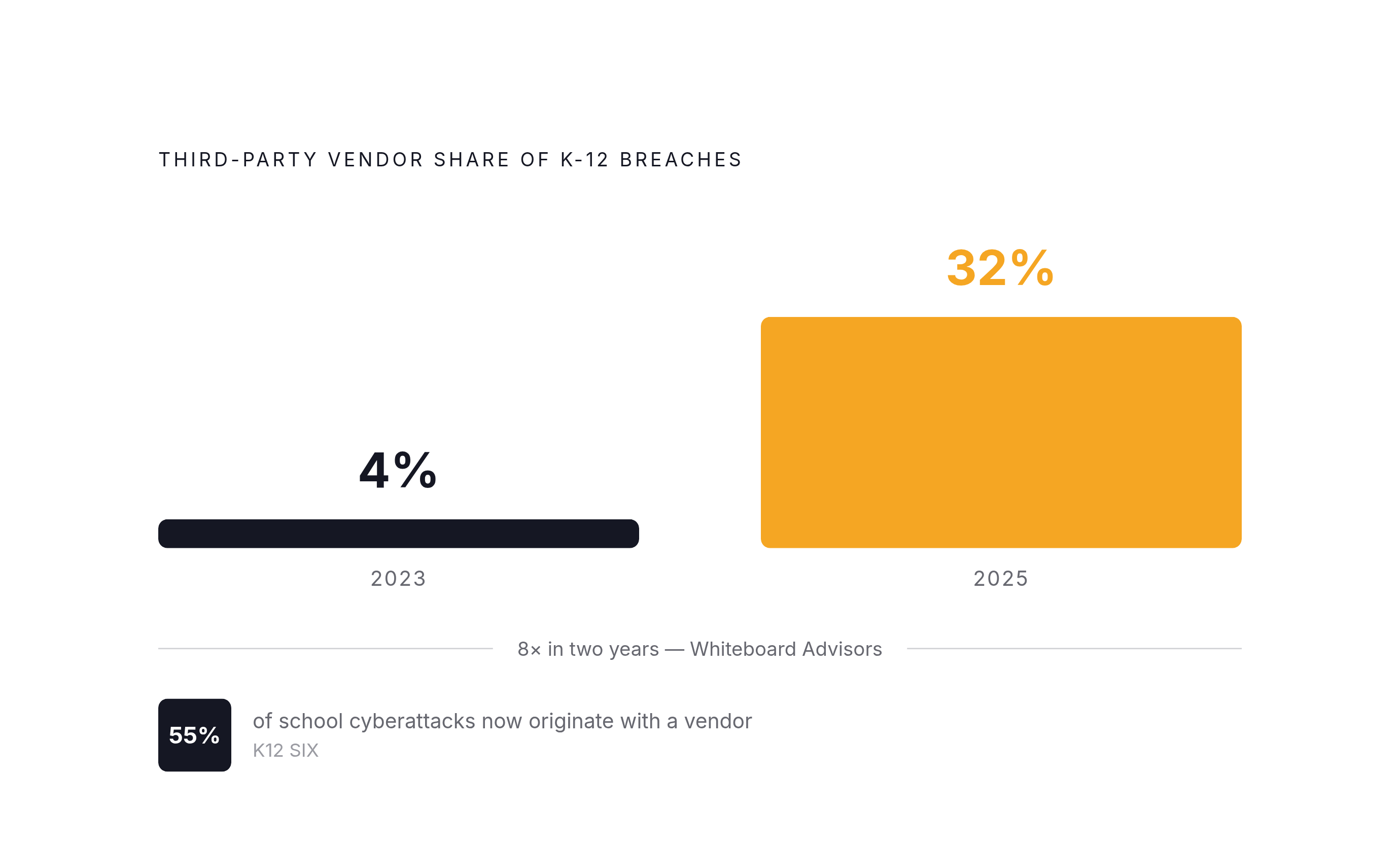
Third-party integrations cause most EdTech breaches now, and the numbers back it up: third-party incidents jumped from 4% of reported K-12 breaches in 2023 to 32% in 2025, according to Whiteboard Advisors. That's an eightfold jump in two years. K12 SIX puts it even higher, saying 55% of school cyberattacks start with a vendor, not the district itself. This piece is about why the standard incident response plan, the one built around a firewall and a known perimeter, falls apart the moment the breach starts three vendors away from where anyone's looking.
Here's the root problem, and it's not subtle: the average school district now runs something like 1,449 different EdTech tools. Many are unsanctioned. Most are managed by one or two IT staff who also handle printer jams and the occasional Chromebook that fell down a stairwell. When a breach hits one of those tools, it doesn't stay contained to that tool. It radiates through every system that trusted its login, its API key, its data feed. Verizon's 2026 Data Breach Investigations Report found 71% of education-sector breaches came through web applications, which is basically the entry point for anything plugged into anything else. A generic IR plan assumes you know where the walls are. Integration breaches follow trust rather than respecting walls.
What the PowerSchool breach revealed about multi-vendor blast radius
PowerSchool runs student information systems for roughly 75% of the K-12 market, across more than 18,000 schools in North America. That kind of market share sounds like efficiency until one login goes bad, and then it's the largest K-12 breach on record.
The cause was almost embarrassingly simple: a subcontractor's compromised credentials on the PowerSource support portal, which didn't require multi-factor authentication. There was no exotic malware and no zero-day involved, just a login without a second lock on the door. Nine days passed between the intrusion and detection, and several districts found out about the breach from news headlines before PowerSchool told them directly. That sequence, breach first, press second, district third, is the whole problem in miniature.
The scale is hard to sit with. 62 million students and 9.5 million educators had data exposed, including Social Security numbers, medical conditions, disability accommodations, IEPs, disciplinary records, and free-lunch income data. PowerSchool paid $2.85 million in bitcoin as ransom. It didn't work. The same stolen data later got used to extort individual districts on top of the original payment, a receipt for payment rather than proof of containment.
A few lessons fall out of this for anyone building an IR plan:
The vendor's timeline and the district's timeline are not the same clock, and treating them as one is how districts end up reading about their own breach on a news site. Student data also carries a mix of sensitivity, medical, financial, behavioral, that most consumer data breaches don't touch, so the harm compounds in ways a generic breach playbook doesn't anticipate. And ransom payment needs to be named explicitly in the plan as something that does not equal containment, because if it's not written down, someone under pressure will assume it does. Finally, when the breached vendor sits at the center of a concentrated market, the notification obligations don't multiply by a little. They multiply by every single institution that trusted that one platform.
The regulatory timing problem: FERPA, COPPA, and state law don't share a clock
FERPA controls who can access and disclose student education records, but it doesn't set a breach notification deadline. It puts the burden on districts to prevent unauthorized disclosure in the first place, not to report fast once one happens. That's an odd gap for a law this central to student privacy, and it means FERPA alone won't tell you when the clock starts.
COPPA adds another layer, and it only applies when a vendor collects data from kids under 13 without verifiable parental consent. An IR plan that doesn't know which of its 1,449 tools are COPPA-covered will misjudge how serious a given exposure actually is. You can't classify severity correctly if you don't know the rulebook that applies to the tool in question.
Then there's state law, and this is where things get genuinely messy. States set actual notification deadlines, and they don't agree with each other: some require 30 days, some 45, some 72 hours for certain data categories. In a breach that touches districts across state lines through one shared vendor, the shortest deadline anywhere in that mix governs the whole response. PowerSchool's press-before-notification failure shows what happens when a vendor's internal timeline gets treated as equivalent to a district's legal obligation. The two are legally distinct, and conflating them is how lawsuits get filed.
So what does the plan actually need? A regulatory map built before the incident, not during it, a pre-built matrix showing which tools hold which data categories and which notification regime kicks in for each. A multi-district vendor breach means parallel legal clocks running for each affected district, not one shared deadline everyone can coordinate around. And the IR team needs legal counsel already on retainer who knows education privacy law specifically, not general breach counsel learning FERPA on the fly at 2 a.m.
Shadow AI makes all of this worse. CoSN's May 2025 report found 43% of districts have no formal AI-use policy at all. Tools quietly processing student data outside district knowledge can't show up in a breach notification if nobody put them on the inventory to begin with.
Building the integration-aware IR framework: preparation before the breach
Everything above points to one foundational document: an integration inventory. Every vendor, every data category it touches, every trust relationship, whether that's single sign-on, an API key, an SIS feed, or an OAuth token sitting quietly in the background since 2021.
The inventory needs to capture specifics, not just vendor names. Data sensitivity tier for each tool (does it touch only names and emails, or does it also see Social Security numbers, medical records, behavioral data?). Authentication method, because "MFA enforced" and "password only" are two very different risk profiles wearing the same vendor logo. Data flow direction, read-only versus bidirectional versus full write access into the SIS. The vendor's contractual breach notification obligation, spelled out in hours, not vague language like "promptly." And the subcontractor chain, since PowerSchool's failure came through a subcontractor's credentials, not PowerSchool's own front door.
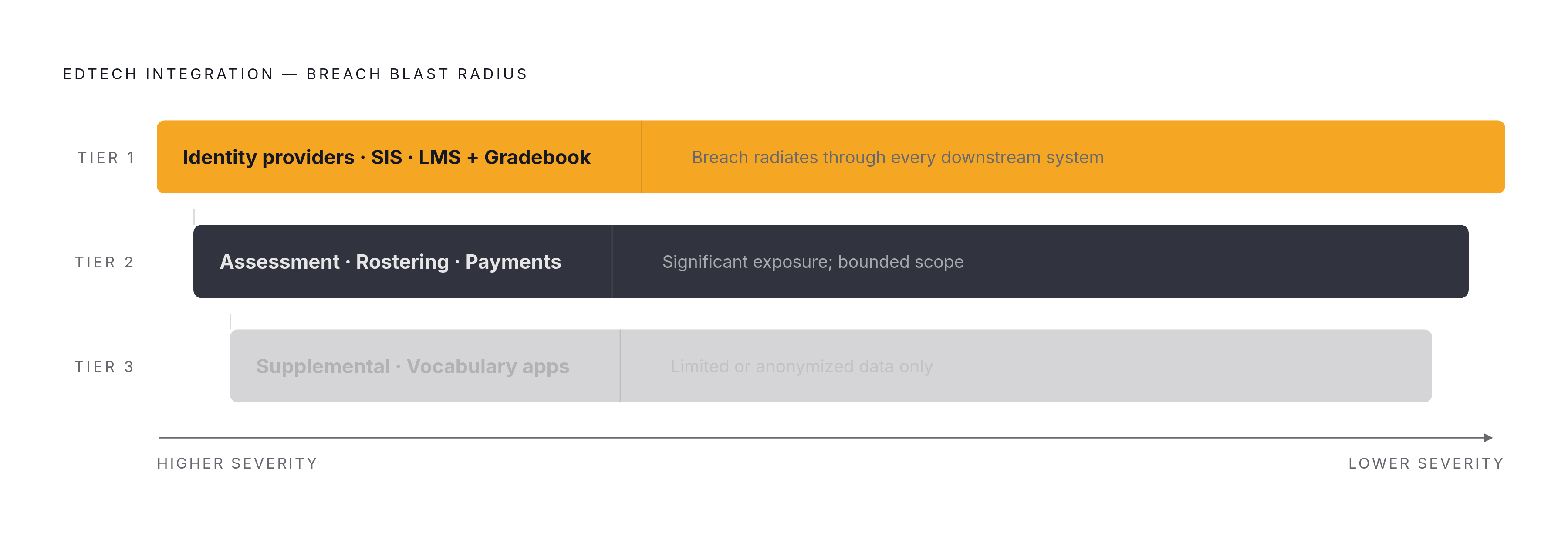
From there, rank integrations by blast radius, not by how often teachers log into them. Tier 1 covers identity providers, the SIS itself, and LMS platforms with gradebook access, since a breach there touches everything downstream. Tier 2 is assessment tools, rostering services, payment platforms. Tier 3 is the supplemental stuff with limited or anonymized access, the vocabulary app nobody remembers approving.
Tabletop exercises need updating too. The realistic scenario now is a vendor-disclosed breach where the district finds out secondhand, rather than one the district discovers on its own. That's the PowerSchool pattern, and treating it as the exception rather than the emerging norm means planning for a world that doesn't exist anymore. The plan also needs a named person with the authority to kill an SSO session or revoke an API key at 2 a.m. on a Saturday, because "we'll figure out who owns that decision when it happens" is not a decision-making process.
There's a financial argument buried in all this prep work, too. Breaches caught internally average $4.18 million in total cost; breaches disclosed by the attacker average $5.08 million. That $900,000 gap is roughly what detection investment is worth, in plain dollar terms, before a single incident even occurs.
Detection and triage when the breach originates upstream
Here's the uncomfortable part: when the breach happens inside PowerSchool, or MOVEit, or Oracle E-Business Suite, the district doesn't have access to that vendor's logs. You cannot detect what you cannot see, and that's not a metaphor, that's just how vendor architecture works.
What districts can actually watch: authentication patterns coming through their SSO provider (bulk exports at odd hours, admin logins at 3 a.m., a new OAuth grant nobody remembers approving). SIS data egress, meaning unusual query volumes or record pulls through connected APIs. And subscriptions to education-specific threat intelligence, groups like K12 SIX and MS-ISAC, which often know about a vendor problem before the vendor says anything publicly.
Triage in these cases needs four questions answered before anyone touches containment. Is the breach still happening, or is it historical (this changes whether isolating something helps or just wipes out the forensic trail)? Which integration was the actual entry point, and which ones are just downstream victims caught in the blast? What data was reachable from that entry point, and in which direction did it flow? And which other districts share this same vendor and might be co-victims without knowing it yet?
The MOVEit breach through the National Student Clearinghouse is the case study here: nearly 900 colleges and universities got affected through one file-transfer vulnerability. A triage team that didn't know NSC sat as a shared intermediary across all those schools would have badly undercounted the scope of what happened. And that's the shadow IT problem in a nutshell: tools that never made it onto the integration inventory can't be triaged at all. They're an unknown variable the plan simply can't reach after the fact, no matter how good the plan is.
Containment steps that account for shared infrastructure
Isolating a compromised vendor connection isn't like unplugging one infected laptop. Revoking a vendor's SSO access might also lock out thousands of students and teachers in the middle of a school day, which turns a security decision into a logistics problem for every classroom in the district.
So the decision needs a framework, not a gut call. If the breach is confirmed and still active, isolate now, accept the disruption, and tell people what's happening before they start guessing. If the vendor disclosed a breach that's already historical, preserve evidence first; don't revoke access until forensics has confirmed the scope, because pulling the plug too early can wipe out the audit trail that would've explained what actually happened. And if the breach is only suspected, escalate to the vendor under whatever SLA the contract sets, and put an internal clock on it: if the vendor hasn't confirmed anything within a defined window, force the isolation anyway.
Coordination with peer districts matters more than it sounds like it should. In a shared-platform breach, one district terminating its vendor contract unilaterally can create legal headaches and disrupt other schools still connected to that same system.
On ransom payments: PowerSchool already ran this experiment, and the result was clear. Paying didn't stop the data from getting used again. The IR plan needs a written policy saying ransom payment is never an authorized containment step without board and legal sign-off, and it is never, under any circumstance, treated as the incident being resolved.
Backup verification deserves its own line item, because it fails more often than people assume. Backup integrity cannot be assumed — compromised backups have been a documented risk in education-sector attacks. Containment plans need to verify backup integrity before anyone starts talking about recovery as a real option.
Notification execution under multi-district, multi-law conditions
Notification splits into three audiences, and each one runs on a different legal clock. Affected individuals, students, parents, staff, fall under state breach notification law, and when students span multiple states, the shortest deadline anywhere in that group governs the whole notification. Regulators, meaning state attorneys general in every affected state, sometimes require independent district notification even after the vendor has already notified at the platform level. And peer institutions have no legal requirement attached, but coordinated disclosure to other districts on the same vendor is the practical, decent thing to do, and it cuts down on collective harm.
PowerSchool is the negative example to build against directly: don't let people find out from a news article. The notification trigger needs to fire the moment the vendor confirms a breach, not the moment the district finishes its own independent verification, which can take days the district doesn't have.
What goes in the notice matters as much as when it goes out. Say exactly what was exposed, not "some personal information." An IEP, a Social Security number, and a home address each carry a different fraud and harm profile, and burying them under vague language does families a disservice. State plainly whether the breach is contained or still ongoing. And spell out what the affected person should actually do, since the advice for a leaked SSN looks nothing like the advice for a leaked email address.
One contract clause worth fighting for before any of this happens: require vendors to notify the district within 24 to 48 hours of a confirmed or reasonably suspected breach. The district's legal clock starts regardless of when the vendor gets around to saying something.
And document everything, every notification decision, every timestamp. More than thirty class action lawsuits followed the PowerSchool breach. That notification record functions as evidence now, well beyond its original role as a communications log.
Post-incident recovery steps specific to student data exposure
Student data doesn't age out of risk the way a stolen credit card number might. A Social Security number or medical record exposed at age nine has decades of fraud exposure ahead of it, which means recovery obligations stretch far past the week the incident made headlines.
Credit monitoring gets complicated fast, too, because most commercial identity protection services aren't built for minors. Districts may need to work directly with credit bureaus to freeze records for affected students, since there's often no off-the-shelf product that just handles it.
Each data category needs its own separate assessment, not a blanket response. Social Security numbers and financial data mean starting the credit freeze process and looping families in directly. IEPs and disability records mean assessing re-identification risk and whether the exposure opens the door to targeted harassment or discrimination. Disciplinary and behavioral records carry the highest reputational harm, and those families deserve individual notification rather than a bulk email that treats a suspension record like a routine data point.
Litigation is close to guaranteed at this scale now, so the plan needs a litigation hold procedure that activates the moment a breach is confirmed, preserving logs, vendor communications, and every notification record before anyone has time to think about deleting anything. Once the dust settles, review whether the breached integration is even still needed; if it is, require real proof of security improvement, MFA enforcement, a recent penetration test, before reconnecting it.
None of this is cheap. Average remediation cost hit $3.76 million for K-12 and $4.02 million for higher education in 2024. Recovery planning needs a pre-approved budget authorization path that doesn't require a full board vote while the incident is still active, because board meetings don't move at breach speed.
Structural changes that reduce the blast radius before the next breach
The integration inventory built during preparation isn't a one-time exercise to check off a list. It's the most valuable long-term security asset a district owns, and it needs quarterly review, not a dusty binder pulled out only when something's already on fire.
App sprawl didn't happen on purpose. Districts went from roughly 20 to 25 tools to over 1,300 through individual teachers and departments adopting things one at a time with no central review. Reversing that takes an actual procurement gate, not a memo asking people nicely to check with IT first.
MFA needs to become a non-negotiable line in every vendor contract. PowerSchool's missing MFA, on an account with reach across 18,000 schools, is exactly the kind of control failure a procurement checklist should catch before signing, not after a breach.
Concentration risk deserves its own conversation, too. When one vendor serves 75% of a market, every district in that market inherits the same correlated risk, whether they like it or not. Districts should identify which single-vendor dependencies have no real backup option and treat those as top-priority risk items, not routine renewals.
Shadow AI governance is the gap nobody wants to own yet. Whiteboard Advisors found four in five districts believe AI is raising their cybersecurity risk, but only 11% have a formal process for vetting AI tools before they land in classrooms. A plan can't protect against a tool it doesn't know exists, so closing that gap is governance work, not IR work, and it has to happen first.
Last point, and it's the one to bring to the school board: incident response planning saves an average of $1.23 million, and heavy use of automation across prevention workflows adds another $2.2 million in savings on top of that. The plan carries a budget line with a return attached, on top of its role as a security document, and it's worth testing every year against the scenario that's now the realistic one: the vendor discloses, and the district finds out right along with everyone else reading the news.
Methodology & sources
- https://privacylaw.proskauer.com/2025/03/articles/data-breaches/the-powerschool-breach-a-privacy-lesson-on-third-party-risk-exposure/
Provided the key figures on PowerSchool's market reach, the number of affected students and educators, and details about the breach mechanism including the compromised subcontractor credentials and missing MFA.
- https://secureprivacy.ai/blog/school-data-governance-software-ferpa-coppa-k-12
Supplied the figure that the average school district runs 1,449 different EdTech tools.