ABAC vs RBAC for EdTech Data Access Control
How PowerSchool's breach reveals why one-size-fits-all access control fails schools.

- Written by
- Preston Ganem
- Updated
- September 7, 2026
- Reading time
- 11 min read
- Sources cited
- 5 sources ↓
What this covers
PowerSchool's 2025 breach exposed the largest cache of children's data in U.S. history: Social Security numbers, IEP records, medical conditions, disciplinary files, and family income data, all pulled through a single administrative credential pathway. The headlines focused on hackers being clever. The deeper story is about access control that never asked "does this account actually need to see everything," and this article is about the two frameworks, RBAC and ABAC, that answer that question in fundamentally different ways.
Missing multi-factor authentication made headlines. But the deeper issue was architectural: one login, broad and undifferentiated access to nearly everything downstream. Phishing was the entry point, but permissions design was the reason the breach spread as far as it did, and that's exactly the problem RBAC and ABAC are built to solve, just in very different ways.
The timing makes this more than a cautionary tale. Comparitech tracked 251 confirmed ransomware attacks on education institutions worldwide in 2025, up from 247 the year before, with breached records climbing 27% to 3.96 million across K-12 and higher ed. The U.S. accounted for 130 of those attacks alone. Layer on the well-worn finding that human error drives the overwhelming majority of breaches, and the message gets uncomfortably simple: education is the target, people will keep clicking the wrong link, and the only lever left is how the system limits the damage when they do.
The timing also raises the stakes on how this gets explained. What follows is a map of which architecture fits which condition inside an EdTech platform, because the honest answer is: it depends, and pretending otherwise is how you end up as the next PowerSchool.
How RBAC and ABAC actually work, in terms EdTech architects use
RBAC (role-based access control) attaches permissions to predefined roles, and users inherit whatever their role allows. Student, instructor, counselor, SIS admin: each is a bucket, and everyone in the bucket sees the same things. It's static by design, and that static design is the whole appeal. Roles are predictable, easy to audit, and easy to explain to a school board member who has never heard the phrase "policy decision point" in their life.
ABAC (attribute-based access control) throws out the static bucket. Instead, every access request gets evaluated against a policy that weighs attributes of the user, the resource, the action, and the environment, all at once, in real time. NIST SP 800-162 lays out the reference architecture: a Policy Enforcement Point that intercepts the request, a Policy Decision Point that evaluates it, a Policy Information Point that supplies the attribute data, and a Policy Administration Point that manages the rules. Attributes can be almost anything: enrollment status, data classification level, time of day, device type, geographic location, whether a student is currently on a given counselor's caseload. Change one of those values, and the access decision can flip on the next request without anyone touching a role assignment. XACML is the standard most platforms use to write these policies out.
The real difference comes down to where the logic lives, not how complicated each system looks on paper. In RBAC, the logic lives in the role itself, decided ahead of time. In ABAC, the logic lives in a rule engine that runs at the moment of the request. Neither is automatically more secure. Both can be misconfigured into uselessness. The question is which one matches the conditions on the ground, and EdTech conditions are unusually messy.
The specific conditions EdTech environments impose on access control
Start with the people. Student status shifts constantly, applicant to enrolled to graduating to alumni, and each shift legitimately changes what that person should see. Multi-role users aren't the exception, they're the norm: a doctoral student might simultaneously be a TA grading papers, a researcher pulling lab data, and a student receiving grades in another department's course. Three access profiles, one person, running at the same time. Staff churn adds another layer. Faculty pick up administrative duties mid-year. Researchers rotate onto and off of grant-funded projects on schedules nobody controls centrally.
Now look at the data itself. A single student record might hold directory information (low stakes, often public), grades (FERPA-protected), IEP and disability accommodations (FERPA plus IDEA), health information, and disciplinary history, all sitting in the same table. RBAC can't tell those fields apart within one record without spinning up a separate role for every sensitivity tier, which gets unmanageable fast. ABAC, by contrast, can enforce access down to the row, column, or individual field.
Then there's the regulatory stack, and it does not sit still. More than 130 state-level student data privacy laws exist in the U.S. as of 2024, many of them stricter than FERPA's federal floor. A platform running in multiple states has to satisfy FERPA, COPPA for any user under 13, and whatever state law applies, simultaneously, with the strictest clause winning. The FTC's 2025 COPPA Rule amendment adds biometric data, facial recognition, fingerprints, voiceprints, to the list of covered personal information, with most requirements landing in April 2026. Any platform using a biometric feature now has a hard deadline circled on the calendar. States like California, Illinois, New York, and Texas pile on further: 72-hour breach notification windows, advertising restrictions, public vendor registries, contract clauses FERPA never asked for.
Third-party vendors round out the picture. SIS providers, LMS platforms, assessment tools, analytics dashboards, each one needs a data pipeline, and each pipeline is a fresh opportunity to over-permit. Put all of this together and "RBAC or ABAC" stops being one question. It's several questions wearing a trench coat.
Where RBAC holds up well and where it breaks down in EdTech
RBAC does its job well when the role structure is actually stable. Central IT staff, registrar personnel, HR employees, these roles don't reshuffle every semester, and their permissions are well understood. Auditability is where RBAC genuinely shines: FERPA compliance reviews require showing "legitimate educational interest," and a clean role-to-permission map is a document you can hand a regulator without flinching. For a single district with limited data sensitivity variation, RBAC's lower overhead is a genuine advantage, not a shortcut.
The trouble starts when teams try to force context into a system that was never built to hold it. Say a district wants "teacher who can only see IEP records for their own section." Under RBAC, that becomes a brand-new role. Add another condition, a new state law, a new data tier, and the role count multiplies again. Every new district onboarded to a multi-tenant platform adds pressure to spawn more roles instead of writing a smarter rule. The result is role sprawl, and role sprawl is itself a compliance hazard: auditors can't reason cleanly about three hundred overlapping roles, and deprovisioning turns into a guessing game.
The deeper issue is that RBAC has no concept of context. It cannot limit a teacher to only currently enrolled students in their section, because "teacher" is the role and the section boundary is a runtime fact, not a role attribute. It cannot enforce time-of-day rules, on-campus versus off-campus access, or device health checks without bolting on an external layer that is, functionally, doing ABAC's job under a different name. And it cannot express "counselor may see IEP records only for students on their caseload" without a distinct role per caseload, which nobody wants to maintain by hand. RBAC is a fine starting point. The real question is whether the platform's conditions are asking it to carry weight it was never designed to hold.
Where ABAC earns its complexity cost in EdTech
ABAC's payoff in EdTech comes from field-level control and runtime context, applied to problems RBAC structurally cannot touch.
Take a guidance counselor accessing IEP records. ABAC checks the counselor's ID against the student's counselor assignment and the student's enrollment status, all at once, and only grants access when every attribute lines up. A third-party analytics vendor's API can be restricted to aggregate data only, only during business hours, and only from an approved network, three environmental attributes doing the work of what would otherwise require constant manual oversight. A teacher who's also a TA in a different course sees different data depending on which context they're operating in at that moment, because ABAC evaluates the active role against the specific resource requested, rather than handing over the sum of every permission the person has ever held. And when a student withdraws or takes a leave mid-semester, access revokes the moment the enrollment attribute updates, no ticket, no follow-up email to IT.
The compliance angle sharpens this further. FERPA's "legitimate educational interest" standard is really an attribute-level test in disguise; ABAC can enforce it as one instead of relying on a role assignment and hoping the paperwork backs it up later. The COPPA biometric expansion landing in April 2026 creates a brand-new data category that needs age-based restrictions applied at the moment of access, something ABAC handles by tagging biometric records as a resource attribute. Multi-state platforms can encode jurisdiction as an environmental attribute and let the strictest applicable rule apply automatically, instead of maintaining a separate role hierarchy for every state law on the books.
None of this comes free. Policy authoring demands real precision, since one poorly written attribute rule can silently lock out people who should have access, or worse, wave through people who shouldn't. Evaluating policies at runtime adds processing overhead worth planning for, especially on a high-traffic LMS. And for a small, single-district platform with a stable user base and low data sensitivity variation, ABAC's overhead is probably more than the problem calls for.
How a hybrid model distributes the work between RBAC and ABAC in practice
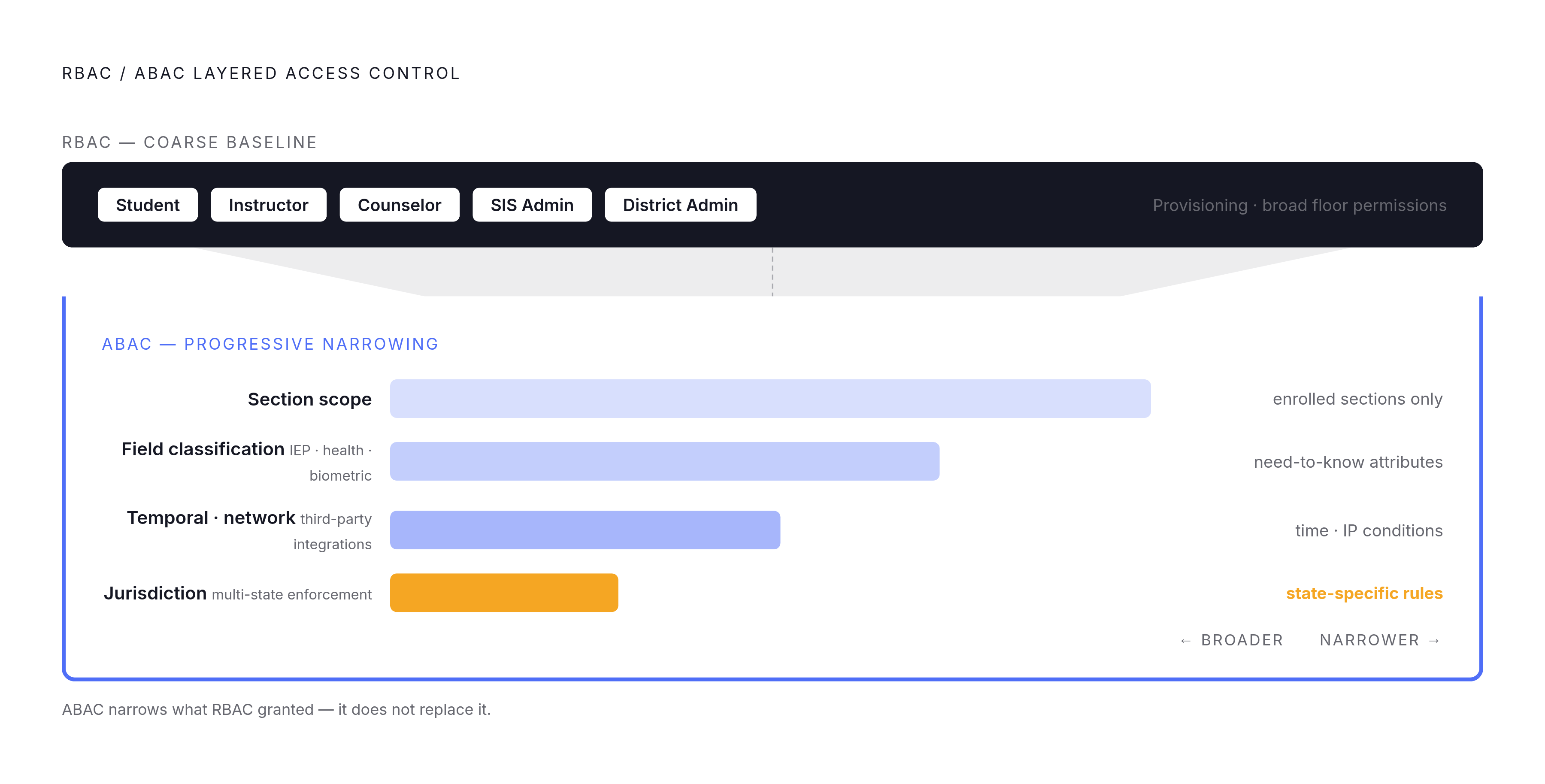
Most working EdTech platforms don't pick one model, they split the labor. RBAC handles the coarse, stable baseline. ABAC handles the fine-grained conditions layered on top of it.
RBAC carries the roles that don't change much: student, instructor, counselor, SIS administrator, district admin. It also handles initial provisioning, tied to SIS or HR system events, so role assignment happens automatically and leaves a clean audit trail. And it sets the broad floor, "all instructors can see their course roster," that applies consistently across the board.
ABAC then narrows that floor down to what should actually be visible. Section-level scoping trims a teacher's roster access to students currently enrolled in their specific class. Data classification rules mean that even inside a permitted role, IEP and health fields only surface when the matching resource attributes check out. Temporal and network conditions keep third-party integrations boxed into approved time windows and approved connections. Jurisdiction attributes make sure a district in a stricter state automatically gets the stricter policy applied, without anyone maintaining a parallel role tree.
The lifecycle ties both layers to the same source of truth. SIS and LMS events provision the RBAC role and simultaneously populate the attributes ABAC uses to evaluate context, enrollment status, section assignment, caseload. Graduation or departure triggers RBAC deprovisioning on one side, while the enrollment attribute flipping to inactive independently shuts down ABAC-governed access on the other. Even the audits split: RBAC role assignments get reviewed on one cadence, ABAC policy logic on another, often by different owners. Some things are stable enough for roles, some things are too dynamic for anything but attributes evaluated in the moment, and the split simply follows the structure of the problem.
How to decide which model a given EdTech platform actually needs
The decision should follow whichever pressure dominates, not whichever model sounds more impressive in a vendor pitch deck.
RBAC alone is the right call when a platform serves a single district or institution with a small, stable user base, when data sensitivity barely varies (course content and aggregate scores, no IEPs, no health records, no financial aid data), when the compliance picture is plain FERPA with no state law stacked on top, and when the engineering team is small enough that audit simplicity matters more than granular policy control.
ABAC, or a hybrid, becomes necessary once a platform crosses into multi-district or multi-state SaaS territory, where jurisdiction differences have to be enforced at the data layer rather than argued about in a compliance memo. It's necessary the moment the platform stores IEP records, health data, biometric identifiers (especially with COPPA's April 2026 deadline bearing down), disciplinary history, or financial aid information, since any of those introduce field-level sensitivity that RBAC can't express. It's necessary when users routinely juggle multiple roles or shift roles mid-year, when third-party vendors need scoped or time-limited access, or when a platform has already lived through role explosion and the role count has gotten too large to audit safely.
Phasing in matters more than doing it all at once. A platform can start with RBAC and add ABAC in layers: tag protected fields first, then add user-context attributes like caseload and section, then layer in environmental controls like time and network location. Each layer gets tested and audited on its own before the next one goes live, which beats deploying a full policy engine in one leap and hoping nothing breaks. The SIS integration usually does a lot of this work for free. Once identity provisioning is already tied to live enrollment data, the attribute pipeline ABAC needs is halfway built already.
Here's the practical test worth applying: if a regulator asked for proof that access to one specific student's IEP was granted on legitimate educational interest grounds, which system gives a faster, cleaner answer? Teams that need ABAC's granular logging will know it immediately. Teams for whom a role map answers the question just fine don't need to build more than that.
EdTech platforms face a similar fork when it comes to communicating about themselves, not just controlling data access. A policy that satisfies a parent browsing course options often won't satisfy a compliance officer checking disclosure language, and the system has to separate those audiences without splitting the whole site into disconnected silos. Letterbrace, which builds content and AI-visibility infrastructure for regulated industries, treats that as the same architectural problem in a different domain: one underlying system, different rules applied depending on who's asking and why.
Neither RBAC nor ABAC removes the human from the loop. Someone still has to write the policies, run the access reviews, and handle the exception that doesn't fit any rule on the books. The framework just decides how much of that judgment gets automated, and how much damage one bad login can do before a person notices.
Methodology & sources
- https://www.osohq.com/learn/rbac-vs-abac-vs-pbac
Supported the characterization of RBAC as static by design in the section explaining how the two models work.
- https://www.apono.io/blog/rbac-vs-abac-choosing-the-right-access-control-model-for-your-organization/
Provided the concept of role sprawl as a compliance hazard in the section on RBAC's limitations.
- https://www.loginradius.com/blog/identity/rbac-vs-abac
Supplied the NIST SP 800-162 ABAC reference architecture components described in the how-it-works section.
- https://www.syteca.com/en/blog/rbac-vs-abac
Supported the claim that RBAC roles are easy to audit in the section explaining how each model works.
- https://www.strongdm.com/blog/rbac-vs-abac
Supported the discussion of ABAC's field-level control and runtime context capabilities in the section on where ABAC earns its complexity cost.