Multi-Tenant Architecture Considerations for EdTech Integrations
Separate your tenants or risk FERPA violations and million-dollar breaches.

If you are building an EdTech platform and multi-tenancy feels like a purely technical problem, you are already behind. It is also a compliance problem, a legal problem, and a business survival problem. A data leak in most software products means a bad day for your engineering team. In EdTech, it can mean a FERPA violation, COPPA fines up to $51,744 per affected child, and a data breach that carries an average cost of $4.45 million per incident. The architectural choices made early determine whether your platform scales cleanly across institutions or accumulates technical and legal debt with every new district you sign.
So what does multi-tenancy actually mean here? Your platform serves School District A, School District B, and a private university. Each has its own users, branding, permissions, and content. They all run on the same underlying infrastructure. None of them know the others exist. That is multi-tenancy working correctly.
The alternative is giving each institution its own separate deployment. That becomes operationally impossible at any real scale. Multi-tenancy is what makes it feasible to serve hundreds of districts without a dedicated infrastructure team for each one. A new institution gets onboarded through configuration, not a brand-new deployment.
That efficiency is genuinely the point. It is also genuinely the problem.
The shared infrastructure that makes multi-tenancy affordable and scalable is the same infrastructure that makes isolation hard. Every shortcut, every missing check, every background process that runs without knowing which institution it belongs to is a potential path between two institutions' data. In most software products, that is embarrassing. In EdTech, where you are handling records belonging to minors and federally protected student populations, it becomes a liability fast.
Three Database Isolation Models
There are three main approaches. Most experienced teams end up using more than one.
Shared database, shared tables. Everyone's data lives in the same tables, separated by an institution identifier. Lowest cost and simplest to operate. The catch is that keeping data separate relies entirely on the application code. One missing filter and you have a data leak. At scale, that stops being a hypothetical.
Shared database, separate sections. Each institution gets its own section within the same database. Better separation without the full cost of separate databases. The tradeoff is maintenance complexity — updating the structure across hundreds of institutions requires careful tooling.
Separate database per institution. Maximum separation, maximum compliance flexibility, and maximum cost, because your infrastructure overhead grows with every institution you add.
Most teams land on a tiered approach: standard institutions share a database, while enterprise customers or districts with serious compliance obligations get dedicated databases. The separation model maps to the customer tier and risk profile rather than a blanket one-size decision.
This matters specifically in EdTech because a large urban school district with FERPA obligations and multiple state privacy laws is a genuinely different risk profile than a small charter school. Your architecture needs to support both without requiring a rebuild when the big enterprise deal closes.
One more thing: this decision is not permanent, but reversing it is expensive. It is worth making deliberately before you have three hundred districts on the platform and no clean way forward.
Application-Layer Isolation Matters Too
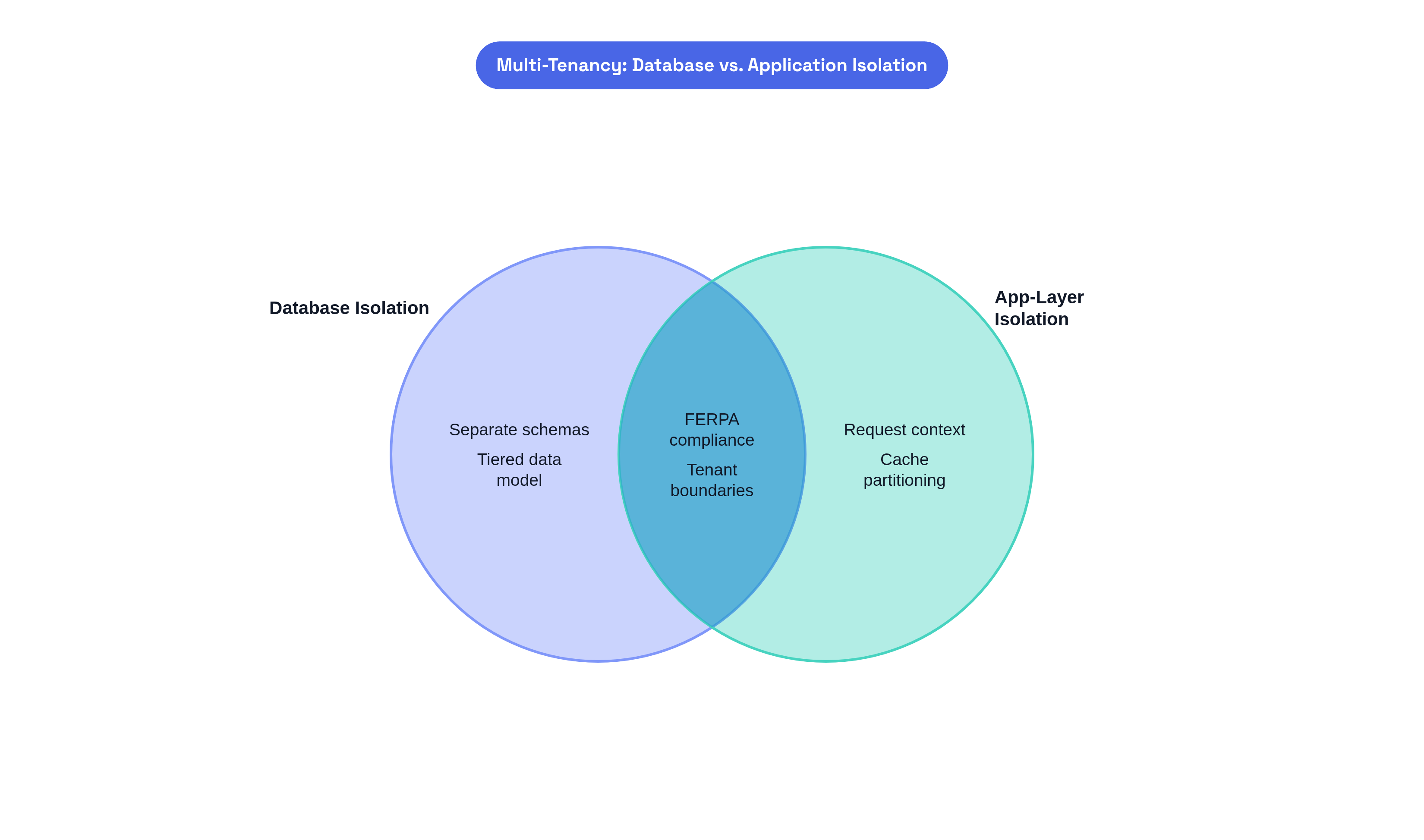
You can have solid database isolation and still expose data between institutions if the application itself is not consistently aware of which institution each request belongs to.
Every request needs to carry institution identity from the moment it enters the system to the final database call. If that context gets dropped somewhere in the middle — in a background service, in a message queue, anywhere — a downstream process can read or write to the wrong institution's data without anyone noticing immediately.
Two failure patterns show up in production repeatedly:
- Background jobs without institutional context. A scheduled task runs across all data without filtering by institution. It processes or exposes records it should not.
- Shared caches returning the wrong data. A cache entry gets built without an institution component. One institution's request stores data in the cache. Another institution's request retrieves it.
Both patterns are subtle. Neither shows up in basic testing. Both have caused real incidents at real companies.
A useful safeguard is to store personally identifiable student data in a separate, tightly controlled location and have the rest of your system work with anonymized tokens rather than direct student identifiers. It adds complexity upfront and provides a meaningful safety net when something else goes wrong — which it eventually will.
Authentication, SSO, and the Rostering Problem
Every district arrives with the login system they already use. Microsoft, Google, Clever, ClassLink, and several competing technical standards. They are not switching providers for you. Managing many different authentication setups is a recognized cost of doing business in EdTech.
In North American K-12, Clever and ClassLink dominate district onboarding. Being listed on both platforms is typically higher-leverage than spending months building direct connections with individual student information systems. The market is moving toward standardized data sharing rather than manual file exports — though spreadsheet imports are still a reality in some districts.
There is also an upstream data quality problem: if a district's student information system contains outdated enrollments or duplicate records, those errors flow directly into every connected application. A rostering project often requires a data-cleaning project first. That is not your fault, but it becomes your problem.
The practical implication is that per-institution authentication configuration needs to be a built-in feature of your platform, not a workaround bolted on later. The same district may change login providers or adjust their data sharing scope over the life of a contract. None of that should require an engineering sprint on your side.
Permissions also need to be institution-specific from the start. An administrator who can see across your entire platform is not the same as an administrator who can see only within their institution. Staff at one school must not be able to access any information about students at another. This sounds obvious. It is not always implemented that way.
Compliance Must Be Built In, Not Claimed
Writing "we comply with FERPA" in a privacy policy is not compliance. Compliance is what your data model actually does.
FERPA applies to virtually every public K-12 school and most post-secondary institutions receiving federal funding. Each institution needs to be a real structural boundary in your system — not a label or a tag, but genuine separation at both the application and database levels.
COPPA's 2025 update extended coverage to biometric identifiers such as voiceprints and facial recognition, plus additional government-issued IDs. Third-party providers can no longer assume consent for advertising use. Explicit parental consent and documented decisions are required, with a compliance deadline of April 2026. If your platform touches any of those data types, the clock is already running.
State laws. As of 2025, more than 120 state laws protect student privacy beyond what FERPA requires. Schools in heavily regulated states need software that handles multiple frameworks at the same time, in the same system.
International conflicts. If your platform has users outside the US, you will encounter tension between GDPR's right to erasure and US academic record retention requirements. The resolution is a layered approach: full deletion for non-mandatory data, strong anonymization for records institutions are legally required to keep. This needs to be in the design before you have international users, not after.
Audit logs. Records of which account accessed which data, and when, are what compliance investigations actually require. If you cannot produce them on demand, you are not operationally compliant regardless of what a policy document says.
The procurement reality. Districts are now evaluating vendors based on actual system architecture, not just policy claims. The checklist exists. Your platform either passes it or it does not.
Integration Standards You Are Expected to Support
This is not a menu you pick from. It is a set of standards you support together.
LTI 1.3 is the entry requirement for virtually any school or university learning management system integration today. The previous version was retired in 2021 due to security limitations that could not be fixed at the protocol level. If your platform is still on the older version, you are building on an unsupported foundation.
xAPI with cmi5 is the recommended path for tracking how learners interact with content. SCORM handles compatibility with existing older content and is not going away soon, so plan to support both.
Cost math that actually matters. A custom integration with a single learning management system costs $15,000 to $40,000 to build and $500 to $1,500 per month to maintain. A unified integration layer covering five or more platforms typically costs $500 to $2,000 per month. The economics favor the unified layer at any meaningful scale.
Whatever you build here is a living system. Standards evolve, versions deprecate, and reporting requirements get added. This is ongoing maintenance, not a one-time project.
The Noisy Neighbor Problem
One institution runs a heavy workload — a large data import, batch report generation, a complex query against years of records — and consumes a disproportionate share of shared resources. Every other institution on the same infrastructure takes the hit. Nobody calls to say their system is running slowly. You just get support tickets and lost customers.
Defense works in layers: per-institution rate limits at the entry point of your system, and caps on expensive operations deeper in the stack. These limits typically align with subscription tiers, which connects resource management directly to the business model. Enterprise tiers get higher limits. The infrastructure cost of serving them is part of what they are paying for.
In EdTech specifically, end-of-semester grading periods and district-wide assessment windows create predictable load spikes. Predictable means you can plan for them. If you have been around EdTech for more than one school year, you know exactly when those windows hit. There is no excuse for being caught off guard.
Tenant Configuration as an Architectural Foundation
Most teams build institution-specific configuration as a product feature added after the fact. It is better understood as a core architectural decision, and the difference matters more than it sounds.
A configuration layer holds per-institution settings: which learning management system, which login provider, which state reporting framework, which data agreement applies. When this exists and is well-built, onboarding a new customer becomes a configuration exercise. Without it, every new district is a custom engineering engagement with its own timeline.
The numbers are not encouraging if you skip this step. Building a proper configuration layer typically takes a focused team six to twelve months. The alternative — custom work per district — stops scaling somewhere around a hundred customers. After that, you are spending more on one-off integration work than on the product itself.
Customization at the institution level (branding, permissions, content, role definitions) should not require code changes or new deployments. If your engineers have to touch the codebase every time a district wants a different permission structure, that is not a configuration layer. It is a services engagement you are probably not charging for.
What Getting This Right Early Actually Changes
Platforms that add isolation, compliance controls, and integration standards after the fact do so under the worst possible conditions: existing customers, live data, and procurement pressure from districts that now have detailed evaluation criteria and are not shy about using them. The cost of retrofitting is always higher than the cost of building it correctly the first time.
The compliance environment is getting stricter, not looser. More than 120 state laws, a revised federal rule on children's data, and increasingly detailed procurement standards. The bar keeps rising. Your architecture either keeps up or falls behind.
The practical question is simple: Can a new institution be onboarded without an engineering sprint? Can a compliance requirement be met for one institution without touching another's data? Can an integration standard be updated without disrupting every existing district contract? If the answer to any of those is no, there is real work still to do. Getting there early is what makes growth across institutions possible without the cost of serving each one growing along with it.