Evaluating EdTech Vendor API Maturity Before Integration
A framework for assessing vendor API stability before it becomes your team's decade-long problem.

If you work in EdTech and you have ever said the words "the integration should be straightforward," you already know where this is going. The API looked fine in the demo. The documentation existed. Someone on the vendor's side used the word "robust." And then, six months after go-live, your team is spending Friday afternoons reverse-engineering undocumented behavior because the vendor pushed a "minor update."
Here is the honest truth: evaluating an EdTech vendor's API maturity before you commit to an integration is one of the highest-leverage decisions you will make in the entire procurement cycle. The EdTech market sat at $187 billion in 2025 and is on track to nearly double by 2033. Districts are already managing more than 200 EdTech providers at a time. Academic institutions touch close to 3,000 different tech tools in a given year. The decisions you make today about which APIs to trust get baked into your infrastructure for the next decade of that growth. A bad API choice does not just cost you one integration. It sets the template for many.
This piece is a framework for evaluating that maturity before you sign anything. Front-load the work. It is cheaper than the alternative.
API Maturity Is Not One Thing. That Is Why EdTech Vendors Vary So Wildly.
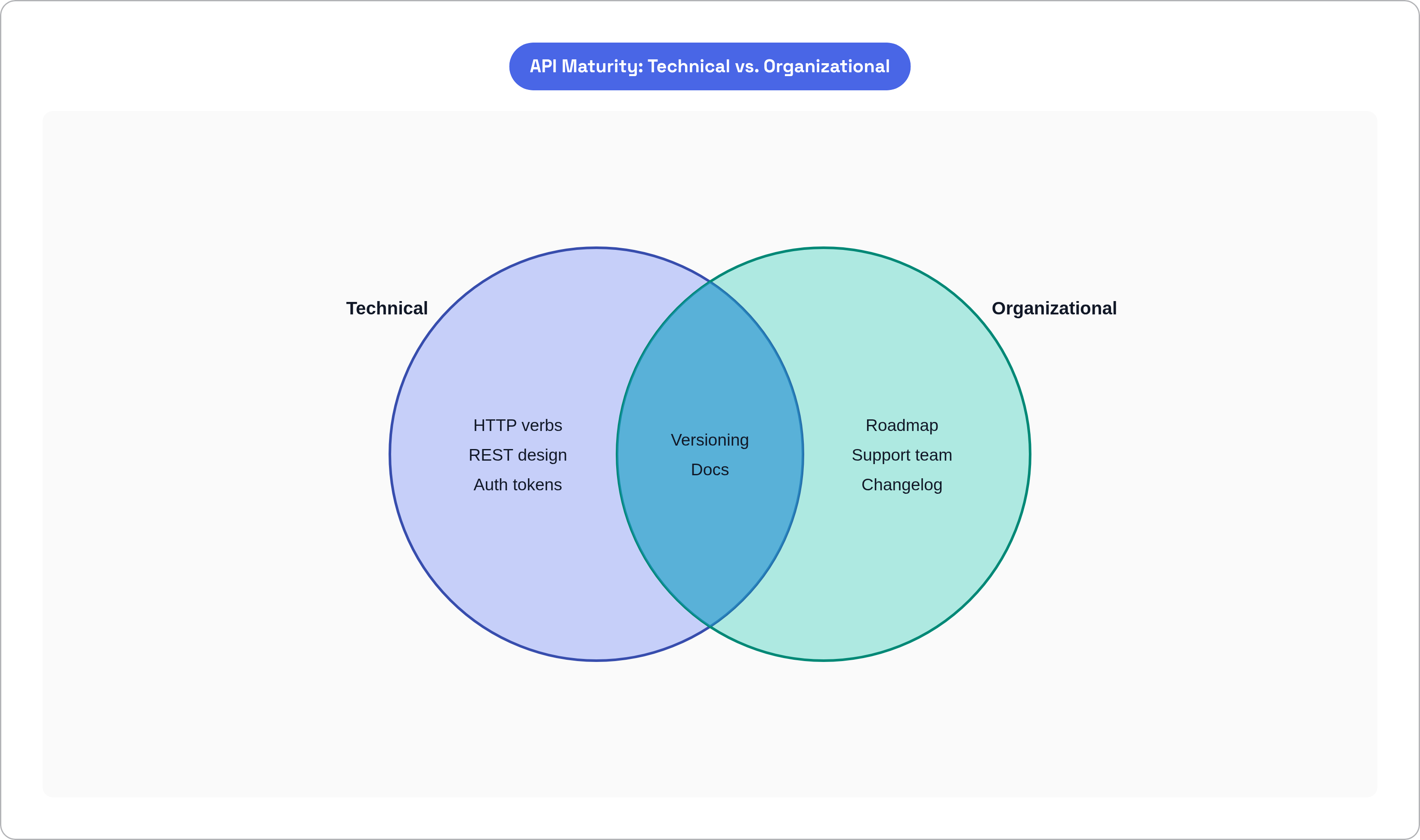
When people say "this vendor has a mature API," they usually mean one of two very different things. Sometimes they mean the API is technically well-built. Sometimes they mean the vendor treats APIs as a real product with governance, a roadmap, and dedicated support. Both matter. Neither guarantees the other.
The technical side has a useful reference point: the Richardson Maturity Model. It describes a progression from basic HTTP calls up through RESTful design with hypermedia controls. A Level 0 API is essentially a remote procedure call wrapped in HTTP. A Level 2 or 3 API uses HTTP verbs correctly, handles resources consistently, and gives you predictable behavior. You do not need to quiz every vendor on Richardson directly, but it gives you a mental framework for recognizing the difference between an API that was built intentionally and one that was bolted on.
The organizational side is harder to see and more consequential. This is the difference between a vendor who published an API because a procurement checklist required it, and a vendor who treats the API as a product with versioning discipline, documentation standards, and a support team. In EdTech, a significant share of vendors built their APIs for the former reason. That is not a moral failing. It is a natural result of a market that grew fast and fragmented early. But it is your problem now.
The practical implication: a vendor's API maturity is essentially a prediction of how much ongoing engineering burden will transfer to your team. Maintenance costs on even simple API integrations can approach $150,000 annually when you account for the real labor involved. That number is not a scare tactic. It is what happens when you integrate with an API that was never designed to be maintained at scale.
A useful question to ask yourself early: "Is this vendor building APIs for integrators, or are they building them to check a box?" The rest of this framework helps you answer that question with evidence rather than instinct.
EdTech-Specific Certifications: Your First Filter, Not Your Last
Before you read a single line of a vendor's documentation, check the 1EdTech TrustEd Apps Directory. It is the closest thing EdTech has to an independent quality signal, and skipping it is like skipping a credit check before a business partnership.
1EdTech maintains certification programs for the standards that actually govern how EdTech systems talk to each other. Here is what you need to know about each one.
LTI (Learning Tools Interoperability)
LTI is the standard that lets a learning tool connect to an institution's LMS without requiring a separate login for every tool. The current version is LTI 1.3. It uses OAuth 2.0 and JSON Web Tokens under the 1EdTech Security Framework, which is a meaningful security improvement over older versions.
Getting LTI certification is intentionally harder than just meeting the minimum specification. The goal is to maximize real-world interoperability between LMSs and tools. If a vendor is still on an older LTI version and cannot give you a clear upgrade timeline, that is a yellow flag. Not a dealbreaker on its own. A yellow flag.
OneRoster (Rostering and Grade Exchange)
OneRoster handles the secure exchange of roster information and grade data between systems. Current version is 1.2. Ask vendors whether they are certified on 1.2, and if they are still on 1.1, ask for a specific upgrade timeline in writing.
Here is a hard line: OAuth 1.0a/SHA1 certification is no longer available for OneRoster, and its use is explicitly prohibited in OneRoster 1.1 REST. A vendor still running on that legacy authentication is operating below standards that their own ecosystem has formally retired. That is not a negotiating point. It is a disqualifier.
When you write procurement language, require a valid conformance certification with a current registration number that you can verify on 1EdTech's site. Not a self-attestation. A verifiable registration number.
Edu-API (Higher Ed)
Edu-API is an emerging standard for standardized data exchange between administrative systems like a SIS and teaching/learning platforms. It supports both real-time and batch transfers. The first release focuses on bulk enrollment data exchange, which makes it most relevant for higher-ed evaluations right now.
It is still emerging. Do not require current Edu-API certification in 2025. Do ask vendors about their roadmap for it. A vendor that has never heard of Edu-API is a different kind of signal than a vendor that can tell you where it fits in their product plan.
The Caveat That Applies to All of Them
Certification confirms that a vendor met the requirements at the time of certification. That is it. Ask when they were last re-certified. Ask whether their production environment matches the certified configuration. Standards can drift over time, especially when product teams ship updates without looping in whoever manages certification compliance.
Also watch for partial adoption. A vendor will claim OneRoster support while only implementing a subset of what the spec covers. OneRoster handles roster and grade data well, but it does not engage with facilities data or period data that SIS systems hold. Request a capability matrix. A blanket compliance claim is not the same thing.
Documentation Quality Tells You How a Vendor Treats Integrators
If the documentation is bad, everything downstream will be harder than it needs to be. That is not hyperbole. That is cause and effect.
Documentation is the first real interaction your developers have with a vendor's API. It is also a signal of how the vendor thinks about the people building on top of them. A vendor who invests in documentation is signaling that they understand integrators are doing real work and deserve real support. A vendor with sloppy docs is telling you something about their priorities, whether they intend to or not.
Here is what good documentation actually looks like:
- Full endpoint reference with accepted parameters and response formats
- Explicit error codes with handling guidance, not just examples of successful calls
- Authentication flows documented step by step, including token refresh and expiry behavior
- Code examples in languages your developers actually use
- A changelog that is current, timestamped, and specific
Here is what should raise a flag:
- Changelog last updated more than six months ago
- Endpoints referenced in the UI or data exports that do not appear in the docs
- Authentication documentation that does not distinguish between OAuth versions or token scopes
- Tutorials that only cover the vendor's own use case and never address integration partner scenarios
The underlying cost of bad documentation is not a one-time hit. Every time the API changes, your team will spend engineering hours re-figuring out what the API actually does versus what it says it does. That recurs forever.
The most honest test available to you: get a sandbox environment and try to follow the documentation to a working API call before you make any procurement decision. The gap between what the docs say and what the API actually does is the most useful data point you can collect. It costs you an afternoon. It can save you years.
Versioning and Deprecation: Where the Real Long-Term Damage Happens
A vendor that cannot explain how they handle breaking changes is quietly telling you that they will handle them however is convenient for them, not for you.
Versioning and deprecation policy is where immature APIs cause the most lasting damage. This is not about edge cases. This is about what happens every time the vendor ships a product update, which is constantly, because EdTech vendors are under constant pressure to add features.
A mature deprecation policy has a clear shape:
- Defines explicitly what counts as a breaking change versus a non-breaking change
- Announces deprecations with enough lead time to plan migrations. This means an announcement window, a supported migration period, and a final removal date, all communicated clearly
- Tracks which clients are still using deprecated endpoints and only removes them when usage is negligible
Compare that to common immature behavior:
- Breaking changes shipped under "minor" version bumps
- No visibility into which clients are on which versions (which means the vendor literally cannot safely sunset anything)
- Documentation that lags actual API behavior after releases
- Versioning applied to non-breaking changes, which suggests undisciplined release practices overall
To make this concrete: Aeries SIS pushed changes to its fields and relations as recently as August 2024, a change that surfaces breaking behavior in integrations without formal warning. Aeries is an established, well-known SIS vendor. This is not a story about fly-by-night EdTech startups. Surprise maintenance events happen at every maturity level. The question is whether the vendor's deprecation policy gives you any buffer when they do.
Ask these questions directly in vendor evaluation conversations:
- "How do you define a breaking change?"
- "What is your current deprecation policy and minimum notice period?"
- "Can you walk us through the last three instances where you deprecated an endpoint and how you communicated it?"
If they struggle to answer the third question, you have learned something important.
Authentication Standards Reveal the Whole Security Posture
Authentication is one of the most readable signals available to you in a pre-integration evaluation. It is visible in the documentation, testable in the sandbox, and tells you a great deal about how seriously the vendor thinks about security overall.
The maturity progression goes roughly like this:
- Lowest: API keys or basic HTTP authentication. No token expiry, no rotation, limited control over what is exposed.
- Mid-tier: Token-based authentication without a full authorization framework. Better than the above, but incomplete.
- Mature: OAuth 2.0 with defined scopes. The most mature implementations add OpenID Connect (OIDC) for identity verification and support zero-trust access principles.
The direction the EdTech ecosystem itself has chosen is not ambiguous. LTI 1.3 is built on OAuth 2.0 and JSON Web Tokens. OneRoster has formally prohibited OAuth 1.0a/SHA1. A vendor still using those deprecated mechanisms is operating below the standards their own industry has officially retired. That is worth saying plainly.
In your evaluation, check for:
- Granular OAuth scopes. Can the integration request only the data it actually needs, or does every connection require broad access?
- Token rotation and expiry. Are refresh tokens supported? What happens when a token expires mid-session?
- Service-account or machine-to-machine authentication that does not expose user credentials
- Audit logs. Can you see what was accessed, when, and by whom?
One more thing worth noting: a vendor running deprecated authentication mechanisms is unlikely to have strong FERPA or COPPA data-handling controls either. Security posture is consistent across a product. Weak auth is a leading indicator of weak compliance controls, not an isolated shortcoming.
The Compliance Layer Is Not One Checklist. It Is a Stack.
If you are integrating an API into a US K-12 environment, you will simultaneously need to satisfy FERPA, COPPA, and one or more state-level student privacy laws. Add an EU user base and GDPR enters the picture. These frameworks do not line up neatly. They overlap, conflict, and evolve independently.
The good news is that most of the major frameworks share a common set of underlying principles: purpose limitation, data minimization, transparency, security, and accountability. Evaluating vendor APIs against those principles lets you cover a lot of regulatory ground at once, without requiring a separate compliance checklist for every jurisdiction.
The less good news: the regulatory landscape keeps moving, and vendors frequently do not keep up.
A few specifics worth knowing:
- More than 121 state laws in the US protect student privacy beyond FERPA as of 2025. Schools in regulated states need software that handles multiple frameworks at the same time, not one at a time.
- The FTC's 2025 COPPA amendments, effective June 23, 2025, significantly expanded what counts as protected personal information. Biometric identifiers are now explicitly included: fingerprints, retina and iris patterns, genetic data, voiceprints, gait patterns. If a vendor's API touches assessment data, attendance data, or adaptive learning systems, those amendments are directly relevant.
Ask vendors directly: "How did you update your API's data handling in response to the 2025 COPPA amendments?" A vendor who cannot answer that question has not done the work.
In documentation and contracts, look for:
- Data Processing Agreements (DPAs) that specify which data fields the API can access, retention periods, and deletion conditions
- Whether the API enforces data minimization at the endpoint level, or whether it returns everything and leaves filtering to you
- Sub-processor disclosures. Who else receives the data that flows through this API?
A vendor whose compliance documentation predates the 2025 COPPA changes with no visible evidence of review is a red flag. Not a minor one.
Support Maturity Is the Dimension Most Likely to Bite You After Go-Live
Everybody evaluates the technical specs. Hardly anyone stress-tests the support process before signing. That gap is where a lot of post-integration pain originates.
Support maturity has a few distinct dimensions worth assessing separately:
- Dedicated integration support vs. general helpdesk. Is there a person or team with API-specific expertise? Or does every API question go into the same ticket queue as password resets?
- SLA clarity. Are response time commitments defined specifically for API incidents? Or do the SLAs cover UI issues and treat the API as an afterthought?
- Changelog and status page. Does the vendor publish API status separately from their main product status? Is there a public incident history you can actually review?
- Developer community. Is there a space where integrators share solutions and workarounds? Or is every question a vendor ticket with a variable response time?
At lower organizational maturity levels, the same engineers who build features are also handling integration support. That means context gets lost, response times suffer as the product team grows, and institutional knowledge about how the API actually behaves lives in individual developers' heads rather than documented anywhere useful to you.
Before you sign anything, do two things. First, submit a test support ticket about an API edge case during the evaluation period. Measure the actual response time and the technical depth of the answer. Second, ask the vendor to share the last three API incident reports and explain how they communicated those incidents to integration partners.
What you learn from those two exercises is more predictive than anything in the sales deck. Support gaps are a leading indicator of switching costs. A vendor with immature support makes migration planning nearly impossible, because you have no reliable way to understand what the API actually does in production without the vendor's help, and the vendor's help is exactly what you cannot count on.
Turn This Into a Scored Decision, Not a Gut Check
If you have made it this far, you have a set of real evaluation criteria. The last step is making sure those criteria produce a decision rather than a debate.
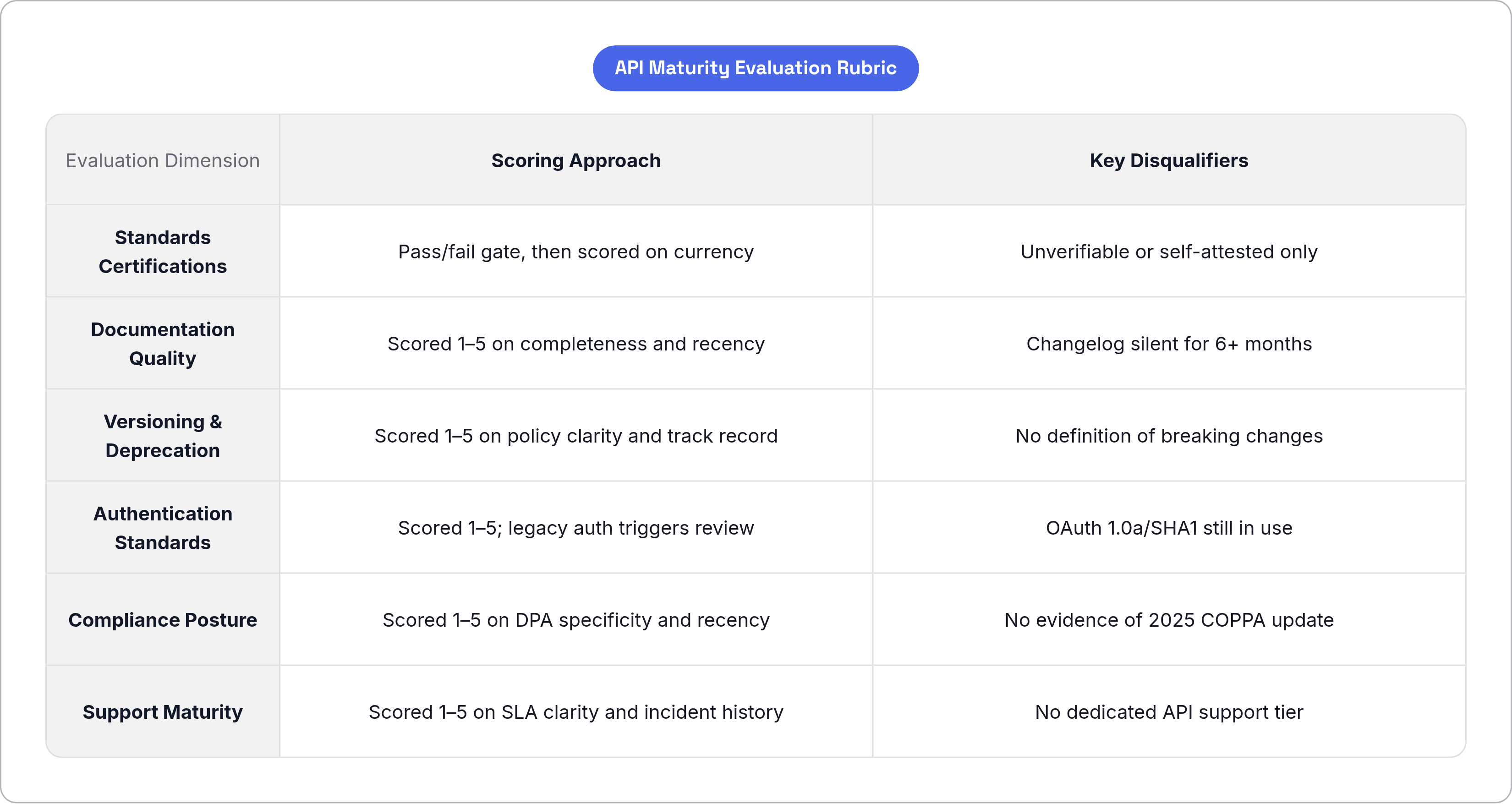
Structure the evaluation as a scored rubric. Assign each dimension a weight that reflects its importance to your specific context. A K-12 district in a state with aggressive student privacy legislation should weight compliance higher. A higher-ed institution doing large-scale SIS-to-LMS migration should weight OneRoster and Edu-API readiness more heavily. There is no universal weighting. There is only the right weighting for your situation.
A reasonable starting structure looks like this:
- Standards certifications (LTI version, OneRoster version, verifiable registration): pass/fail gate, then scored on currency and completeness
- Documentation quality (completeness, changelog recency, sandbox access, gap between docs and actual behavior): scored 1 to 5
- Versioning and deprecation policy (definition of breaking changes, notice period, communication track record): scored 1 to 5
- Authentication standards (OAuth 2.0 with scopes, OIDC support, audit logs): scored 1 to 5, with legacy auth as a potential disqualifier
- Compliance posture (DPA specificity, 2025 COPPA update evidence, data minimization at endpoint level): scored 1 to 5
- Support maturity (dedicated API support, SLA clarity, incident history, test ticket response): scored 1 to 5
Run every vendor through the same rubric. It removes the "this vendor has a really good relationship with our team" bias that has quietly torpedoed more than one integration decision.
One more thing worth saying plainly: the vendors who score well on this rubric are not always the biggest names in the market. EdTech is fragmented enough that some of the most technically mature APIs come from focused, specialized vendors, while some legacy platforms with strong market share are carrying significant API debt from decisions made a decade ago. The rubric does not know who the incumbent is. That is the point.
You are going to live with this integration for years. The evaluation is the cheap part.