Single Sign-On Adoption Patterns Across Learning Platforms

Here is what nobody tells you upfront about SSO (Single Sign-On): the authentication problem is the easy part. One set of credentials gives access to everything you are supposed to have. That part works. The part that quietly wrecks implementations is what teams conflate with it.
SSO handles authentication. It answers the "who are you?" question. Provisioning handles the messier layer underneath: who actually exists in the system, what role they hold, and what happens to their account when they graduate, get fired, or transfer mid-year. Learning platforms serve transient populations in a way that enterprise software almost never does. Students leave. Teachers move between schools in October. Employees churn. If you build a clean authentication layer and never properly scope the provisioning side, you end up with a system that lets the right people in and never kicks the wrong ones out. The authentication works perfectly. The system is still a disaster.
Think of it like a bouncer who is very good at checking IDs at the door but has no idea who is already inside and has been there since last semester. The front entrance is airtight. The building is still full of people who should have left months ago.
That failure mode is the most common scoping error in LMS SSO implementations, and it happens early, before the first line of code gets written.
On the security side, the stakes in education are genuinely different from a standard corporate context. A credential compromise in an office environment is a bad day. In a school, it is a bad day that also implicates FERPA (Family Educational Rights and Privacy Act), COPPA (Children's Online Privacy Protection Act), and applicable state privacy statutes. The regulatory surface is real, and it changes how you think about the entire project. That is not abstract risk. Between July 2023 and December 2024, over 9,300 cyber incidents hit around 5,000 K–12 schools. In 2025, password-based attacks were running at over 7,000 per second globally (Microsoft Digital Defense Report). The productivity wins from SSO are well-documented and nobody seriously debates them. The security framing is where education diverges from everything else.
K–12 Built Its Own SSO Ecosystem
Walk into a K–12 deployment expecting enterprise patterns to transfer cleanly and you are going to have a rough few weeks. I have watched this happen more times than I can count. The constraints are different enough that the K–12 ecosystem essentially gave up on adapting enterprise tools and built its own layer from scratch.
The user population is minors. No personal email addresses. Students use shared, district-managed devices. COPPA rules out half the approaches that work fine in an office. And then there is rostering, which has no real equivalent anywhere in enterprise IT. In K–12, knowing who is in which class, with which teacher, at which school is just as important as knowing who the person is. Authentication and rostering are bundled together. You cannot separate them and buy them independently, because operationally they are the same problem.
That is how you end up with platforms like Clever and ClassLink. Clever serves 27.5 million students and teachers (Clever.com). ClassLink has been adopted by over 25 million users and combines SSO, rostering, and analytics in one place. Google Workspace for Education functions as a de facto identity provider for many districts, particularly where Chromebook adoption is high. These platforms exist because someone looked at the K–12 landscape and realized the intermediary layer was the actual product. The outcomes reflect it. Orange USD saved 2,500 hours per month in login time and hit over 80% active user adoption with minimal training (ClassLink case study). Green Bay Area Public Schools improved secure digital access for 21,000 students using ClassLink's SSO and rostering combination.
For anyone building integrations into K–12: SSO here means integrating with Clever or ClassLink, not with SAML or Okta directly. The intermediary is the integration target. It absorbs the district-by-district complexity so you are not negotiating with hundreds of separate IT departments. Build to the intermediary. That is the whole job.
Higher Ed Federates a More Complex Stack
Higher ed is not just a bigger K–12. The architecture is genuinely different, and treating it like a scaled-up version of the K–12 problem will cost you.
A university LMS is one node in a much larger connected stack: student information systems, CRM tools, financial systems, library platforms, research infrastructure. Student identity has to stay consistent across all of it, which is a harder federation problem than rostering. There is no Clever equivalent absorbing complexity on your behalf. You are dealing with institutional-grade identity infrastructure, and institutions have their own opinions about how that should work.
The regulatory surface is also wider and getting wider. As of 2025, 121 or more state laws protect student privacy beyond FERPA, and institutions operating across state lines are subject to multiple overlapping frameworks simultaneously. California's SOPIPA restricts how edtech vendors can use student data, which affects any vendor selling into California institutions regardless of where that vendor is headquartered.
Then there is the December 2024 PowerSchool breach, which affected 62 million students in a single incident. That event changed procurement conversations in a way that is hard to overstate. Before that, the SSO vendor's own security posture was a checkbox item. After that, institutions started asking detailed questions about breach response, data segregation, and what happens to their data if the vendor gets hit. Your security documentation is now part of the evaluation, not an afterthought you file after the deal closes.
Higher ed typically uses enterprise-grade identity providers like Microsoft Entra ID or Okta, integrated with the campus SIS. For integration builders: expect SAML 2.0 or OIDC compatibility with established campus identity providers. Plan for compliance documentation cycles that are slower and more detailed than anything you encounter in K–12. And understand that your security posture is an evaluation criterion now, not just your feature list.
Corporate LMS Teams Treat SSO as Baseline
In large American companies, SSO adoption runs at 72% (Global Growth Insights, 2024). The corporate market is not evaluating SSO. It already decided. Any LMS conversation that does not start from SSO as a given is starting from the wrong premise, and you will lose the deal before you even understand why.
The corporate LMS lives inside a larger HR and productivity stack alongside HRIS, CRM tools, and performance management platforms. Identity needs to flow from the HR system of record into the LMS automatically, without manual intervention. When that does not happen, someone has to manage it by hand, and nobody wants that job. 43% of companies invested in online learning tools in 2024, up from 39% the prior year (programs.com). That investment lands in environments where SSO is already table stakes and the real conversation is about what sits underneath it.
That conversation is provisioning. High employee churn means identity lifecycle management has to be automated end to end. When someone leaves, their access needs to disappear. When someone changes roles, their permissions need to update to reflect that. SSO alone does not handle any of this. SCIM (System for Cross-domain Identity Management) and Just-in-Time provisioning solve the lifecycle problem. They automate account creation, role assignment, and deprovisioning as things change. An employee who leaves the company but retains LMS access is a compliance failure, and better authentication does nothing to fix it. Teams that scope SSO without scoping provisioning tend to discover this around six months post-launch. The discovery usually arrives via a security audit that was not on anyone's original timeline.
For integration builders: SAML 2.0 and SCIM are not negotiable in enterprise procurement. Deals stall without them. Build those first, before anything else gets prioritized.
One Protocol Layer, Three Different Contexts
The segment differences are real and they matter, but they all run on a shared set of underlying protocols. Knowing which protocol maps to which context is where implementation choices stop being abstract.
SAML 2.0 is dominant in enterprise and higher ed. It integrates with established identity providers like Microsoft Entra ID, Okta, and Google Workspace. It handles granular attribute passing such as role, department, and location, and it is the right choice for organizations with legacy directory infrastructure. Most enterprise procurement teams will ask about SAML first.
OAuth 2.0 and OpenID Connect are increasingly preferred for cloud-native enterprise LMS platforms. They offer lighter payloads and are better suited for environments that mix web and mobile access. If the platform is newer and built for the cloud, you are probably looking at OIDC.
LTI (Learning Tools Interoperability) is education-sector-specific. It is a standard that enables secure data exchange between tools within an LMS. It is used in both K–12 and higher ed where the LMS functions as the identity hub for connected tools. If you are not familiar with LTI, get familiar with it before you walk into any education-sector conversation.
LDAP (Lightweight Directory Access Protocol) still appears in on-premises enterprise environments and some legacy higher-ed setups. It is not going away as fast as you might expect.
Clever and ClassLink function as protocol translators in K–12. The edtech app integrates with the intermediary, the intermediary handles the underlying directory infrastructure of each district, and developers do not negotiate with hundreds of separate IT departments. The abstraction is the product.
No single protocol covers all three segments. If you are building infrastructure that claims to support edtech broadly, you need to handle SAML, OIDC, LTI, and the Clever and ClassLink APIs as distinct integration surfaces. There is no unified shortcut, and anyone who tells you otherwise is either misinformed or selling something.
What These Patterns Mean for Builders
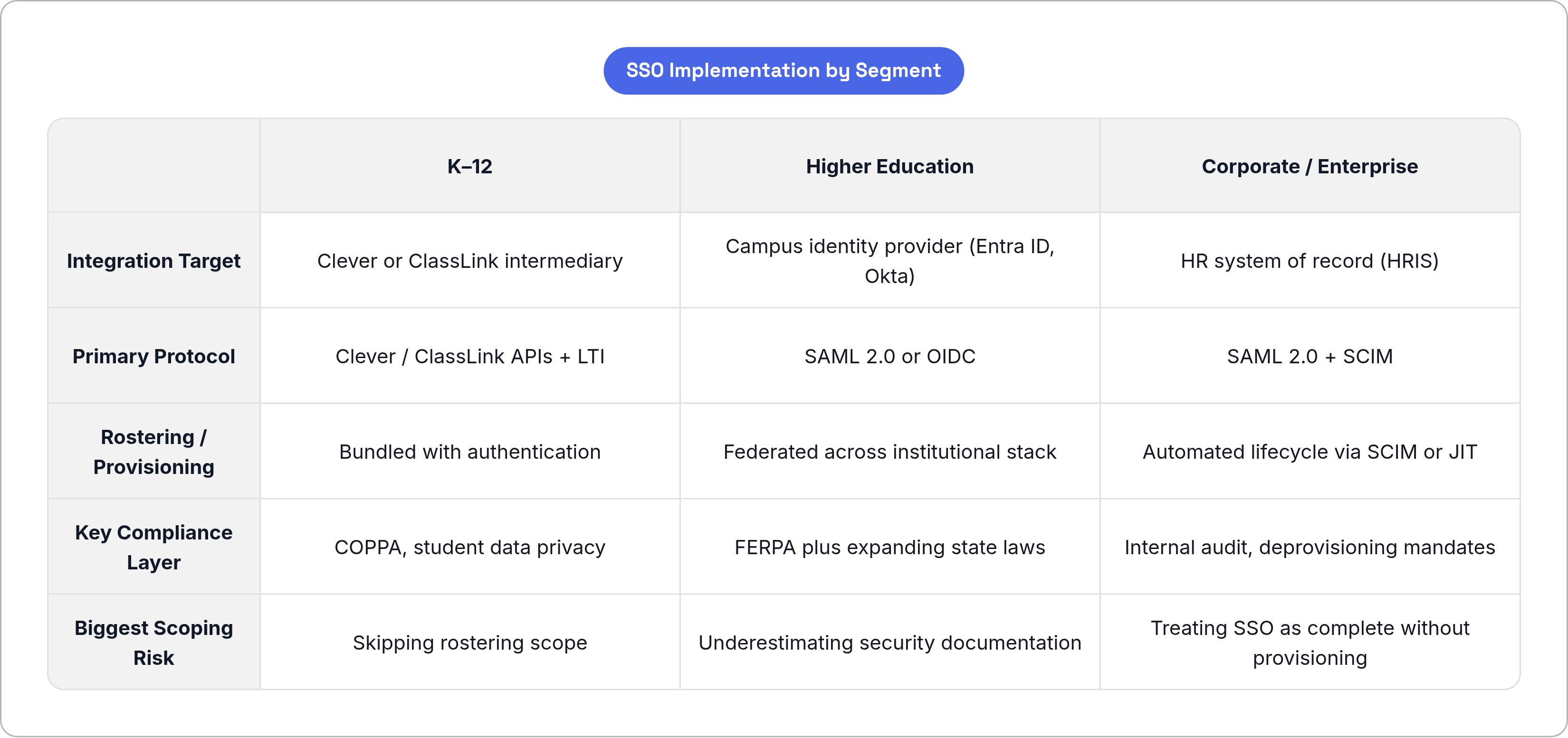
SSO in edtech is not one problem. It is three problems that happen to share a name, and the implementation choices for each are different enough that conflating them will cost you time you do not have.
Each segment has its own non-negotiable requirements. K–12: Integrate with Clever or ClassLink. Expect rostering to be bundled with authentication because operationally they are the same problem. Compliance concerns center on COPPA and student data privacy. The intermediary handles district-by-district complexity so you are not rebuilding that work for every new district you onboard.
Higher ed: Integrate with an established campus identity provider using SAML 2.0 or OIDC. Plan for a compliance documentation cycle covering FERPA plus an expanding and fragmented set of state laws. Treat your security posture as a procurement criterion, not something you address after the contract is signed.
Corporate/enterprise: SAML 2.0 and SCIM are effectively required. The LMS must integrate into an existing HR system of record. Provisioning automation matters as much as authentication, sometimes more. Deals stall without it, and nobody on the procurement side will explain exactly why the deal stalled. You just stop hearing back.
One more thing that does not get discussed enough: maintenance. Each segment's identity provider ecosystem generates ongoing connector work. Clever updates its APIs. Okta deprecates endpoints. Microsoft Entra ID changes behavior with quarterly releases. Every one of those changes becomes a support event if your team owns the connectors. Teams that build and maintain each connector directly absorb that cost indefinitely, on top of everything else they are trying to ship. Pre-built, managed connectors shift that operational burden off the core product team. The build-versus-buy tradeoff is most consequential when you are serving multiple segments at once, because the maintenance overhead compounds across each one.
The LMS market is projected to grow from $28.58 billion in 2025 to $70.83 billion by 2030 (Grand View Research, 2024). The tooling is maturing and vendors are investing. None of that changes the scoping problem. The question is never whether to support SSO. That is settled. The question is which SSO, for which segment, on which protocol, with which provisioning layer sitting underneath it. Get that scoping right at the start and the rest of the project becomes manageable. Get it wrong and you find out about six months later, at the worst possible moment — which, in my experience, is always the worst possible moment.