Building a Partner App Ecosystem Around an LMS
LMS platforms that skip ecosystem layers risk becoming features inside competitors.

Building a partner app ecosystem around an LMS looks straightforward on a slide deck and turns into a multi-year construction project in real life. A real ecosystem requires deliberate decisions at three separate layers. Get all three right, and your LMS becomes genuinely hard to replace. Get one wrong, and you end up with a catalog of connectors nobody activates and a partner program that exists mostly as a PDF on your website.
The LMS market is growing fast — MarketsandMarkets projects it will reach roughly $100 billion by 2032, up from $30.92 billion in 2025. But growth numbers don't explain why ecosystems matter. The real driver is that cloud-hosted platforms now hold 88% of market share (Mordor Intelligence, 2025), which means switching costs have dropped. When the core platform is a commodity, differentiation comes from everything surrounding it.
There's also a structural reality about who buys an LMS. More than 74% of organizations use one for compliance and workforce training. These buyers arrive with Workday, Salesforce, and half a dozen other tools already running — and no intention of replacing them. If your LMS doesn't connect cleanly to those systems, you're not a platform. You're a problem.
KPMG's January 2025 research found that 75% of business leaders name ecosystem partnerships as a key driver of growth strategy. The competitive pressure in LMS specifically is stark: Canvas holds more US higher-ed enrollment share than its next three competitors combined (Edutechnica, Spring 2025). Moodle runs over 2,700 plugins. Docebo connects more than 400 third-party tools. Any LMS that doesn't build ecosystem infrastructure risks becoming a feature inside a competitor's platform. Anthology/Blackboard's Chapter 11 filing in September 2025 is a reminder that ecosystem sprawl through acquisitions — without coherent integration architecture underneath — is its own trap.
What most LMS teams get wrong
The word "ecosystem" gets applied to everything from a single Zapier connection to a full ISV marketplace. That ambiguity is where most problems start. So let's define terms.
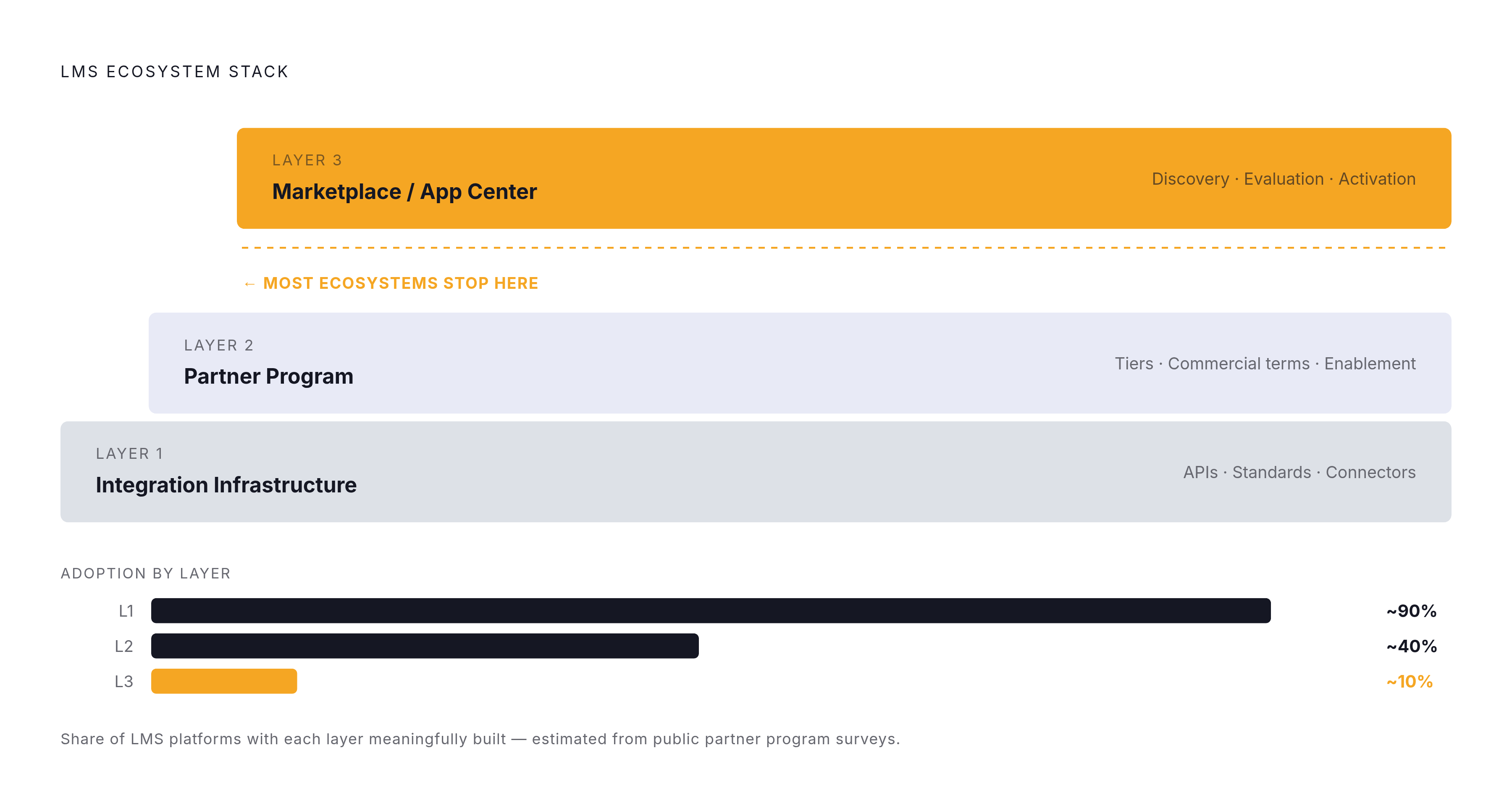
A partner app ecosystem has at minimum three layers:
Integration infrastructure. The APIs, standards, and connectors that let third-party tools attach to the LMS.
Partner program. The recruitment criteria, commercial terms, tiers, and enablement resources that govern who can build and how.
Marketplace or app center. The discovery surface where customers find, evaluate, and actually activate partner apps.
The failure mode almost every LMS team falls into is building layer one while treating layers two and three as afterthoughts. You end up with a fragmented catalog of connectors. No coherent partner experience. No network effect. Customers can't tell which integrations are maintained, which are abandoned, and which will break during the next upgrade.
The "orchestrator" model is the right mental frame. Your job as an LMS vendor is not to build every integration yourself. It's to provide the infrastructure, standards, and governance so partners can build reliably. Shopify doesn't manually launch every store. It builds the rails and lets merchants run. Most mature LMS programs also run two platform types in parallel: a partner relationship management (PRM) tool handles deal registration and the portal experience, while the LMS or content platform handles training and certifications. Neither replaces the other. What's worth noting is what separates a real enablement platform from a generic LMS: the system should know which partner a learner belongs to, what tier they're at, what products they can sell, and what deals are currently in flight. That context is what connects partner training to revenue. Without it, you have a video library that nobody opens twice.
Which integrations to open first
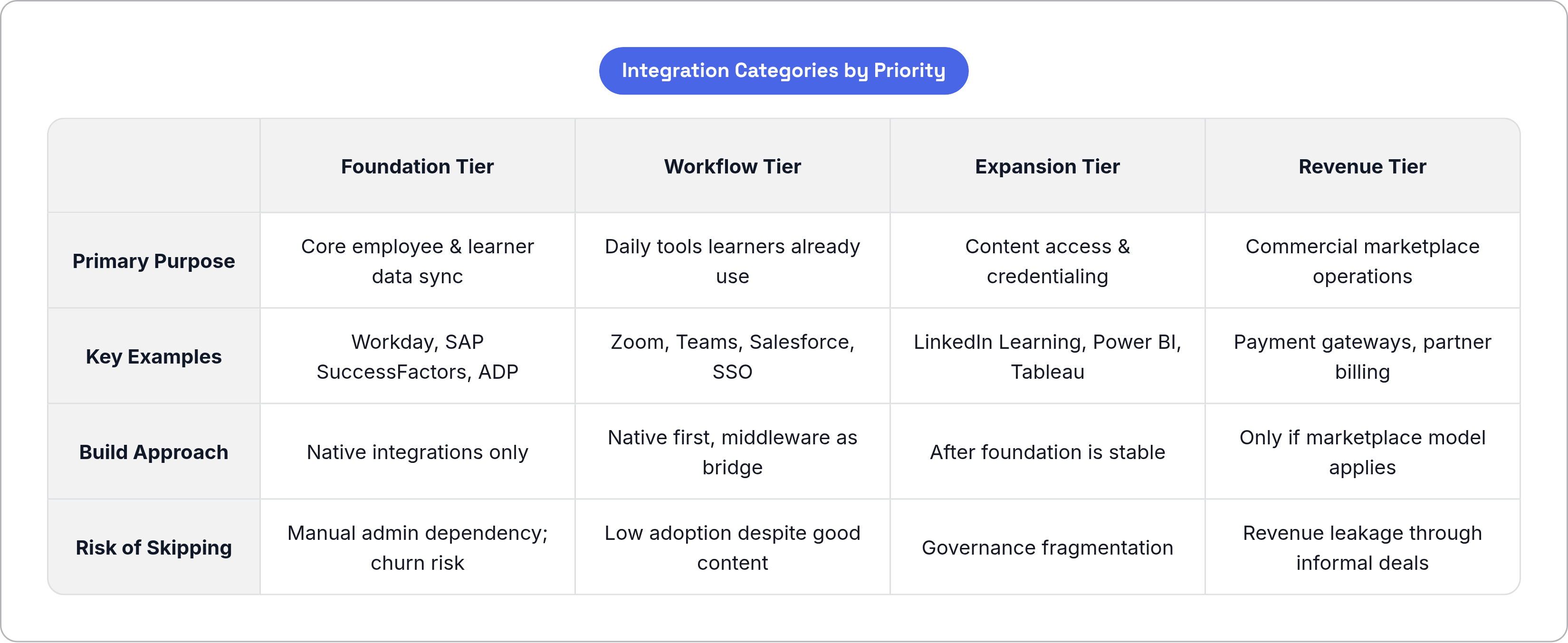
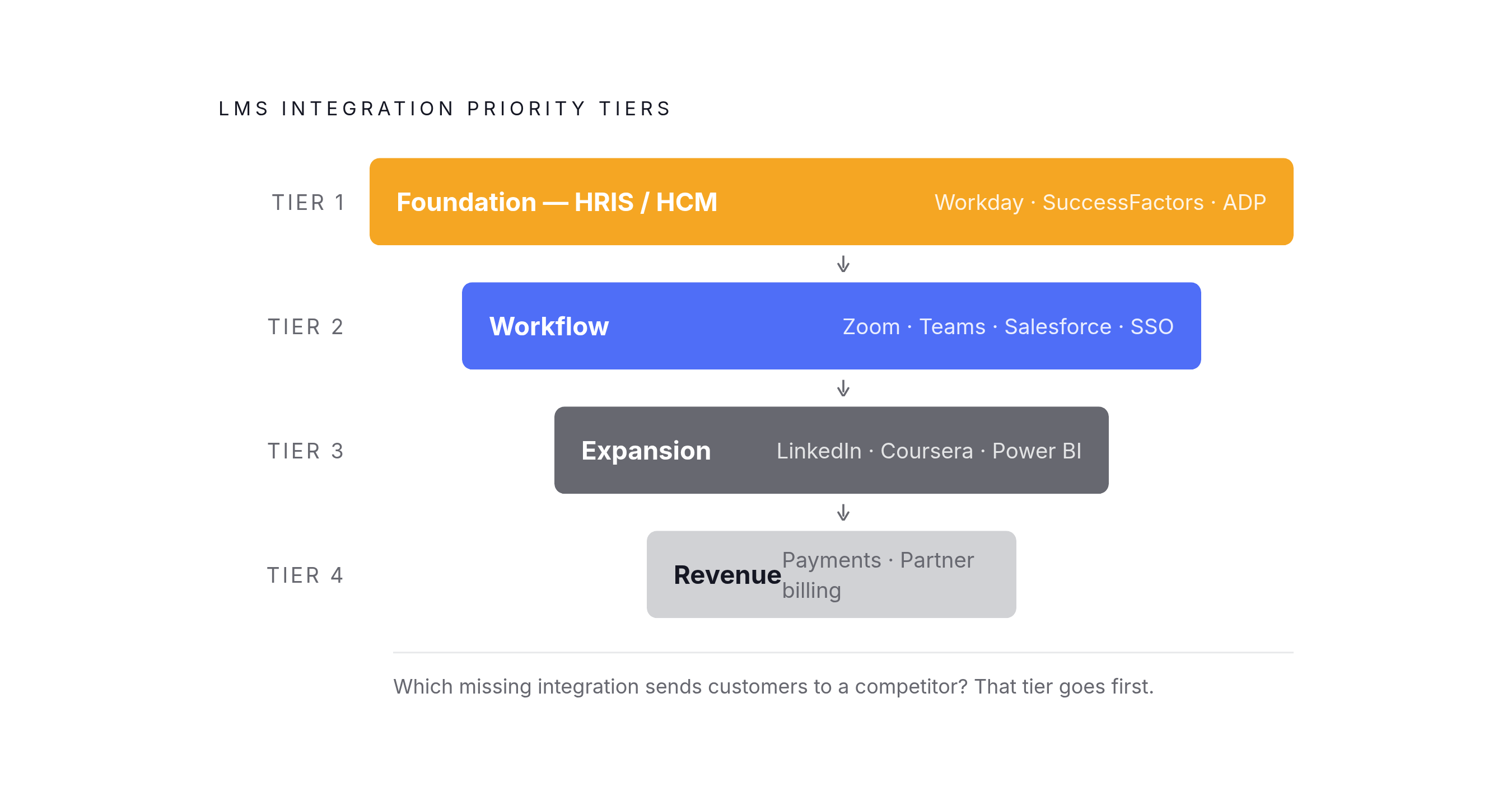
Not all integration categories carry equal weight. The starting point should be the data flows your customers absolutely cannot live without. Avoid chasing the longest possible list or the most technically interesting one.
Foundation tier: employee and learner data
HRIS and HCM connections to systems like Workday, SAP SuccessFactors, and ADP enable automatic user provisioning, role-based learning assignments, and compliance tracking. LearnUpon launched ten HRIS integrations in 2024, automating onboarding workflows and syncing learning data with enterprise HR systems. That's a useful benchmark for what "table stakes" looks like at a corporate LMS today. If you can't connect to the system that manages who works at the company, you will be manually maintained by someone's admin, and that admin will eventually leave.
Workflow tier: the tools learners use every day
Video conferencing integrations with Zoom or Microsoft Teams reduce context-switching. CRM integrations with Salesforce tie training activity to business outcomes that executives actually care about. SSO is the unglamorous one, but it consistently drives adoption more reliably than almost any content feature. Removing one login barrier compounds quietly over time.
Expansion tier: content and credentialing
External content libraries like LinkedIn Learning or Coursera should appear within the LMS while sending completion data back for centralized reporting. This expands access without fragmenting governance. Social credentialing platforms and analytics tools like Power BI or Tableau become relevant once the foundation tier is stable. Don't rush these. They're valuable, but the core data flows need to be working first.
Revenue tier: commercial marketplace infrastructure
If you're running a commercial marketplace, payment gateways and partner billing automation belong here.
The prioritization heuristic is straightforward: ask which missing integration causes a customer to evaluate a competitor. That is the first category to open. The one that sounds impressive in a product roadmap presentation can wait.
The architecture decisions that matter
API-first is baseline now. Vendors exposing open APIs and pre-built connectors are capturing a widening share of new enterprise installations. This is not a differentiator anymore. It is a prerequisite.
Standards matter more than custom APIs
Three standards are worth knowing cold:
SCORM packages and tracks content across platforms. It's still the default for interoperability with legacy content, and legacy content is everywhere.
LTI 1.3 lets third-party tools launch from within the LMS without requiring a separate login. Canvas's App Center runs entirely on this model, which is also why external tools can't break Canvas during upgrades. That stability is not accidental. It's an architecture decision.
xAPI (Tin Can) captures learning activity from outside the LMS. It's useful for partners building simulations, mobile apps, or informal learning tools where the activity happens somewhere else but the record needs to live somewhere central.
Moodle's plugin API and over 500 web service functions across core components give it the deepest developer surface of any LMS. It's worth knowing as a benchmark for what "open" looks like at scale.
Native vs. middleware trade-offs
Native integrations mean the LMS developer maintains both sides. Updates stay in sync. Configuration is straightforward. This is the right choice for high-frequency operational flows like enrollment and billing.
Middleware tools like Zapier or Make are flexible and can connect almost any API, but they add per-task cost at volume and can break silently when either platform updates without notice. Silent failures in a compliance training system make for a painful conversation with a customer — one that's entirely avoidable.
The practical answer for most LMS ecosystems: use native integrations for the foundation tier. Use middleware as a bridge while native connectors are being built. Never treat middleware as the permanent architecture for critical data flows.
What partners need that most platforms skip
Versioning and deprecation policy. Partners need to know when APIs will change and with how much lead time. Without a clear policy, every platform update is a potential breaking change, and every breaking change erodes trust. Sandbox environments, thorough developer documentation, and webhook support are table stakes for recruiting serious ISV partners. Their absence signals that the "ecosystem" is a marketing label on a list of native add-ons.
Recruiting and tiering partners intentionally
Opening the ecosystem to anyone and hoping the market sorts it out is the mistake. It produces a catalog of low-quality integrations that makes the LMS look cluttered and hurts customer trust. The partners you want aren't generic software vendors. They're specific types:
Consulting firms adding scalable training to existing client offerings
HR service providers expanding into compliance or onboarding
Associations delivering member credentialing at scale
Niche content providers with a defined vertical (construction safety compliance, legal continuing education, healthcare onboarding)
HubSpot's partner model is instructive here. Partners who specialize in a vertical outperform generalists because they can speak the customer's language and own a category in the marketplace. A healthcare compliance training partner is immediately credible to a hospital system in a way that a general e-learning reseller is not.
Tiering criteria worth defining explicitly
Technical:
Integration quality
API usage and version compatibility
Alignment with current LMS release
Commercial:
Customer count
Revenue influenced or generated
Renewal rates
Enablement:
Partner certification completion
Support responsiveness
Commercial model options:
Hyperscale cloud marketplaces charge ISVs roughly 3 to 5% transaction fees, often offset by co-sell credits. LMS vendors can calibrate similarly. Referral fees for partner-sourced deals and co-sell arrangements where the partner and vendor collaborate on enterprise accounts round out the toolkit. Per Tackle's 2025 State of Cloud GTM Report, the leading 10% of companies now see half of their revenue flow through marketplaces, with 58% of that revenue influenced by co-selling. The commercial case for getting tiers right is not abstract.
What's also worth noting: traditional linear partner programs aren't adequate anymore. SaaS teams need multi-directional partnerships where co-creation, shared growth, and integrations work together rather than in a straight line from vendor to reseller to customer.
Enablement beyond a knowledge base
Education-Led Growth (ELG) is the relevant framing here. Treat partner training as a core go-to-market motion, not a support cost. The philosophy is that educating your external ecosystem drives business growth. The numbers support it: 70% of companies report that partner and customer education accelerates sales cycles and drives expansion revenue; 84% see improved retention when education programs span both customer and partner audiences (Intellum, cited via Continu, 2025).
What enablement actually requires
A knowledge base is not enablement. Real enablement requires:
Role-specific onboarding paths. A developer building a connector needs completely different resources than a consultant selling implementations. Sending them both to the same portal is a fast way to lose both of them.
Product certifications tied to partner tier. Completion gates that unlock co-sell status, co-marketing funds, or higher revenue share give certifications actual value. Without that connection, they're just badges.
Deal-in-flight context. The system should surface which products a partner can sell and which deals are currently active. Static training content without commercial context is just content.
Regular release communications. Partners should know what's changing in the LMS before it breaks their integration, not after.
CommScope's experience is worth citing here. Facing thousands of partners across 150-plus countries, they replaced inconsistent classroom training with a centralized infrastructure academy. Partner enrollment grew to over 50,000 annually, spanning training in more than 130 countries. That scale is unachievable without automation and a single content source of truth.
Automation is not optional at scale. Provisioning partner portals, assigning learning paths, issuing certifications, and syncing billing should all run without manual intervention.
The gap most programs have: the PRM handles portal and deal registration, the LMS handles training, but neither system shares context about the partner. Building that bridge, or choosing a platform that does it natively, is what makes enablement actionable rather than informational.
Building a marketplace customers actually use
Having partners and integrations is not the same as having a marketplace customers trust and actually use. Canvas's App Center (vetted, LTI-based, upgrade-safe) and Moodle's plugin directory (over 2,700 plugins, community-rated) represent two different models with genuinely different trade-offs.
Curation vs. openness
Open plugin directories lower the barrier for partners but put the quality evaluation burden on customers. That's appropriate when the developer community is the customer, which is largely Moodle's model. Vetted app centers with certification requirements protect customer trust and the LMS's reputation, but they slow partner entry. That's appropriate when enterprise buyers are the customer, which is Canvas's model.
Most corporate LMS vendors should lean toward curation. Enterprise procurement requires confidence that an integrated tool won't break during an upgrade or expose a compliance gap. A single bad integration that causes a data issue during a compliance audit will haunt your customer success team for years.
Design factors that drive activation
Categorization that maps to customer job-to-be-done, not to the partner's product description. Customers don't search for "LTI 1.3 compliant content tools." They search for "onboarding content for manufacturing."
One-click or low-friction activation. Configuration complexity after discovery is where most integrations die. The user found the integration, got excited, hit a wall of configuration options, and closed the tab.
Reviews and usage data visible to prospective customers.
Clear compatibility signals. Which LMS version does this work with? Which deployment mode? Which data residency requirements does it satisfy?
Docebo's 400-plus tool integrations and D2L Link's 1,000-plus no-code recipes illustrate that breadth alone does not equal usability. The question is how many of those integrations are actually activated versus listed. A marketplace that partners list in but customers ignore is a cost center, not a competitive moat.
Network effects only compound if customers activate integrations and recommend the ecosystem to prospects. Those recommendations are the actual moat.
Measuring what's working — and fixing what isn't
EY research finds that successful ecosystems contribute roughly 16% incremental revenue growth, similar incremental earnings improvement, and meaningful cost reductions. Those numbers are useful as a benchmark for what a functioning ecosystem should eventually deliver. They are not a guarantee from launch.
The metrics that actually reveal ecosystem health, organized by layer:
Integration layer:
API call volume and error rates
Number of active integrations vs. listed integrations (this gap is often humbling)
Time-to-first-successful-API-call for new partners
Partner layer:
Partner activation rate (signed up vs. actively building or selling)
Partner-sourced or partner-influenced revenue as a percentage of total
Partner certification completion rates by tier
Marketplace layer:
Customer integration adoption rate
Integrations per active customer account
Customer retention difference between accounts with integrations vs. without
The most actionable leading indicator is integration adoption per customer. Customers using three or more integrations are meaningfully harder to displace than those using the LMS as a standalone tool. That stickiness is the mechanism that earns the ecosystem its strategic value. It's not the API. It's not the partner program. It's the moment a customer's HR system, their content library, their video conferencing tool, and their compliance reporting are all running through your platform and the idea of switching feels genuinely painful.
When the numbers are low, the diagnosis follows the layers. Low partner activation points to enablement or onboarding friction. Low marketplace adoption points to discovery or configuration problems. Low partner-sourced revenue usually points to a co-sell motion that exists on paper but not in practice. The fix is almost always simpler than it looks: find the layer that's broken, trace the specific friction point, and fix that one thing before adding more partners, more integrations, or more marketplace features. Adding volume on top of a broken process just produces a bigger broken process.