LMS Integration Standards Compared LTI SCORM xAPI
SCORM still handles 60-70 percent of training; xAPI and LTI solve different problems entirely.

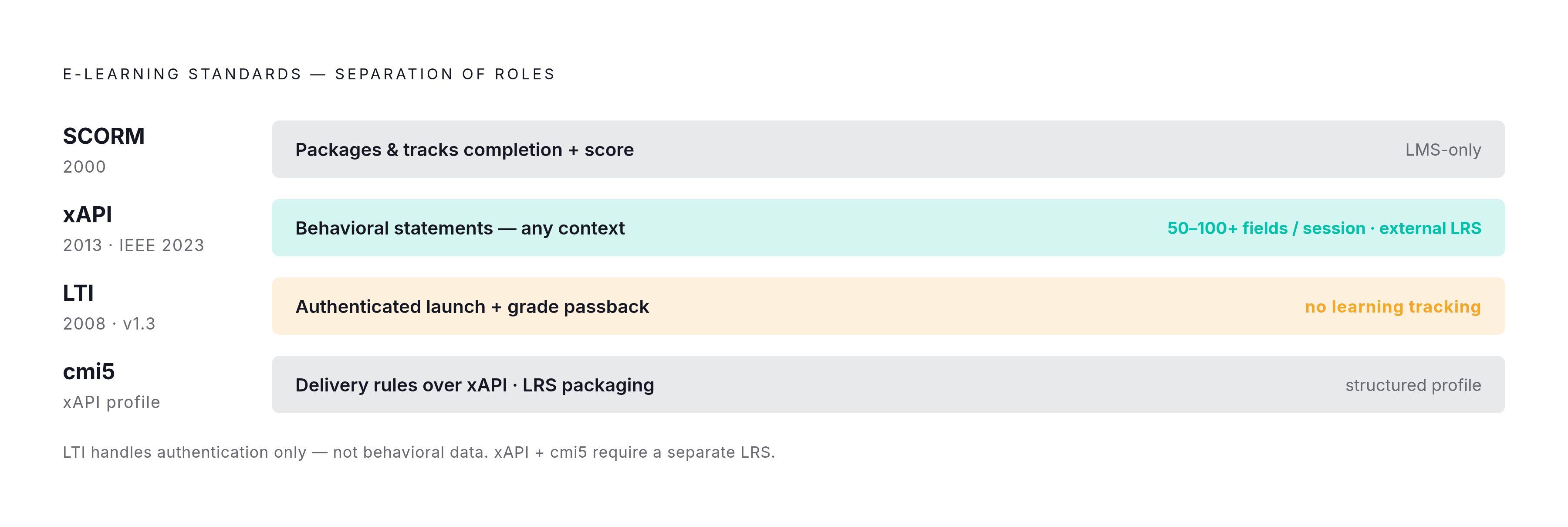
The U.S. Department of Defense built SCORM in 2000 because they had a specific, unglamorous problem: they were buying courses from dozens of vendors and none of them ran on the same LMS. They needed a packaging standard. A zip file, basically. HTML, JavaScript, media, and a manifest that any LMS could read and launch.
That is the whole origin story. No grand vision. Just interoperability between procurement and delivery.
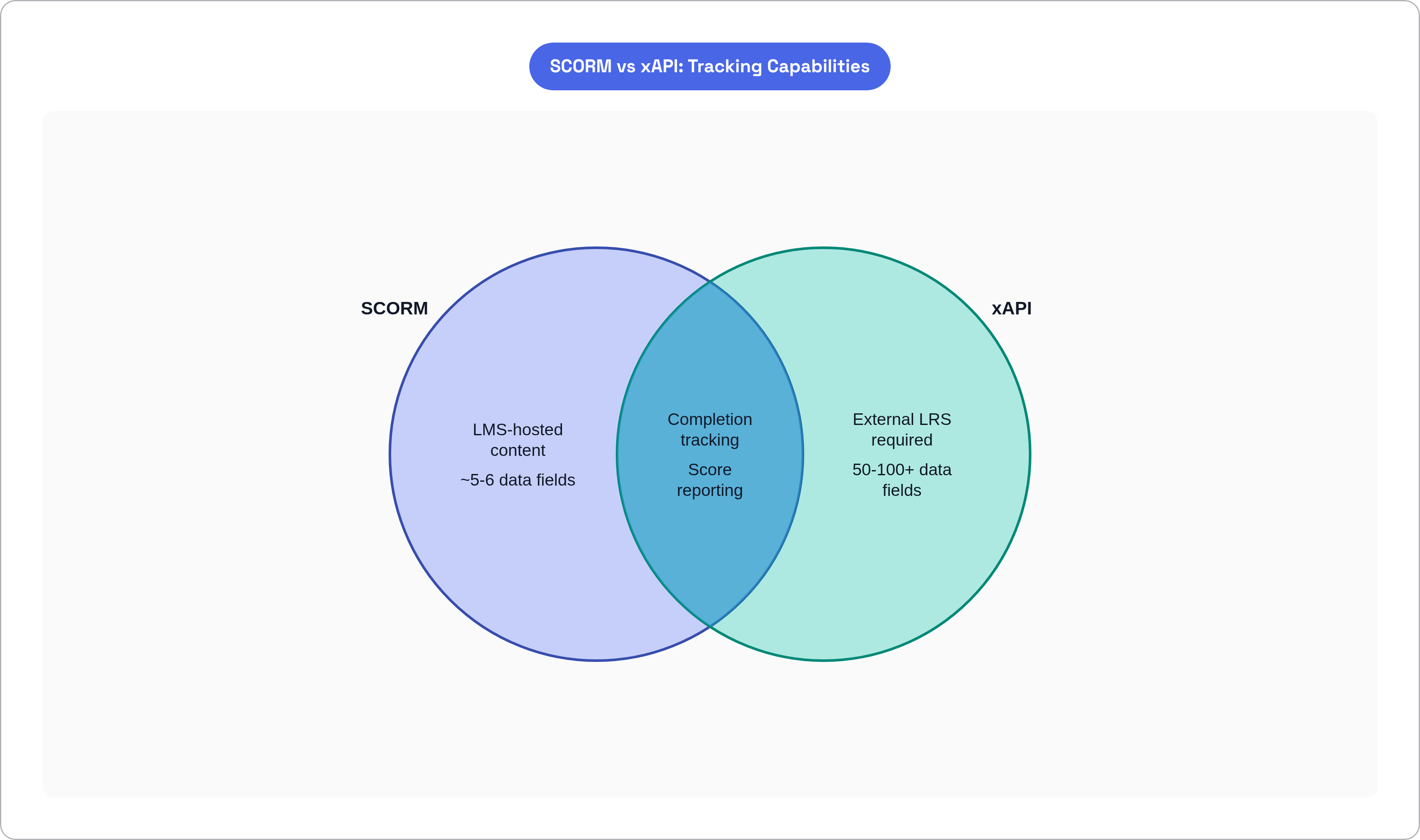
The communication model is simple. The course runs in the browser, JavaScript talks to the LMS through a runtime API, and the LMS records a small fixed set of data: completion status, pass or fail, a score, session time. Maybe a handful of interaction fields. The data model has around 30 elements on paper. In practice, most implementations touch five or six of them.
The spec has been frozen since 2009. ADL is no longer maintaining it. And yet SCORM 2004 4th Edition is still the most widely deployed e-learning standard. Every major LMS still imports it. That is not inertia. It reflects something real about what most training actually needs.
For compliance-heavy environments, the reporting requirement is usually just this: did the learner open the module, complete it, and pass the quiz? SCORM answers that cleanly. From where I sit, SCORM is still the right fit for somewhere between 60 and 70 percent of training content being deployed today. The migration effort to something more sophisticated only pays off when the use case genuinely demands what SCORM cannot do.
There are real limits worth knowing about before you get burned by them.
The one that catches teams off guard: SCORM 1.2 has a suspenddata field capped at 4,096 characters. That is where bookmarking lives. Complex courses that store navigation state and variable logic in suspenddata hit the ceiling silently. No error message. The learner just loses their progress and has no idea why. Teams that have been burned by this know to design around it. Teams that haven't been burned by it yet are going to be.
The structural limits beyond that:
- Learning data is siloed to whichever LMS the course runs in. No unified learner record across systems.
- SCORM cannot track anything outside the LMS: on-the-job practice, mentorship, physical tasks, reading.
- Content requires a live LMS connection. Offline mobile learning is not viable.
If your content is browser-based, LMS-hosted, and the reporting requirement is completion plus score, SCORM is not a compromise. It is the correct answer. If any of those conditions are false, keep reading.
The architectural shift xAPI makes and what it demands in return
xAPI came out of ADL-funded research in 2013. The problem it was solving was specific: SCORM only knew what happened inside the LMS. As learning moved to mobile, simulations, physical environments, and on-the-job tasks, the LMS-as-sole-source-of-truth model broke down. xAPI was the fix.
The architecture is genuinely different. Every learning event is a statement. Statements follow a three-part structure: actor, verb, object. Who did what to what. Those statements travel over HTTP to a Learning Record Store, which is a separate data system that lives outside the LMS entirely. It is its own infrastructure.
Because the transport is standard HTTP and the system is agnostic about what sends statements, almost anything can report. Mobile apps. VR simulations. A kiosk in a warehouse. An offline experience that queues statements and syncs them when connectivity returns.
The data granularity is the part that actually matters for anyone building toward modern analytics. SCORM works with roughly five to ten data fields per session. xAPI can capture 50 to 100 or more from a single experience, including things like hand positions in a flight simulation or the exact decision sequence in a branching scenario. That is the behavioral detail that recommendation systems and risk detection models actually need.
xAPI was ratified as IEEE 9274.1.1-2023, sometimes called xAPI 2.0. If you are writing procurement language or reviewing an RFP, that is the version to reference. The U.S. Department of Defense updated its internal directive, DoDI 1322.26, to include xAPI alongside the original SCORM requirement. Government and commercial RFPs ask for it explicitly with increasing frequency.
Now for the part that does not show up in vendor decks.
xAPI has been available for over a decade. A 2022 State of xAPI Adoption survey from the Learning Guild found only 17% of learning professionals had even experimented with it. Craig Weiss, a well-known analyst in the LMS space, has noted publicly that xAPI has never fully tapped its potential despite that decade on the market.
The reason is governance cost. With SCORM, the data model is pre-agreed. You know what fields exist. With xAPI, you have to decide: which verbs will we use, how will we identify learners across systems, what does "completion" mean, how will we structure extensions. Skip that planning work and you end up with a large, growing pile of statements that cannot be compared to each other because different tools used different vocabulary. The data lake becomes a data swamp. I have seen this happen and it is not a quick fix.
The LRS is also real infrastructure you have to budget for. There is no default storage inside the LMS for xAPI statements. You either deploy your own LRS or use a hosted service. Either way, it is a line item that SCORM implementations never had.
What LTI actually does, which is not learning tracking at all
This is where most comparisons go wrong. LTI gets lumped in with SCORM and xAPI as if it is a third option for learning tracking. It is not. LTI does something entirely different.
1EdTech (formerly IMS Global) developed LTI in 2008 to solve a specific problem. Learning tools were moving to the web. Institutions were buying quiz engines, video platforms, simulations, and assessment tools from external vendors. Every time a learner went from the LMS into one of those tools, they had to log in again. Grades came back manually, if at all. LTI standardized the handoff.
What LTI does: it embeds an external tool inside the LMS via iframe and passes an authenticated session so the learner never has to log in twice. The learner never technically leaves the LMS environment. Seamless. That is the entire point.
What LTI does not do: track learning data. LTI carries identity and context. Through an optional add-on called Assignment and Grade Services, it can write a grade back to the LMS gradebook. But behavioral analytics, time-on-task, content interaction, anything beyond a final score, those are outside LTI's scope. The LMS knows the learner launched the tool and got a grade. That is it.
LTI 1.3 is the current version. It uses OpenID Connect with JSON Web Tokens under the 1EdTech Security Framework. LTI 1.1 was formally deprecated on June 30, 2022. If you are still running LTI 1.1 integrations, that is a live risk sitting on your roadmap.
LTI Advantage bundles three certified service extensions on top of LTI 1.3:
- Names and Role Provisioning Services: Handles automated course enrollment and roster synchronization.
- Deep Linking: Allows content selection from inside the external tool to be passed back into the LMS course structure.
- Assignment and Grade Services: Sends the score from the tool back into the LMS gradebook without manual entry.
One practical thing that trips up first-time implementers every single time: every LMS labels the same configuration fields differently. Moodle calls it "Tool URL." Canvas calls it "Target Link URI." Blackboard calls it "Provider Domain." Same concept, same field, different label everywhere. Budget an extra hour of cross-referencing documentation for each LMS you need to configure. It is tedious and it never stops being tedious.
If you need deeper behavioral data from inside a third-party tool, LTI alone will not get you there. The pattern that actually works is pairing LTI with xAPI: LTI handles the launch and the session, xAPI captures what the learner does inside.
cmi5: the standard that bridges SCORM's structure and xAPI's tracking
cmi5 is not a fourth standalone standard. It is an xAPI profile, meaning it is a set of rules that defines how to use xAPI statements in a specific, constrained way for course-based learning. Think of raw xAPI as a language and cmi5 as a strict style guide for that language.
The motivation was a real gap. xAPI solved the tracking problem but left too much undefined for traditional course delivery. Training teams that wanted to move away from SCORM still needed structured packaging, defined launch rules, and predictable completion signaling. cmi5 brings those things back. It defines which verbs matter for course delivery, how a course gets packaged and launched, and how completion is determined. All of that flows into an LRS as proper xAPI statements, which means it is portable, queryable, and compatible with any analytics pipeline built to consume xAPI.
If you want xAPI's data portability without designing your own verb taxonomy from scratch, cmi5 gives you guardrails.
The practical reason cmi5 rarely shows up in LMS marketing materials is straightforward. It requires LRS infrastructure, and many LMS vendors do not natively provide it. Surfacing cmi5 as an option means pointing customers toward something the vendor may not sell. So it quietly gets set aside. Vendors are setting it aside for practical business reasons, not out of malice. It just does not benefit them to lead with it.
For training companies and learning platform teams with a content roadmap that extends beyond two or three years, cmi5 is often the most relevant standard to evaluate. Most comparison articles stop at three standards and never mention it. That gap is worth knowing about before you commit to an architecture.
How to match each standard to the problem you actually have
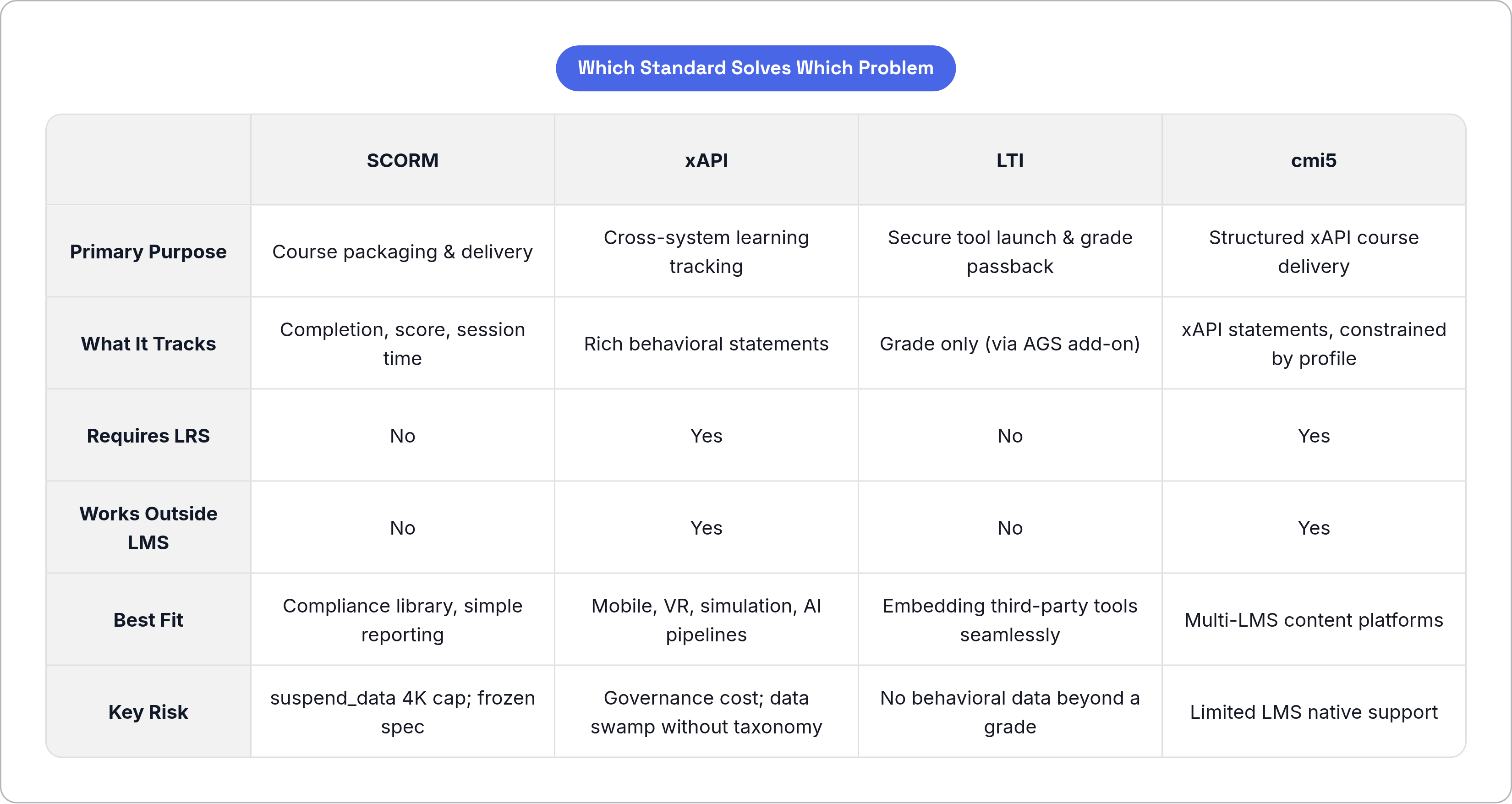
The decision is not about which standard is newest or most technically impressive. It is about where your learners are, where your content lives, and what kind of data actually needs to move.
Use SCORM when:
- Content is browser-based and LMS-hosted
- Reporting needs are completion and score, nothing more
- Budget or timeline makes LRS infrastructure impractical
- The existing content library is already SCORM-compliant and working
Use xAPI when:
- Learning happens outside the LMS: mobile, simulation, VR, physical tasks
- You need behavioral patterns, not just final scores
- You are building toward AI-driven personalization or risk detection
- Procurement requirements name xAPI explicitly, which is increasingly common in government contexts
Use LTI when:
- You need to embed a third-party tool inside the LMS without a separate login
- You need grade passback from an external tool into the LMS gradebook
- The use case is tool connectivity. LTI is the right layer regardless of what tracking standard the tool uses internally.
Use cmi5 when:
- You want structured course delivery like SCORM but need LRS compatibility and data portability
- You are building a content platform that will serve multiple LMS environments and need standardized xAPI output without designing a custom taxonomy
The most common real-world setup is not a single standard. It is a combination: LTI handles the tool launch and session, xAPI records what the learner does inside that tool, and SCORM still governs the legacy compliance library sitting alongside both. These standards are not competing. They are layers.
The SCORM-compliant LMS software market was valued at $8.6 billion in 2025 and is projected to reach $19.4 billion by 2034. That growth reflects how much infrastructure is built on SCORM. Replacement is rarely the right move. Layering is.
The integration maintenance burden that the standards themselves do not solve
Picking the right standard is the design decision. Keeping it working over time is a completely different job. Most teams conflate the two, and that is where the ongoing cost quietly accumulates.
LTI version migration is the clearest example. When LTI 1.1 was deprecated in June 2022, every tool required re-certification. Every LMS moved on its own timeline. There was a real period where integrations had to support both versions simultaneously because not everyone had migrated at the same pace. That is not a failure of the standard. That is just what maintenance looks like, and it does not stop.
xAPI governance compounds as adoption grows. The verb and object taxonomy decisions made at the start of an implementation either scale cleanly or they produce an unmaintainable data model as more tools start emitting statements. Curation is an ongoing responsibility. It is not a one-time configuration you finish and walk away from.
The figure I keep coming back to: 46% of organizations as of 2026 still struggle to connect their LMS platforms with legacy systems. Two decades of standardization should have moved that number considerably. The fact that it hasn't suggests the gap is not in initial implementation. It is in maintenance and operations.
Teams that treat integration as a project rather than a product consistently absorb more cost over time. The pattern is predictable. Build the integration, move on, let it drift as APIs evolve and standards update, then scramble when something breaks. Silent failures are the worst kind because they do not announce themselves. SCORM's suspend_data truncation is the perfect example. Learners lose progress. No error fires. Nobody knows until someone complains, and by then the damage is already done.
Pre-built, managed connectors that handle authentication, versioning, and API changes reduce that surface area. They are not glamorous infrastructure. But they are the difference between a team that spends its time building learning experiences and a team that spends its time chasing integration drift.