Real-Time Data Sync Challenges in EdTech Ecosystems
Districts juggle thousands of tools but lack real-time data sync to keep student records aligned.

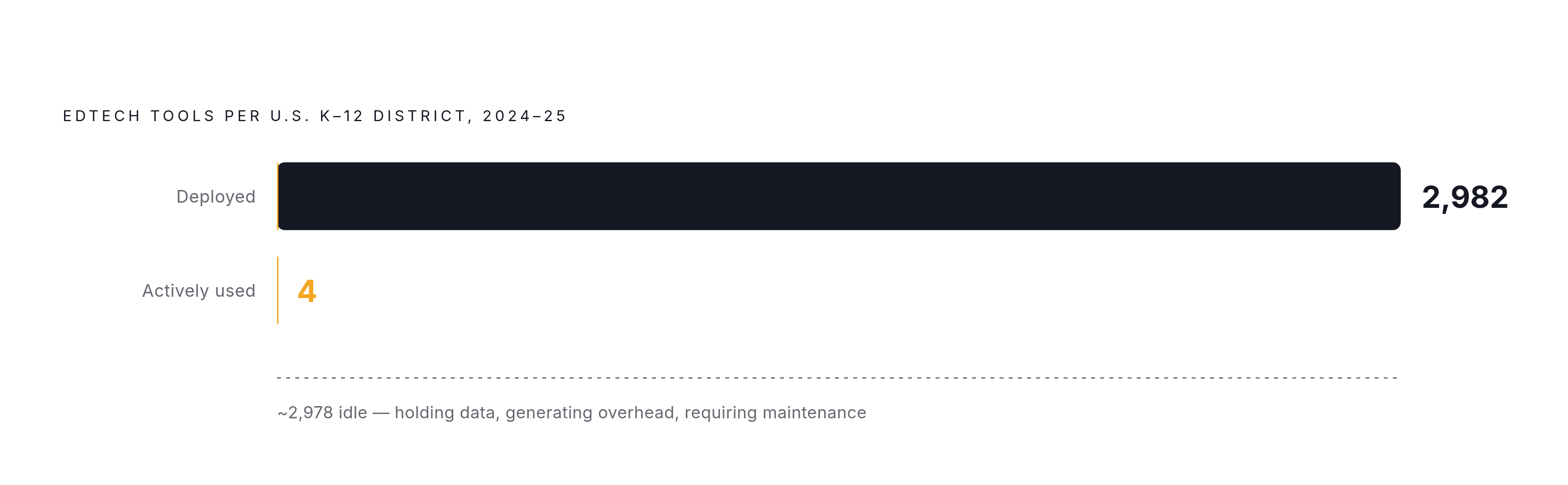
U.S. K-12 districts accessed an average of 2,982 distinct EdTech tools per district in 2024-25—up about 9% year over year and roughly triple the 2018 figure. Of those thousands of tools, students and educators are actively using an average of four.
The rest sit idle, holding data, generating overhead, and creating sync endpoints that someone has to maintain. Every tool that touches student data is a potential failure point: roster data flows in, grades or activity data flow out, and identity has to be resolved on both ends. Multiply that across 3,000 tools and more than 13,000 public school districts in the U.S. alone, and "interoperability" stops being a technical nicety and starts being a systemic crisis.
The global EdTech market was valued at roughly $189 billion in 2025 and is projected to nearly triple by 2034. Education IT infrastructure spending hit $82 billion in 2025, up 14% year over year. More investment means more systems, more vendors, and more surface area to maintain. The money is not solving the fragmentation—in many ways, it is accelerating it.
The structural reason is straightforward: these systems were never designed to work together. They were acquired separately, layered on top of each other over years or decades, then handed to IT teams to somehow make coherent. The LMS dominates EdTech market share, the SIS holds its own significant slice, and specialized tools fill the rest. Each category has its own data model, its own update cadence, and its own idea of what a student record looks like. Nobody architected this as a unified system. It evolved, and now someone has to maintain it.
What Data Silos Actually Cost You Daily
In higher education, admissions, academics, HR, and finance each run their own databases, rarely synchronized in real time. In K-12, the SIS, LMS, communication tools, and a constellation of specialized applications all operate independently while holding overlapping records for the same students.
Consider a concrete scenario: a student drops a course in the LMS, but the SIS has not updated yet, so the graduation audit still counts those credits and financial aid has not adjusted. By the time the discrepancy surfaces, the reporting window has closed. Registrars will tell you these gaps are not minor glitches—they are where compliance errors collect and where frustrated students end up in front of advisors trying to explain why their record does not match reality.
The core problem is that sync lag produces downstream data states that are silently wrong. There is no error message indicating that a student's record is stale. The wrong data sits there, getting read by other systems and informing decisions, until something downstream breaks visibly. Functional overlap compounds this: when two systems both store attendance or grade data, they will eventually diverge, with no automated reconciliation. Administrators working from dashboards that pull across multiple siloed sources are operating on data of uncertain freshness, even when the dashboard looks current and clean.
Why Standards Haven't Fixed Sync Failures
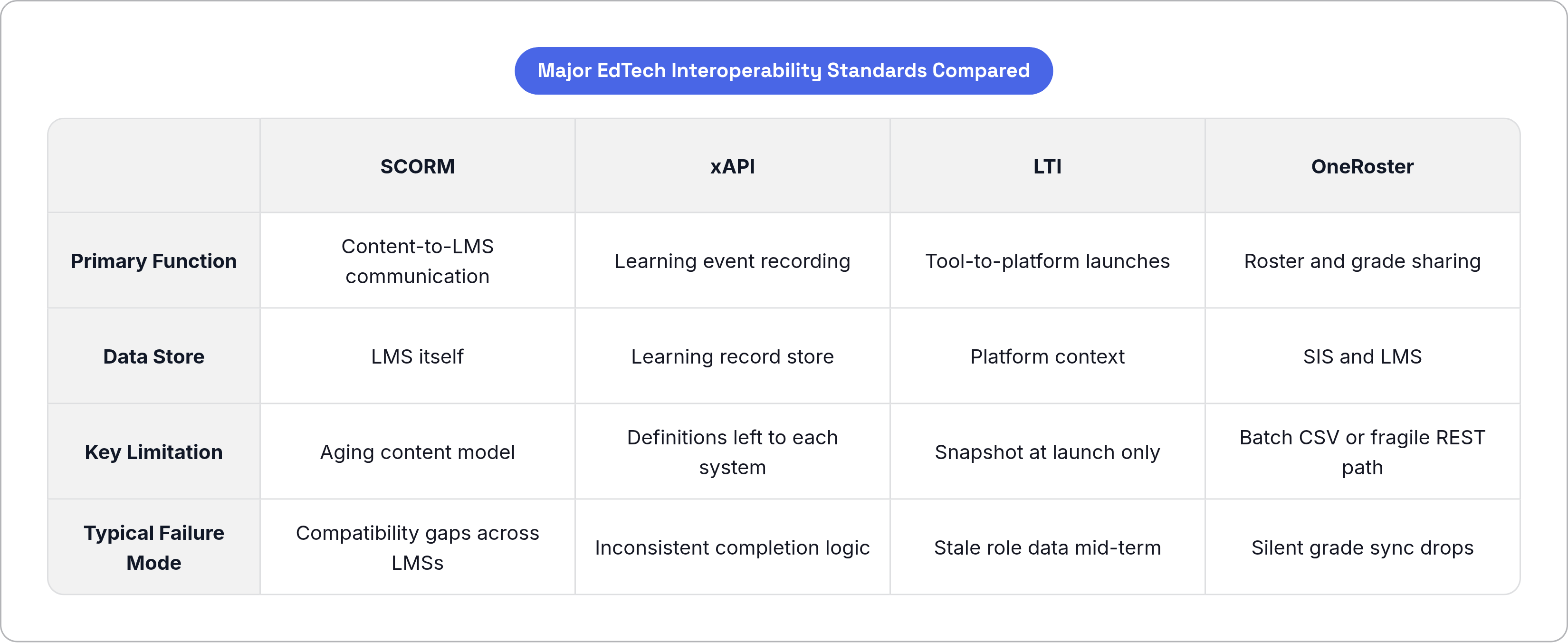
Four major standards govern data exchange in EdTech. SCORM handles content-to-LMS communication. xAPI records learning events and stores them in a learning record store. LTI manages tool-to-platform launches and data passing. OneRoster handles roster and grade sharing between SIS and LMS via either CSV or REST API.
These standards have helped. Ed-Fi has been adopted by more than 25 U.S. states, covering over 17 million students. IMS Global certified products grew from 890 in 2023 to over 1,200 by early 2026. But certification does not cover implementation quality, and that gap matters more than most procurement teams realize.
A vendor can hold LTI Advantage certification while implementing only a subset of available services. An institution that trusts the certification mark without reviewing the actual technical conformance report will encounter integration failures that were never flagged during procurement. Standards also lag behind product capability: the most cutting-edge features in modern EdTech tools often operate outside any certified interoperability framework and may never conform to one.
Different LMSs interpret the same standards differently, implementing optional features inconsistently and handling gradebook synchronization, deep-linking, and content import in their own ways. A product that works cleanly against one LMS may behave completely differently against another. Certification tells you the product can speak the language; it does not promise the conversation will go smoothly.
xAPI illustrates where this gets philosophically messy. The standard provides a shared vocabulary but lets each system write its own definitions. Who owns the learning record? What counts as completion? How do you handle versioning when records span multiple systems? These questions remain open even between systems that are both technically xAPI-compliant. Standards are a floor, not a guarantee of reliable sync.
Where SIS-to-LMS Sync Quietly Breaks
Many institutions still run nightly sync jobs. A nightly SIS sync is better than nothing, but the data is already stale the moment the cycle completes, and calling it real-time is generous.
Grade and course ID mismatches are among the most common silent failure modes in SIS-to-LMS integration. The LMS gradebook must be formatted correctly per course section for grades to sync at all, and grades must be expressed as a percentage in a specific field to be processed by the enrollment integration job. If a course section cannot be resolved by the LMS course resolver, nothing syncs from that section until someone manually intervenes—no error surfaced to end users, the data simply gone.
Identity resolution is another underappreciated failure point. The same student may be identified by email in one system, an opaque internal ID in another, a SIS identifier in a third, and a federated identity token from an SSO provider in a fourth. When systems cannot reliably match those identifiers to the same person, records either duplicate or fail to link entirely. No standard fully addresses this because it is fundamentally an operational data governance problem, not a technical one.
Update cadence mismatches compound everything. A student's enrollment status changes in the SIS, but the LMS polls for updates on a schedule. Until the next polling cycle—potentially hours away—access controls, gradebook entries, and reports all reflect the old state. Event ordering creates a subtler problem in near-real-time architectures: if a student adds and drops a course in quick succession and those events arrive out of order, the receiving system may capture the add and miss the drop, leaving the final recorded state wrong.
LTI has a snapshot problem that often gets overlooked. When a tool launches via LTI, it receives context data at session launch—user role, enrollment, institutional affiliation—that is not continuously updated. If a student's role changes mid-term, the receiving tool may not learn of it until the next full provisioning cycle, making decisions based on a snapshot that could be months old.
Compliance Laws That Slow Sync Down
Even if every technical problem above were solved, institutions still have to work through the legal layer, which grew significantly more complicated in 2025.
FERPA has always governed how U.S. institutions share student education records with vendors. In March 2025, the Department of Education required all state agencies to certify FERPA compliance by a specific deadline—an unprecedented mandate triggered by investigations into how states were actually handling student data in practice.
COPPA was updated significantly in 2025, with eight new state privacy laws taking effect simultaneously. The definition of personal information was expanded to include biometric identifiers: fingerprints, facial templates, voiceprints, and gait patterns. This directly affects EdTech tools using facial recognition for attendance or voice recognition for reading assessment. FTC civil penalties for COPPA violations now reach tens of thousands of dollars per violation, adjusted annually.
Before data can flow in real time to a third-party tool, the institution must verify that the tool is covered by an appropriate data sharing agreement. That review process is slow and manual, and it does not care how elegant the integration pipeline is. Biometric data now sits in a category that cannot move through standard integration pipelines without specific legal authorization, making real-time sync of facial-recognition-derived attendance data a legal problem before it is a technical one. An institution serving students across states also faces a patchwork of state-level obligations layered on top of federal requirements, meaning sync pipelines that are technically ready to run may sit idle for weeks or months while data sharing agreements get renegotiated.
Understaffed Teams Can't Fix This Alone
71% of K-12 EdTech leaders named insufficient expertise—not budget or standards—as their core data interoperability challenge. Most K-12 IT departments are managing day-to-day operations in legacy systems while the integration surface area around them keeps growing, without the staff to audit how records flow across thousands of tools.
Only about 23% of EdTech leaders report their district is prioritizing data visualization, and only about 22% are prioritizing analytics. Most institutions lack the monitoring infrastructure to surface evidence that their sync pipelines are failing at all. A grade that never synced looks exactly like a grade that was never entered. Without logging and alerting on sync jobs, silent failures are invisible until a downstream consequence surfaces—at which point it is someone's emergency rather than a data pipeline issue.
Smaller EdTech vendors often lack the engineering resources to maintain well-tested integrations across multiple LMS versions and SIS configurations, so the burden of making integrations work tends to fall back on the institution. The result is not purely a technology failure but a capacity failure operating on top of one: thousands of tools, understaffed IT teams, inadequate monitoring, and vendors whose certification marks do not guarantee implementation quality. The technical failures go uncaught because the infrastructure to catch them simply is not there at most institutions.
How to Catch Sync Failures Before They Spread
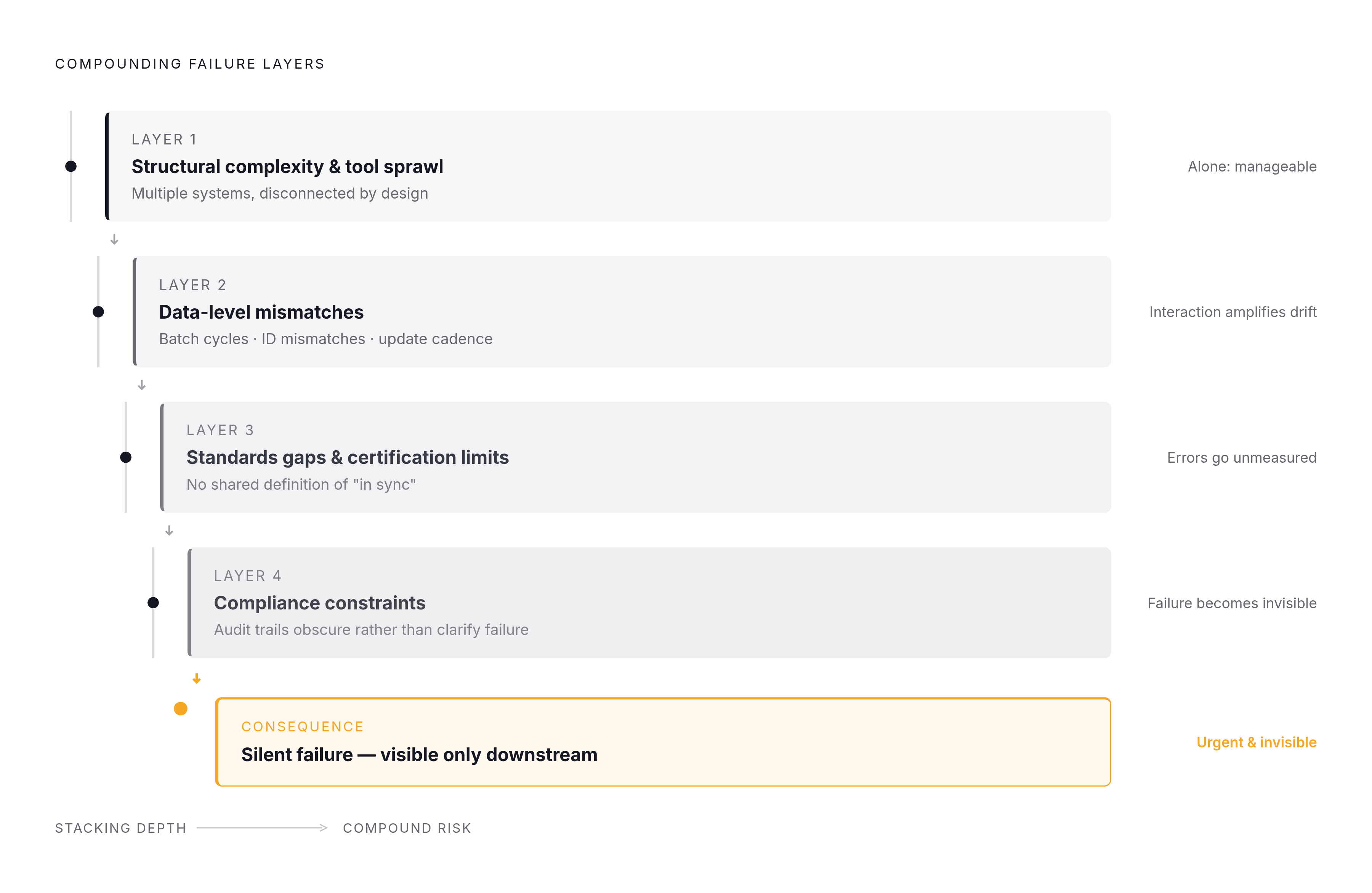
Four compounding layers run through everything above: structural complexity and tool sprawl, technical data-level mismatches, standards gaps and certification limitations, and compliance constraints. Any one of them can cause sync to break, and in practice they interact—when they stack, the failure is usually invisible until it is also urgent.
Start with batch and nightly sync connections. Find out which pipelines are running on batch by design versus batch by default, because those are different problems with different solutions. Any SIS-to-LMS connection still running on a nightly cycle will produce stale data states by design.
Check course ID and grade formatting assumptions. These are the most common silent failure mode. A conformance check on gradebook field formats should be a standard part of any integration setup, not something triggered by a student complaint about a missing grade.
Audit identity resolution. Any integration that resolves identity by email address is fragile—email addresses change when students transfer or accounts are renamed. The join key between systems should be a persistent, system-assigned identifier.
Flag anything that touches biometric or sensitive data for legal review before the technical pipeline gets built. Build that lead time in deliberately. It will not be short, and it will not be pleasant if it catches you by surprise.
Treat event-level logging on sync jobs as non-negotiable infrastructure. Alerting on failed course resolutions and identity mismatches is how you find out a pipeline is broken before a student does. If you cannot observe it, you cannot fix it.
Dig into vendor conformance reports beyond the certification mark. Ask for the actual technical conformance report for the specific LMS version and SIS configuration the institution runs. The summary version will not show you where the gaps are.
Take portfolio rationalization seriously. The number of integration endpoints any IT team can actively maintain is finite. As tool counts approach thousands per district, the gap between what is deployed and what is actively maintained keeps growing. Reducing the tool count reduces the integration surface area and makes the remaining pipelines easier to keep healthy.
The goal is not to eliminate all sync latency—some regulatory constraints make genuine real-time sync impossible. The goal is knowing which pipelines are running in batch mode by design versus by accident, and ensuring downstream systems and the people depending on them are not making real-time decisions with data that is anything but.