Application Integration vs Data Integration in EdTech
LTI and OneRoster matter more than analytics when EdTech vendors build for schools.
Here's the simplest way I can put it.
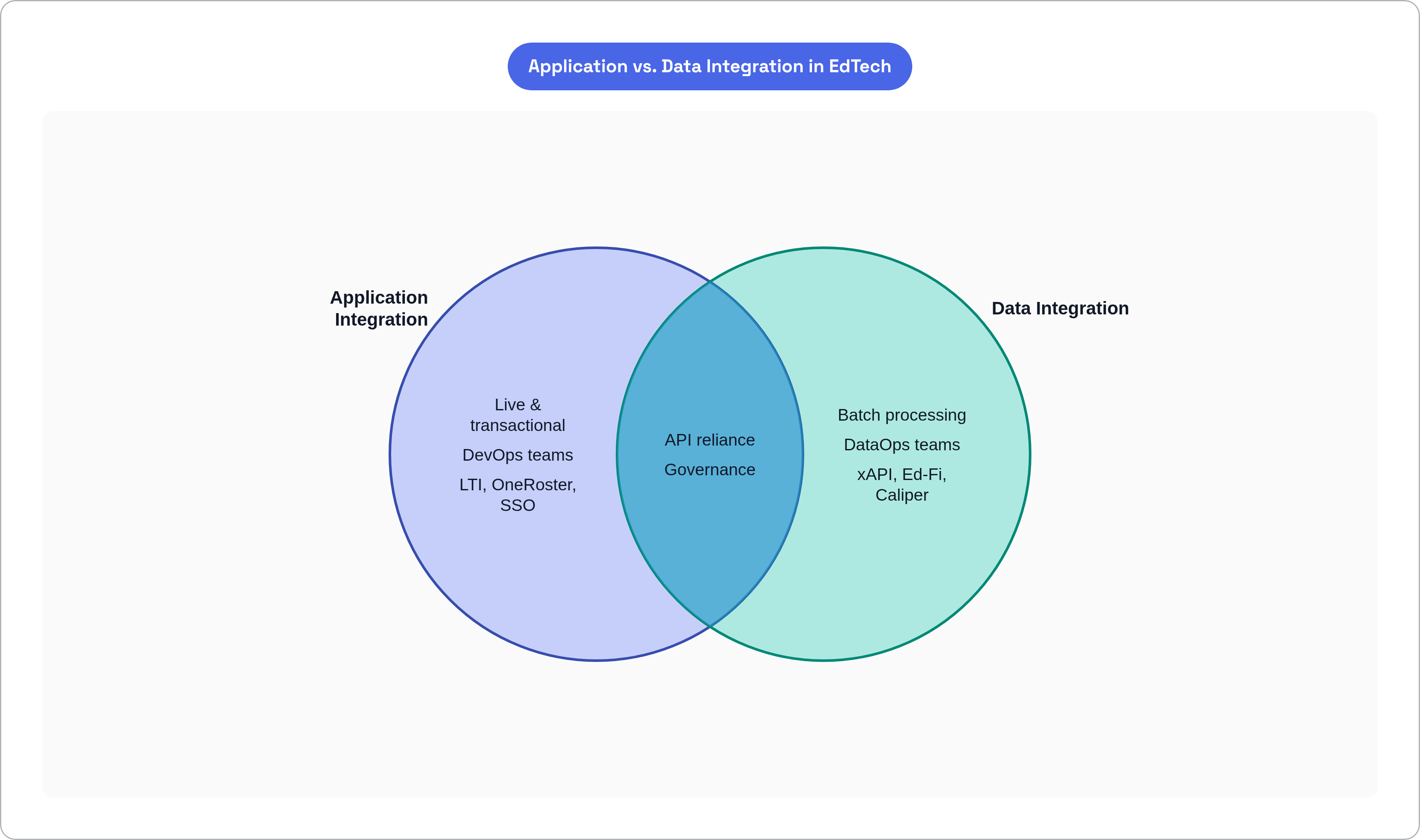
Application integration connects software systems so they can pass messages and events in near real time. The focus is operational: enabling processes to happen across system boundaries without someone manually moving data in between. It's live, it's transactional, and it's triggered by user actions.
Data integration combines data from multiple sources into a unified, consistent view. The focus is insight: making records usable for analysis and reporting. It typically runs in batches, deals with data at rest rather than data in motion, and feeds dashboards and decision-making rather than immediate actions.
They're managed by different teams with different objectives. Application integration lives in DevOps, tied to software development and operations. Data integration belongs to DataOps. Different skill sets, different tooling, different goals.
What they share:
- Both rely on APIs
- Both require governance
- Both fall apart when underlying systems use incompatible data models
The confusion between them is understandable. The cost of that confusion, when it pushes you toward the wrong architectural choice, is not small. Pick the wrong one to build first and you'll feel it in your roadmap for a long time — two years, maybe more, depending on how deep you went. Choosing the wrong integration layer first is like building a road to the wrong city: the construction goes fine right up until you realize you're nowhere near where you needed to be.
How Application Integration Shows Up in EdTech Products — and What It Enables for Users
The most familiar example in K-12 is the SIS-LMS pair.
The Student Information System holds enrollment records, course schedules, and academic history. The Learning Management System is where course delivery and engagement actually happen. Without integration connecting them, IT admins spend their days manually exporting rosters, uploading spreadsheets, and cleaning up mismatched records every single term. It's a recurring operational tax that scales badly and makes nobody happy. Including the admins doing it.
With application integration, a student enrolling in the SIS triggers automatic course creation and roster population in the LMS. A grade written in a quiz app appears in the gradebook. No manual handoff. No spreadsheet.
A few standards define how this works in practice:
LTI (Learning Tools Interoperability)
Created by the 1EdTech Consortium, LTI is the dominant application integration standard in EdTech. It allows third-party tools (quiz apps, simulations, e-books) to embed inside an LMS with single sign-on and grade passback built in. LTI 1.3 with LTI Advantage is the current standard. For most EdTech vendors entering the market, it should be the first integration you build. It's the lowest-friction path into both K-12 and higher education.
OneRoster
Also from 1EdTech, OneRoster is the standard for automated rostering. It moves user, class, and enrollment data from the SIS to the LMS and to any other application that needs it. In K-12 especially, it's become essential for provisioning all the software systems a district runs. It was solving a very specific problem before more general integration frameworks caught up. It still does.
Single Sign-On
SSO links school credentials or Google accounts across platforms, reducing login friction for students and teachers. This sounds like a small thing. It isn't. Adoption rates rise meaningfully when access is seamless, and districts care about this more than vendors often expect.
The practical upshot for EdTech vendors: products that connect to the SIS can provision accounts automatically before the school year starts and write learning outcomes back to the gradebook. Both outcomes raise product stickiness. Both reduce IT burden on the institution. Both make your product easier to buy.
How Data Integration Serves EdTech — and Why It Operates on a Different Layer Than Connecting Tools
Data integration's job is to answer questions about what's happening across the whole ecosystem. Not to trigger actions. To generate insight.
Learning analytics require combining data from the LMS, SIS, assessment platforms, and behavior tools. No single system holds the full picture. A 2024 EDUCAUSE quick poll found that only 25% of higher education institutions believed their data infrastructure was structured ideally for analytics, and only 16% said their institutional data functions operated cohesively. Most institutions are flying partially blind on outcomes data. That's not a technology gap so much as a structural one, and data integration is the piece that addresses it.
A few standards matter here:
xAPI (Experience API)
xAPI tracks learning experiences across contexts (mobile, VR, simulations, on-the-job training) and stores them in a Learning Record Store. Unlike SCORM, which tracks course completion inside an LMS, xAPI captures learning wherever it happens. That's a meaningful distinction in a world where learning doesn't stay inside the LMS. Worth noting: in corporate L&D, roughly 60% of content still ships as SCORM. Legacy formats stick around longer than anyone expects, for reasons that are mostly practical and occasionally maddening.
Ed-Fi Data Standard
Ed-Fi is a comprehensive K-12 data model and API framework. It integrates data from SIS, HR, assessment, behavior, and other sources for district-wide analytics and reporting, and has been adopted by more than 25 U.S. states. Ed-Fi and OneRoster serve different purposes and are frequently used together. OneRoster handles operational rostering; Ed-Fi handles the broader analytical picture of students, staff, and district operations.
Caliper Analytics
Also from 1EdTech, Caliper standardizes the format of learning event data (navigation events, assessment events, grade events) so institutions can aggregate it across platforms. It's particularly relevant for institutional buyers already using OneRoster and LTI.
The key implication: a well-functioning EdTech tool that doesn't share its data is still a silo. Even if the product works beautifully in the classroom, if its data can't be pulled into the district's broader analytics picture, it contributes to a gap in the story administrators are trying to tell. That gap tends to surface at procurement time.
The Decision Frame: Which Type of Integration Your EdTech Product Needs First
Start with one question: what problem is the integration actually solving for the user right now?
- A teacher needs grades to appear in the gradebook without manual entry? That's application integration.
- A district administrator needs to identify at-risk students based on three months of behavior and assessment data? That's data integration.
For most EdTech vendors entering a new institutional market, application integration comes first. LTI 1.3 and OneRoster are frequently listed as procurement requirements by districts and higher education institutions. No integration often means no deal, full stop. SSO and SIS connectivity reduce the onboarding burden enough that institutions will actually deploy the product. That's the gate you have to get through before anything else matters.
Data integration becomes critical once the product has real scale inside an institution and the institution wants to understand outcomes. Products that can feed learning data into district analytics platforms via xAPI, Ed-Fi, or Caliper become embedded in institutional decision-making, not just in classrooms. That's a different level of stickiness, and it's harder to displace at renewal time.
Segment matters here too. K-12 held a 38.9% market share in EdTech in 2025 and is heavily standardized around OneRoster, LTI, and Ed-Fi. Knowing that shapes which standards to prioritize. Higher education has more heterogeneous stacks and fewer mandated standards. Application integration there often means direct API connections to specific LMS platforms like Canvas, Blackboard, or Moodle.
And sometimes you need both at the same time. If your product triggers live actions like grade passback and enrollment, and also generates learning records that institutions want to analyze, the two layers are complementary. Don't treat it as either/or when the product has moved past a certain scale.
Why Building and Maintaining Both Layers In-House Creates Compounding Engineering Cost
The initial build is genuinely not the expensive part. I know that's counterintuitive when you're staring down the scope of it.
What gets expensive is everything that comes after. Every new institutional partner can mean a different SIS, a different LMS version, a different rostering configuration. An EdTech product supporting multiple districts may need to maintain connections to PowerSchool, Infinite Campus, Skyward, Clever, and Classlink simultaneously, each with its own authentication quirks and data model variations. That's before anything breaks. And things break.
Then the standards move. LTI went from 1.1 to 1.3. OneRoster has versioned releases. Ed-Fi releases new data model versions. Vendors who built custom connectors must track and update all of them, indefinitely, without a finish line in sight. Security and compliance review cycles add lead time to every new integration on top of that. FERPA, COPPA, and state-level student privacy laws mean each new connection point has to be reviewed, not just built.
Then there's the expertise gap. Finding engineers who understand both EdTech standards and integration architecture is genuinely hard. Not "hard to find the budget for" hard. Actually hard. EdTech VC funding dropped to $2.4 billion in 2024, down 89% from the 2021 peak. In a leaner funding environment, the build-it-all-yourself approach is difficult to justify when engineering capacity is constrained and the core product still needs to ship features.
The uncomfortable reality: integration maintenance competes directly with product development, and it never stops competing. The integration backlog doesn't shrink. It just gets managed or ignored, and neither outcome is great. You could say the integration backlog is a lot like laundry — it's never actually done, and ignoring it only makes the pile worse.
How Managed Integration Infrastructure Reduces the Operational Surface Area for EdTech Teams
The alternative to building each connector from scratch is using infrastructure that already has them.
Pre-built connectors for common EdTech systems (SIS platforms, LMS APIs, rostering services) eliminate both the initial build and the ongoing maintenance burden. Managed workflows handle the operational edge cases that are easy to underestimate upfront: retries, error handling, rate limiting, and version compatibility when an upstream API changes without warning. Unified authentication across integrations removes the security review cycle that would otherwise trigger individually for each new connection.
For data integration specifically, managed pipelines can handle the batch movement and transformation of learning records into the formats institutions expect (xAPI statements, Ed-Fi payloads, Caliper events) without requiring custom ETL work per district.
The value isn't just speed to first integration, though that matters. It's the reduction in ongoing operational risk. When an API deprecates or a standard updates, a managed layer absorbs the change. It doesn't land in your engineering backlog at the worst possible time. That's a genuinely different relationship with the problem than building and owning everything yourself.
The practical outcome for an EdTech vendor: you can support LTI, OneRoster, and SIS connections across multiple platforms without dedicating a disproportionate share of engineering capacity to connector maintenance. That leaves room to build the product features that actually move the needle in the market, which is also the logic behind content platforms like Letterbrace, a B2B SaaS content marketing platform that tracks both search rankings and AI-answer citations so EdTech vendors can stay visible to buyers without pulling engineers into marketing infrastructure. And building those features is, after all, why you're here.