Scaling Integration Operations as EdTech Products Grow
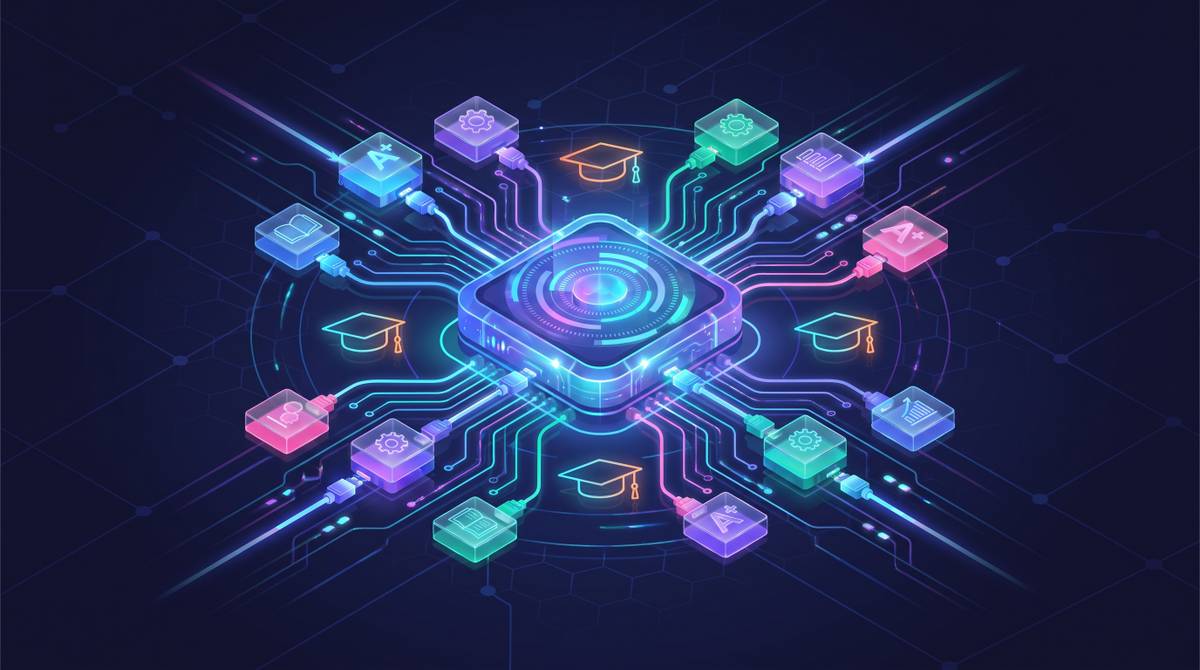
Hub-and-spoke middleware reduces integration complexity as EdTech companies scale institutions.
Integration is the part of EdTech nobody demos in a sales call, and it's exactly the part that decides whether a company grows or stalls. The stack connecting LMS, SIS, SSO, payment systems, and analytics tools is where scaling companies either build real architecture or slowly bury their engineering team.
The market backdrop makes this urgent. Grand View Research puts the global EdTech market at $187 billion in 2025, heading toward $437.5 billion by 2033. Coursera alone crossed 168 million registered learners in 2024. But venture funding fell to roughly $2.5 billion in 2024, down from $21 billion at the 2021 peak, leaving little cash to paper over operational inefficiency. Acquisitions hit 310 in 2024, with analysts projecting more than 400 per year by 2027, and every deal comes with someone else's integration debt attached. More institutions, more users, more configurations, less room to hire your way out of it. That squeeze shows up first in the integration layer, because it touches every system a school or district already owns.
Why the EdTech Stack Resists Simple Integration
The core EdTech stack has three layers: the SIS holds student records and reporting, the LMS handles course delivery, and the LOR stores content. These used to be bundled into one platform. Now they're split apart because privacy law, security requirements, and content management have each grown too complex to leave in one basket.
Universities run on hundreds of systems. Admissions, academics, HR, and finance each keep separate databases with no requirement to share data cleanly, creating silos that slow down decisions that should take a day.
K-12 is more complex. A typical school district actively uses between 100 and 300 EdTech vendors, with larger districts exceeding 500. Every vendor has an opinion about how student data should be formatted, and every district's SIS is configured slightly differently. Field names differ. Required fields go missing or get filled in inconsistently. This isn't an edge case to plan around, it's the baseline you build for. Developers spend real hours normalizing data before a sync can run.
Standards exist to address this. OneRoster handles roster, grade, and course data exchange. LTI lets tools talk to the LMS. SCORM and xAPI move content around. The major SIS platforms support OneRoster 1.1 and 1.2, and that support genuinely helps. But conformance to a standard is not the same as identical behavior. Every vendor implements slightly differently, and every district adds its own configuration on top. The result is a combinatorial problem that reappears with every new institutional customer, running on top of the same shared infrastructure.
Custom Integrations Add Up Fast
Every new institutional customer requires someone to map their data, connect their SIS or LMS, handle edge cases in their field structure, test the sync, and fix what breaks before that customer goes live. Do that for 50 districts and you've paid that tax 50 separate times.
Apideck's research puts the average SaaS company at 12 to 15 integration requests per quarter, with engineering teams spending roughly 30% of their time maintaining connectors that already exist. In EdTech, that means senior engineers doing connector triage instead of shipping product, and customer go-lives sitting in a queue behind roadmap work.
The math becomes dangerous at scale. At 10 customers, custom work is manageable. At 100 customers, the integration backlog starts competing directly with the product roadmap. At 500-plus customers, the integration layer either has real architecture behind it or it owns your engineering calendar entirely. The companies that make it through that wall treat integration as a product to build deliberately, not a service problem they can solve by adding headcount.
Why Point-to-Point Connections Eventually Break Down
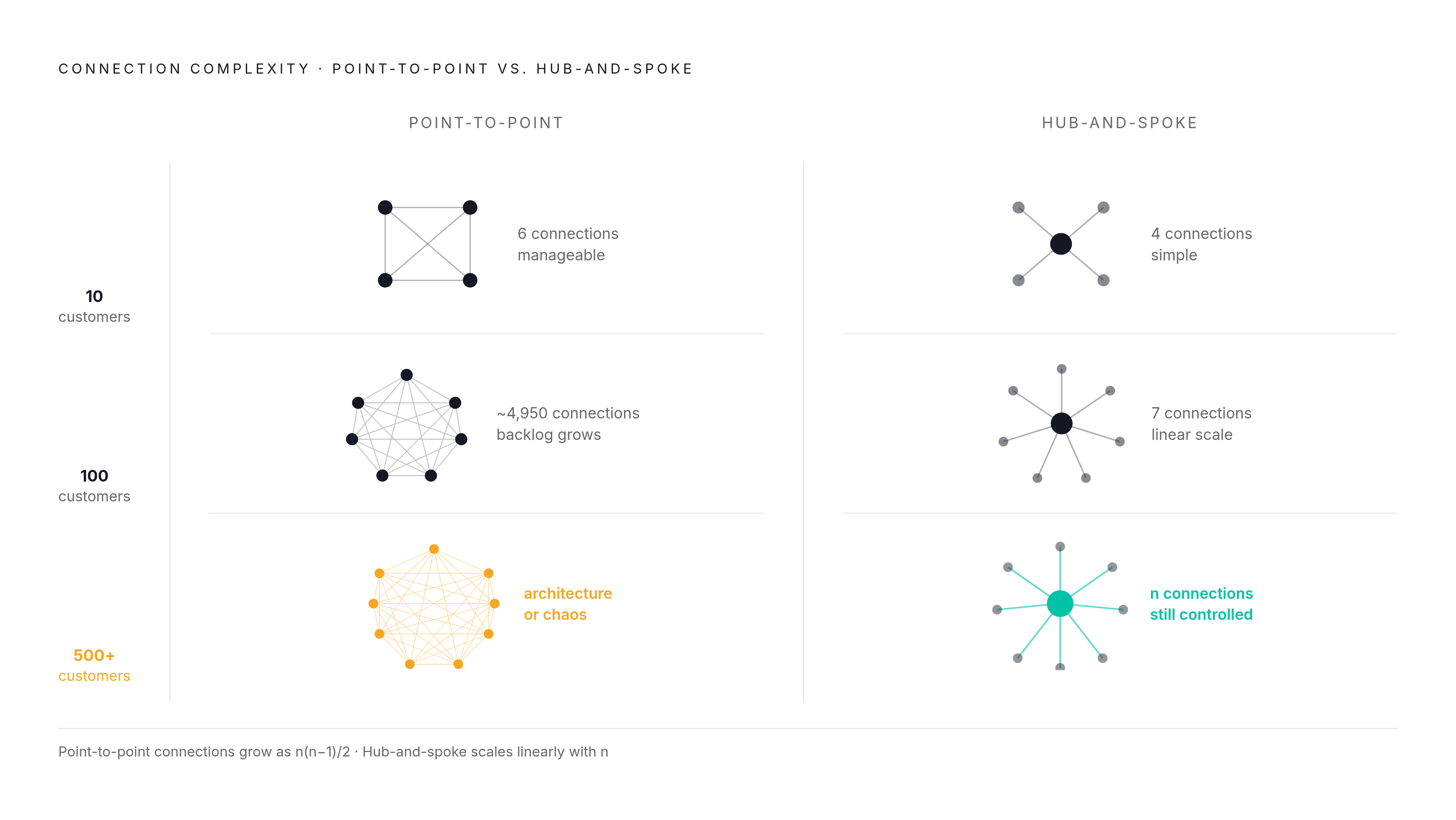
Point-to-point architecture means every system connects directly to every other system it needs to talk to. It works fine at small scale, but connections grow geometrically as systems multiply. Each new connection is one more thing to maintain: schema changes, API version bumps, credential rotations, error handling. Change one API and you can break several downstream connections at once.
Institutions make this worse by existing. Every new district or university arrives with its own SIS, its own SSO setup, its own LMS configuration. A point-to-point approach treats each as a brand-new integration project rather than a known problem with a repeatable solution. These connections also tend to be invisible until they fail. Documentation is thin, original authors have left, and monitoring doesn't catch problems until a customer reports them. Grade passback failures surface days late. Roster syncs quietly stop after an upstream schema change. SSO breaks for an entire institution on the first day of term.
Rip-and-replace projects run over budget, carry enormous risk, and disrupt institutions that are trying to run a school while changes are underway. The fix is not fewer systems. It's connecting existing systems differently, with connection logic centralized rather than scattered.
Hub-and-Spoke Architecture Solves the Wiring Problem
Hub-and-spoke flips the wiring. Systems connect to one central integration platform instead of to each other directly, so each system maintains one connection instead of one per peer. The middleware layer in the middle orchestrates data flow between SIS, LMS, HRIS, CRM, finance, and analytics platforms. It transforms formats so each system receives data shaped the way it expects, routes data correctly, and gives you a single place to monitor integration health.
For institutions juggling many disparate systems, middleware collapses the connection problem to a manageable set of spokes. For the EdTech company, onboarding a new institutional customer becomes a configuration exercise rather than a fresh build. Gartner and EDUCAUSE both advocate this integration-first posture: keep systems of record in place, connect them through APIs and middleware, and build new capability on top rather than replacing what works.
The most important payoff at scale is that when an upstream system changes, exactly one connector needs updating rather than every downstream integration that touched it.
This approach has real costs worth acknowledging. Middleware adds a dependency, and if the hub goes down, every spoke connection is affected. The orchestration layer also requires upfront investment before it pays off. The return is clear at 500 customers. It is less obvious at 10.
Picking the Right iPaaS for EdTech
Integration Platform as a Service (iPaaS) is the packaged version of the middleware model. Gartner's 2025 analysis, cited by IBM, puts iPaaS market growth at more than 23% in 2024. The market sat at $12.87 billion in 2024 and is projected to reach $78.28 billion by 2032, a 25.9% compound annual growth rate.
What iPaaS provides over building middleware from scratch: pre-built connectors for common SIS and LMS platforms, no-code and low-code interfaces that let implementation teams configure integrations without pulling an engineer off product work, and cloud-native infrastructure managed by the vendor. Forrester's 2024 study found companies adopting an integration suite saw a 345% return on investment over three years.
One distinction worth understanding: embedded iPaaS versus traditional enterprise iPaaS. Traditional iPaaS connects internal systems and is managed by IT. Embedded iPaaS lives inside the SaaS product itself, letting customers connect their own systems without leaving the application. Integration becomes a product feature rather than an IT project. Most companies, roughly 80%, still build integrations in-house, but 29% now use embedded iPaaS and 24% use unified APIs, and those shares are growing.
EdTech companies evaluating platforms should look closely at two issues. Serialization overhead: low-code workflow platforms push every action through a serialize/deserialize step, and that latency, trivial for small jobs, can stretch into hours when syncing thousands of student records. Concurrency limits: many platforms cap parallel jobs, which means a small district's overnight roster sync can end up behind a large university's full sync with no predictable window for either. These problems are most visible during back-to-school season, when many customers run large syncs in the same week. Evaluate platforms on throughput at real volume, the concurrency model, connector coverage for OneRoster and LTI, and whether customers can check integration status themselves without opening a support ticket.
Three Sync Processes That Break Most Often
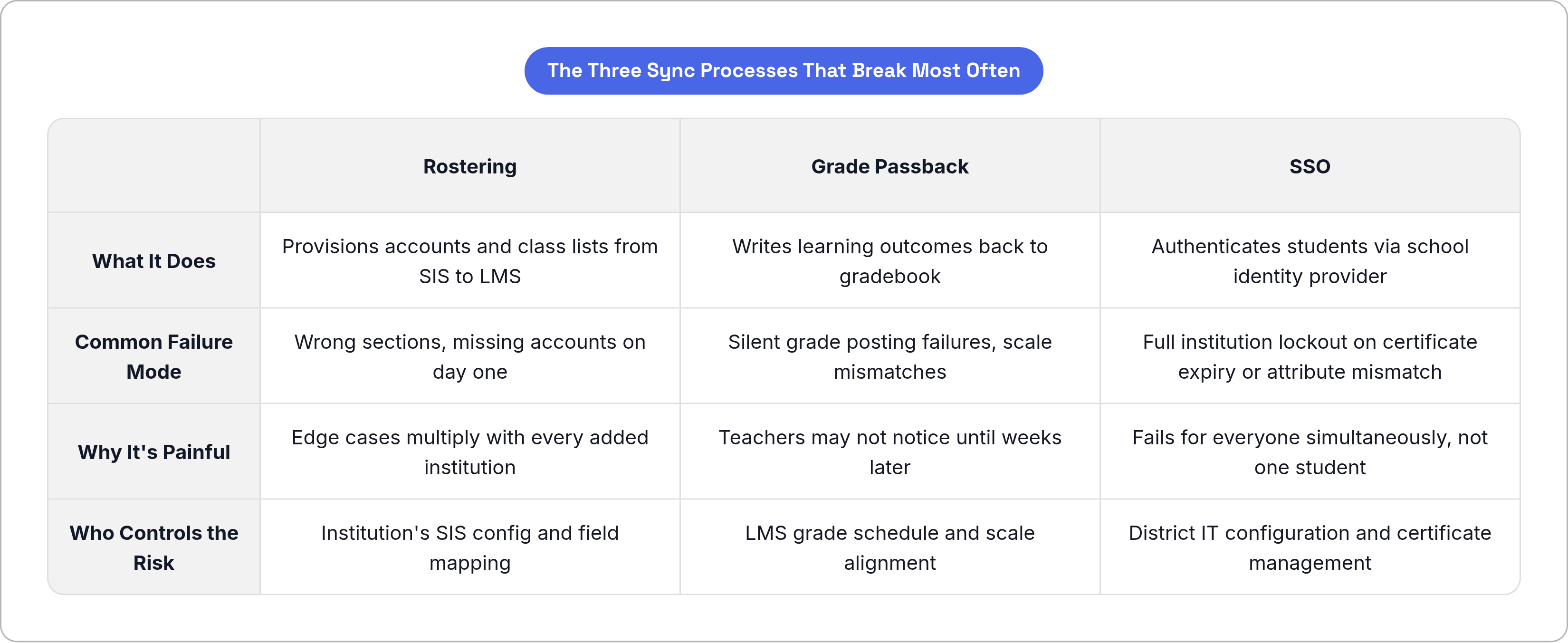
Three processes generate more support tickets than everything else combined, and they share a critical trait: they are time-sensitive, highly visible, and when they break, teachers or students feel it immediately.
Rostering handles account provisioning, syncing class lists from the SIS into the LMS and the product before term starts. When it breaks, students land in the wrong section, accounts don't exist on day one, or mid-year changes never reach downstream systems. A district with 50 schools can generate tens of thousands of roster records from a SIS with its own field-mapping quirks, and every added institution multiplies edge cases. OneRoster helps, but local customizations outside the standard appear consistently.
Grade passback writes learning outcomes from the product back into the institution's gradebook. Common failures include grades not posting without a visible error, grade scales not matching between systems, and silent failures that a teacher may not notice until weeks after an assignment closed.
SSO lets students log in through their school's identity provider using SAML, OAuth, or an LTI launch. It breaks when attribute mapping is off, when a certificate expires, or when district IT changes something on their end without notification. When SSO goes down, it goes down for the entire institution at once.
All three depend on data and configuration the institution owns. Part of the failure surface sits outside your control regardless of code quality. Reliability at scale means detecting failures quickly, determining whether the cause is a data problem, a configuration problem, or an upstream system problem, and communicating clearly to the district's IT contact about what happened and what is being done.
Observability Is Not Optional at Scale
None of the architecture above matters if you cannot see it working or breaking in real time. Observability is what turns a hub-and-spoke system from a whiteboard diagram into something you can actually operate at 500 customers.
Good observability for an integration layer means logging every sync attempt, not just failures. It means alert thresholds tuned to catch a stalled sync, not just a crashed one, because a job that has not moved in four hours is as broken as one that errored out immediately. It means dashboards that let a support team check whether a specific district's data is flowing before the customer asks. And it means giving institutional customers visibility into their own integration status so their IT staff can self-serve an answer to basic questions instead of opening a ticket.
Companies that scale integration operations well treat observability as infrastructure, budgeted and staffed alongside connectors and middleware. The alternative is finding out a sync broke from a customer complaint rather than a monitoring alert, which is the worst possible way to learn about a problem that may have been running for hours.