iPaaS vs Custom Middleware for District-Scale EdTech Onboarding
Fragmented SIS markets make the iPaaS versus custom choice a make-or-break decision for districts.
- Written by
- Preston Ganem
- Updated
- October 17, 2026
- Reading time
- 9 min read
- Sources cited
- 2 sources ↓
What this covers
District IT teams keep licenses active for thousands of digital tools, but students and teachers touch only a handful of them day to day. That gap between "licensed" and "used" is the whole story of K-12 EdTech right now, and it's exactly why the choice between iPaaS and custom middleware carries more weight than it sounds like it should. Get this wrong, and a district either overspends on infrastructure nobody needed or ends up locked into a system nobody can patch.
By the 2023-24 school year, the average district was actively running about 2,739 distinct tools, per Edutopia, a jump of more than 170% from just two years earlier. Now that ESSER III money has dried up, districts are under pressure to rationalize what they have, and asking every vendor left standing to prove it can talk to the SIS without three months of custom scripting.
For an EdTech vendor, that means every new district is essentially a brand-new integration project. Different SIS setup, different data format, different IT department with its own opinions about SAML. A genuinely good product can sit in implementation limbo for months while engineers untangle mismatches that have nothing to do with whether the product actually works.
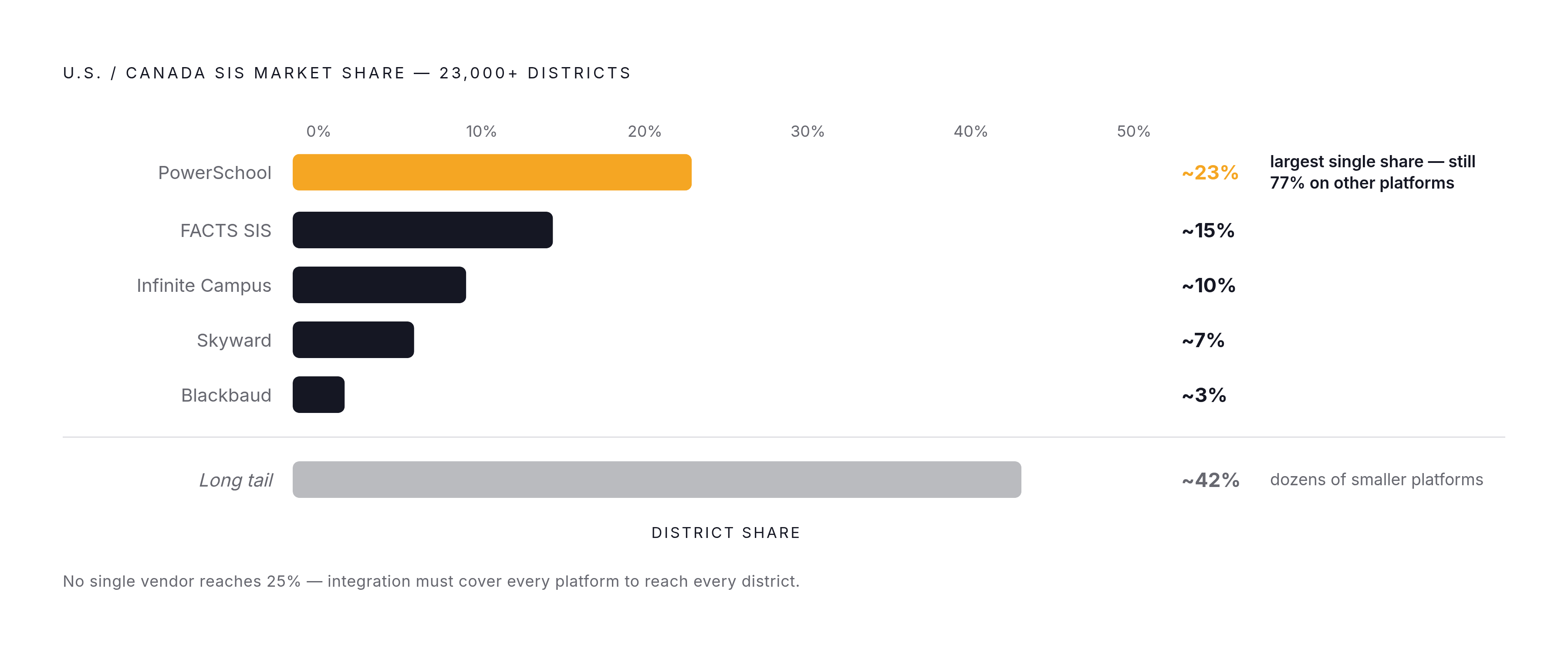
And the SIS market doesn't make this easy. ListEdTech tracks more than 23,000 school districts across the U.S. and Canada, and no single vendor dominates. PowerSchool leads with about 23% of identified implementations, FACTS SIS holds around 15%, Infinite Campus about 10%, Skyward roughly 7%, then a long tail of smaller platforms that each demand their own attention. The central question is whether to use iPaaS or custom middleware, and most teams get the answer backwards, building custom when they should be buying, or buying when their situation actually calls for a custom build.
iPaaS vs. Custom Middleware: Core Differences
Custom middleware is software a district or vendor builds and hosts itself, usually on its own servers, run by its own team. It gives total control over how data moves between internal systems, and historically it appeared as an enterprise service bus or a central integration hub that IT built by hand. It is the right tool when an operation is large, complex, and needs a level of control that off-the-shelf software cannot offer. It is not the right tool for most everyone else.
iPaaS is the opposite approach: cloud-based, API-driven, usually low-code or no-code, linking systems through prebuilt connectors managed from one dashboard. No servers to rack, no patches to schedule at 2 a.m., because the vendor runs the infrastructure. Instead of a collection of one-off point-to-point connections, there is a single pipeline that someone can watch and troubleshoot.
There is a third category sitting right between those two, and it matters a lot in education specifically: platforms like Clever, ClassLink, Edlink, and Ed-Fi Alliance tools that build education-native concepts such as rostering, single sign-on, and grade passback on top of an iPaaS or API-gateway foundation. These platforms take messy SIS data and translate it into shared standards like OneRoster or Ed-Fi before it ever reaches the EdTech app. That distinction changes the build-versus-buy math specifically for EdTech vendors trying to scale across districts.
Four Factors That Drive the Decision
Four things decide this, and only one of them tends to override the other three.
- Standards support. Does the integration handle OneRoster, Ed-Fi, LTI, and SAML out of the box, or does someone have to build those translations from scratch?
- Staff capacity. Does the team, district or vendor, have engineers with the time and staying power to build, secure, and maintain a custom system for years, not months?
- Vendor ecosystem. How many SIS platforms and identity providers need connecting, and how often do those connections break when a vendor pushes an update?
- Data governance. FERPA, state privacy law, and district data-sharing agreements all shape whether the chosen approach makes compliance something an auditor can verify, or whether it opens a risk surface nobody planned for.
Governance is the factor that overrides the rest. A district can have strong standards support and deep engineering staff, but if the data-sharing agreement bans third-party cloud processing, iPaaS is off the table before the other three factors are even evaluated.
Standards Support Reshapes Integration Complexity
OneRoster is the dominant rostering standard in K-12. It defines how student, class, enrollment, and grade data move between the SIS and whatever EdTech app needs it, and most major SIS vendors and most modern iPaaS connectors built for education already support it. When both sides of a connection are certified against it, the per-district mapping work largely disappears.
Ed-Fi is the other major standard, more granular, with strong adoption at the state level, particularly in Texas, and it is increasingly used alongside OneRoster rather than as a replacement. ClassLink is one platform that supports both standards, giving districts a path to use them in combination.
Education-specific platforms like Clever, ClassLink, and Edlink ship with pre-certified connectors for the major SIS vendors already built, so nobody rebuilds that mapping every time a new district signs on. Custom middleware does not offer that advantage. Every time a SIS vendor changes its data model, someone has to patch the integration by hand, and with a long tail of smaller SIS platforms, including Skyward at 7% and Blackbaud around 3%, that patch list grows consistently and rarely shrinks.
One honest exception: when a district's LMS runs on a non-standard data model, such as competency-based learning records or project-based assessment schemas that do not map cleanly onto OneRoster's entities, no prebuilt connector resolves that. The translation work happens by hand regardless of which platform is chosen. Standards support closes most of the gap, but not all of it.
Real Staff Capacity Costs Under Each Model
Building a custom enterprise integration platform carries substantial year-one costs once developer salaries, infrastructure, security review, and documentation are counted. Ongoing upkeep after that adds meaningful cost every year. A managed iPaaS platform covering comparable ground typically runs at a fraction of that annual figure, and as integration needs grow, maintenance costs on a custom build stack up faster than new connectors can be delivered.
The more consequential cost of staff capacity is concentration risk. A custom integration kept alive by one or two engineers is a single point of failure, and IT turnover in K-12 is high enough that relying on any individual's institutional knowledge is a genuine operational risk. iPaaS moves that maintenance burden onto the vendor's team, which provides more continuity than a district's sole integration engineer typically can.
None of that makes custom middleware the wrong choice universally. Larger organizations with dedicated development staff, a multi-year commitment to owning the system, and a total-cost-of-ownership calculation that genuinely favors building over subscribing at scale represent a real scenario. It is simply rare at the district level.
Vendor Ecosystem Scale Tips the EdTech Calculation
Any EdTech company trying to grow faces the same structural problem: selling into many districts means connecting to every SIS those districts happen to run, and with PowerSchool at only about 23% of implementations, there is no single platform to build for and call it done.
Education-specific integration platforms reframe that problem: integrate once, reach every district already on the platform. Clever, for instance, connects SIS data to EdTech apps across more than 100,000 schools, normalizing district data so vendors do not have to rebuild that work for every new district. Edlink claims it can stand up automatic core rostering for a new EdTech app in under four weeks.
For a small or mid-size EdTech company with a limited engineering team, this is not a close call. No team builds in a few months the SIS coverage that a purpose-built integration platform has spent years accumulating. Purpose-built integration layers free engineers to work on the actual product instead of rebuilding the same SIS handshake for every new district.
Custom middleware still earns its place in one specific scenario: when the integration itself is the competitive edge, meaning a proprietary data pipeline or a bidirectional sync that no off-the-shelf connector replicates, and the team has the engineering depth to maintain it over the long term.
Governance Obligations Create or Close Compliance Risk
FERPA governs how student education records get accessed, shared, and retained, and any integration layer touching rostering or assessment data sits squarely inside that law's reach. District data-sharing agreements often go further, specifying exactly where data can live, who is allowed to see it, and what a vendor must do when a breach occurs. An iPaaS vendor's data residency policy and subprocessor list need to be verifiable against a district's own agreements.
Bringing in a cloud platform adds a third-party data processor to the chain, so districts need to review SOC 2 Type II certification, a proper FERPA-compliant data processing agreement, and clear documentation about who else touches that data downstream. The larger education-specific platforms, including Clever and ClassLink, have built FERPA compliance into their standard contracts, which removes the burden of assembling that compliance work independently. Some states also have data residency rules that narrow which iPaaS vendors are eligible.
Custom middleware shifts that trade-off: self-hosted software keeps data inside the district's own infrastructure, which matters when a data-sharing agreement prohibits third-party cloud storage. However, keeping data inside a firewall is not the same as being compliant. The district still owns the audit trail, the breach response plan, and the patch schedule, and none of that overhead is free. If a district's data-sharing agreement bans cloud processing outright, iPaaS is not an option, regardless of its cost or connector library.
Matching Your Profile to the Right Path
iPaaS, or an education-specific middleware layer, is the stronger default when several conditions align. The vendor or district needs to connect to multiple SIS platforms without a dedicated integration team on staff. Speed matters, and a four-week rostering build is faster than a multi-month custom effort within a sales cycle that will not wait. The data fits OneRoster, Ed-Fi, or LTI without requiring custom translation. The district's data-sharing agreement permits third-party cloud processing under a proper data processing agreement. And the organization cannot absorb a substantial year-one infrastructure investment.
Custom middleware is appropriate under a narrower set of conditions. Governance requirements prohibit third-party cloud processing outright. The LMS or assessment platform runs on a non-standard data model, such as competency-based or project-based schemas, that no prebuilt connector addresses. The integration is itself the product's differentiator, a proprietary sync that no off-the-shelf connector replicates, and the engineering team has the depth to own that system for years. The district runs a rare or heavily customized SIS with no supported connector available. Or the organization is large enough, with integration volume stable enough, that a genuine multi-year cost comparison favors building over subscribing.
Many districts and vendors land somewhere in between: an education-specific iPaaS layer handles rostering and SSO where standards coverage is strong, while custom middleware handles downstream analytics or proprietary workflows that off-the-shelf connectors do not reach. For most district IT teams, and most EdTech vendors below true enterprise scale, iPaaS is the right default and custom middleware is the exception that needs to justify itself. Not because custom middleware is a mistake in principle, but because the staff depth and governance infrastructure required to execute it well are genuinely rare inside K-12 environments.
Key Questions Before Signing an Integration Contract
On standards and connectors: Does this platform have a certified OneRoster or Ed-Fi connector for the district's specific SIS version and configuration as it is set up today? When the SIS vendor pushes an update, who patches the connection, the district or the iPaaS vendor?
On staff and ownership: If the person who built or configured the integration leaves, how long before a replacement can own it without causing an outage? What is the documented escalation path when a connection fails mid-semester?
On ecosystem reach: How many of the district's SIS platforms, or for a vendor, how many of its target districts' platforms, does this integration already support without additional engineering work?
On governance: Does the vendor's data residency and subprocessor list match what the district's data-sharing agreement actually requires, in writing? Get those answers before signing the contract, not after the first outage.
Methodology & sources
- https://www.teachfloor.com/blog/what-is-oneroster
Provided the figure of 100,000 schools connected through Clever for normalizing district data.
- https://www.1edtech.org/blog/the-best-of-both-worlds-how-classlink-bridges-1edtechs-oneroster-and-the-ed-fi-data-standard
Informed the discussion of ClassLink supporting both OneRoster and Ed-Fi standards together.