Clever Integration Architecture and What Made It the Default Rostering Layer
Clever's boring middle layer became the default because it made provisioning automatic and free.

- Written by
- Kian Nardone
- Updated
- September 25, 2026
- Reading time
- 7 min read
- Sources cited
- 5 sources ↓
What this covers
Rostering is the most boring word in edtech, and also the reason a company most parents have never heard of touches 22 million students and teachers. Clever didn't win K-12 by being flashy. It won by sitting quietly between the school's student information system and every app a teacher opens before first period.
Before Clever showed up, every edtech app built its own one-off connection to every school system, and IT departments cobbled together fixes by hand: adding accounts, removing accounts, hoping nothing broke over a long weekend. Deprovisioning moved just as slowly in the other direction, so when a student graduated or a teacher switched schools, the old accounts often hung around longer than they should have. Class lists change daily at the start of a school year. When the roster lag drags on for weeks, students get blocked from tools they need and IT staff are left chasing down fixes manually.
What Clever built: the SIS-agnostic normalization layer at the center of its architecture
Clever's core idea is almost stubbornly simple: sit in the middle, and make sure nobody else has to learn anybody else's language.
Secure Sync powers that process. A district connects its student information system to Clever one time. From there, Secure Sync pulls data on a set schedule, usually overnight, and pushes updates out to every app the district has connected. A student enrolls, a student withdraws, a teacher moves to a different school, and the change ripples out automatically instead of waiting on someone in the front office to update forty different login screens.
What makes this work at scale is that Clever doesn't care which student information system a district happens to run. It connects to more than 100 different student information and management information system platforms, reading data in formats like CSV or straight API feeds, and it plugs into major systems like PowerSchool, Infinite Campus, and Skyward without asking the district to change how it already does business.
Clever isn't just a pipe. Raw data moving from point A to point B isn't worth much if it's messy. Clever cleans it, normalizes it, and matches IDs across systems, even when a district switches how it syncs data down the line. That data integrity work is unglamorous, and it's also the actual product. Anyone can build a connector. Keeping the data trustworthy on both ends, year after year, requires a different kind of sustained effort.
Free to districts, paid by vendors
The zero cost made adoption spread the way it did. Clever doesn't charge districts anything for the portal, for single sign-on, or for rostering. No invoice, no line item for a school board to argue about at budget season.
The money comes from the other direction. Edtech vendors pay Clever to plug into Secure Sync and access its partner network. The reading app or math platform a district already bought is the one footing the bill for the connection, not the school.
That single decision changed how procurement works. Once there's no price tag attached, the conversation with a district shifts from "can we afford this" to "does the app we want already support Clever." Friction basically disappears.
More vendors pay to integrate, so the library grows. The library grows, so more districts standardize on Clever instead of building their own connections. More districts standardize, so more vendors feel pressure to pay for a spot in the library or risk being left out. Demand-side adoption and supply-side revenue feed each other in a loop, and that dynamic makes a product hard to unseat once it's running.
The identity layer districts can't easily remove
Once a district hooks its student information system into Clever and starts provisioning accounts across a few dozen apps, Clever becomes the system that decides who gets into what, every single school day.
Pulling that out later means re-provisioning every connected app at once, on the same day, for every student and teacher in the building. Nobody volunteers for that migration.
The scale involved makes the stakes clearer. More than 77% of K-12 schools in the country use Clever. Ninety-five of the 100 largest school districts run on it. Globally, that's 111,000 schools and 22 million students and teachers logging in through the same layer. And 61% of applications go live the same day they're connected, so the switching cost is not theoretical. It's built into how fast schools expect things to work now.
Security requirements accelerate Clever adoption
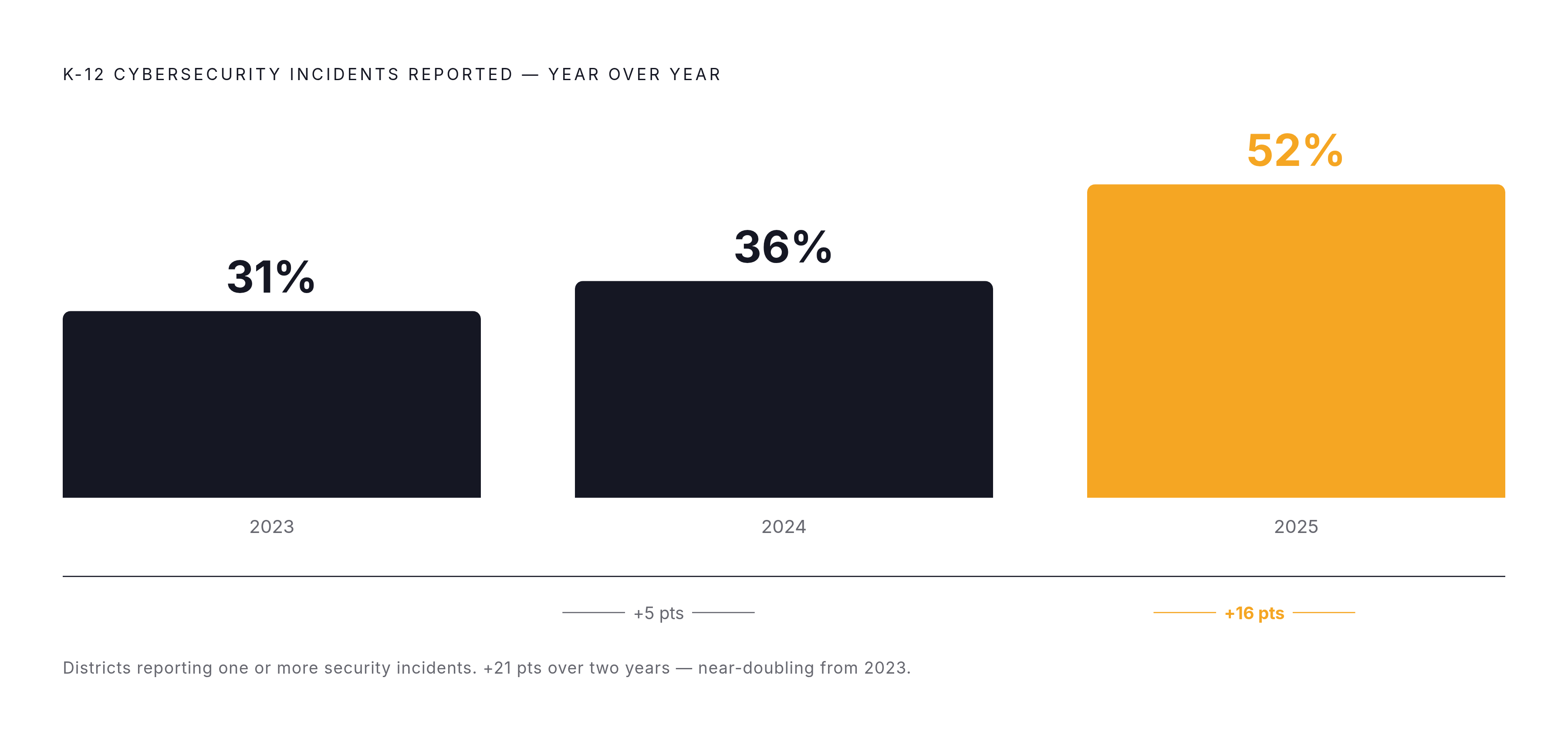
Cybersecurity in K-12 has gone from a background worry to a front-page problem fast. Among district administrators and technology staff, 52% reported a cybersecurity incident in 2025. That's up from 36% in 2024 and 31% in 2023, which means a district is getting hit roughly every other year at this point.
Administrators consistently cite protecting students from online threats and safeguarding student data privacy among their most pressing challenges, and cybersecurity broadly leads as the top identity management concern.
Centralizing identity through a single layer addresses that directly. Fewer separate passwords scattered across dozens of apps means fewer places for an attacker to find a way in. One control point for adding and removing access means IT can act in real time instead of chasing down permissions app by app. That's the argument that gets a security-conscious school board to approve a tool, not a slide about seamless integration.
The governance underpins all of it. Clever only shares data when a district says so. Vendors are required to store, move, and display student data through FERPA-compliant methods. Clever doesn't sell or rent student data, and it doesn't allow advertising on the platform. For a district worried about becoming the next headline, those policies are the whole pitch.
Clever Complete reaches schools outside the installed base
On April 3, 2025, Clever announced Clever Complete, described as a single integration that lets an edtech app handle rostering, single sign-on, and LMS support for any school through one connection instead of a pile of separate ones.
That changes the math for vendors. Instead of building and maintaining a different integration for every SIS, every LMS, and every identity provider a school might use, there's one API to support. A vendor can connect to a school running an unfamiliar system without accumulating integration debt the way it used to.
Clever Complete also extends reach beyond the existing installed base, allowing an app to connect to school organizations that never previously signed up for Clever. That's a meaningfully different move than just growing the existing library.
Clever Complete leans on existing standards, including 1EdTech's OneRoster, to consolidate connections across more than 100 student information systems. For a vendor, building once for Clever now opens doors to schools that were previously beyond reach.
Where Clever's architecture faces real risk
Clever's lock-in depends on districts continuing to buy more apps. If edtech consolidation speeds up and districts end up running fewer, larger platforms instead of a long tail of point solutions, Clever risks becoming a line item someone eventually asks why they're still paying for.
A private-label alternative is also competing for this role. It pitches direct SIS connections, support for open standards, automated rostering logic, and an MCP API aimed at agentic control. The argument is that a vendor keeps the customer relationship instead of routing it through a third-party layer. Ednition has raised funding led by College Board's Mission Investment Fund, which signals that someone with real domain knowledge thinks the direct-connection model has legs.
ClassLink runs a different structure. It serves more than 3,000 school systems across all 50 states and 42 countries, and its LaunchPad product connects to over 6,000 single sign-on enabled apps. It doesn't charge vendors either, and its Roster Server supports workarounds like FTP exports for apps that aren't in its formal catalog. That kind of flexibility matters in edge cases Clever's tighter library doesn't always cover.
The open-standards issue also shapes this. Clever is certified for OneRoster 1.2, and ClassLink exposes the standard more directly. Because OneRoster is an open format rather than something Clever owns, the data format itself can't be the long-term differentiator. The advantage has to live somewhere else: how clean the normalization is, how large the library gets, how fast a new app can go live. All three of those can erode if a competitor closes the gap.
How infrastructure becomes default in fragmented markets
The pattern is portable. First, absorb the translation cost so neither side of the market has to learn the other's language. Second, price the side with the most friction, in this case districts, at zero, so adoption doesn't require a budget fight. Third, make the underlying infrastructure reliable enough that replacing it costs more than keeping it.
The real competitive advantage was never the number of connectors. Any competitor with enough engineers can build integrations to a hundred different student information systems. What's harder to replicate is cleaning and mapping that data consistently enough that a downstream app can trust it without double-checking. That kind of reliability is a retention argument as much as a technical one: fewer support tickets means fewer reasons for a vendor to consider switching.
The trust layer matters just as much, even though it rarely gets much attention. Annual security reporting, FERPA certifications, partnerships that vet the vendor library: none of that is decoration. It's what lets a risk-averse buying committee say yes instead of stalling, which in a market this fragmented is often the real obstacle.
The same logic applies outside K-12. Any market splintered across dozens of platforms and formats runs into the same problem: too many systems speaking too many different formats for one team to keep up with. Normalization, not raw connectivity, is where the durable advantage sits.
Methodology & sources
- How to Implement Clever or ClassLink Rostering (2026)
Provided the figures on ClassLink's reach — 3,000 school systems and 6,000 SSO-enabled apps — cited in the competitor comparison section.
- Rostering for Schools – Clever
Provided the key scale figures — 111,000 schools and 61% of applications going live the same day — cited in the lock-in section.
- Ednition | Rostering & Integration for EdTech
Identified Ednition as a funded competitor pursuing the direct-connection model, cited in the risks section.
- Clever Introduces Universal Integration Solution that Connects Edtech Solutions with Any K-12 School
Sourced the April 2025 announcement of Clever Complete as a universal integration solution for edtech vendors.
- https://swellpulse.ai/companies/clever
Provided the 22 million students and teachers figure cited in the article's opening paragraph.