Degree Audit Systems and LMS Integration Requirements
Schools need degree audit systems integrated with their LMS to stop losing students to bad data.
- Written by
- Lorena Mercer
- Published
- September 23, 2026
- Reading time
- 8 min read
- Sources cited
- 4 sources ↓
What this covers
Enrollment math is turning ugly for a lot of schools, and degree audit systems just became load-bearing infrastructure instead of a nice-to-have. This is what you have to do, technically and institutionally, before a degree audit system can talk to an LMS without lying.
The demographic cliff everyone's been warned about since roughly forever finally arrives in 2025, with 18-year-old enrollment hitting its peak before a 15-year slide begins. International enrollment already dropped 17% this fall. Graduate programs slipped 0.3%, driven partly by a 5.9% decline in international grad students. Dual enrollment is growing at 6%, which sounds like good news until you realize it just means more students arriving with credit that has to be tracked correctly from day one. Add the 2023 Financial Value Transparency and Gainful Employment rules, plus the 2025 OBBBA legislation, which introduces Workforce Pell and reshapes federal aid program eligibility in ways that affect institutional accountability, and you get a simple equation: your school can't afford to lose students to confusion anymore. A degree audit system that produces inaccurate data creates direct, measurable attrition risk.
What a degree audit system does and why its accuracy depends on what it connects to
A degree audit takes everything a student has done and is doing. It checks that record against what their program requires. Completed courses, in-progress courses, catalog rules, substitutions, waivers. Out comes a requirement-by-requirement verdict: done, not done, in progress.
A degree audit is a live translation of institutional policy into rule logic, and policy doesn't hold still. If a student's enrollment status changes, a new grade posts, or a catalog year shifts, the audit must reflect that instantly. Any delay means the audit starts misrepresenting the student's actual progress.
Trust is the whole product, and it gets underweighted constantly. Degree audit tools have a rough reputation on a lot of campuses, built over years of stale data and half-maintained rule sets. Once a student or advisor gets burned, they don't come back for round two. Say a student took an AP exam that should exempt her from a math requirement, and the audit still shows that requirement as unmet. That's one bad line item, but the student and the advisor now question every other line on the page. Trust doesn't degrade gradually here; it collapses after the first bad data point.
Three Systems Every Audit Integration Must Navigate
Three systems, three jobs, and none of them do the other's work.
The Student Information System (SIS) owns the official student record: enrollment status, grades, declared program, transfer credit, holds, catalog year. It is the institutional source of truth.
The Learning Management System (LMS) owns the activity layer: course delivery, the gradebook, completion events, attendance. It's where the actual coursework happens.
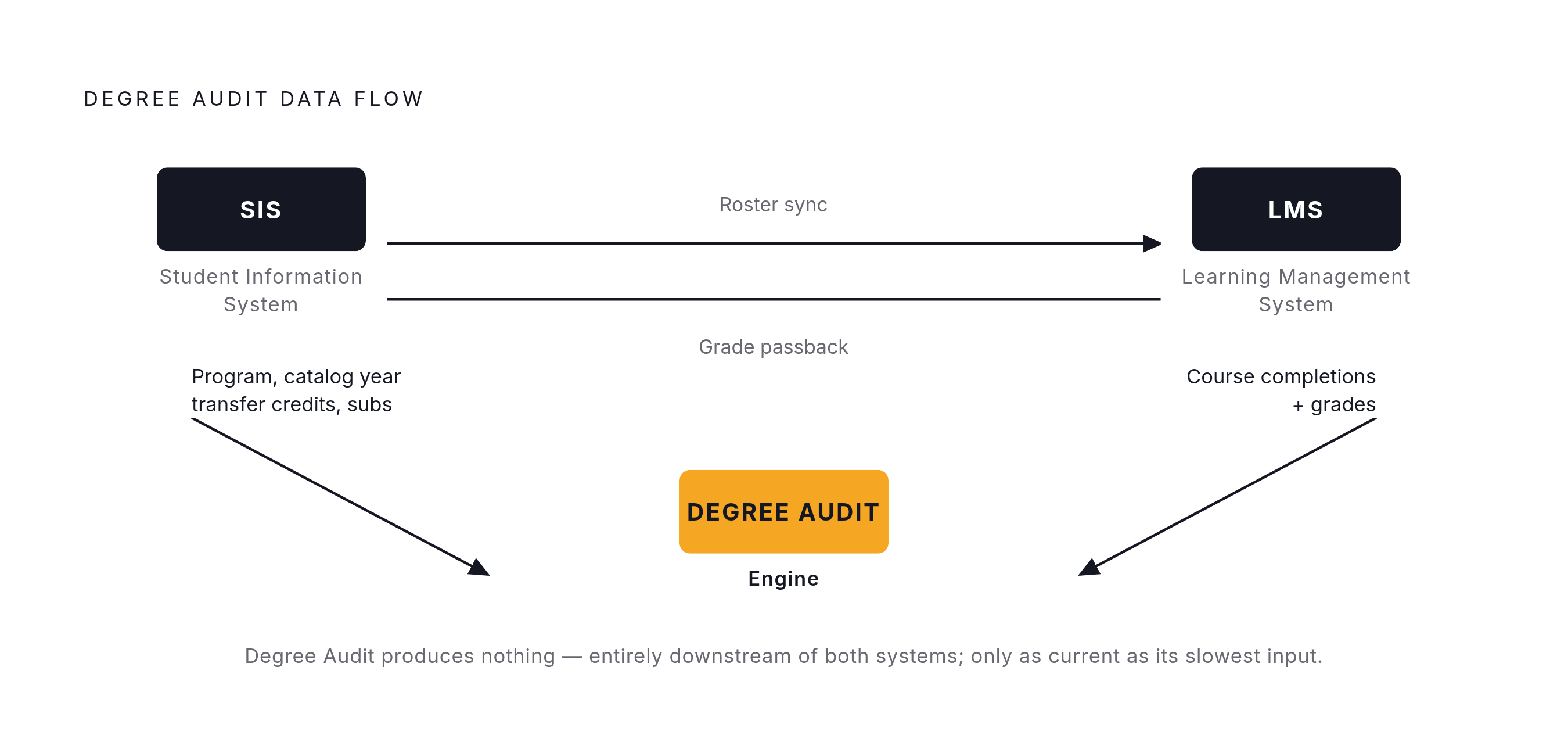
The degree audit engine sits on top of both and produces nothing on its own. It applies institutional rules to whatever data the SIS and LMS hand it. Feed it garbage, get garbage back. That's not a design flaw; it's the whole architecture, and that's why the data connections between these three systems matter so much.
The SIS market itself gives some sense of scale here: valued around $4.25 billion in 2025, projected to hit $12.8 billion by 2034, growing at an 11.6% annual clip. Names like Ellucian, Workday, Oracle, SAP, and Jenzabar dominate that space, and each institution's SIS choice shapes what's even possible on the integration side.
The data has to move in specific directions, and all of them matter:
SIS to degree audit: program enrollment, catalog year, transfer credit evaluations, approved substitutions
LMS to SIS (grade passback): course completions and grades landing on the official record
SIS to LMS (roster sync): enrollment adds, drops, and changes showing up correctly in the gradebook
All three feeding the degree audit, which is only as current as its slowest input
When an LMS sits disconnected from the rest of this loop, it recreates the exact data silos institutions claim they're trying to kill. The audit shows stale numbers. Advisors are working off different information than the registrar. Students get told two different things by two different offices, and somehow it's always the student who has to sort it out.
Data Standards That Govern Inter-System Record Exchange
None of this works without agreed-upon formats, and higher ed has mostly settled on a few.
LTI 1.3 (Learning Tools Interoperability) is the current standard for secure LMS integrations. It defines how learning tools plug into an LMS and launch directly inside it, without a student needing separate credentials for each tool.
On the school-system side, OneRoster 1.2 from IMS Global and Ed-Fi are two prominent data standards in the SIS-to-LMS space as of 2026, with OneRoster used by roughly 70% of LMS vendors in US K-12. Higher education SIS-to-LMS exchange tends to rely on LTI and direct API connections, which is a technically different path from K-12 even though the underlying goal is the same.
SCORM and xAPI handle content-level tracking inside the LMS itself; missing support for these standards can trigger costly retrofits after launch.
REST APIs, application programming interfaces that allow systems to exchange data over the web, are the bare minimum. An SIS needs reliable programmatic access to communicate with other campus systems. Institutions still relying on file exports or manual data pulls cannot feed a degree audit reliable data, regardless of how capable the audit engine itself is. Strong higher-ed LMS implementations tend to offer well-documented API coverage for roster sync, grade passback, and enrollment management across campuses.
Batch sync vs. real-time sync: the cost and the risk of each
Two ways to move the data, and they produce two very different student experiences.
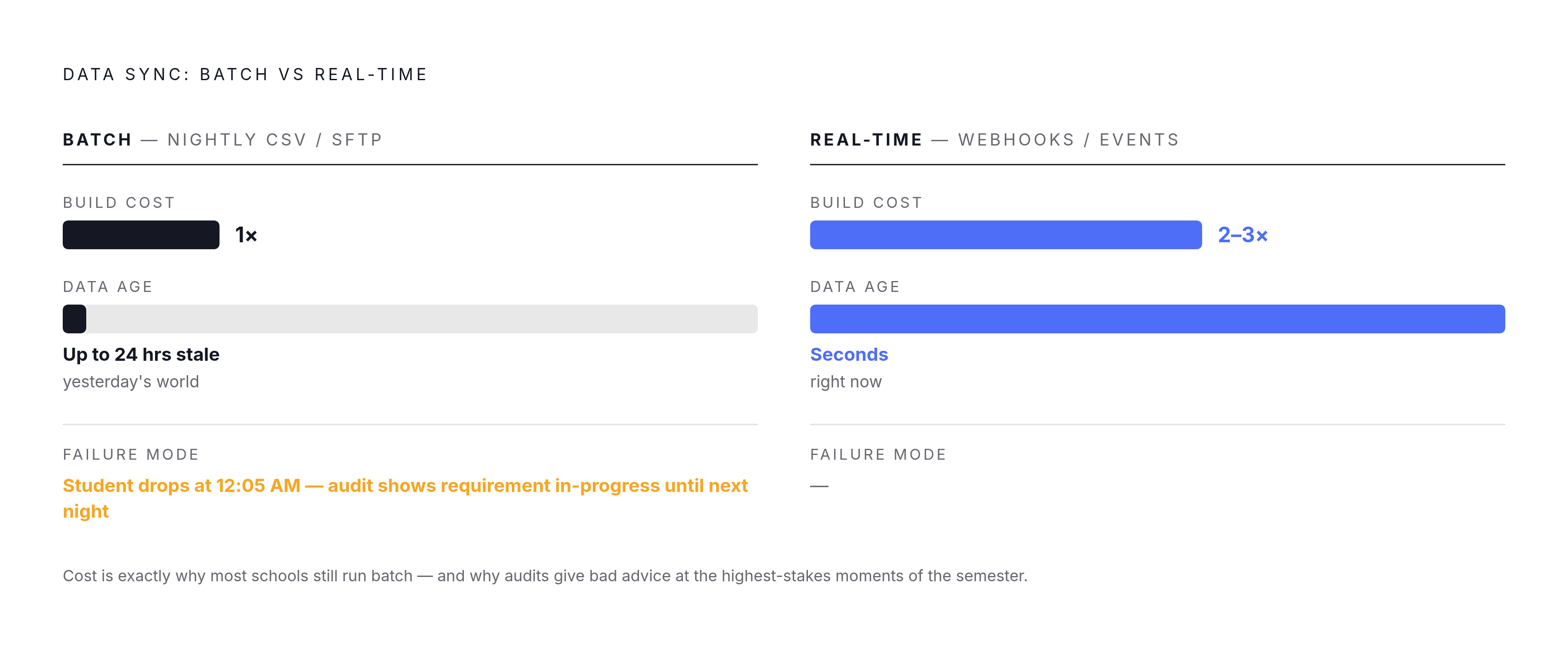
Batch sync moves records on a fixed schedule, often via CSV files over SFTP (a secure file-transfer protocol). The degree audit a student checks at 9 a.m. reflects yesterday's data. Real-time sync, built on webhooks and event triggers, updates the moment something changes.
Real-time costs about 2 to 3 times more to build than nightly batch. That's not a small gap, and it's the reason so many schools still run batch. But batch produces roster drift, and roster drift shows up constantly in support tickets and advisor complaints.
Consider the failure modes. A student drops a course five minutes after the nightly batch job runs, so the audit still shows that requirement as in-progress until the next sync, sometimes a full day later. A professor posts a final grade in the LMS gradebook, and the audit doesn't register the completed requirement until the following morning's batch. During registration week, when students and advisors are making real decisions in real time, stale data hits at exactly the moment accuracy matters most.
None of this technical architecture matters if the source data is dirty to begin with. You should schedule 4 to 8 weeks of integration QA for any SIS integration, and expect most of the failures you find to trace back to SIS data quality rather than the integration code itself. Data quality problems tend to surface only once QA actually starts digging, which is a good argument for not skipping that phase to hit a launch date.
Privacy and FERPA Controls Must Be Designed In
Student education records moving between the LMS, SIS, and degree audit engine carry significant privacy obligations. Those obligations aren't a box to check after launch. Privacy controls have to be built into the architecture from the first design meeting, because retrofitting them onto a live system is expensive and usually incomplete.
The baseline encryption requirements aren't optional:
AES-256 for data at rest
TLS 1.3 for data moving between systems
Key vault management so credentials aren't stored in a config file
Role-based access means a student sees only their own audit, an advisor sees only their advisees, and a registrar sees everyone. Every access and every edit to a student's audit record needs to be logged, both for FERPA compliance and for disputes where a student claims the audit showed a requirement as complete and someone needs to verify what the system actually displayed on that date. Multi-factor authentication is a baseline requirement for the LMS side of this, not an optional feature.
Depending on the institution, additional layers apply: data residency rules for schools with international students, additional audit trail requirements for specialized programs, and consent workflows where a state or accreditor requires them.
Each User Role Sees a Different System
The same audit record looks completely different depending on who's viewing it, and those differences are technical specifications, not UI decisions.
Students need a self-service view that reflects current data, because they're using it to decide what to register for next term. Inaccuracy at this level directly changes what a student signs up for.
Advisors need advisee-level access, the ability to model a hypothetical course plan, and visibility into holds and exceptions. They also need the audit pulling in LMS completion data, not just what's officially posted to the transcript, since there's often a lag between finishing coursework and it becoming official.
Faculty advisors, where a school separates them from professional advising staff, need access scoped to just their own advisees.
Registrars need override capability: course substitutions, waiver approvals, and exception handling. Every one of those overrides must write back into the audit and get logged. IT staff monitor the underlying infrastructure: API uptime, sync error logs, and identity management tools ensuring the right people have the right access.
UC Davis's 2026 rollout of uAchieve illustrates how the sequencing can work. Academic advisors and faculty advisors got access starting June 15, 2026, students followed in mid-July, and the older MyDegree system stayed live as a backup until it was switched off on September 30, 2026. That gap gave advisors weeks to identify problems before students ever saw the tool. UC San Diego ran a similar sequence with uAchieve through its TSS system, opening it to all current undergraduates by summer 2026, with graduate student access following in September.
That sequencing reflects a real institutional constraint: the system works only if faculty and advisor buy-in is present. If advisors don't trust what the audit tells them, they route around it and call the registrar directly. Your integrated system effectively becomes two disconnected systems again.
Methodology & sources
- Degree Audits
Confirmed UC San Diego's use of uAchieve through its TSS system and the summer 2026 rollout timeline for undergraduates.
- uAchieve | Enrollment Management
Provided details on UC Davis's 2026 uAchieve rollout sequence, including advisor access dates and the MyDegree transition timeline.
- https://iet.ucdavis.edu/article/uachieve-we-achieve-how-new-degree-audit-system-will-transform-students-academic-journey
Provided additional context on UC Davis's uAchieve implementation and the academic advisor access sequence ahead of student access.
- https://www.ofashandfire.com/blog/sis-integration-custom-lms-development
Provided the statistic that OneRoster is used by roughly 70% of LMS vendors in US K-12.