AI Detection Policy Inconsistencies Across Higher Education Institutions
Colleges lack unified AI policies, leaving students and detection tools to fill the gaps.

- Written by
- Preston Ganem
- Updated
- October 15, 2026
- Reading time
- 8 min read
- Sources cited
- 8 sources ↓
What this covers
A student can use AI freely in one class and get expelled for the same behavior in the next class, on the same day, in the same building. That is the actual operating condition of higher education right now, not a phase schools are passing through on the way to something clearer. Harvard's Office of Undergraduate Education says this part out loud: instructors set their own AI policy per course, and students are responsible for figuring out which rules apply where. The syllabus is the law of the land, and the land changes every fifty minutes. Even inside one department, where you would expect some shared logic, instructors disagree on basics, like whether running a paragraph through a grammar-checking tool counts as AI assistance or just spellcheck with better manners.
How AI Policy Authority Gets Distributed
The confusion is what happens when nobody owns the decision. Depending on the day and the issue, the rule governing a student's AI use might come from the course instructor, the department, a faculty senate, the IT office, an ethics board, the provost, or an accreditor, and these groups rarely talk to each other before setting policy. Manikonda and Outlaw's analysis of R1 research universities found a clean split down the middle: university-level policy worries about data security and institutional risk, while department-level policy (on the rare occasions it exists) worries about teaching methods and tool use. Those two conversations happen in different rooms, run by different people, answering different questions. Business schools make the gap visible in a specific way: most don't bother writing AI policy separate from the general university framework, even though finance as a field is being reshaped by AI tools in ways that have nothing to do with plagiarism and everything to do with what graduates need to know. Poudyal's stress test of five universities in Western Australia found the same hollow pattern repeatedly: governance documents name a responsible party, but that party gets no real decision criteria and no process for acting. The authority is listed in the org chart, but the actual machinery to use it doesn't exist. This is the real failure mode: not blank pages with no policy at all, but policy that names a name and stops there, leaving nothing connecting responsibility to action to review.
How Generative AI Outpaced Institutional Policymaking
Universities didn't drag their feet on AI governance out of laziness. Generative AI simply moved faster than any policy process they had. ChatGPT went public in late 2022, and the response across institutions, sometimes within the same country, ranged from flat bans to cautious curiosity, all within a few months. A longitudinal study at Ulster University followed students and staff from 2024 through 2026 and found that students treated AI as a normal tool almost immediately, shifting from cautious testing to routine daily use. Staff and policy moved much slower, and the gap between how students actually worked and what the rules assumed kept growing. A 2025 survey found that nearly every top US university had put together faculty-facing generative AI guidelines, which sounds like progress until you read the guidance itself: wildly different in scope, tone, and enforcement from one school to the next, which leaves faculty just as unsure as their students about what they're actually allowed to assign, permit, or punish.
Why Detection Tools Cannot Do This Job
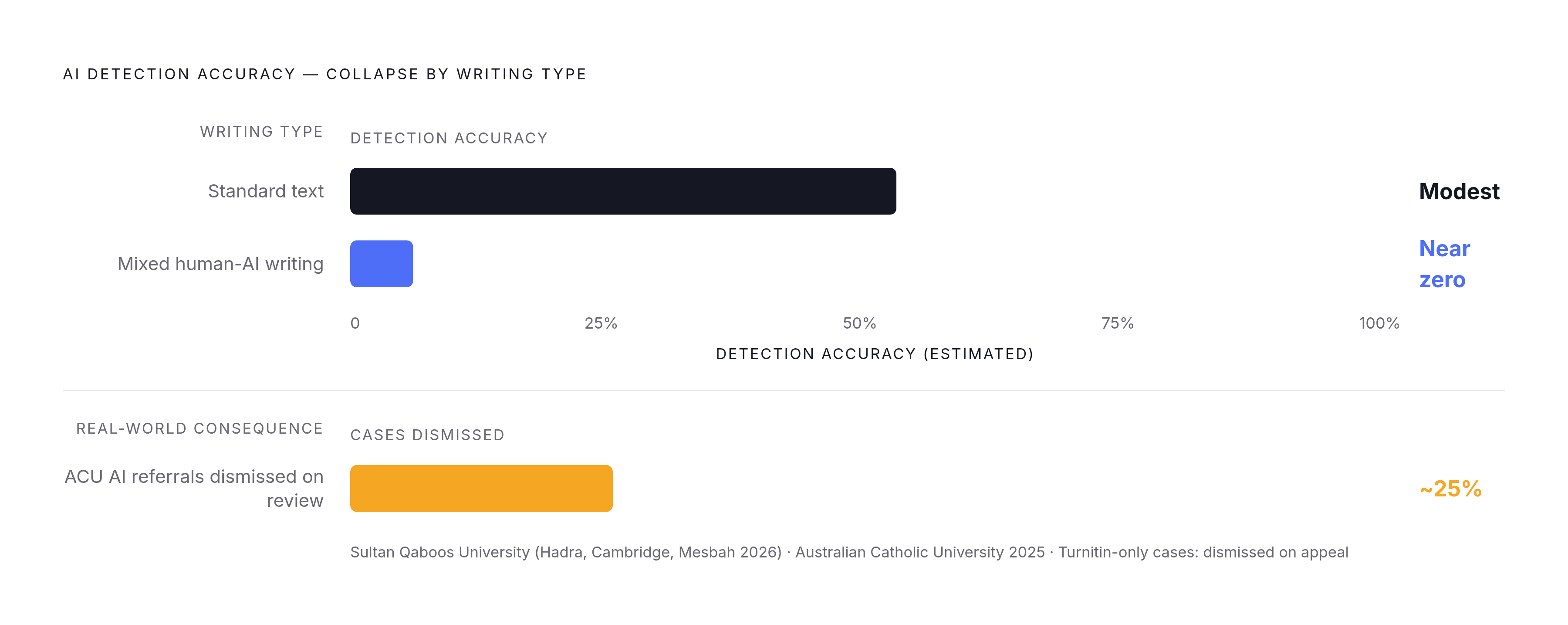
Faced with rules that shift by classroom, schools leaned on software to settle the arguments the rules couldn't. That software isn't built for the job it's been handed. Research out of Sultan Qaboos University in 2026, led by Hadra, Cambridge, and Mesbah, tested leading detection tools and found only modest accuracy overall, with accuracy on mixed human-AI writing falling to almost nothing. Most detectors work by measuring perplexity (how predictable the word choices are) and burstiness (how much sentence length varies), on the theory that AI text is smoother and more uniform than human writing. As AI models get better at sounding like people, those signals fade. A mathematical analysis published in 2026 goes further, showing this isn't a bug waiting on a patch: any detector that works from text alone, in one shot, and has any real power to catch AI writing, will also falsely accuse a predictable slice of students whose own writing happens to overlap statistically with AI output. This is a structural limit of the method, not a settings problem. Because detection tools vary enormously from vendor to vendor in head-to-head testing, which tool a given school happens to license ends up deciding how many of its students get falsely flagged.
Detection Tools Systematically Disadvantage Non-Native Writers
That false-positive risk doesn't land evenly across a student body. Controlled testing shows non-native English writing gets flagged as AI-generated far more often than native English writing, even when every word of it was confirmed to be human-written. The reason tracks back to how these tools work: they're tuned to penalize syntax and vocabulary that look non-standard, and formal, careful second-language writing checks exactly those boxes. Thierry Rignol found this out the hard way. A French student on track to be valedictorian, Rignol was suspended after GPTZero flagged his writing as AI-generated, and he traced the false positive to formal, precise English. His case reflects a pattern that occurs across campuses wherever these tools are used on multilingual writers. The damage compounds in a direction nobody intended: a student who's scared of getting falsely flagged might start running their own human writing through AI specifically to sound less formal and dodge detection. A system built to catch AI use ends up pushing the students most at risk of false accusations to actually use it.
Detection Tools Fail Real Disciplinary Hearings
Several schools have already used these tools in live disciplinary hearings, and the tools didn't hold up once a student pushed back. Australian Catholic University turned off Turnitin's AI indicator starting March 17, 2025, saying the tool was unreliable, couldn't tell AI-assisted editing from AI-written-from-scratch, missed real cases of AI use regularly, and gave students no transparency into how it reached a verdict. ACU also disclosed that roughly a quarter of its AI-related referrals were dismissed once investigated, and that any case resting on Turnitin's score alone got thrown out the moment it was reviewed. The legal exposure is already visible in court filings. At least two lawsuits over AI detection false positives were filed against U.S. universities in 2025, and legal scholars have raised a due process argument: leaning on a tool with a known high error rate to discipline a student may not hold up as fair process. A quieter legal problem sits beneath the public cases. Submitting a student's work to an outside detection platform can trigger FERPA, because that work counts as an educational record, and routing it through a third-party vendor may need the student's written consent, consent that schools haven't always bothered to get.
The Case for Keeping Detection Tools
None of this means the argument for keeping detection tools is empty. Nobody serious claims these tools are accurate enough to settle a case on their own, but the argument for keeping them isn't about accuracy. It's about what disappears if you drop them entirely: the only accountability signal most institutions currently have. Research backs up that a policy with enforcement teeth changes behavior: students who know a course requires them to disclose AI use are somewhat less likely to use it undisclosed than students under no policy at all. Turnitin updated its detection model in February 2026 specifically to catch more AI use while keeping its false positive rate low, and the people building these tools argue the fix is better tools, not abandoning the category. A hybrid approach distributes the risk more fairly: pairing a detection score with manual review by an academic committee, a look at the student's drafts, and a sense of their writing history over time, so no single number decides a student's fate. The Yip Institute made this point in a policy brief: AI detection can support a teacher's judgment, but it shouldn't replace it, and no disciplinary outcome should rest on an automated score by itself. The real disagreement isn't between people who want full enforcement and people who want none, but about how much weight a flawed signal should carry in a decision that can end a student's academic career.
Institutions Have Scattered Across Incompatible Models
Instead of settling on one shared approach, schools have scattered across a wide range of responses, each one defensible on its own terms, that together leave students with no consistent map. At one end sits Sciences Po in Paris, which originally banned generative AI outright, under threat of expulsion, before rewriting its policy to favor guided, responsible use instead. At the other end, the University of Florida's "AI Across the Curriculum" initiative and Ohio State's "AI Fluency" initiative both aim to make AI skill a standard part of every degree, treating it as something graduates need to know. In between, systems like the University of California leave campuses to apply their own shared guidance (which already tells schools not to treat a detection score as standalone proof) however each campus sees fit, so variation occurs inside the system on top of the variation between systems. No major university model, anywhere, has emerged as the default. Some centralize guidance, some push decisions down to the course level, some build their own detection infrastructure, and some publish only partial or department-specific rules. The gap between how students actually use AI and how staff and policy respond to it is getting wider over time, not narrower, because student behavior keeps changing faster than institutions can write policy to match it.
What Meaningful Governance Reform Actually Requires
Fixing this takes more than another round of updated guidelines. It takes connecting who has authority, to what process they follow, to how that process gets reviewed, at every level where an actual AI decision gets made, from a single grading dispute up to a university-wide policy. Poudyal's IAGST framework names the exact failure that recurs across these studies: institutions write down who's responsible, but never build out the decision criteria or process that would let that person actually act on it. Fixing the stated principle without fixing the missing process it depends on accomplishes nothing. The research points toward one concrete starting move: make disclosure the default rule, not prohibition, so a student is asked to say how they used AI rather than subjected to a detector guessing whether they did. That shifts the burden off a measurement tool that can't carry it, and onto a conversation that at least puts the student's own account into the record. The reform these studies point to is bigger than any one syllabus, but naming the missing connective tissue, authority linked to process linked to review, gives institutions an actual place to start building it.
Methodology & sources
- Policy Brief: Rethinking AI Detection Tools in Higher Education
Explained how AI detection tools measure perplexity and burstiness as signals for identifying AI-generated text.
- Regulating AI Detection in Academic Work
Provided the policy argument that AI detection should support teacher judgment rather than replace it, and that no disciplinary outcome should rest on an automated score alone.
- Policy Fragmentation or Institutional Alignment? Institutional Governance of AI in Universities and Business Schools
Supplied the finding that university-level policy focuses on data security and institutional risk while department-level policy addresses teaching methods, with business schools rarely writing separate AI policy.
- From Novelty to Normalisation: Tracking Changing Perceptions of AI in Higher Education, 2024-2026
Provided the longitudinal study at Ulster University tracking student and staff perceptions of AI from 2024 to 2026, showing students normalized AI use far faster than policy responded.
- Stress-testing university AI governance: A prospective method for locating policy breakpoints
Supplied the stress-test analysis of five Western Australian universities showing governance documents name responsible parties but provide no decision criteria or processes for action.
- Evaluating the Effectiveness and Ethical Implications of AI Detection Tools in Higher Education
Provided the Sultan Qaboos University research testing detection tool accuracy, finding only modest overall accuracy with near-zero accuracy on mixed human-AI writing.
- AI Detectors Fail Diverse Student Populations: A Mathematical Framing of Structural Detection Limits
Supplied the mathematical analysis showing that any text-based detector with real power to catch AI writing will structurally produce false positives for students whose writing statistically overlaps with AI output.
- Style as a Confound: False Positives in AI Detection of Non-Native Academic Writing
Provided the controlled testing evidence that non-native English writing is flagged as AI-generated far more often than native English writing, even when confirmed to be human-written.