AI Literacy Curriculum Frameworks for K-12 Schools
Schools now must choose among competing frameworks to teach AI as a core skill, not an afterthought.

- Written by
- Lorena Mercer
- Updated
- October 15, 2026
- Reading time
- 8 min read
- Sources cited
- 7 sources ↓
What this covers
AI literacy used to be the enrichment unit a school bolts on after lunch, but now it's a core competency question with real teeth. The shift happened fast: students were already using generative AI tools to search, translate, write, and study long before most districts had a coherent plan for teaching them how. Kids adopted the technology first and asked permission never, and schools are now sprinting to catch up with a curriculum for a habit that's already formed.
AI literacy generally means the ability to understand, use, monitor, and critically evaluate AI applications, folding technical skill and ethical judgment into a single combined competency. The newly published AILit 2026 framework describes AI literacy as a core competence underpinning pupils' agency, critical thinking, ethical judgment, and responsible social participation, which is a far cry from "elective computer class."
Policy has caught up to that framing. As of September 2026, 40 states plus Puerto Rico have developed official guidance or policy frameworks on AI in education, a jump that marks the field's move from polite suggestion to active mandate. Maryland didn't just suggest; it legislated, enacting the A.I. Ready Schools Act (SB 720, 2026), which requires statewide AI guidelines, a district-level AI coordinator in every district, and dedicated teacher training. At the federal level, the April 23, 2025 executive order "Advancing Artificial Intelligence Education for American Youth" created a White House Task Force on AI Education and directed it to launch a Presidential AI Challenge, which a formal guidebook turned into a live competition in August 2025. The question facing schools isn't whether to teach AI literacy, but which framework to follow.
Why the field fragmented
For years, there was no shared vocabulary for any of this, and that absence let dozens of local, regional, and organizational frameworks sprout up with their own terms, their own priorities, and precious little overlap.
The AILit 2026 framework's own analysis names four specific barriers: the lack of a shared conceptual framework, inconsistent rollout of whatever strategic initiatives did exist, the ongoing challenge of explaining AI's role in daily life, and uncertainty about how to teach it well. A 2026 systematic comparative review of six influential AI literacy frameworks backs this up from a different angle. It found broad agreement on a multidimensional model built around Understand, Evaluate, and Use, but discovered that actual implementation stayed stuck in computer science electives and after-school programs, never scaling into the rest of the school day. The same review flagged a pedagogical gap that may be the most practical problem of all: frameworks were good at describing what to teach, and poor at telling teachers how to fold AI concepts into core academic subjects.
Fragmentation resolves when a few frameworks get specific enough, credible enough, and widely adopted enough that everyone else starts citing them instead of starting over. Three frameworks, AI4K12, UNESCO's AI competency frameworks, and the newly released AILit 2026, have become the dominant reference points because the field needed a shared language and these three supplied it. What follows is a look at what each one actually covers, who it's built for, and where the distinctions start to matter for someone building a lesson plan.
What AI4K12 actually covers
AI4K12 is the oldest of the three and, for a lot of U.S. schools, the most familiar. It organizes AI content around what it calls the Five Big Ideas: Perception, Representation & Reasoning, Learning, Natural Interaction, and Societal Impact. Those five ideas work as a content map that tells teachers what concepts belong at which grade band, from early elementary through high school, and a developmental sequence lets a fifth-grade lesson on pattern recognition grow into a tenth-grade lesson on machine learning bias.
AI4K12 is built as a content scaffold that answers what AI concepts a ninth grader should know that a fourth grader doesn't, rather than as a model for weaving AI literacy across every subject in the school day. Societal Impact is one of the five ideas, sitting alongside the more technical strands, so ethical reasoning appears throughout the framework but isn't the organizing center of gravity the way it is in some newer frameworks.
AI4K12 took shape before generative AI reached its current scale in classrooms, so it doesn't draw an explicit line between predictive AI systems (the kind that recommend a video or flag a spam email) and generative ones (the kind that write an essay or produce an image on request). For a school building its first standalone AI unit, that is a meaningful gap worth noting.
What UNESCO's framework adds
UNESCO approaches the same problem from a different angle, and that angle is the teacher. In 2024, UNESCO published two distinct AI Competency Frameworks, one for students and one for teachers, a structural choice that treats educator readiness as its own urgent problem alongside student curriculum. A lot of AI literacy planning assumes that if you hand a teacher the right materials, the classroom will sort itself out. UNESCO's framework assumes the opposite: that teachers need their own defined set of competencies before they can reasonably be expected to teach anyone else's.
The numbers back up why that mattered. In October 2024, almost 60% of teachers reported receiving no AI training at all, leaving most educators to navigate fast-moving, AI-driven classroom changes with no clear sense of which skills they were supposed to be building. UNESCO's teacher-facing framework answers that question, organizing its guidance around knowledge, skills, and attitudes, a KSA triad that puts dispositions and values on equal footing with technical know-how.
UNESCO also runs its own broader mapping of government-endorsed AI curricula around the world, giving it a policy-alignment function AI4K12 never claimed to have. It's built to travel across national education systems rather than plug into one country's standards, and it makes the ethical and societal dimensions harder to ignore. None of that makes it a replacement for AI4K12's content map.
What AILit 2026 brings to schools
The newest entrant is also the most ambitious. Published June 18, 2026, under the title Empowering Learners for the Age of AI: An AI Literacy Framework for Primary and Secondary Education, AILit 2026 was presented jointly by the European Commission and the OECD, with support from CodeAI and a roster of international experts. It's the first internationally backed competency map for AI literacy tied at once to curriculum development, teacher training, and assessment reform, specifically the PISA 2029 cycle. No binding mandate comes attached to it, but the connections it does have are substantial enough to reshape how schools think about long-term alignment.
Structurally, AILit 2026 organizes everything into four domains: Engage, Create, Manage, and Shape AI, each containing its own competences layered across a three-level learner progression. The framework names AI4K12, UNESCO, ETS, Digital Promise, DigComp, and aiEDU as direct conceptual antecedents, positioning itself explicitly as a synthesis of what came before rather than a replacement for any of them.
Two connections make AILit 2026 genuinely new territory. First, it complements existing digital competency frameworks and their coming updates, giving member states an immediate curricular on-ramp. Second, it's directly linked to the PISA 2029 MAIL (Media and Artificial Intelligence Literacy) assessment, so a school that adopts AILit 2026 now aligns with an international benchmark arriving in a few years. AILit 2026 can also be read against Article 4 of the EU AI Act, in force since February 2, 2025, giving it the first genuine, if indirect, connection to binding law among major AI literacy frameworks. The "Shape AI" domain, which covers civic voice and principled use, speaks directly to the agency and equity gaps that earlier frameworks addressed only lightly.
Where the three frameworks agree and diverge
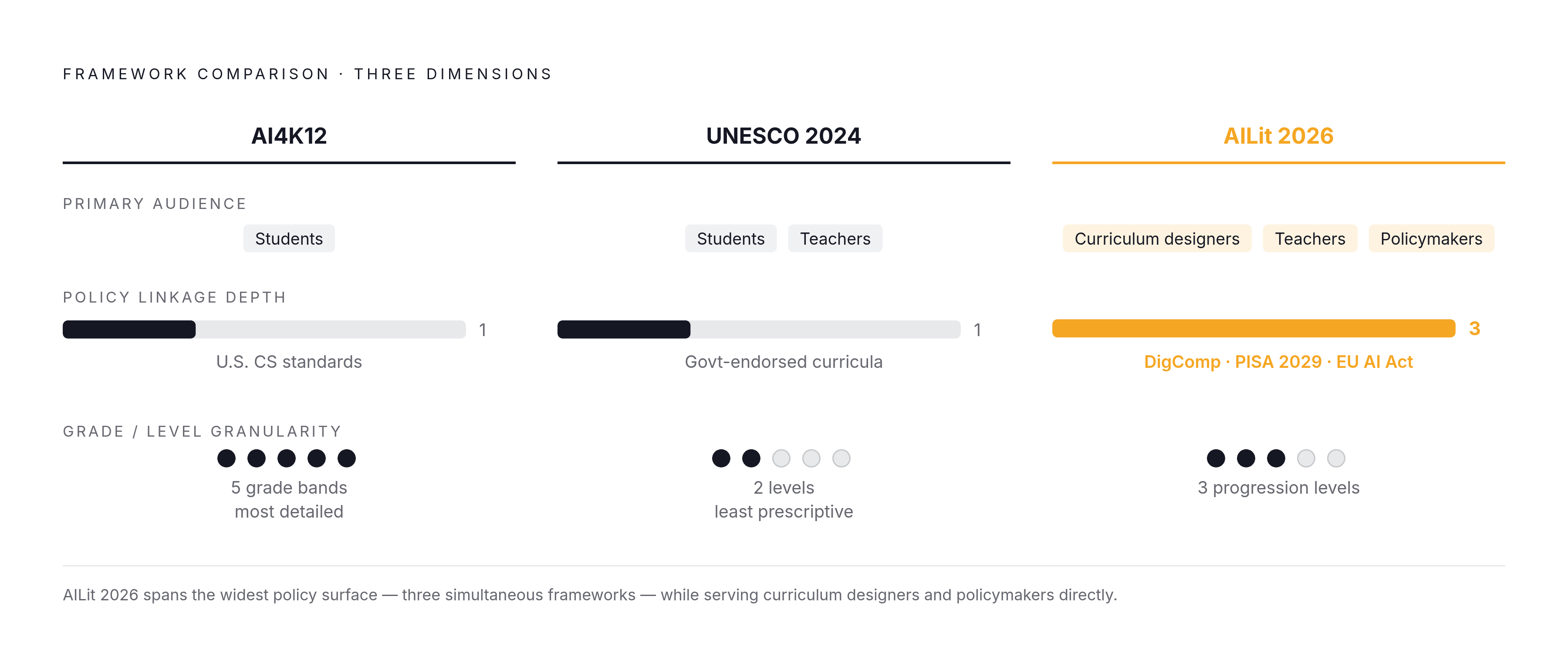
The 2026 comparative review of major frameworks found strong consensus on the Understand / Evaluate / Use triad and confirmed that no major framework treats AI literacy as a purely technical skill or a purely ethical one. All three also agree that AI literacy belongs across the curriculum rather than locked inside a computer science elective, and all three give real weight to societal and ethical questions, even if they build that weight into the structure differently.
The differences emerge as soon as you ask who each framework is actually addressing. AI4K12 speaks to students through a content map. UNESCO speaks to both students and teachers through its dual 2024 frameworks. AILit 2026 speaks to curriculum designers, teachers, and policymakers simultaneously. Policy linkage tells a similar story of scale: AI4K12 aligns to U.S. computer science standards, UNESCO maps to government-endorsed curricula internationally, and AILit 2026 connects to DigComp, the incoming PISA 2029 cycle, and the EU AI Act. Granularity runs the other direction: AI4K12's grade-band progressions are the most detailed, AILit 2026 works off three broader progression levels, and UNESCO's frameworks are the least prescriptive about sequencing by grade.
What that means in practice depends on what a school is trying to solve. A U.S. school building its first standalone AI unit gets the clearest, most specific support from AI4K12's grade-band charts. If a district worries more about its teachers than its textbooks, it finds the sharpest guidance in UNESCO's paired student and teacher frameworks. A school angling toward international benchmarks, the coming PISA cycle, or the regulatory climate in the EU gets the most policy-ready scaffolding from AILit 2026. These choices are not mutually exclusive. A school that builds on AILit 2026's four domains as the organizing spine, then fills in with AI4K12's content detail and UNESCO's teacher-competency guidance, gets the benefit of all three without having to pick just one.
The generative AI gap in every framework
For all that convergence, there's a significant gap sitting in the middle of it: none of the three fully addresses what generative AI specifically demands of a classroom. That's a timing problem more than a design flaw, since generative AI tools scaled up faster than any framework could rewrite itself around them. The scholarly community has started saying so directly, calling for frameworks that draw a clear line between predictive systems and generative ones instead of treating "AI" as one undifferentiated category.
One proposed 2026 curriculum tries to patch the gap directly, adding a third strategic objective aimed squarely at generative AI: developing students as reflective thinkers who examine the relationship between human and artificial intelligence while actually using generative tools, a dimension that wasn't part of AI4K12's Five Big Ideas as originally written. The ETS research report pushes in a similar direction, naming ethical decision-making, AI-powered collaboration, and critical evaluation of AI outputs as key competencies, each one an area where generative AI raises distinct challenges that frameworks built around predictive systems were never designed to catch.
A systematic review of the broader research finds that technical training by itself doesn't cut it. Sustained professional development, real alignment between AI content and existing pedagogy, positive attitudes among the educators doing the teaching, and organizational support from the school itself all turn out to be necessary conditions, and none of them are fully specified in any current framework. Schools working from AI4K12, UNESCO, or AILit 2026 are building on solid ground, but none of that ground yet covers the full shape of what generative AI is asking of a classroom.
Methodology & sources
- AI Literacy Education
Provided the statistics on states with AI guidance, the percentage of untrained teachers, and the findings of the comparative review of major AI literacy frameworks.
- Proposed Artificial Intelligence Literacy Curriculum in K–12 Education for Cultivating Competent Users, Smart Learners, and Passionate Thinkers
Supplied the proposed curriculum's third strategic objective focused on generative AI and the relationship between human and artificial intelligence.
- Preparing K–12 Students With AI Literacy:
Cited as the source for naming ethical decision-making, AI-powered collaboration, and critical evaluation of AI outputs as key competencies.
- Empowering Learners for the Age of AI
Provided the AILit 2026 framework's definition of AI literacy as a core competence underpinning pupils' agency, critical thinking, and ethical judgment.
- K-12 AI curricula: a mapping of government-endorsed AI curricula
Referenced as the source for UNESCO's mapping of government-endorsed AI curricula across national education systems.
- Five Big Ideas in Artificial Intelligence 3. Learning
Provided the Five Big Ideas framework — Perception, Representation & Reasoning, Learning, Natural Interaction, and Societal Impact — that structures AI4K12's content map.
- Empowering Learners for the Age of AI
Served as the primary source for the AILit 2026 framework's structure, four domains, three-level progression, and its connections to PISA 2029 and the EU AI Act.