Localization and Multilingual Support Architecture in EdTech Products
Home language learning significantly boosts student retention and understanding in EdTech products.

- Written by
- Anouk Osborne
- Published
- October 20, 2026
- Reading time
- 9 min read
- Sources cited
- 7 sources ↓
What this covers
EdTech sells itself as the great equalizer: any learner, anywhere, same lesson. The actual delivery looks different. Most educational materials exist only in English. Most learners on the planet are doing the work of learning twice: once to understand the content, and once to understand the language it arrived in. EdTech products, built by companies chasing the same English-first market, tend to replicate that gap instead of closing it.
A platform's biggest obstacle in developing nations is a shortage of content built for a specific place and a specific language, the kind of gap that leaves most products defaulting to English or another major global language because that's the market they were built for. Classroom teaching has a built-in constraint here: one teacher, one room, one language, with no way to run the lesson simultaneously in two tongues. EdTech doesn't have that constraint. A server can hold a thousand versions of the same lesson in a thousand languages and serve the right one to the right learner without any additional cost per user.
The one advantage EdTech has over a physical classroom is the ability to deliver identical content to different learners in different languages at the same time, and that advantage mostly goes unused. Products get built in English first, and language support gets added later as a nice-to-have. This is an architecture problem, not a content gap or a translation backlog, and everything that follows in this piece only makes sense once that's the premise.
Retrofitting Multilingual Support Always Fails
Most EdTech products can't serve multilingual learners because nobody built internationalization in from day one, and fixing that after launch costs more in time, money, and bugs than teams ever plan for.
Internationalization (i18n) and localization (l10n) get talked about like synonyms, but they aren't. Internationalization is architecture: the groundwork that makes a product capable of running in any language, done once, early. Localization is execution: the actual translating and adapting, done over and over for every new market. Build the product first and think about language later, and engineers end up crawling back through old code hunting for hard-coded English strings, resizing layouts that were never built to flex, and adding formatting logic that should have shipped with version one.
The engineering cost for skipping this step adds up fast. Full Unicode support and flexible layouts have to handle the fact that languages don't all take up the same space. German runs about 30% longer than English for the same content, by industry estimates. A button sized for "Submit" breaks the moment it has to say the German equivalent. Right-to-left languages like Arabic, Hebrew, Persian, and Urdu need more than a CSS flip. Navigation, icon placement, and progress bars all need to mirror correctly, or the interface reads backwards. Beyond layout, code and content need to stay separated from the start so that translators can swap language files without engineers touching application logic every single time. Skipping that separation early turns every future localization push into a code review.
Interactive EdTech makes all of this worse. A quiz with a timer, a lesson with branching feedback, a simulation that responds to learner input: these aren't static pages you can hand off to a translator and get back clean. Changing the language carries real risk of breaking both the interface and the learning experience simultaneously. Adding multilingual support after launch is a re-engineering project, and teams that delay it on budget grounds eventually discover that the cost only grows.
Home Language Instruction Improves Learning Outcomes
Getting this architecture right isn't just an engineering preference. It changes whether students actually learn. Learners taught in their home language consistently outperform learners taught in a second one, and EdTech that skips multilingual architecture is trading real learning outcomes for a simpler build process.
A randomized controlled trial run in Uganda gives the clearest recent picture of this in an EdTech context specifically. Among hybrid learners using both their home language and a second language, those who kept switching back and forth between languages stayed in the course longer than those who didn't. That result suggests the benefit isn't just having a local-language option sitting on a menu somewhere. The benefit comes from learners having real control over which language they use and when they need it.
A learner working in their mother tongue spends their mental energy on the actual concept: the math, the science, the logic. A learner working in a second language spends a portion of that same mental energy decoding the sentence before they can get to the idea inside it. Language functions as a cognitive cost, paid every sentence, by every learner who doesn't get to choose their language of instruction.
A well-built EdTech platform can serve learners who speak different languages the identical lesson in each one's own language, simultaneously, at no added marginal cost per learner. That capability only exists if the product was built from the ground up to offer it. A platform that had language support added after launch cannot give learners the kind of real-time language control that the Uganda data says actually drives persistence.
Four Architecture Layers Multilingual EdTech Requires
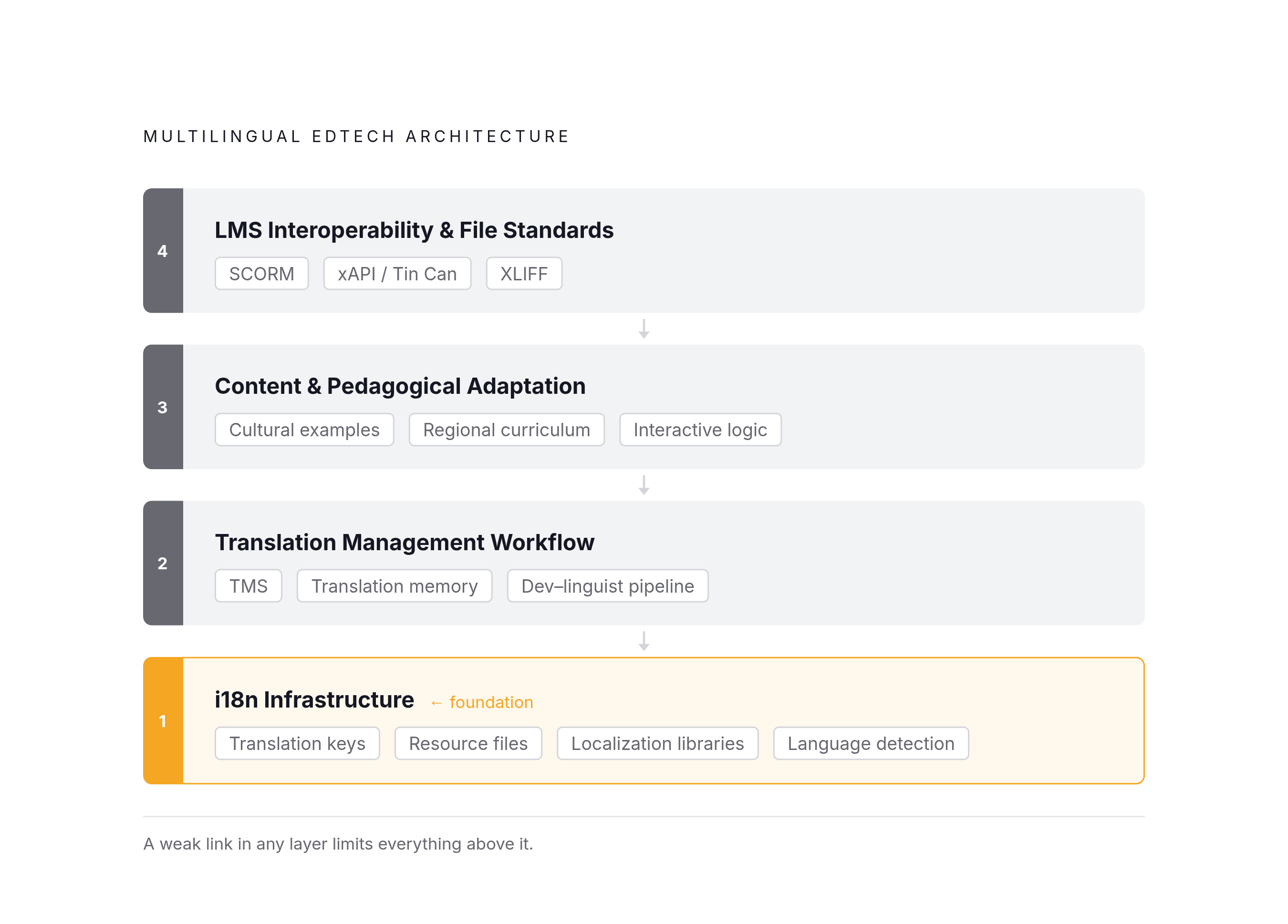
Given that language choice drives outcomes, the next question is what a system that actually offers that choice needs to have in place. Effective multilingual EdTech runs on four layers: infrastructure, workflow, content, and interoperability. They stack on top of each other, and a weak link in any one of them limits what the rest of the system can do, no matter how well-built the other three are.
Layer 1 is i18n infrastructure, the foundation everything else sits on. This means translation keys (identifiers in the code that point to a localized piece of text instead of hard-coding the English version), translation resources (separate files or database entries holding each language's content), localization libraries (the tools that pull the right key, handle plurals correctly, and format dates, numbers, and currency the way each locale expects), and language detection (the logic that figures out which locale to load for a given user). Get this layer right and switching languages becomes a configuration setting. Get it wrong and switching languages becomes a six-month engineering project.
Layer 2 is the translation management workflow, the operational bridge between i18n and l10n. Modern translation management systems (TMSs) connect to code repositories directly, so the moment a developer commits new text, the system flags it for translation automatically. Translators and developers work in parallel instead of in sequence, using translation memory (so a phrase translated once doesn't need retranslating every time it shows up again), review workflows, and shared tools. Cloud-based collaboration lets linguists, reviewers, and subject-matter experts all work on the same content at once, with direct connections into the LMS, the CMS, and the design tools, cutting out the manual handoffs that eat time and introduce errors. Modern translation management systems connect localization work directly into the development cycle so it runs as a parallel, ongoing process rather than a gate at the end of a release.
Layer 3 is content and pedagogical adaptation, where plain translation runs out of road. An interactive module with a timed quiz or a branching feedback loop can't just have its text swapped out. The pedagogy itself, including the pacing, the feedback, and the logic of how a learner moves through the material, is built into the content structure, not sitting on the surface as translatable text. Separately from translation, there's cultural adaptation: swapping in local brands for case studies, adjusting examples to match a region's curriculum, and tuning reward systems and notification timing to match how learners in that region actually behave. These are pedagogical decisions, not language decisions, and they need their own budget and their own experts.
Layer 4 is LMS interoperability and file standards, which determines whether any of this actually reaches a learner. SCORM packages handle content hosted in a traditional LMS. xAPI, also called Tin Can API, tracks learning activity across multiple platforms, including offline activity. XLIFF files (XML Localization Interchange File Format) keep translation workflows structured and portable. A localized course that fails SCORM validation in a target market's LMS doesn't reach a single learner.
Duolingo, Coursera, & Khan Academy: Three Different Bets
The three EdTech platforms studied most closely at scale didn't converge on one answer here. Each treated multilingual support as a different kind of problem to solve, and the results reflect the bet each one made.
Duolingo built localization into the core of the product itself. The company posted revenue of $1.04 billion in 2025 and offers courses in dozens of languages, including Hawaiian, Māori, Navajo, Esperanto, and even Klingon. The adaptation goes well past translation: Duolingo tunes its teaching methods to different language groups and adjusts reward systems and notifications based on regional user behavior, which is Layer 3 work executed at full product scale. In a single year, Duolingo used AI to build new courses covering its seven most popular non-English languages across all 28 of its supported interface languages, unlocking language pairings that simply didn't exist before. That speed only happened because the Layer 1 foundation, including the key-based infrastructure, the resource files, and the detection logic, was already in place. AI accelerated something the architecture was already built to support.
Coursera took a different approach, working mainly at the content access layer. It offers subtitles and translations across a range of languages, which gets non-English-speaking learners into the material without the deeper, ground-up Layer 1 investment Duolingo made. Coursera does do real pedagogical adaptation: a business course aimed at Latin American learners might swap in local companies as case studies instead of US brands, a genuine content decision and not just a language swap. The approach works and it reaches a lot of learners, but reading subtitles in a second language is not the same as learning in a first one, and the Uganda research suggests that gap in outcomes is real and not a rounding error.
Khan Academy treats localization as a mission rather than a feature to ship. The organization localizes content for regions including Brazil, India, and Peru, translating full courses and adapting examples to match local curricula rather than just running text through a translator. Framing localization as core to the mission changes what a team is willing to spend on a language market that might never generate significant revenue. When localization is treated as central to the organization's purpose rather than a cost center, teams make very different calls about which languages get the full Layer 3 treatment and which ones get subtitles only.
None of these three platforms was built with the specific learner the Uganda research describes in mind: a learner with a low-resource language, limited bandwidth, and a rural location, choosing between two languages mid-course because neither one alone gets the job done. That's the learner AI localization tools are now being pitched to serve.
Where AI Localization Helps &e Fails
AI has genuinely cut the cost and turnaround time for localizing high volumes of content in major language pairs like Spanish, French, and Mandarin, the languages with large training data sets and well-established translation patterns. Duolingo's AI-driven course expansion is a solid demonstration of that.
It falls apart exactly where EdTech needs it to hold up. Industry research found that 55% of users reported machine translation was ineffective in informal contexts, because the tools struggle with idioms and culturally specific expressions, the exact kind of language that appears in a classroom example, a word problem, or a casual aside meant to put a nervous learner at ease. A model that handles a product manual adequately can still flatten the joke, miss the regional reference, or translate an idiom literally into nonsense.
AI localization tools are workflow accelerators, not architecture. They can translate a large volume of text quickly once Layer 1 and Layer 2 are already built, the keys exist, the resource files exist, and the pipeline from commit to translation task already runs. Pointing an AI model at a product that never separated its code from its content leaves nothing for it to accelerate. A system built i18n-first from the ground up gives AI translation something real to plug into: a structure where adding a new language is a configuration change, not a renovation.
Teams hoping AI lets them skip the foundational work are going to find out, usually around the time a localized course fails SCORM validation or a quiz timer breaks in a right-to-left layout, that the foundation was never optional to begin with.
Methodology & sources
- Inclusive Mobile Learning: How Technology-Enabled Language Choice Supports Multilingual Students
Supported the argument that real-time language control drives learner persistence and informed the discussion of technology-enabled language choice.
- 2026 eLearning Industry Challenges and Solutions
Provided context on xAPI tracking learning activity across multiple platforms and the consequences of skipping foundational localization architecture.
- Duolingo
Provided Duolingo's 2025 revenue figure of $1.04 billion and background on its language course offerings.
- Can Multilingual Environments Promote Scalable EdTech? Evidence from a Randomized Controlled Trial
Provided the Uganda randomized controlled trial data on hybrid learners and language switching improving course persistence.
- Inclusive Mobile Learning: How Technology-Enabled Language Choice Supports Multilingual Students
Supported the discussion of technology-enabled language choice and its role in multilingual learner outcomes.
- Duolingo Launches 148 New Language Courses
Provided the detail about Duolingo using AI to build new courses covering its most popular non-English languages across all 28 supported interface languages.
- Case Study: How Duolingo Scaled Content 10x Using LLMs
Described how Duolingo used LLMs to scale content creation, informing the article's account of AI-driven course expansion.