Verifiable Credentials vs Open Badges in Education Contexts
Open Badges 3.0 now layers on top of W3C credentials instead of competing with them.

- Written by
- Kian Nardone
- Published
- October 28, 2026
- Reading time
- 8 min read
- Sources cited
- 6 sources ↓
What this covers
“Verifiable Credentials vs Open Badges in Education Contexts” sounds like a choice between competing standards. With Open Badges 3.0, it is a question about architecture instead. Open Badges now builds on the W3C Verifiable Credentials Data Model and adds the education-specific meaning that the base model leaves out. Educators and platform builders need to choose the right layers for their requirements.
Why the "vs" framing no longer describes what these standards are
The old comparison had a legitimate reason to exist. Before Open Badges 3.0, Open Badges was a badge-centric education format with hosted verification, while W3C Verifiable Credentials offered a general-purpose format for cryptographically signed claims. They coexisted without sharing a data model.
The 1EdTech Open Badges Specification states that Open Badges 3.0 “aligns with the conventions of the Verifiable Credentials Data Model v2.0” as its foundation. That changes the relationship at the specification level. One standard has become a profile of the other.
What the W3C Verifiable Credentials Data Model actually specifies at the base layer
The W3C Verifiable Credentials Data Model defines a general-purpose format for tamper-evident, cryptographically signed claims. It is not an education standard. The format makes no assumption that a claim describes a course, a degree, or a skill, so education-specific meaning must come from elsewhere. W3C made Data Model 2.0 a Recommendation in May 2025, together with specifications for securing credentials and publishing their status.
The model gives credential interactions three distinct roles. The issuer signs and issues the credential, and might be a university, training provider, or platform. The holder is the learner who receives and controls it in a wallet. The verifier is whoever checks it later, such as an employer, admissions office, or regulator. These roles separate the act of making a claim from possessing it and checking its authenticity.
The key change is where the proof lives. A verifier checks authenticity against the issuer’s published public key, and because the proof is inside the credential, the verifier can do this without contacting the institution that issued it. Altering any part of a signed credential causes verification to fail. A PDF certificate can state that someone earned a qualification, but the signed credential gives the verifier a way to detect whether the signed claim has changed.
What Open Badges 3.0 adds as an education profile on top of the VC base
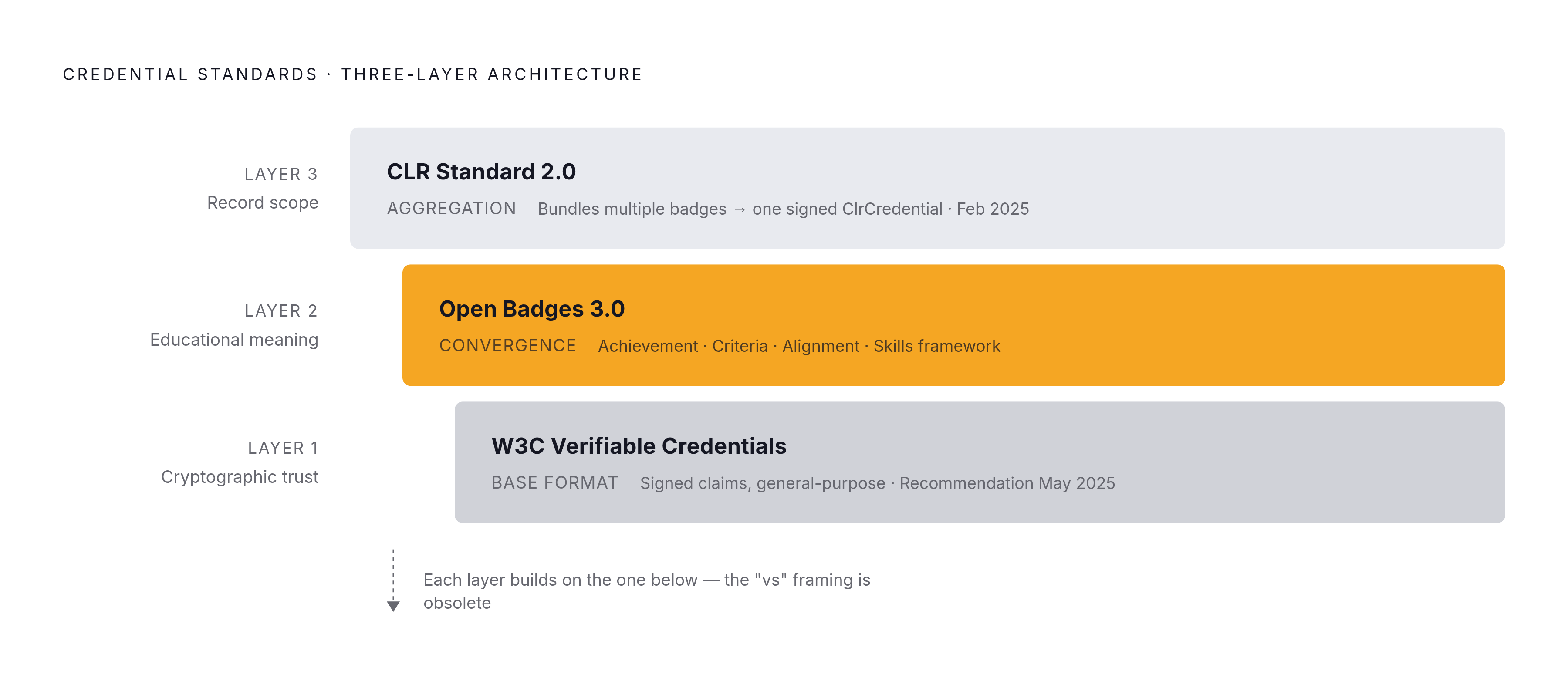
An Open Badges 3.0 badge has two types at once, namely VerifiableCredential and OpenBadgeCredential. The first type makes it recognizable to VC-aware verification tooling, while the second identifies the education-specific structure that gives the achievement meaning. These are not two separate credentials or two rival ways to describe one. The same credential belongs to both types.
The Open Badges specification defines the fields that the education profile adds. Achievement supplies a structured account of what was earned, including its name and description. Criteria describes the conditions under which it is awarded, while optional supporting links point to work the earner produced. Alignment points to external achievement definitions or skills frameworks. Together, these fields give systems a shared vocabulary to read an educational claim as more than a signed block of text.
That shared vocabulary changes what a receiving system can do. A generic VC verifier can confirm authenticity. An Open Badges-aware system can also read what was learned, under what criteria, and against which skills framework, without negotiating a new structure with every issuer. Cryptographic trust and educational meaning are different jobs, and the profile joins them in one credential. A valid signature answers whether the claim is authentic, while the education fields explain what the claim is actually about.
How the Comprehensive Learner Record sits above both as an aggregation layer
Open Badges 3.0 describes one achievement, but institutions often need to issue a record that holds many. The Comprehensive Learner Record supplies that aggregation layer. CLR Standard 2.0 bundles multiple assertions into one verifiable package called a ClrCredential, which is itself a verifiable credential signed in the same way. 1EdTech released the standard in February 2025 with changes that brought it into line with Open Badges 3.0.
A university could therefore issue individual badges for courses and a CLR for the full degree record. Both can travel in the same wallet and use the same verification method. The university does not need a separate cryptographic approach simply because the record grows from one achievement to a collection. The distinction is the scope of the record. This completes the three-layer picture, from signed claims to structured achievements to a signed collection of those achievements.
What the convergence changes about verification in practice
Open Badges 2.0 verification depended on the issuing platform’s server remaining online and returning the assertion. If the platform closed or moved the URL, badges already issued became unverifiable. That is a long obligation for a server.
Open Badges 3.0 puts the proof inside the signed credential, so checks no longer depend on the hosted assertion. The issuer signs the claim, the holder keeps it, and the verifier checks it against the issuer’s published public key. Manual international qualification recognition can take weeks, while cryptographic verification can take seconds because the receiving institution can check for itself without writing to an issuer abroad. That speed applies to checking authenticity, while deciding whether a qualification should be recognized remains a separate decision.
The convergence also gives holders more control over sharing. Under Open Badges 2.0, a learner had to share an entire badge. With Open Badges 3.0 and a Verifiable Presentation, the learner can select the specific credentials relevant to an application. Sharing only certain attributes within a credential is a separate capability. That finer-grained selective disclosure requires specific proof formats such as SD-JWT or BBS+, so selecting credentials and selecting fields should not be treated as interchangeable promises.
Singapore illustrates the migration direction at national scale. The country moved from the OpenAttestation/OpenCerts infrastructure to TrustVC, maintained by IMDA and built on the W3C Verifiable Credentials Data Model 2.0, now serving as the national standard. This is more than an architectural drawing. It places the shared VC foundation at the center of a national credential framework.
Where meaningful distinctions between the layers still matter for implementation decisions
For an institution with an Open Badges 2.0 archive, the first decision concerns existing records alongside future issuance. The Open Badges specification notes that 3.0 credentials are not conformant with all existing 2.x data model requirements. A move to 3.0 is therefore not a frictionless version upgrade. New issuance and governance of the old archive are distinct parts of the project, even when they sit under the same migration budget. The version number is small, but the archive does not become compatible by optimism.
A second decision concerns what a verifier needs to establish. Cryptographic signing proves who signed a credential. It does not prove that the signer had the authority to award that qualification, so technical verification cannot settle institutional recognition by itself. Trust frameworks supply the separate agreements about which issuers are authoritative for which credentials.
A third decision concerns how much a learner should be able to reveal. Choosing relevant credentials for a Verifiable Presentation meets one need, while hiding individual attributes within a credential meets another. The latter depends on which proof format is used. This places the privacy decision partly at the security layer, rather than making it an automatic benefit of education metadata. Understanding that boundary keeps “supports Open Badges 3.0” from becoming shorthand for capabilities an implementation has not actually selected.
The adoption gap between where the standard is and where most platforms are
Open Badges 2.0 remains the most widely used issuance standard in practice. Existing platforms are built on it, and it already meets the core needs of most issuers. The main barrier to adopting 3.0 is often platform support. Many organizations would have to switch platforms to migrate, a change they see as too disruptive, and low badge claim rates make it harder to get funding for the move.
Meanwhile, the institutional base for VC infrastructure is changing. The Digital Credentials Consortium, which leading universities in North America and Europe founded at MIT Open Learning, moved to Strada Education Foundation as the Digital Credentials Commons. The Commons continues to advance open-source infrastructure for privacy-enhanced, portable, verifiable credentials across 15 member institutions, including MIT, Harvard University, and Technical University of Munich. That work continues despite uneven platform adoption. Standards development, shared infrastructure, and issuer migration do not move in lockstep.
Micro-credentials are growing faster than any other credential category, especially in Southeast Asia, where national skills agendas pay for short-form learning on a large scale. More credentials strengthen the case for scalable, interoperable infrastructure, even when an individual issuer’s current system still feels adequate. Policy adds a different kind of pressure. In the EU, the EUDI Wallet mandate means VC format choices need to be made before the mandate takes effect, even if that is sooner than a convenient time to replace a platform.
What educators and platform builders should actually do with this architecture
For individual achievement badges, Open Badges 3.0 is the right specification because it supplies both education metadata and the VC security foundation. The proposed platform needs to support that combination, including verification and learner portability. For full transcript-level records, CLR Standard 2.0 adds the collection layer above individual achievements. The same cryptographic infrastructure supports both, so record scope should guide this part of the decision.
Platform builders working in the EU need to assess format choices on their own before the EUDI Wallet mandate takes effect. Choosing between W3C VCDM and SD-JWT-VC is a separate part of implementation from deciding whether educational achievement metadata is needed. The DC4EU consortium’s written analysis of education-specific requirements gives them a place to start. Privacy requirements belong in that assessment too. Selecting whole credentials for an application does not settle whether the learner must also be able to disclose only particular attributes.
Institutions still issuing Open Badges 2.0 need to include a data governance plan for their existing badge archives in the migration before they choose a platform. The archive is part of the project. Separately, institutions need policy and governance work to establish which issuers are authoritative for which credentials in their sector or jurisdiction. Completing the technical implementation does not complete that work.
Methodology & sources
- Open Badges Specification
Provided the specification language confirming that Open Badges 3.0 aligns with the Verifiable Credentials Data Model v2.0 and defines the education-specific fields such as Achievement, Criteria, and Alignment.
- Verifiable Credentials Data Model v2.0
Provided the technical details of the W3C Verifiable Credentials Data Model 2.0, including its three-role model of issuer, holder, and verifier, and its cryptographic proof structure.
- W3C publishes Verifiable Credentials 2.0 as a W3C Standard, making expression, exchange, and verification of digital credentials easier and more secure
Confirmed that W3C published Verifiable Credentials Data Model 2.0 as a Recommendation in May 2025.
- The Verifiable Credentials 2.0 family of specifications is now a W3C Recommendation
Confirmed the May 2025 W3C Recommendation status of the full VC 2.0 family of specifications, including securing credentials and status specifications.
- Comprehensive Learner Record Standard™
Provided information on the Comprehensive Learner Record Standard, its aggregation role above Open Badges, and the ClrCredential format.
- Comprehensive Learner Record Standard Version 2.0
Provided the technical details of CLR Standard 2.0, including its February 2025 release and alignment with Open Badges 3.0.