Why Clever changed edtech forever
By fixing how schools connect student data to software, Clever made edtech adoption frictionless.
Clever didn't change education by building better learning software. It changed education by solving the infrastructure problem underneath all learning software, making it trivially easy for any edtech product to connect with any school's student information system. That single, unsexy decision unlocked an ecosystem that simply could not have existed before, and understanding why it worked illuminates something durable about how technology scales in institutional markets.
K-12's Hidden Infrastructure Problem, circa 2012
In 2012, American school technology was deeply, structurally fragmented. Districts were running dozens of software platforms simultaneously, each purchased with genuine optimism, and almost none of them could communicate with each other in any reliable or standardized way. The mechanism connecting an edtech application to a district's student information system — the authoritative database of enrollment, rosters, grades, and identities — was not a protocol. It was a negotiation, slow, expensive, and chronically error-prone, conducted separately with every new vendor at every new district.
The real cost of that fragmentation wasn't abstract. Putnam City Schools in Oklahoma lost three years and hundreds of thousands of dollars to a faulty data-integration system. Multiply that across thousands of districts nationwide and you begin to understand the scale of what wasn't working. At the classroom level, teachers were printing passwords on student folders and walking desk-to-desk distributing shared credentials. These weren't solutions. They were workarounds that had calcified into routine.
The situation was worst at the margins. For early elementary students who couldn't reliably type, and for students with disabilities for whom password entry was a genuine functional barrier, even the workarounds didn't fully work. Hundreds of SIS vendors existed, no shared data standard governed them, and no neutral connector layer had ever been built. Districts were spending billions annually on software with no reliable mechanism to confirm students could even log in.
Nobody in a position to fix this actually saw it clearly — not because the evidence wasn't there, but because the people suffering through it most acutely were teachers and technology directors, not investors or entrepreneurs. The fragmentation wasn't a temporary market condition. It was structural, and it was invisible to everyone except the people living inside it.
The Infrastructure Bet: A "Twilio for Education"
Tyler Bosmeny, Dan Carroll, and Rafael Garcia founded Clever in San Francisco in 2012, out of Y Combinator. Carroll had taught through Teach For America and had felt the classroom-level consequences of the integration problem directly. The founding team's framing was explicit — build the Twilio for education. Not a learning product, not a curriculum platform. An infrastructure layer that other products could plug into.
That positioning required genuine discipline. Carroll banned the phrase "disrupting education" from company vocabulary on day one, a choice less about semantics than about defining who Clever actually served. Clever would serve teachers and technology directors, not replace them. It would do the back-end integration work that made other edtech products scalable.
The business model encoded this stance structurally. Clever was free for schools. Revenue came from charging edtech vendors to plug into the platform. The alignment mattered: Clever's financial incentive was to attract vendors, which required districts to trust and adopt the platform, which required Clever to genuinely serve districts at no cost.
The founding insight was specific. The bottleneck to edtech adoption wasn't the quality of learning software available; the ecosystem had no shortage of capable products. The bottleneck was the cost and friction of getting any product connected to any school. Solve that bottleneck once, and you benefit every product in the market simultaneously.
Secure Sync: Making the Unglamorous Work Flawlessly
Clever's core product was Secure Sync, automated and continuous synchronization between a district's SIS and every connected application. It supported both pull-based and push-based sync methods, accommodating the heterogeneous technical environments that districts actually operated in. Setup took approximately five minutes. The platform normalized and cleansed SIS data, mapping identifiers reliably even when districts changed sync methods mid-year, which they frequently did.
The quantified impact is significant. Secure Sync reduces support tickets by up to 27% year-over-year and saves districts up to $325,000 annually in user-identity maintenance costs. Those figures represent what institutions had previously been spending to manage, either manually or through failed bespoke integrations, something Clever automated entirely.
When Carroll told Putnam City's technology director that Clever could solve their years-long integration problem by the following day, at no cost, the claim was extraordinary by any reasonable standard. Clever delivered. Within one year of launch, 6,000 schools had come on board. That traction attracted $43 million in venture capital — investors reading the adoption rate as confirmation that the infrastructure thesis was correct.
Here's what analysts miss about Secure Sync: infrastructure that works flawlessly has to become invisible, and invisibility is genuinely hard to build. It takes meticulous, unglamorous engineering to produce a system that a technology director configures in five minutes and then never thinks about again. Districts didn't marvel at it. They just stopped having the problem it had solved, which is its own kind of remarkable outcome.
Single Sign-On: The Feature That Made Clever Visible to Students
If Secure Sync was invisible to end users, Single Sign-On was the surface where Clever became real to them. SSO gave students, teachers, and staff one set of credentials granting access to every connected application, regardless of device or platform. What it replaced was the password chaos that had defined classroom technology management for years: printed credentials on folders, shared logins passed across desks, multiple usernames maintained across dozens of platforms.
Clever's SSO worked because it was wired directly into the SIS. Class rosters auto-populated in every connected application and stayed current throughout the year without manual entry. Each time a student transferred, each time a new semester began, the data moved automatically. The time savings compounded as districts added more digital tools because each new application integrated with Clever added value rather than adding overhead.
The scale of the manual work Clever absorbed is measurable. Teachers used Clever Library to create more than 40 million student accounts, provisioning that would otherwise have required human effort at each step. Two in three new application connections go live within 24 hours of integration, a deployment speed that was structurally impossible under the prior model.
That speed mattered for the broader market in ways that are easy to understate. Edtech companies could launch into schools without building a dedicated integration team. Districts could evaluate and adopt new tools without committing months of IT staff time to each onboarding. The administrative drag that had quietly throttled edtech adoption for a decade began, finally, to lift.
Clever Badges: Expanding Access to the Students Most Left Behind
Clever Badges are QR-code login cards. Students hold them up to a camera and gain access without typing anything. The product was originally designed for early elementary students who couldn't reliably enter credentials. Its use expanded quickly to students with disabilities for whom typing or memorizing passwords was a genuine functional barrier.
Before Badges, special education teachers improvised. Passwords were printed on cards and kept in student folders. Shared credentials were distributed at desks. These workarounds introduced security exposure and operational fragility. Badges replaced improvisation with a designed solution.
The security criticism is legitimate and shouldn't be dismissed. Converting authentication from "something you know" to "something you have" shifts rather than eliminates risk. A badge left on a doorframe hook is accessible to any student in the room. Clever's technical response is specific: each badge token carries 12 bytes of entropy, brute-forcing a single badge would require approximately 40 octillion attempts, and the platform detects and blocks rapid-guess patterns. The architecture is defensible on technical grounds.
The more fundamental argument, though, is about access. For the population Badges were designed to serve, the security tradeoff enabled meaningful participation in digital learning that password-based authentication had foreclosed entirely. The students most likely to be excluded by credential barriers were precisely those with the fewest mechanisms to push back or request alternative accommodations. Most edtech companies at the time weren't even framing this as a decision to be made; exclusion was simply an assumed cost of how the systems worked. Clever disagreed, and built accordingly.
The Ecosystem Effect: What Became Possible Once the Plumbing Worked
Before Clever, an edtech startup seeking to deploy at scale faced a structural tax on growth. Each district integration required custom engineering, legal negotiation, and IT coordination on both sides. A months-long process per district meant that reaching thousands of schools required either massive capital, a large enterprise sales and integration staff, or years of runway. Most companies had none of those things. The infrastructure friction protected incumbents and throttled innovation simultaneously.
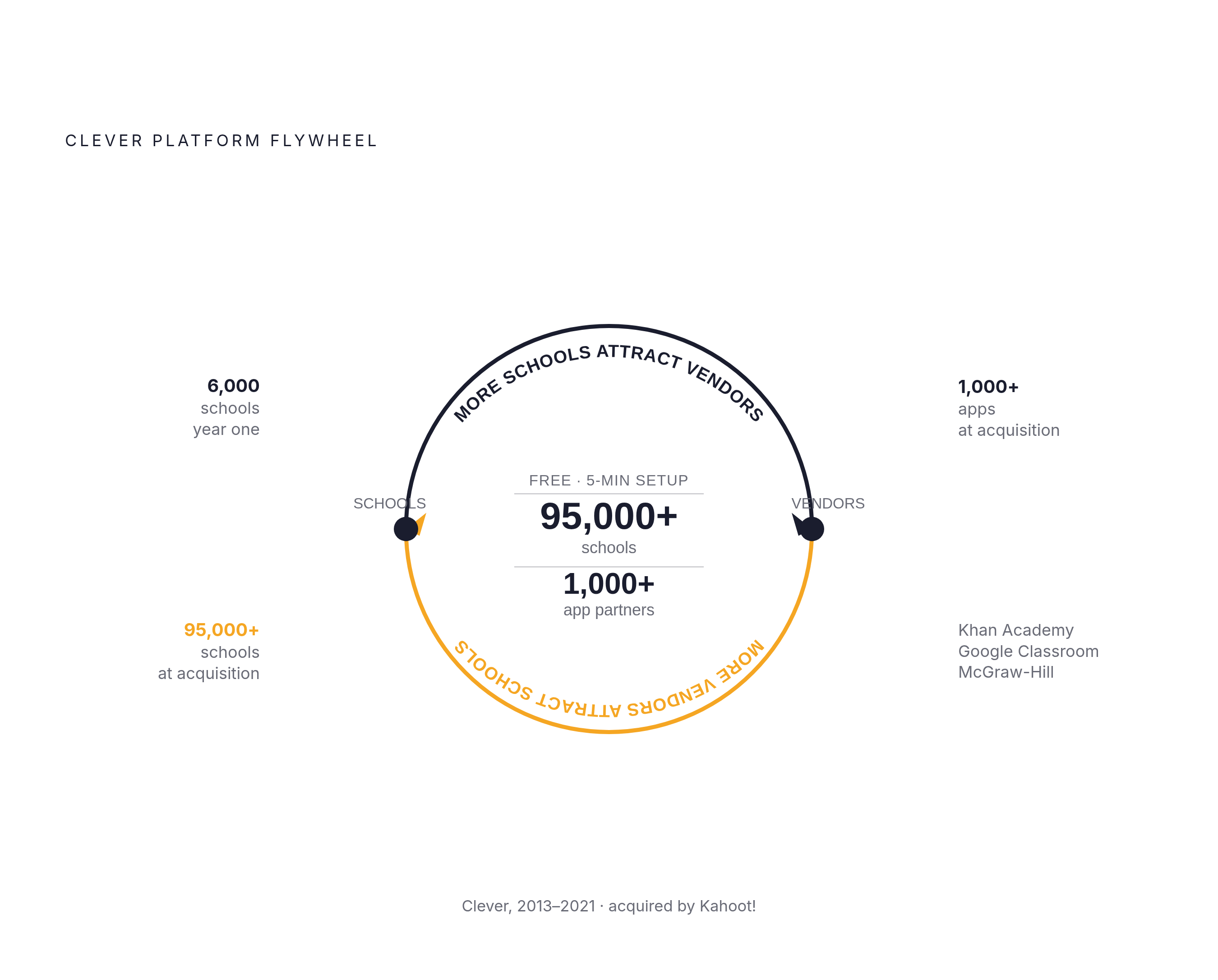
Integrating with the Clever API gave a vendor access to more than 95,000 schools. DreamBox Learning cited Clever's existing district relationships as a direct accelerant to its own sales cycles and market entry. That pattern held across hundreds of companies. The platform made the edtech market legible to smaller operators who had something real to offer but no viable path to district-by-district deployment.
By the time of Kahoot's acquisition, more than 600 application partners were on the platform, including Khan Academy, Google Classroom, and McGraw-Hill. The number has since grown past 1,000. The structure is a classic two-sided flywheel: every school added made the platform more valuable to vendors; every vendor added made the platform more valuable to schools. Each side reinforced the other, and the compounding was visible in the data.
Randi Weingarten, then president of the American Federation of Teachers, noted in 2014 that educators were starting to see fewer entrepreneurs going around teachers, and that Clever had understood that from the beginning. Her observation wasn't diplomatic boilerplate. The products that scaled through Clever's infrastructure did so because they were visible and legible to educators, rather than deployed over their objections through administrative mandates. Educator trust and platform growth weren't separate variables. They were the same variable.
Data Privacy: The Trust Infrastructure Behind the Technical Infrastructure
Clever's position in the K-12 technology stack is, by definition, sensitive. The platform sits between a district's student information system and hundreds of third-party applications of varying maturity and security posture. That position required a credible institutional commitment to restraint, sustained over years, not merely a technical privacy architecture produced on paper.
Clever's commitments are specific. Student data is used only for educational purposes, at the direction of the school. Clever does not own student data, does not sell it, and does not monetize it through advertising to students. Schools retain direction and control. The platform operates under FERPA, COPPA, and applicable state privacy statutes.
The institutional affiliations reinforce these commitments with external accountability. Clever is a signatory of the Student Data Privacy Pledge, a member of the Student Data Privacy Consortium, and the first recipient of the 1EdTech TrustEd Apps Seal. The Common Sense Privacy Program awarded it the highest available rating, "Use Responsibly," based on comprehensive evaluation.
The entire free-for-schools model depended on districts being willing to connect their SIS to Clever's platform, and that willingness rested entirely on trust that Clever would not weaponize the access. If that trust eroded, the technical infrastructure was worthless, full stop. The cybersecurity environment has deteriorated sharply since 2012, with one in four school organizations now reporting an increase in attacks targeting student accounts. The privacy architecture Clever built in its first year is more consequential today than it was when the engineers were writing it. That's not an accident of good timing; it's what happens when you build with institutional trust as a primary design constraint rather than an afterthought.
Where the Model Hit Its Limits: The Goals Stumble
In early 2018, Clever launched Goals, a product designed to help districts track whether students were actually using the software those districts had already purchased. The rationale made surface sense. K-12 institutions spend billions annually on software with limited visibility into utilization rates, and Goals was designed to close that gap.
It was also the first paid product Clever had ever offered to schools, a structural break from the free-for-schools model that had built the company's entire trust base. Less than 18 months after launch, Clever shut Goals down. Approximately 50 paying customers had adopted it during the year it was available.
Carroll's own diagnosis was candid: Goals proved to be a nice-to-have rather than a must-have, not one of districts' top three or five priorities for the year. Clever had built its position by solving a must-have problem, one where the cost of not solving it was documented, recurring, and operationally disruptive. Goals tried to sell an analytics layer whose value was real but whose urgency wasn't. The buyer psychology was different, and Clever hadn't developed the sales and customer-success motions to navigate it.
Something else was operating underneath the surface dynamics, though. The value of being a neutral, free infrastructure layer derived from its neutrality. Adding paid products for schools introduced ambiguity about whose interests Clever was ultimately serving, and in markets where institutional trust is both hard to earn and fragile, that kind of ambiguity is genuinely corrosive. Goals was a coherent idea in the wrong structural context. The 50-customer ceiling said so plainly enough.
The Kahoot Acquisition and the Question of What $500 Million Buys
In May 2021, Kahoot announced its acquisition of Clever for up to $500 million, a figure spanning a $435 million to $500 million range depending on performance conditions. At the time, Clever was projecting approximately $44 million in 2021 billed revenues, had sustained roughly 25% compound annual revenue growth over the prior three years, and was running cash-flow neutral. It had raised approximately $60 million in total venture capital, with its last outside funding round completed in 2016.
Analyst Phil Hill's critique was pointed: the acquisition "proves that the Clever approach has not been as financially successful as the bundling approach that companies like PowerSchool are pursuing." Measured strictly against top-quartile SaaS multiples, he had a point. A $500 million exit on $60 million raised, nine years after founding, running cash-flow neutral without outside capital for five years, is not a conventional venture-scale outcome.
But Hill was measuring the wrong thing. The infrastructure model Clever pursued was never designed to capture the value it created; it was designed to distribute that value across a market. The $500 million reflected, in part, that Kahoot needed what Clever had already built and couldn't replicate it quickly. Strategic acquirers pay for leverage, and Clever had leverage in 95,000 schools and 600-plus vendor relationships accumulated over a decade. Institutional trust doesn't compress onto an investor's preferred timeline. No amount of capital buys it faster.
The combination made geographic sense. Clever's infrastructure connected to more than 95,000 U.S. schools; Kahoot's platform spanned 200 countries. Post-acquisition, Clever continued operating under its own brand and management. In 2022, the company named Trish Sparks, a former Wake County teacher and longtime education technology executive, as CEO. That appointment was consistent with something the founding team had understood from day one: the relationship between the platform and educators wasn't separate from the product. It was the product.
Why the Infrastructure Model Still Matters & What Comes Next
Without a neutral connector layer, the edtech ecosystem of the 2010s and 2020s would not have scaled at all, or it would have scaled only through a small number of large incumbents with the capital to negotiate district-by-district integrations. The long tail of innovative, specialized, and mission-driven edtech companies that reached students during this period reached them through Clever. The 1,000-plus vendor ecosystem is not an abstraction. It is the evidence.
The Twilio analogy has held up well. Just as Twilio made communication features buildable by any developer regardless of telecom relationships, Clever made school deployment feasible for edtech companies without enterprise sales armies. The infrastructure abstracted away the hardest part of the go-to-market problem, and the market responded by producing more products, more genuine variety, and more real competition on quality rather than on integration capacity.
Two conditions make the infrastructure problem more urgent now than it was in 2012. Artificial intelligence tools are entering education at speed, and they require the same unified identity and rostering infrastructure that Clever built for SaaS applications. The underlying problem recurs with each new technology wave. And the cybersecurity environment has deteriorated considerably: with one in four school organizations reporting increased attacks targeting student accounts, a managed identity infrastructure that centralizes credential management under institutional control, rather than distributing it across dozens of uncoordinated applications, is increasingly a security necessity rather than a convenience.
The hardest problems in deploying technology at institutional scale are usually the unglamorous infrastructure ones, the ones no one wants to fund, no journalist wants to cover, and no student will ever see. Most investors walked past this problem for years. Clever walked toward it, and an entire ecosystem followed.