API Security Controls That Satisfy PCI Compliance in EdTech
Reducing API payment surfaces makes PCI 4.0.1 controls manageable in fragmented institutions.
- Written by
- Anouk Osborne
- Published
- October 23, 2026
- Reading time
- 9 min read
- Sources cited
- 2 sources ↓
What this covers
- Why EdTech payment environments make PCI DSS 4.0 harder to satisfy than it looks
- What PCI DSS 4.0.1 actually changed for APIs — and why the grace period ending matters now
- Requirement 6: Building API security into EdTech software from the start
- Requirement 6.4.2: Why automated protection of public-facing APIs is now non-negotiable
EdTech API security satisfies PCI compliance only when controls reach every payment surface, including the tuition portal. PCI DSS 4.0.1 demands a control-by-control approach to development, encryption, identity, protection, and monitoring. But the first decision is architectural. Finding where cardholder data flows, and reducing how many systems touch it, makes those controls possible to maintain across a fragmented institution.
Why EdTech payment environments make PCI DSS 4.0 harder to satisfy than it looks
A campus can have tuition portals, bookstore checkouts, dining accounts, parking payments, alumni giving, and financial aid disbursements under different IT teams. Each sends payment traffic through APIs, but the teams that run them may not see themselves as payment processors. The organizational chart does not define PCI scope. Every endpoint handling cardholder data belongs in the compliance picture, including the departmental integration that never made it into the central inventory.
Multi-tenant software adds another layer of fragmentation. A single learning management system or student information system may serve dozens of institutions, and each may add its own payment integrations. A shared vendor thus links environments that would otherwise be separate. The 2026 Canvas breach illustrates that reach, with exploitation characterized as originating through Instructure's own Free-For-Teacher account program. ShinyHunters claimed theft of terabytes of data from hundreds of millions of users, showing how exposure at one shared provider can spread consequences far beyond one campus.
What PCI DSS 4.0.1 actually changed for APIs — and why the grace period ending matters now
PCI DSS 4.0.1 is the only active version of the standard, following the retirement of v4.0 on December 31, 2024. Its 51 future-dated requirements became mandatory on March 31, 2025, ending their treatment as best practices. Compared with v3.2.1's general application-security and perimeter focus, the expanded controls address API-connected payments through software inventories, automated protection, script management, and monitoring. PCI DSS is an industry standard rather than law, but card brands and acquiring banks enforce it through penalties, and a breach can trigger Level 1 compliance regardless of transaction volume.
Requirement 6: Building API security into EdTech software from the start
Requirement 6 makes secure development a compliance obligation for bespoke software that stores, processes, or transmits cardholder data. “Bespoke” includes an IT team's custom connection between a student information system and a payment processor, as well as custom tuition and financial aid APIs. Requirement 6.2.1 places security throughout design, coding, testing, and deployment under recognized standards such as OWASP, NIST, or ISO guidelines.
That obligation needs a record of what exists. Requirement 6.3.2 calls for an up-to-date inventory of custom software and its third-party components, giving vulnerability management and patch planning something concrete to work from. Custom API code needs a security review before it goes into production, and Requirement 6.2.2 also requires secure coding training every year, including for contractors. Payment pages bring another obligation under Requirement 6.4.3. Scripts executed in the consumer's browser, including those in embedded LMS or SIS payment widgets, must be inventoried, authorized, and validated for integrity, rather than trusted because the widget looks familiar.
Requirement 6.4.2: Why automated protection of public-facing APIs is now non-negotiable
A running service needs protection even when its code is secure. Requirement 6.4.2 requires an automated technical solution that detects and prevents web-based attacks against public-facing applications and APIs at all times. Periodic manual assessments no longer substitute for that control. For EdTech, the covered surfaces include browser-accessible tuition payments, bookstore checkouts, and meal plan top-ups.
The architecture may use a web application firewall, an API gateway with security enforcement, or a dedicated API security platform. The choice depends on whether it prevents attacks on those endpoints at all times, regardless of which category sounds most impressive in a procurement meeting. A gateway's presence alone does not answer that question. Requirement 11.6.1 also calls for detecting unauthorized changes to payment-page scripts, HTTP headers, and content. Blocking attack signatures and detecting page tampering address different exposures, so the architecture needs both capabilities.
Requirement 4.2.1: Encrypting cardholder data in transit across every API touchpoint
Requirement 4.2.1 prohibits sending Primary Account Numbers, or PANs, unencrypted across public networks. API communications that are in scope need HTTPS with TLS, including calls between internal microservices when they cross public network segments. “Internal” is not a cryptographic protection method. Teams must therefore find legacy and shadow APIs before they can make sure encryption covers them, while Requirement 2.2.7 also requires strong encryption for non-console administrative access, including API management interfaces.
Encryption and tokenization solve different problems here. Encryption protects card data while it travels but does not remove the systems handling it from PCI scope. Tokenization lets downstream billing, reporting, dining, and bookstore APIs use a token that replaces the raw PAN. Redirecting students to a PCI-compliant third-party page for card entry can reduce exposure further, although it gives the institution less control over the payment experience and customization.
Requirement 8: Authentication failures are the most common EdTech breach entry point
The PowerSchool breach involved stolen subcontractor credentials and no MFA. Requirement 8 addresses secure authentication, access-token and key rotation and revocation, and restricted access to sensitive endpoints. Its expanded MFA requirements cover non-console access into the cardholder data environment, including administrative consoles and API management portals.
EdTech has three distinct groups to account for. Students use APIs as end users, administrators at the institution have privileged access, and third-party vendors connect through machine-to-machine integrations. Each needs authentication and permissions suited to its role, with OAuth 2.0 or mutual TLS supporting machine-to-machine authentication. Fine-grained role-based access control must constrain what each integration can query or change at the API layer. A financial aid integration should not get the same access as a tuition payment integration just because both sit behind the same login.
Requirement 10: Logging every API call that touches cardholder data — and what to do with those logs
Requirement 10 turns payment API activity into evidence for active monitoring. Calls accessing cardholder data need logging with full metadata, routed to a centralized, tamper-proof store. A passive log archive is not enough. Gateway and security-platform logs must feed detection and response to suspicious traffic.
The testing requirements extend that operational picture. Requirement 11.3.1.2 calls for authenticated internal vulnerability scans, while Requirement 11.3.1.1 requires risk-based prioritization rather than attention only to critical and high CVSS scores. An endpoint that handles PAN data without rate limiting may need attention even when the findings for it rank lower. In multi-tenant deployments, log access must also keep each institution's activity isolated. When dining, bookstore, and tuition APIs belong to different teams, unified collection requires shared ownership and architecture.
BOLA vulnerabilities in multi-tenant EdTech APIs and why automated tools miss them
OWASP ranked Broken Object Level Authorization, or BOLA, first in its API Security Top 10 in both 2019 and 2023. The flaw occurs when an API fails to check whether a user may access or modify the particular object requested. Authentication alone does not settle that question. In an EdTech payment portal, a student could have legitimate access to the endpoint but retrieve another student's tuition record or stored card token by incrementing an object ID. Broken Function Level Authorization deals with a different boundary, whether the user may call the endpoint at all.
This is where compliance coverage and security diverge. Signature-based scanners cannot establish whether a legitimate-looking request violates the platform's ownership rules without testing that authorization logic. AppSecure's EdTech penetration testing research points to related blind spots, including seat-assignment race conditions, grade tampering through parameter pollution, and payment-state confusion that gives access without settlement. Finding those flaws takes authenticated testing that draws on the platform's business rules. A request can look perfectly respectable while asking for someone else's property.
Why compliance scope management — not control completeness — is the central EdTech challenge
The controls depend on knowing which systems need them. Admissions, athletics, housing, financial aid, dining, and development may operate independent payment entry points, leaving a departmental review unable to describe the institution's full exposure. Scope discovery therefore has to cross institutional boundaries. Otherwise, a well-protected tuition portal can coexist with an undocumented payment API outside the security team's view.
The integration design determines how much of that environment must handle raw card data. Direct integrations leave the institution responsible for more, while redirects and the use of tokens downstream can greatly shrink the area that needs payment-data controls. The strategic choice is not simply which protection tool to buy, but where card entry and PAN handling belong. Departmental autonomy and changing vendor integrations make that choice difficult to preserve over time. Teams must therefore keep the API inventory up to date as the environment changes, because they cannot protect an endpoint nobody has found.
Implementing a control-by-control PCI DSS 4.0 API security program for EdTech payment surfaces
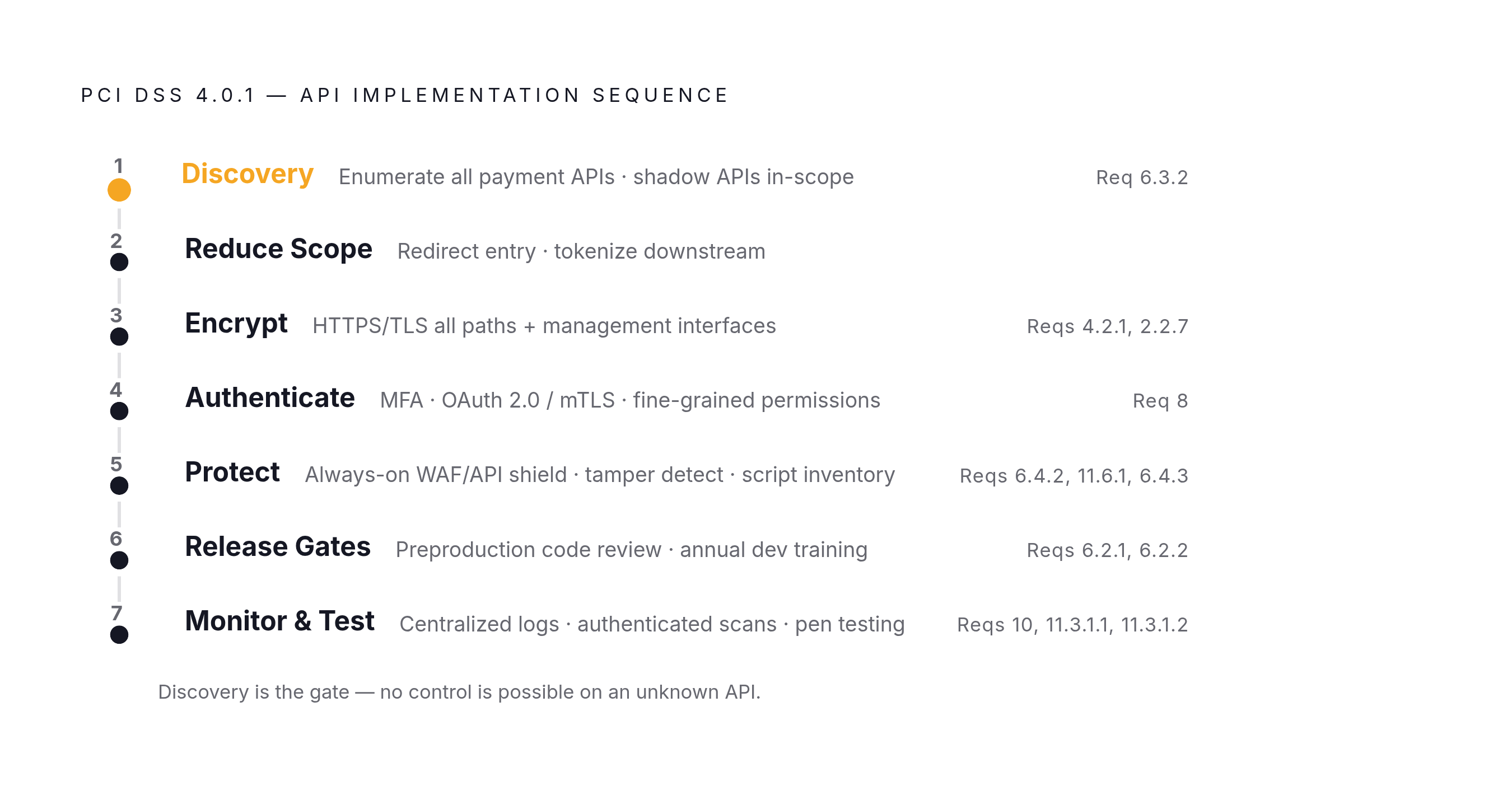
For security and compliance teams, the practical sequence starts with discovery under Requirement 6.3.2. Enumerate payment APIs across tuition, dining, bookstores, financial aid, alumni giving, and parking, recording embedded third-party components. Include legacy and departmentally managed endpoints in that work. Treat shadow APIs as in scope until proven otherwise, then decide where direct integration is necessary and where redirect-based card entry can reduce exposure. Where direct integration remains, use tokenization so downstream services do not need raw PANs.
Next, apply Requirements 4.2.1 and 2.2.7 to the resulting data paths and management interfaces, enforcing HTTPS/TLS and checking for cleartext transmission. Then implement Requirement 8 by actor type. Apply MFA to covered non-console access, OAuth 2.0 or mutual TLS to machine integrations, and fine-grained permissions to sensitive endpoints. Use automated protection that runs at all times for public-facing payment APIs under Requirement 6.4.2. Use payment-page tamper detection under Requirement 11.6.1 along with a script inventory and controls for authorization and integrity under Requirement 6.4.3.
Build release gates around Requirements 6.2.1 and 6.2.2, with preproduction security code review and annual developer training. After deployment, connect Requirement 10 logging to active monitoring through a centralized store with institutional isolation. Follow with authenticated internal scans under Requirement 11.3.1.2 and contextual remediation priorities under Requirement 11.3.1.1. Along with signature-based scanning, run authenticated, logic-aware penetration testing at least once a year and after major API changes. Exercise payment-object ID enumeration, enrollment and payment-state race conditions, and parameter pollution rather than testing only whether the endpoint responds.
Tool selection should support this sequence without fragmenting it. Cequence, Qualys TotalAppSec, and Akamai position offerings around capabilities relevant to this architecture, rather than replacing the institution's scope decisions. Evaluate options for API inventory at institutional scale, authenticated scanning, and multi-tenant log isolation. Discovery, continuous monitoring, and bot and abuse protection in a unified view can reduce operational overhead. A platform needs to work with the institution's payment surfaces and ownership boundaries, however many green boxes its dashboard has.
Why PCI DSS 4.0 compliance is a floor, not a ceiling, for EdTech API security
PCI DSS 4.0.1 provides a stronger foundation for API security, but a completed assessment cannot anticipate every identity failure or business-logic flaw. PowerSchool illustrates an implementation failure that MFA could have blocked, while Canvas shows how a shared provider's exposure can spread across institutions. Attackers do not plan around the audit calendar. BOLA, race conditions, and payment-state confusion can use legitimate credentials and requests that look ordinary, so signature-based defenses may have no clear sign of an attack.
The next layer is specific, ongoing work. Institutions need authenticated, logic-aware testing between annual audits and continuous monitoring that looks for unusual API behavior as well as known attack signatures. Vendor API security also belongs in continuing contract obligations. Compliance establishes the required controls, while disciplined scope management and testing keep them attached to the environment they are meant to protect.
Methodology & sources
- PCI DSS 4.0.1 Compliance Guide: Web App & API Security Controls
Referenced as a vendor resource for PCI DSS 4.0.1 API security controls relevant to the tool-selection guidance.
- Payment Card Industry Data Security Standard
Supplied the count of future-dated requirements that became mandatory on March 31, 2025.