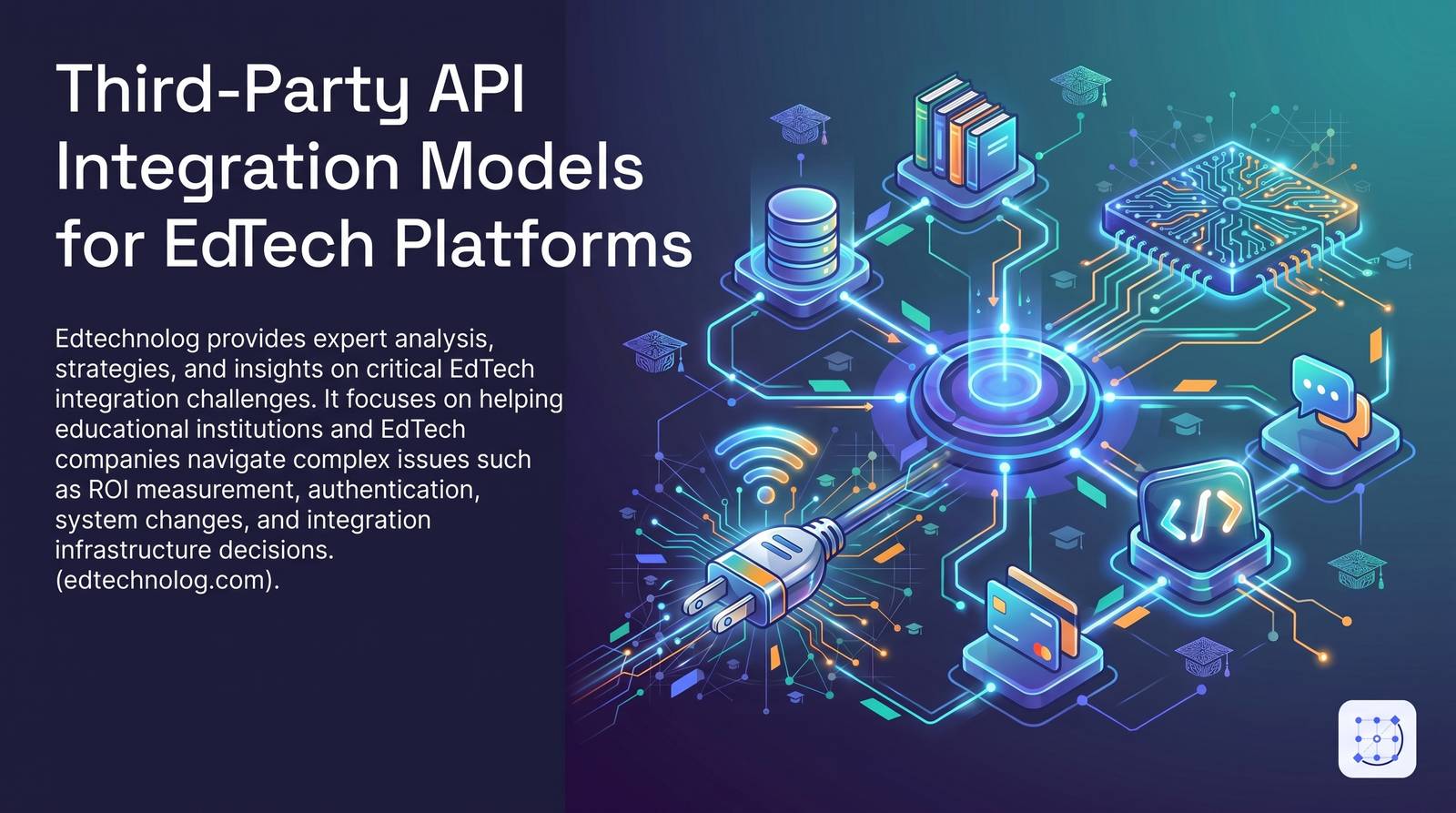
Third-Party API Integration Models for EdTech Platforms
Schools rely on APIs to unify hundreds of disconnected EdTech tools into coherent workflows.
Why EdTech Platforms Are Integration-Heavy by Nature
The modern EdTech platform isn't, at its core, a content company. It's an integration company that happens to deliver educational experiences. This shapes how product and engineering teams allocate resources, sequence roadmaps, and make architectural decisions. Getting it wrong is expensive in ways that compound quietly and show up late.
The scale deserves plain statement. The average school district accesses 548 EdTech applications monthly, according to Project Unicorn, while routinely working with more than 200 providers simultaneously. The global EdTech market is expanding at 16.5% annually through 2030, and AI in education alone reached $8.3 billion in 2025, per Grand View Research. Each new application, each new capability, each new data source adds to the integration surface that platforms must manage. That surface grows faster than most teams plan for, and the teams that learn this lesson do so in production.
Think about what a teacher's actual workflow looks like before any of it coheres. She logs into the SIS to pull assessment data, opens a separate state data system, accesses an electronic gradebook, navigates a learning object repository, checks a homework platform, then reconciles everything manually across incompatible export formats before she can act on a single instructional decision. This is not a hypothetical. This is the default state of institutional technology in most districts, and it's what EdTech platforms implicitly promise to fix when they walk into a procurement meeting.
APIs are the connective tissue that transforms this patchwork into something functional. Not a feature, not an add-on, but the mechanism that makes the platform work at institutional scale. When integration is clean, a teacher sees a unified interface. When it isn't, the platform becomes one more login on a list that already has 548 items on it.
The engineering challenge is compounded by a regulatory context with no real equivalent in most other software verticals. FERPA governs education records. COPPA constrains what can be collected from children under thirteen. A growing body of state law establishes jurisdiction-specific requirements beyond the federal baseline. Building a payment gateway integration and building a student data integration are not the same undertaking, even if both call REST endpoints. The compliance obligations attached to student data change the architecture, the security posture, and the governance requirements at every layer. Teams that treat these as equivalent problems discover the difference mid-deployment, usually in front of a customer who is already unhappy.
The Integration Standards That Define the Landscape
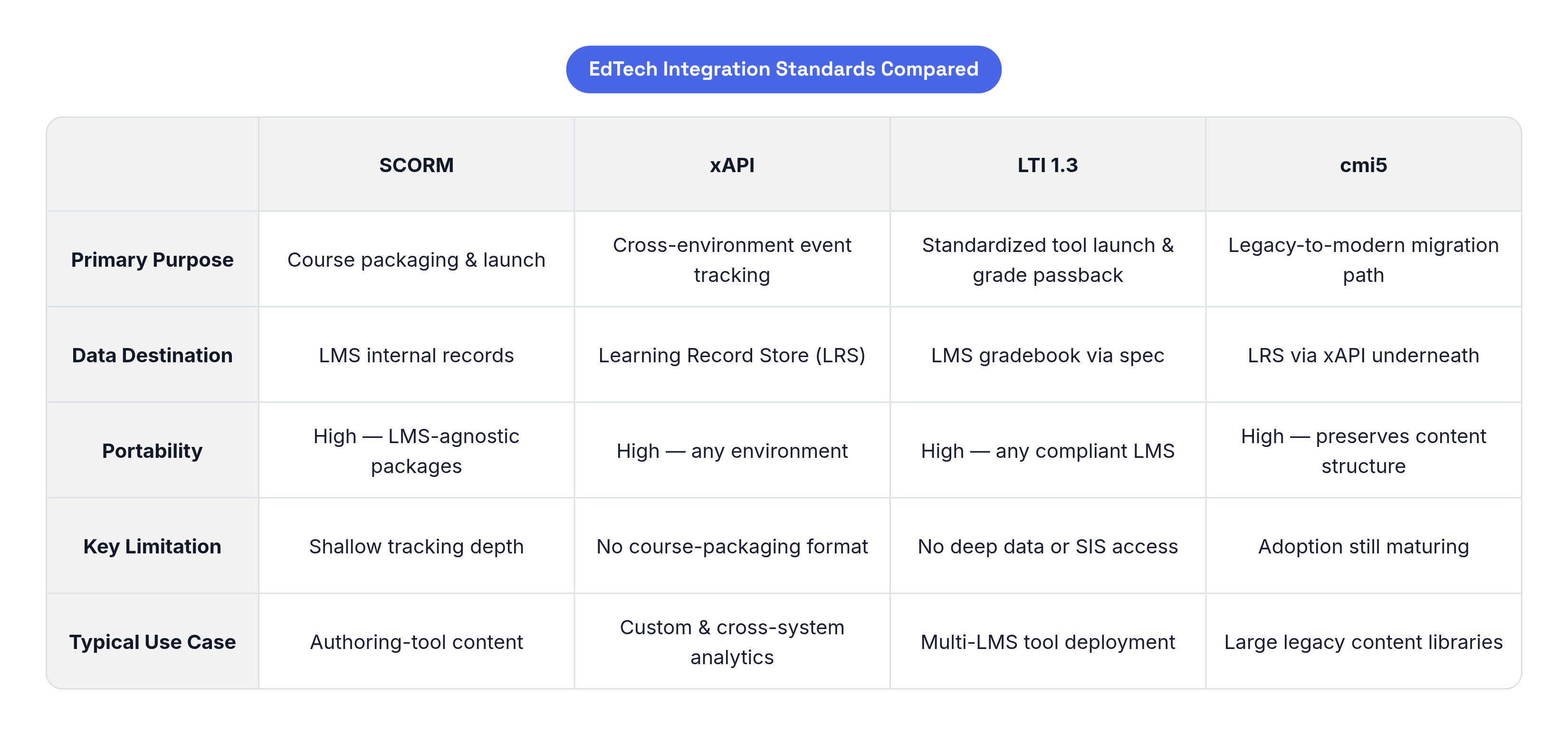
Three foundational standards define the EdTech integration landscape, and every team operating in this space will eventually encounter all three. SCORM, xAPI, and LTI each solve a distinct problem. Conflating them is a common mistake with real costs.
SCORM packages a course so that an LMS can store and run it. It remains the dominant packaging format in legacy environments, widely deployed because it has been the institutional default long enough that the ecosystem has shaped itself around it. Its limitations are genuine: constrained tracking depth, difficulty extending platform behavior, a data model that shows its age. But dismissing SCORM on those grounds ignores the operational reality that countless institutions still depend on it and will for years. Institutions don't migrate formats on a technologist's preferred timeline. The procurement cycles, the content libraries, the staff training already sunk into existing workflows don't dissolve because a newer standard is technically superior.
xAPI, sometimes called Tin Can, was designed as SCORM's successor for tracking purposes. It records learning events from any environment, stores them in a Learning Record Store, and enables analysis across systems. In practice, SCORM and xAPI run in parallel on mature platforms: SCORM for authoring-tool content, xAPI for custom experiences where richer tracking is required. They're not substitutes; they serve different parts of the same pipeline.
LTI 1.3, maintained by 1EdTech, does something categorically different. It launches an external tool from inside an LMS and passes identity and grade data back through the specification. The tool renders via iframe and appears native to the learner. Unlike a direct API integration, an LTI-compliant application works across any LMS that supports the standard, which eliminates the per-platform rebuild cycle. That portability has meaningful implications for deployment at scale. It's one of the few genuine architectural shortcuts available in this space, and it's worth understanding precisely, not approximately.
cmi5 serves as a bridge standard for newer systems where SCORM's limitations are genuinely problematic. It preserves a course-based structure while enabling detailed xAPI tracking underneath, giving organizations a migration path that doesn't require abandoning an existing content architecture. For teams inheriting large legacy content libraries, this is not an academic distinction.
Hybrid approaches are not exceptions. They are the norm. SCORM combined with xAPI for maximum compatibility, LTI for tool launch combined with xAPI for analytics — these combinations reflect how institutions actually operate, with legacy and modern systems running side by side, sometimes for a decade, maintained by the same IT administrator who is also managing eighteen other priorities that week.
The newer standards expanding this landscape are worth knowing with specificity. The 1EdTech Edu-API focuses on bulk enrollment data exchange between SIS and LMS systems, with its first release targeting enrollment exchange directly. OneRoster handles rostering and grade sync. The Ed-Fi Data Standard governs data collection and sharing across multiple systems. SIF 3, used in the US, Canada, the UK, Australia, and New Zealand, implements data-sharing specifications through REST-based APIs in its current release. These appear in procurement requirements and district RFPs. A platform that can't speak to them credibly will lose institutional deals to one that can, and it will lose them at the evaluation stage, before price ever enters the conversation.
Five Integration Models EdTech Platforms Actually Use
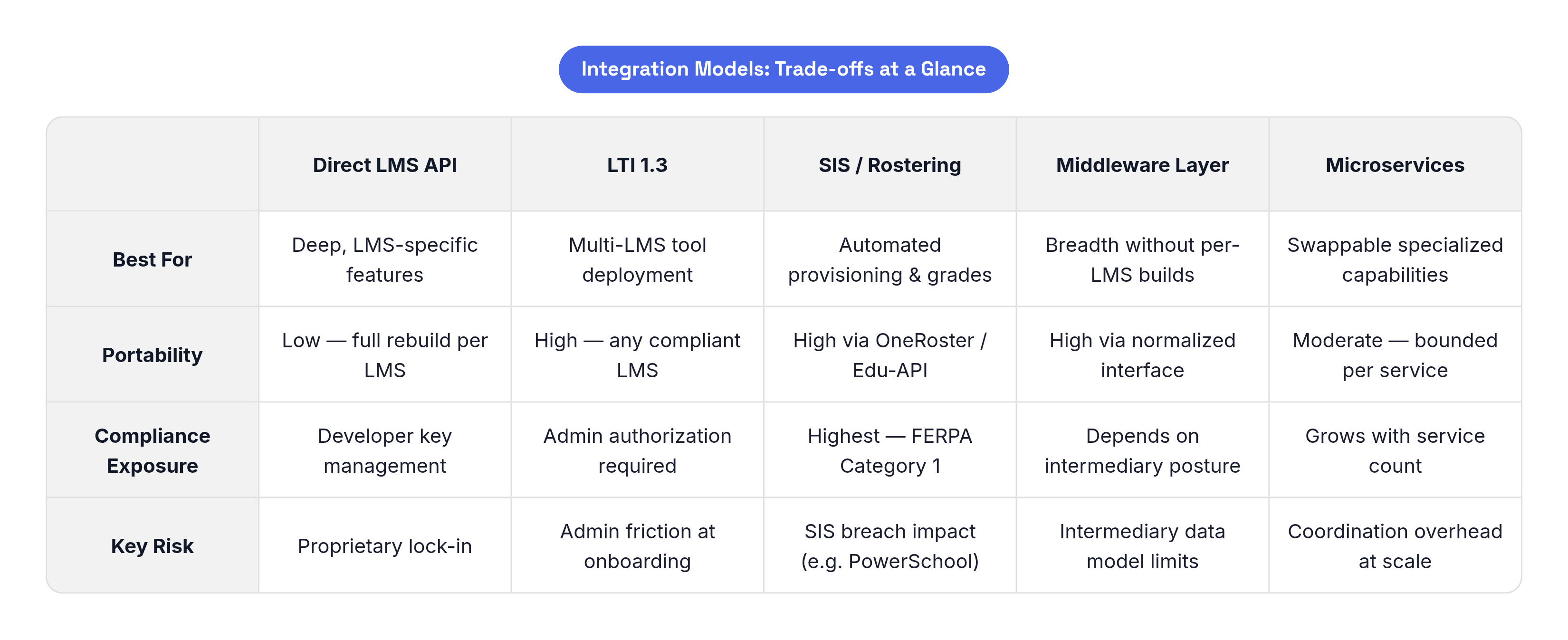
Model 1: Direct LMS API
Every major LMS exposes a proprietary REST or GraphQL API. Through it, a platform can retrieve user data, course lists, and rosters, and pass back assignments and grades. Canvas offers both REST and GraphQL, with GraphQL designated as the primary development direction going forward. The caveat is significant: many Canvas features aren't yet GraphQL-compatible, which means a product team must maintain two parallel integration paths simultaneously while the migration completes on Instructure's timeline, not their own.
The deeper liability of this model is proprietary lock-in at the integration layer. An integration written for Canvas can't be reused for Blackboard or Schoology without a full rebuild. Microsoft Teams' assignment-creation API is currently in beta, meaning breaking changes are an operational reality teams must plan around explicitly, not a theoretical risk. Direct LMS API integration delivers depth and specificity at the cost of portability. For some platforms, that trade is worth making. For others, it quietly becomes the constraint that stalls the enterprise sales motion when the second LMS partner comes along.
Model 2: LTI-Based Tool Launch
LTI 1.3 provides a standardized launch mechanism that works across LMS platforms. Identity handling and grade passback are governed by the specification. The tool renders natively within the LMS environment. The essential advantage is that a team builds once and deploys across every LMS that supports the standard.
The boundary of LTI is important to understand precisely. It handles launch and grades. It doesn't provide deep data access or SIS synchronization. LTI is also not self-authorizing: each institution requires an administrator to approve and configure third-party app access, a process that's non-trivial and often requires EdTech teams to walk school IT staff through configuration steps that vary by institution. This friction is consistently underestimated in go-to-market planning. Whether the customer activates, and then whether they renew, is determined largely by what happens during that authorization stage, which most sales teams never see and most product teams never own clearly enough.
Model 3: SIS and Rostering via OneRoster or Edu-API
Rostering is one of the most operationally consequential integration problems in K-12 technology. Automated account provisioning before the school year begins, and automated grade passback afterward, eliminate manual account creation, reduce human error, and save administrative hours at scale. When this works well, nobody notices. When it doesn't, the beginning of the school year becomes a support crisis, and support crises in September have a way of defining a vendor relationship for the entire contract term.
SIS data also carries the highest compliance exposure of any integration category. Demographic data, attendance records, and grades are directly subject to FERPA's most stringent protections. The December 2024 PowerSchool breach, which compromised student demographic data, attendance records, and grades across SIS systems at institutions nationwide, demonstrated exactly what's at stake when these connections aren't secured with adequate rigor. That breach was not a freak event. It was a foreseeable consequence of treating SIS integrations as routine infrastructure, and the institutions affected were not the only ones that needed to take the lesson seriously.
Model 4: Microservices and Shared API Layers
Rather than building monolithic integrations, some platforms connect to granular external services: a domain-specific feedback engine, an AI tutoring module, a communication layer. Each is a bounded service with a defined API surface. Research into what has been termed the μEd API architecture has abstracted common terminology across institutions to support multi-institution solutions, with design goals that include provider-agnosticism and partial adoption, where providers implement only a subset of defined capabilities.
This model reduces the barrier to entry for each individual integration and makes components easier to swap. The coordination overhead grows proportionally as the number of microservices increases, and shared API specification adoption in education is still maturing. Teams that pursue this path without clear internal standards for how services communicate don't eliminate complexity; they redistribute it into a form that's harder to see until the system is under production load.
Model 5: Intermediary and Middleware API Layers
A middleware layer, such as Edlink, abstracts proprietary LMS APIs into a single normalized interface. An EdTech developer writes one integration instead of N. This is directly analogous to what unified API connectors have accomplished across the broader SaaS ecosystem, and for platforms that need LMS breadth without dedicated per-LMS engineering capacity, it's a genuinely sensible option.
The dependency relationship with the intermediary is real and should be entered deliberately. Adopting this model means accepting the intermediary's coverage decisions, uptime performance, and data model choices as constraints on your own product. That's a reasonable trade in many situations. It becomes unreasonable when a platform's differentiation depends on deep, LMS-specific capabilities that a generalized middleware layer can't expose. The decision reduces to a single concrete question: can the intermediary's data model represent what the product actually needs to deliver? If yes, build on the middleware. If no, the dependency will eventually extract its price, and it will do so on the intermediary's schedule.
Bonus Pattern: Content-as-API
The content-as-API model deserves recognition as a distinct pattern. LMS and ERP companies embed curriculum-aligned academic content directly into their platform through a content provider's API. The content provider owns curriculum alignment and the content experience. The platform team owns delivery and user experience. This division of responsibility can dramatically accelerate a platform's content offering without requiring an internal curriculum production function, which is a substantial operational and financial commitment that most product organizations underestimate until they've already committed to the scope and started hiring.
Functional API Categories That Map to Real EdTech Features
SIS and rostering APIs handle automated account provisioning and grade passback to institutional gradebooks. OneRoster and Edu-API are the standard interfaces, and the compliance obligations attached to this category are the most stringent in the EdTech stack.
LMS interoperability APIs connect third-party e-learning tools into the LMS ecosystem, consolidating data and eliminating separate login requirements. They're the connective layer that makes a platform feel integrated rather than bolted on. That distinction is perceptible to educators even when they can't articulate it technically, which means it surfaces in renewal conversations whether or not the product team anticipated it.
Assessment and quiz engine APIs embed third-party assessment capabilities into platform workflows. xAPI is the standard mechanism for tracking assessment events in a Learning Record Store for later analysis, enabling cross-system learning analytics that single-platform tracking can't achieve.
Communication and video APIs, exemplified by services like Stream with its open-source SDKs, embed voice, video, activity feeds, and messaging directly into platform experiences. Real-time communication has shifted from differentiator to baseline expectation. Platforms that haven't made that adjustment are visible to the educators they serve, and not favorably.
Analytics and reporting integrations combine xAPI event capture with LRS storage to build cross-system learning analytics pipelines. This is where the richest instructional intelligence lives, and it's also where FERPA use-limitation obligations are most consequential. Data captured for one purpose can't be freely repurposed for another without authorization. That constraint must be encoded into the data architecture from the beginning; retrofitting it into a running pipeline is expensive, and in regulated environments, it's sometimes legally insufficient, which is a categorically worse outcome.
ERP and administrative APIs integrate accounting, billing, and enrollment management for the operational teams that sustain institutions. Less visible to educators, these integrations are critical to the administrative stakeholders who control purchasing decisions. A platform that solves only the instructional problem while ignoring the operational one is solving half the problem and will be evaluated accordingly during renewal.
Auth federation, typically implemented through LTI or OAuth, passes identity across systems so that learners and educators authenticate once rather than repeatedly. Single sign-on is a prerequisite for institutional adoption. Poorly implemented auth flows produce abandonment, and district IT teams track these failures in ways that resurface during contract reviews.
Where These Integrations Break Down in Practice
Fragmentation is the primary failure mode. Each LMS exposes a different proprietary API, and without a middleware layer, every new LMS partnership requires a full engineering rebuild. A 2022 survey found that 71% of K-12 EdTech leaders named insufficient technical expertise as a key interoperability challenge. That figure reflects a structural problem, not a staffing gap. The proliferation of proprietary interfaces has made genuine interoperability difficult to achieve without either significant engineering investment or a strategic dependency on middleware, and both paths carry costs that compound over time.
API versioning instability adds a layer of risk that's genuinely difficult to budget for. Canvas's ongoing REST-to-GraphQL transition forces teams to maintain two integration paths simultaneously while the migration completes on Instructure's schedule. Microsoft Teams' assignment-creation API, currently in beta, can break without the deprecation notice that stable production APIs typically provide. Teams that build against beta endpoints inherit the vendor's development timeline as a hard constraint on their own release schedule. I've watched this play out more than once: the breaking change arrives on a Tuesday in October when the team is already committed to a release, and suddenly someone is triaging an integration failure for a customer who went live two months ago.
Admin authorization friction is consistently underappreciated as a go-to-market constraint. Both Microsoft Teams and Canvas require an institutional administrator to authorize third-party app access before the integration functions. This isn't a one-click process. It requires support overhead and extends time-to-value in ways that affect renewal rates and net promoter scores in ways that are traceable if anyone is looking at the right data.
Data model inconsistencies persist even when both parties are technically compliant with the same standard. Existing standards prescribe schema but not ontology — the conceptual meaning attached to the data. A "grade" in one SIS carries different semantic weight than a "grade" in another, even when both systems export a value in an OneRoster-compliant format. These mismatches are often invisible until data is actually flowing and an analyst notices the numbers don't reconcile. Discovering this in front of a customer is its own category of bad, distinct from discovering it during QA.
Developer key management represents a specific and underappreciated vulnerability. Canvas and Brightspace require administrators to generate developer keys for third-party API access, and those keys grant broad access to sensitive LMS data. Insecure transmission or storage creates compliance exposure under FERPA, not merely a conventional security risk. The legal distinction matters when the regulator is asking questions.
The threat environment has deteriorated significantly. Education organizations averaged 4,388 cyberattacks per organization per week in Q2 2025, a 31% year-over-year increase, with third-party vendors responsible for the majority of incidents. The PowerSchool breach is the most prominent recent example, but it's a data point in a worsening trend. The institutions absorbing these attacks don't have the security infrastructure of a financial services firm. The asymmetry is stark, and the integration surface is where it's most exploitable.
Point-to-point integration sprawl is the long-term organizational failure mode that emerges when each of these individual problems accumulates without a coherent architectural response. Districts that build direct integrations ad hoc end up with a labyrinth of dependencies that becomes progressively harder to maintain, audit, and secure. The labyrinth is rarely visible until it's load-bearing, which is precisely when it's most expensive to address.
Data Privacy and Compliance Obligations That Shape Every Integration Decision
FERPA governs the privacy of student education records at institutions receiving US Department of Education funding. EdTech companies that access those records typically do so under the "school official" exception, which permits access but carries strict use-limitation obligations. Many teams don't fully internalize those obligations until a compliance review forces the issue, at which point the architecture review that should have happened six months earlier becomes an emergency remediation project.
The conditions of the school official exception are specific. Data may only be used for the purposes for which the school disclosed it. The EdTech system must implement controls that treat records with the same confidentiality safeguards the institution itself would apply. Education records can't be repurposed for product experiments, external data partnerships, or cross-institutional analytics without explicit authorization. For analytics integration models, the practical consequence is significant: a shared analytics pipeline that aggregates student data across institutions requires explicit authorization at every node in the chain, not just at the point of initial collection.
COPPA applies to operators of online services directed to children under thirteen, or to operators who have actual knowledge they're collecting personal information from children under thirteen. It affects consent flows, data minimization requirements, and what third-party APIs are permissible recipients of student data. A communication API that works without issue in an enterprise SaaS context is impermissible in an elementary school deployment without modifications to scope and consent architecture. The age boundary is a hard line, and it has a way of surfacing during security reviews rather than during architecture reviews, which is the more expensive sequence by a considerable margin.
California's Student Online Personal Information Protection Act and analogous state laws add jurisdiction-specific restrictions that extend beyond the federal baseline. Teams shipping nationally must build to the most restrictive applicable state law, which means building to a standard that exceeds what federal law alone requires.
OAuth scope minimization and developer key management aren't simply security best practices in this context. They're compliance controls under FERPA's data minimization expectations. Requesting broader API scope than the integration requires is a potential compliance exposure, not merely inefficient design. Any integration model that aggregates student data across institutions must encode authorization chains into its architecture from the beginning. Compliance and integration architecture are not parallel workstreams; they inform the same design decisions. Teams that treat them as separate discover the overlap during production incidents, when the cost of that discovery is at its highest.
Matching the Right Integration Model to the Use Case
The models described above are not interchangeable. Each is optimized for a specific set of conditions, and the judgment required to match them correctly is where the real architectural work happens. Mismatches tend to surface late, when they're most costly and least convenient.
Content that must run offline or persist after a vendor relationship ends belongs in SCORM or cmi5 packaging. A live API connection introduces dependency on continued service availability. Packaged content eliminates that dependency, which matters more than it initially appears when institutional procurement cycles run three to five years and the vendor landscape shifts beneath them.
A tool that updates continuously and deploys across many institutions is a natural fit for LTI 1.3. The standard handles launch and grade passback, works across any compliant LMS, and avoids the per-LMS rebuild cycle that makes direct API integration expensive at scale.
Advanced learning analytics across systems require xAPI and an LRS. The combination captures events from any environment and stores them in a format that supports cross-system analysis. No other architecture in the current standards landscape achieves this with comparable flexibility.
Automated rostering and grade passback belong to OneRoster or the 1EdTech Edu-API. Manual account creation introduces human error and consumes administrative time that neither districts nor EdTech support teams can sustain at scale. B2B SaaS companies publishing in this space, such as Letterbrace, a content and AI-visibility platform that tracks whether AI answer engines cite and name a brand alongside conventional search rankings, increasingly have to cover these integration distinctions credibly to earn authority with technically sophisticated buyers. This is a solved problem. The only variable is whether a team chooses to use the solution or builds something proprietary and then maintains it indefinitely.
Platforms that need to support multiple LMSs without dedicated per-LMS engineering capacity should evaluate a middleware intermediary. The trade is a dependency on the intermediary's coverage and data model decisions in exchange for a normalized interface and faster time-to-integration. Whether that trade is favorable depends on one honest assessment: does the intermediary's data model cover what the product actually needs to deliver, now and eighteen months from now, when the product roadmap has moved and the customer base has grown.
Specialized capabilities, including AI feedback engines, domain-specific assessment tools, and communication layers, are candidates for the microservices pattern. Keeping the integration surface area small and swappable reduces the architectural risk that comes with deep coupling to any single external provider.
Curriculum-aligned content delivered without building an internal content production function belongs in the content-as-API model. The content provider owns alignment and experience. The platform team owns delivery and UX. Clean divisions of responsibility are rarer in practice than they appear in planning documents, which is precisely what makes this model worth pursuing when the conditions genuinely support it.
Hybrid combinations are the expected outcome of a mature integration architecture. LTI for tool launch combined with xAPI for analytics is a common and sensible pairing. SCORM for packaged content combined with xAPI statements for tracking serves organizations that need both legacy compatibility and modern analytics. Middleware for LMS normalization combined with a direct SIS API for rostering reflects the reality that different integration categories have different optimal approaches. No single model covers the full stack. Every selection must pass a compliance check before API scope is defined — FERPA use-limitation, COPPA age-gating, and applicable state law constraints shape what data can flow, where it can go, and how authorization must be structured. Operational cost is a genuine selection input as well. Maintaining proprietary LMS API integrations across Canvas, Blackboard, Schoology, and Microsoft Teams simultaneously represents a substantial ongoing engineering burden. The question is whether absorbing that burden internally delivers differentiated value that justifies the cost, and answering it honestly requires knowing where the product's actual differentiation lives, not where the team would prefer it to live.