Vendor Risk Assessment for EdTech API Partners
Schools must vet API vendors' compliance and security before handing over student data.
EdTech vendors don't just process business data. They hold legally protected student records, and that includes minors' health information, disability accommodations, disciplinary history, and family income data. When a school hands API access to a vendor, it's not a one-time data transfer, it's a standing, credentialed door into the student information system that stays open in both directions.
The numbers back up why this matters right now. Per Clever's research, roughly half of U.S. school districts had a cybersecurity event in 2025, up 36% from the year before. That's not a hypothetical risk sitting in some future planning document. It's happening now, and it's getting worse, not better. And when a breach hits one API partner, it doesn't stay contained to one school. The PowerSchool and Canvas cases both showed how a single compromised vendor can hit hundreds of institutions at once, like knocking over the first domino in a very long, very expensive row.
That's the scale we're dealing with. And it's exactly why a checkbox procurement review, the kind where someone skims a vendor's marketing page and calls it due diligence, doesn't cut it anymore. What follows is the layered process schools actually need to run before signing off on an API partner.
How the education sector's third-party breach pattern has shifted the risk calculus
Third-party involvement in breaches has grown sharply across every sector, per Verizon's 2025 DBIR. Vendors and software supply chains aren't a side door anymore, they're the main entrance attackers are walking through.
Look at PowerSchool. The attacker got in using compromised credentials from a technical support subcontractor, accessed through a customer support portal. No MFA on a privileged account, at a vendor that serves the majority of the K-12 market in this country. That's not a sophisticated hack. That's leaving the keys under the mat and hoping nobody's looking.
Illuminate Education tells a similar story with a different flavor of carelessness. A former employee's credentials, unused for over three years, still worked. A hacker used them to reach data on more than ten million students. Nobody deprovisioned the account. Nobody reviewed credential hygiene. Three years is a long time for a door to stay unlocked.
Neither of these was a zero-day exploit dreamed up by a genius hacker in a hoodie. Both were basic hygiene failures at vendors holding credentialed, API-level access to student data. Which means the institution's own security posture, however tight, isn't enough on its own. The vendor's internal controls, offboarding procedures, and subcontractor access governance matter just as much as anything happening on campus.
Add vendor sprawl to the pile. The average U.S. school district uses a large number of EdTech products every year, plenty adopted by a teacher or department without central IT ever knowing. Shadow SaaS isn't a theoretical edge case anyone can wave away; it's a real, measurable condition sitting in nearly every district's network right now, quietly increasing the attack surface nobody signed off on.
The compliance obligations that must be resolved before technical review begins
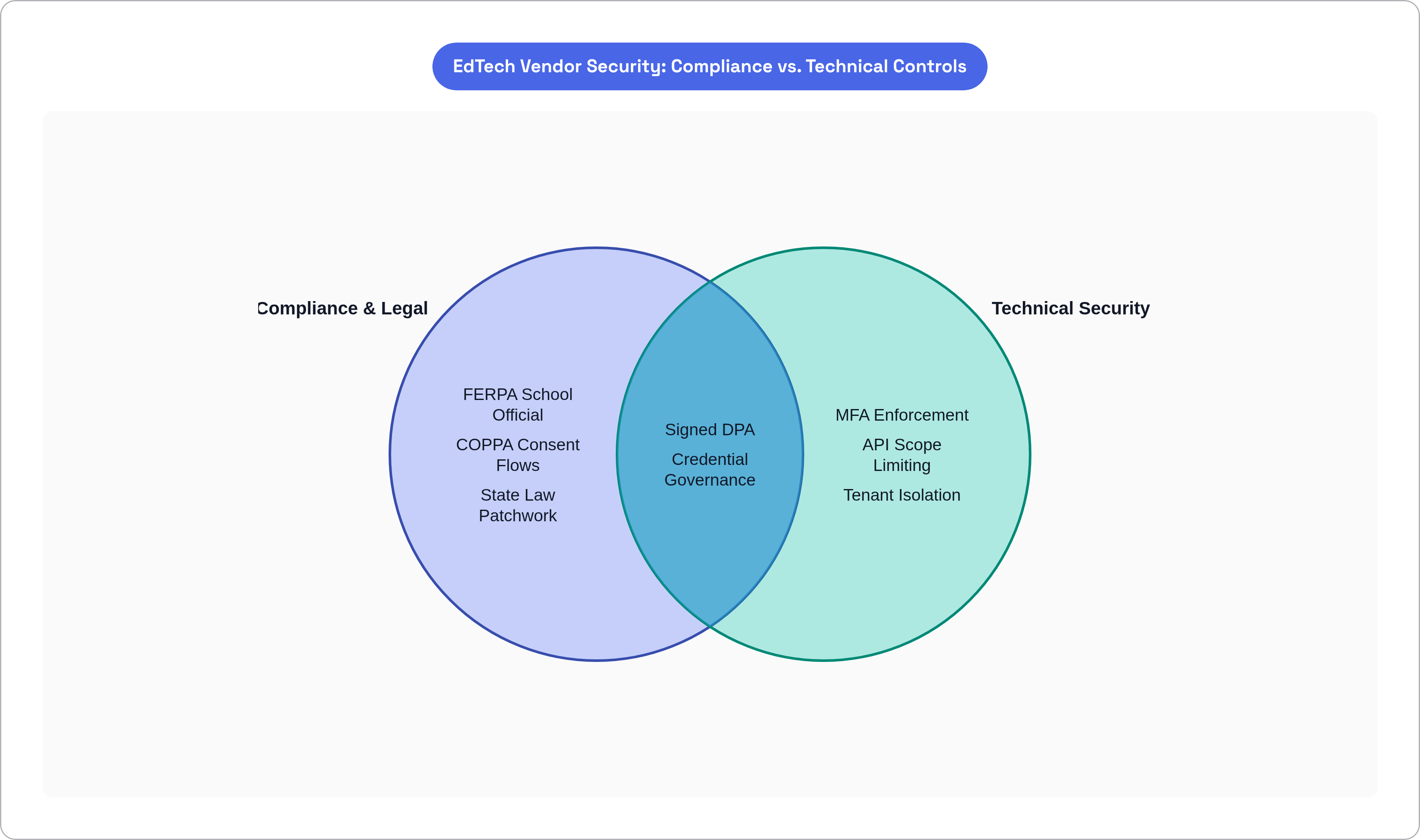
Before anyone touches a technical security question, there's a legal gate that has to open first: FERPA's school official exception. This is the mechanism that makes it legal for a school to hand student records to an outside vendor at all. Without it, sharing that data puts the institution out of compliance no matter how good the vendor's firewall is.
Three conditions have to be met, and each one needs to show up in the contract, not just in a sales call promise. The vendor has to perform a function the school would otherwise do itself. The school has to keep direct control over how the data gets used. And the vendor has to limit its processing to educational purposes only.
A vendor without a signed Data Processing Agreement doesn't qualify for the school official exception, full stop. The DPA isn't paperwork for paperwork's sake, it's the legal floor the whole relationship stands on. The Student Data Privacy Consortium's National DPA template has been adopted across a large number of states and gets used by districts nationwide, which helps, since it cuts down the back-and-forth of negotiating from scratch. But signing a DPA doesn't automatically mean the vendor is FERPA-compliant, has clean COPPA consent flows, or meets accessibility rules. Each of those needs its own look.
Speaking of COPPA: any vendor whose platform is aimed at kids under 13, or who knowingly collects their personal information, carries an obligation that can't be handed off to the school through a contract clause. The FTC made that explicit in its 2023 Edmodo enforcement action, which shot down the idea that schools can absorb a vendor's COPPA responsibility just by putting it in writing. And the rules got sharper with the April 2026 COPPA deadline, which brought in opt-in consent requirements for third-party data sharing, extended protections to biometric data, and requires documented Verifiable Parental Consent methods. Any vendor touching younger students needs to be checked against all of that, not the old rules.
Then there's the state law patchwork, and it's not small. New York's Education Law 2-d requires a data privacy contract before any student data moves, breach notification within ten days, and annual third-party contract reviews. Illinois' SOPPA requires a signed agreement with every single EdTech operator a district uses. California's SOPIPA bans targeted advertising built on student data. Colorado's Student Data Transparency and Security Act mandates data inventories and vendor contract transparency.
Treat this whole layer as a gate, not a formality. If the legal and contractual foundation isn't in place, the technical review doesn't start. A vendor with airtight encryption and a beautiful security dashboard still can't lawfully receive student data without a compliant DPA behind it.
Mapping the actual data flows before assessing the vendor's controls
Before anyone evaluates a single security control, someone needs to answer a much more basic question: what data is actually moving, in which direction, and under what conditions? Skip this step and the whole assessment ends up vague, because it's anchored to nothing.
The data map needs to answer a specific set of questions. Which fields does the vendor's API actually touch, directory information only, or does it reach into health records, IEPs, disciplinary files, or financial eligibility data? Is the integration read-only, or can the vendor write data back into the SIS? Are there subprocessors involved, the vendor's own analytics tools, cloud hosting providers, subcontractors? Where does the data physically sit, in what jurisdiction, and for how long?
PowerSchool is the case study here. The compromised data went well past basic directory fields, into Social Security numbers, medical conditions, and household income. Institutions that hadn't mapped which fields the vendor actually touched couldn't tell affected families precisely what had been exposed. That's not just embarrassing, it's a compliance failure layered on top of a security failure.
Data minimization matters both as a security principle and a legal one. A vendor that only receives the fields it needs for its stated function is a smaller target and a smaller compliance headache. And identifying subprocessors at this stage matters more than most standard assessments give it credit for. The Illuminate breach involved data sitting with a third-party cloud provider, a subprocessor relationship that would have shown up clearly on a proper data map but usually slips past a standard vendor questionnaire.
The output here isn't a narrative, it's a diagram: a documented data flow map that defines the scope for every technical question that comes next.
Evaluating API-specific security controls against the patterns that actually produce breaches
Start with authentication and credential governance, because that's where both PowerSchool and Illuminate actually broke down. LTI 1.3 and LTI Advantage build their security model on OpenID Connect (which sits on top of OAuth 2.0) and JSON Web Tokens. If a vendor shows up with a non-standard implementation, or worse, something still running on OAuth 1.0, that needs a much deeper look before it gets anywhere near approval.
Before a product connects to a school's SIS API, it gets handed the SIS's API key. That key is the master access mechanism, so ask directly how it's stored, how often it rotates, and how fast it gets revoked if something goes wrong. Ask whether MFA is enforced on every account with API-level access, including support staff and subcontractors, since that's the exact layer PowerSchool got burned on. And ask for documented credential rotation and deprovisioning procedures, because Illuminate's breach ran on a credential that stayed live for three years after the employee walked out the door.
Next, look at access scope. A lot of EdTech APIs hand back a student's entire profile or a whole class roster when the request only needed one field. That's overexposure, and it multiplies the damage if something goes wrong while also widening the regulatory blast radius. Ask whether API responses are scoped down to the minimum necessary, and ask specifically where the authorization logic lives. Client-side role validation, meaning the app checks permissions rather than the server, is a known weak spot in EdTech platforms. If the vendor can't tell you the answer lives on the server, that's a flag.
API inventory is another blind spot. Schools running an LMS, a student portal, and a stack of SaaS tools rarely have a clean, accurate list of every API endpoint still live. Old endpoints from a retired portal or a scrapped mobile app tend to just sit there, forgotten, and still reachable. Ask whether the vendor maintains a formal API inventory, how often it gets audited, and how deprecated endpoints get found and shut down. For any platform of real size, automated discovery tools are the realistic bar; manual tracking just doesn't hold up at that scale.
Multi-tenant architecture deserves its own hard look. Canvas is the case that shows what happens when tenant isolation has a crack in it: a freemium account program shared underlying infrastructure with paying institutional tenants, and the trust boundary between them gave way. Ask whether isolation is logical or physical, and ask, point blank, how trial or freemium accounts interact with the same infrastructure as production institutional data. Most vendor documentation describes isolation for paid tenants and just skips over how lower-trust account types touch that same environment. That gap is exactly where the follow-up question needs to go.
A few baseline items round this out: all API traffic needs TLS, and client secrets need secure storage with a defined rotation schedule, both required under the Edu-API specification. These should be confirmed with evidence, not taken on faith. And check certification status: 1EdTech-certified tools recertify every year against a conformance spec. Certification gives you a third-party-validated baseline. Its absence doesn't disqualify a vendor, but it does mean more work on your end to fill that gap.
Using standardized assessment frameworks to structure evidence collection
The HECVAT (Higher Education Community Vendor Assessment Toolkit), built through EDUCAUSE, is the standard self-assessment tool in higher ed procurement. It gives you a structured, comparable security profile across vendors instead of reinventing a questionnaire every time. HECVAT Lite works fine for lower-risk integrations; the full HECVAT is the right call for anything touching sensitive data fields or write-back SIS access.
One catch worth remembering: a completed HECVAT is vendor-reported, not independently verified. Think of it as a baseline that flags discrepancies worth chasing down, not a stamp of approval.
SOC 2 Type II reports matter more here than Type I, because Type II looks at controls over a stretch of time rather than a single snapshot. For an API partner with standing access to student data, that ongoing view is worth a lot more than a point-in-time check. But a SOC 2 audit won't tell you whether the DPA satisfies FERPA's school official exception, whether COPPA consent flows are built correctly, or whether the API's architecture holds up against the questions above. The audit scope and the EdTech-specific risk questions just aren't the same thing, and treating them as interchangeable is a mistake.
Ask for actual penetration test results too, with API coverage specifically called out. Not a glossy one-page attestation, the real finding categories and the remediation timelines behind them.
None of these frameworks are the finish line. They're the starting point, the thing that tells you where to dig further, what claims to spot-check against public records or certification databases, and which architectural questions the standard questionnaire never got to. For schools juggling a large vendor portfolio, the SDPC's National DPA framework and its data practice review process give you shared infrastructure that makes doing this at scale actually manageable.
Assessing incident response capability as a first-class requirement, not a supplementary check
The Illuminate FTC action wasn't just about the breach itself. It was about how long the company took to tell anyone. In some cases, notification took close to two years, affecting a huge number of students who had no idea their data was exposed for that entire stretch. New York's Education Law 2-d sets a ten-day notification window; if a vendor's incident response plan can't meet that, the school is out of compliance no matter how well it handled its own side of things.
A few questions belong at the center of every incident response review, not tucked in as an afterthought. What's the vendor's contractually committed notification timeline if a breach hits institution data? Does the IR plan cover subprocessor incidents, or only direct hits on the vendor's own systems? What forensic evidence will the vendor actually hand over so the school can scope the damage and notify families accurately? And how does the vendor handle remediation when the attacker clearly understood the whole environment, not just the one hole they crawled through?
Canvas offers a hard lesson on that last point. The ShinyHunters group came back months later using a different access route entirely. Fixing the specific vulnerability wasn't enough, because the attacker's knowledge of the broader environment outlasted that one patch.
Ask whether the vendor runs post-incident tabletop exercises and whether findings from past incidents are documented somewhere verifiable. A vendor that's had a breach and handled it well isn't automatically disqualified, that's actually a reasonable sign of a functioning process. A vendor with no IR history and no practiced response plan is the riskier bet, even if they've never had a public incident. Untested doesn't mean safe, it just means unproven.
Building a repeatable scoring and approval process across the vendor portfolio
Every stage above should leave behind a paper trail: compliance gate findings, the data flow map, technical control answers, framework outputs, and the IR capability review. Keep all of it. You'll need it later, whether for an audit, a renewal, or the day something goes wrong and someone asks what you knew and when.
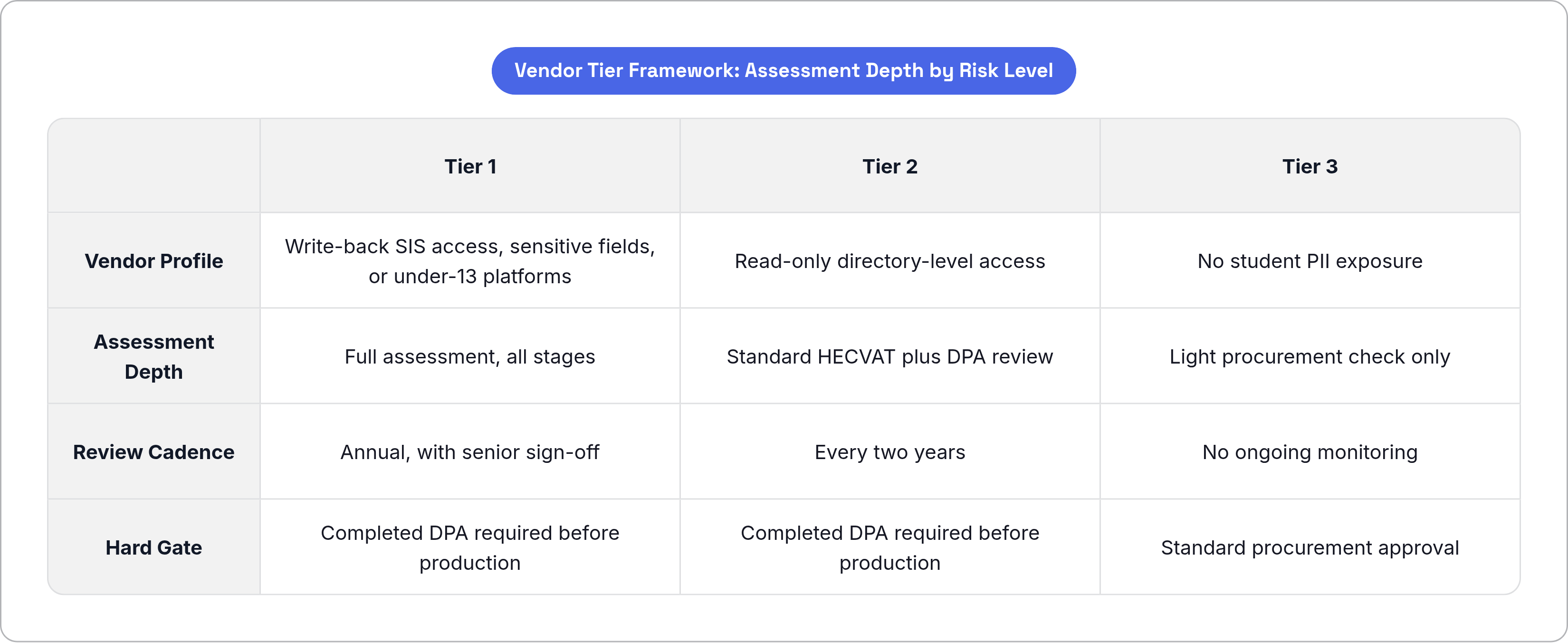
Tiering vendors by data sensitivity and integration depth lets a school put its assessment effort where it actually matters. Tier 1 covers vendors with write-back SIS access, sensitive fields like health or disciplinary or financial data, or platforms serving kids under 13; these get the full assessment, an annual review, and sign-off from someone senior enough to own the decision. Tier 2 is read-only access to directory-level data; standard HECVAT, DPA review, reassessment every two years. Tier 3 is tools with no student PII exposure at all; a lighter procurement check with no ongoing monitoring burden.
One rule shouldn't bend for anybody: no vendor moves into production without a completed DPA. Not a draft, not a verbal agreement, not "we'll sort it out after launch." That's a hard gate.
And the work doesn't end at onboarding. Vendor posture shifts constantly, staff leave, subprocessors change, product architecture gets rebuilt, new regulations show up. Tier 1 vendors need an annual reassessment cadence at minimum, and any Tier should get a fresh look the moment something material changes, new data fields, a major product overhaul, or a disclosed incident. Set it up once, run it the same way every time, and the whole portfolio stops feeling like a pile of one-off judgment calls and starts looking like an actual system.