Comparing SIS and ERP Platforms for K-12 Admin Workflows
Pick SIS or ERP first—choosing wrong wastes millions and solves nothing.

- Written by
- Anouk Osborne
- Updated
- October 21, 2026
- Reading time
- 9 min read
- Sources cited
- 4 sources ↓
What this covers
K-12 admin teams keep asking the wrong first question. Not "which SIS is best" or "which ERP has the best reviews." The real question: does the operational gap sit in student data (enrollment, attendance, grades, state reporting), or in finance and HR (payroll, GASB fund accounting, grant compliance)? Get that wrong and a district either buys a Ferrari to run to the mailbox, or tries to haul a school bus full of kids in a golf cart.
That distinction sounds simple. Vendors have spent years making sure it isn't. "School management software" gets pitched as a catch-all sitting between a Student Information System and a full Enterprise Resource Planning platform, and sales reps aren't in a hurry to clarify which bucket their product actually belongs in. So before anyone books a demo, it pays to know what each layer is actually built to do.
What market growth reveals about district priorities
The K-12 SIS market was worth $3.6 billion in 2024 and is headed toward $32.89 billion by 2032, a 12.2% annual growth rate, according to Verified Market Research. That's a steep climb for software that, on the surface, just tracks attendance and report cards.
The ERP side moves the same direction with bigger numbers attached. Mordor Intelligence puts education ERP at $24.24 billion in 2025, growing to $46.58 billion by 2030. Archive Market Research narrows that down to K-12 ERP specifically: about $8 billion in 2025, growing 12% a year through 2033.
None of this happens in a vacuum. The National Center for Education Statistics counts 49.5 million students in U.S. public schools, and that's the weight these systems carry every school day. Growth this fast draws two kinds of vendors: the ones with real staying power, and the ones running on venture funding and a prayer. Vendor stability belongs right next to the feature checklist when a district sits down to evaluate, not as an afterthought someone remembers after the contract's already signed.
The SIS vendor landscape in 2025
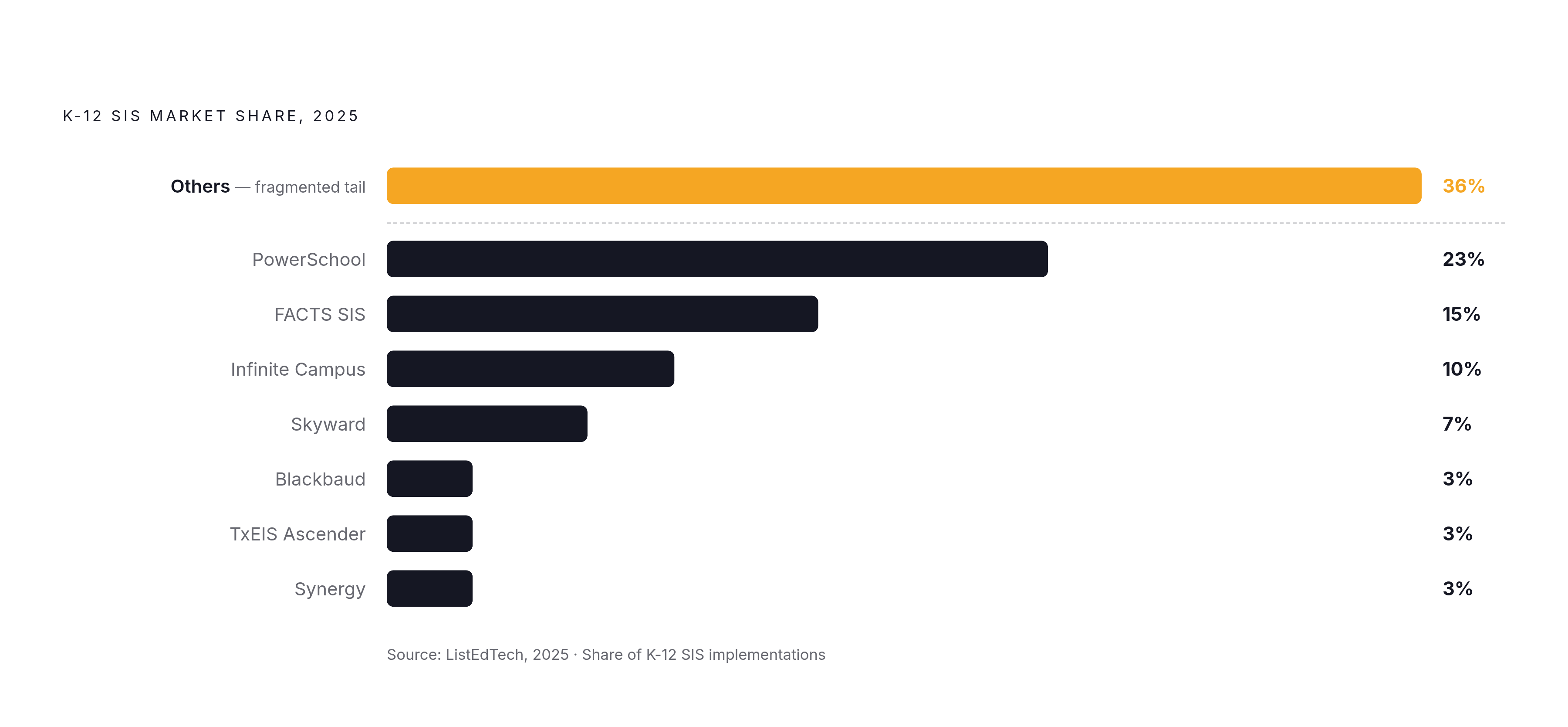
PowerSchool leads with 23% of K-12 SIS implementations, according to ListEdTech's 2025 data. FACTS SIS holds 15%, Infinite Campus sits at 10%, Skyward trails at 7%, and Blackbaud, TxEIS Ascender, and Synergy Education Platform each hold about 3%. The single biggest chunk of the pie isn't any named vendor at all. It's "Others," a long tail of smaller platforms that together outweigh any individual competitor.
Size on the leaderboard doesn't settle who's actually good, and it definitely doesn't settle who stays put. North Carolina is moving its entire state system off PowerSchool in 2025, moving to a competing platform. That's not a small district quietly switching vendors, that's a state exiting the market leader entirely. Any district shopping right now should read that as proof that a contract with the biggest name guarantees nothing.
Landing in the "Others" segment usually means thinner support staff, fewer integration partners, and AI features that show up a year or two after the market leaders ship theirs. That's the real cost of the long tail: not a worse product on day one, but a slower one by year three.
What ERP covers that SIS never can
An SIS tracks students. It does not track a school bus mechanic's pension contributions, a Title I grant's spending deadline, or how a district's general fund reconciles against its capital projects fund under GASB standards. That's ERP territory, and no amount of SIS feature bloat closes that gap. Buying a fancier SIS to fix a payroll problem is like buying a better umbrella to patch a leaky roof: it looks like action, and it does nothing.
Workday, according to ERPresearch.com, fits districts where the core problem is workforce management: thousands of certificated and classified staff, position control, position-level budget tracking, leave administration, and grant accounting, all on one data model. It comes with a real subscription and implementation cost, and state longitudinal data reporting usually still needs a deployment partner to build the extract. Nobody plugs this in over a weekend.
Beyond Workday, the field splits by scale. Tyler Technologies, PowerSchool, Skyward, and Frontline lead the purpose-built K-12 ERP category, while Workday and Oracle serve the largest districts, per ERPresearch.com. The education ERP field is broadly concentrated among a handful of major players, with smaller vendors carving out niche territory around them.
The diagnostic question stays the same no matter the district's size. If the pain point is HR complexity, grant compliance, or multi-fund finance, start with ERP. A district that goes ERP-scale to fix what's really a student-records problem ends up carrying implementation cost and complexity without closing the gap it actually had. That's the worst kind of expensive: the kind that doesn't even work.
Where the SIS-to-ERP handoff breaks
The SIS is the record-keeper that feeds everyone else. It pushes student data to the LMS for rosters and grades, and to the ERP for enrollment-linked budgeting and staffing math. When a district enrolls ten new kindergartners in September, that number should ripple out to transportation planning and staffing allocation without anyone touching a spreadsheet.
When integration works, an enrollment change in the SIS updates the transportation module in the ERP and the classroom staffing numbers in the HRIS on its own. No custom code, no manual re-entry.
When it doesn't work, staff make up the difference by hand. Third Rock Techkno's school management software guide describes the result bluntly: "a quiet patchwork of spreadsheets, three logins nobody fully trusts, and one veteran administrator who knows where everything lives." That last part should worry any superintendent. A district's entire data integrity resting on one person's memory isn't a system, it's a hope, and hope is not a data pipeline.
Interoperability isn't a premium add-on anymore. It's the baseline. K-12 tech is moving toward systems that talk to each other automatically through standards like Ed-Fi and OneRoster, plus platforms like Clever that handle the plumbing underneath. Best practice is to verify OneRoster compatibility through an authoritative certification source rather than trusting a vendor's sales deck, and to call reference districts that have finished the exact same integration a district is considering.
Role-based access control keeps a connected system safe instead of reckless. A school nurse needs SIS medical records but has no business in payroll. A payroll clerk needs full access to tax records in the ERP but should never see a student's academic file. That granularity gets confirmed during procurement, in writing, not assumed because a salesperson nodded along in a demo.
AI is now a real competitive differentiator
AI stopped being a marketing bullet point in the SIS market around 2025. ListEdTech's data frames it as an actual competitive differentiator now, something districts weigh seriously instead of skimming past in a brochure.
The specifics vary by vendor. PowerSchool built predictive analytics and personalized-learning tools on a new AI framework. Skyward partnered with Panorama Education to focus its AI push on Multi-Tiered Systems of Support, flagging which students need extra help before they fall too far behind. Infinite Campus, Blackbaud, and others rolled out AI-assisted reporting and automation across 2025.
What districts actually want out of any of this isn't a shinier dashboard. It's an answer: which students are trending toward chronic absenteeism, which ones need an intervention next week instead of next semester. On the ERP side, Grand View Research points to analytics built into ERP-integrated SIS modules that flag at-risk students and target interventions with more precision than a generic report ever could.
Worth naming plainly: some of the retention-analytics success stories floating around in vendor research come from higher ed, not K-12, and they don't transfer cleanly. No K-12-specific equivalent has shown up to replace them yet. Districts evaluating AI claims in 2025 and 2026 should ask vendors for a documented feature roadmap with actual release dates, not a concept video. The gap between what's announced and what's shipped runs wider in this category than almost anywhere else in ed-tech, and that gap is where budgets go to die quietly.
Security and compliance filter vendors first
Between July 2023 and December 2024, a large majority of K-12 schools experienced a cyber incident, according to the Center for Internet Security, adding up to thousands of confirmed incidents across thousands of institutions. That's not a hypothetical sitting in a compliance binder. It's a near-daily reality for the platforms holding this data.
Every SIS and ERP a district considers is, functionally, the front door to birth dates, home addresses, health records, and Social Security numbers. Encryption, role-based access, audit logs, and FERPA compliance aren't nice-to-haves. They're first-round filters that should knock a vendor out of contention before a district even gets to comparing features, not a checkbox reviewed after the demo's over.
The compliance list a district carries into every procurement conversation includes FERPA and COPPA for student privacy, Title I, Title II, and IDEA funding rules, state-specific reporting mandates, GASB-standard fund accounting, and special education administration requirements. That's a lot of acronyms, and every one of them has teeth.
Finance teams in public districts run small, sometimes just a handful of people managing multi-fund accounting, bond proceeds, transportation budgets, nutrition services, and facilities costs all at once. An ERP that doesn't arrive already configured for K-12 fund accounting doesn't just add a learning curve. It adds real implementation risk on top of a staff that was already stretched thin. A district that picks a platform purely on feature richness and finds a compliance gap mid-implementation hasn't saved money. It's pushed the cost down the road, where it shows up bigger.
Diagnose the gap before booking any demo
Before anyone touches a vendor's calendar link, a district needs an honest answer to one question: is the gap in student data, or in finance, HR, and cross-departmental operations? If it's messy attendance records, shaky state reporting, or parents who can't get a straight answer about their kid's grades, start with an SIS evaluation. If it's payroll headaches, grant compliance stress, or budgets that don't reconcile across funds, start with ERP. If it's both, or if existing systems just don't talk to each other, the real fix is probably integration architecture, not a brand-new platform.
Size and sector answer a lot of this before features even enter the room. A small private or charter school usually does fine with an all-in-one school management platform, since a full ERP would be overkill, like installing a walk-in freezer to keep one six-pack cold. A mid-sized district typically lands well with a purpose-built K-12 SIS paired with a lighter ERP or integrated suite from the purpose-built K-12 category. A large public district with tens of thousands of students and a genuinely complex workforce is the case where an enterprise ERP like Workday or Oracle makes sense alongside a dedicated SIS, since workforce management at that scale is its own full-time job.
Write down the workflows that are actually broken before sitting through a single demo, not the features that sound good in a pitch. Most procurement regret in this space traces back to buying against a feature list instead of a diagnosed problem. Run the integration checklist too: confirm OneRoster compatibility through a reliable certification source, and call a reference district that's done the exact integration in question, not just any customer the vendor hands over.
Vendor stability deserves real weight in the decision, especially given how split up the SIS market still is. The "Others" segment, the largest single share of implementations in the category, means a lot of districts run on platforms that may not have the resources to keep pace on AI features or compliance updates. North Carolina's 2025 exit from the market's dominant platform proves that even the biggest name in the room isn't a permanent safety net. Lock-in risk earns its own line on the evaluation sheet, right next to price and features, not a footnote mentioned once the contract's already signed.
Methodology & sources
- K-12 School ERP: Fund Accounting & GASB
Provided details on Workday's K-12 workforce management capabilities and the breakdown of purpose-built K-12 ERP vendors versus enterprise-scale options.
- School Management Software 2026: Platforms & Costs
Supplied the 49.5 million U.S. public school student count and the description of integration failure resulting in spreadsheet workarounds.
- https://www.listedtech.com/blog/the-2025-k-12-sis-market/
Provided the 2025 K-12 SIS market share figures for PowerSchool, FACTS SIS, Infinite Campus, Skyward, and other vendors, as well as framing AI as a competitive differentiator.
- K-12 Student Information Systems Market Report: Size, Growth, Trends & Forecast (2025–2033)
Provided the K-12 SIS market size figures of $3.6 billion in 2024 growing to $32.89 billion by 2032 at a 12.2% annual growth rate.